


Chinese Journal of Rehabilitation Theory and Practice ›› 2026, Vol. 32 ›› Issue (9): 1061-1067.doi: 10.3969/j.issn.1006-9771.2026.09.008
Previous Articles Next Articles
Shen Xiaohua, Chen Fangyuan, Rong Jifeng, Rao Biaoqin, Kong Lingxuan, Tian Wei, Chen Zhiqun, Li Li( )
)
Received:2026-04-28
Revised:2026-08-07
Accepted:2026-08-10
Published:2026-09-25
Online:2026-09-20
Contact:
Li Li
E-mail:58698030@qq.com
Supported by:CLC Number:
Shen Xiaohua, Chen Fangyuan, Rong Jifeng, Rao Biaoqin, Kong Lingxuan, Tian Wei, Chen Zhiqun, Li Li. Effect of anterior seat inclination on sit-to-stand ability in patients with stroke and related brain network[J]. Chinese Journal of Rehabilitation Theory and Practice, 2026, 32(9): 1061-1067.
Table 1
Comparison of baseline data between two groups"
| 组别 | n | 性别(男/女)/n | 年龄/岁 | 卒中类型(梗死/出血)/n | 大脑半球受损(左/右)/n | 病程/d |
|---|---|---|---|---|---|---|
| 对照组 | 21 | 11/10 | 69.00(65.50, 72.50) | 16/5 | 9/12 | 101.00(35.00, 158.50) |
| 试验组 | 22 | 16/6 | 67.50(61.00, 71.00) | 15/7 | 10/12 | 111.50(60.00, 187.25) |
| χ2/Z值 | 1.904 | -0.887 | 0.343 | 0.029 | 0.620 | |
| P值 | 0.168 | 0.380 | 0.558 | 0.864 | 0.535 |
Table 2
Comparison of FTSST time between two groups pre- and post-treatment"
| 组别 | n | 测试 | t值 | P值 | |
|---|---|---|---|---|---|
| 对照组 | 21 | 前测 | 24.819±8.209 | 3.469 | 0.002 |
| 后测 | 22.236±6.462 | ||||
| 试验组 | 22 | 前测 | 23.658±6.020 | 7.441 | < 0.001 |
| 后测 | 18.615±4.971 | ||||
| 训练前两组均值差 | -1.161±2.188 | -0.531 | 0.599 | ||
| 训练后两组均值差 | -3.620±1.753 | -2.065 | 0.045 | ||
Table 3
Comparison of BBS scores between two groups pre- and post-treatment"
| 组别 | n | 测试 | M(QL, QU) | Z值 | P值 |
|---|---|---|---|---|---|
| 对照组 | 21 | 前测 | 27.00(22.00, 32.00) | -4.019 | < 0.001 |
| 后测 | 34.00(30.00, 41.50) | ||||
| 试验组 | 22 | 前测 | 32.50(22.50, 38.50) | -4.111 | < 0.001 |
| 后测 | 43.50(32.00, 48.25) | ||||
| 训练前两组差值 | -1.460 | 0.144 | |||
| 训练后两组差值 | -2.250 | 0.024 | |||
Table 4
Comparison of functional connectivity in the experimental group pre- and post-treatment"
| ROI-ROI | 训练前 | 训练后 | t值 | P值 |
|---|---|---|---|---|
| 左PMC-右PMC | 0.651±0.437 | 0.677±0.472 | -0.321 | 0.962 |
| 左PMC-左S1 | 0.809±0.339 | 0.847±0.401 | -0.639 | 0.921 |
| 左PMC-左PFC | 0.579±0.370 | 0.531±0.334 | 0.797 | 0.921 |
| 左PMC-右PFC | 0.531±0.329 | 0.465±0.283 | 1.434 | 0.563 |
| 左PMC-左M1 | 0.926±0.402 | 0.913±0.381 | 0.204 | 0.962 |
| 左PMC-右M1 | 0.708±0.464 | 0.711±0.435 | -0.042 | 0.982 |
| 左PMC-右S1 | 0.646±0.377 | 0.581±0.418 | 1.384 | 0.563 |
| 右PMC-左S1 | 0.614±0.426 | 0.657±0.472 | -0.544 | 0.921 |
| 右PMC-左PFC | 0.532±0.354 | 0.540±0.319 | -0.113 | 0.981 |
| 右PMC-右PFC | 0.595±0.398 | 0.573±0.342 | 0.280 | 0.962 |
| 右PMC-左M1 | 0.718±0.557 | 0.639±0.484 | 0.808 | 0.921 |
| 右PMC-右M1 | 0.962±0.469 | 0.831±0.529 | 1.399 | 0.563 |
| 右PMC-右S1 | 0.794±0.456 | 0.740±0.464 | 0.671 | 0.921 |
| 左S1-左PFC | 0.599±0.337 | 0.573±0.348 | 0.453 | 0.962 |
| 左S1-右PFC | 0.554±0.309 | 0.522±0.330 | 0.591 | 0.921 |
| 左S1-左M1 | 0.915±0.383 | 0.840±0.381 | 1.156 | 0.663 |
| 左S1-右M1 | 0.732±0.454 | 0.812±0.390 | -1.254 | 0.626 |
| 左S1-右S1 | 0.691±0.408 | 0.780±0.430 | -1.578 | 0.563 |
| 左PFC-右PFC | 0.641±0.357 | 0.651±0.286 | -0.180 | 0.962 |
| 左PFC-左M1 | 0.581±0.342 | 0.454±0.317 | 2.942 | 0.073 |
| 左PFC-右M1 | 0.552±0.356 | 0.553±0.318 | -0.023 | 0.981 |
| 左PFC-右S1 | 0.555±0.336 | 0.637±0.305 | -1.814 | 0.563 |
| 右PFC-左M1 | 0.574±0.322 | 0.407±0.315 | 4.224 | 0.011 |
| 右PFC-右M1 | 0.586±0.340 | 0.552±0.333 | 0.548 | 0.921 |
| 右PFC-右S1 | 0.643±0.340 | 0.630±0.357 | 0.249 | 0.962 |
| 左M1-右M1 | 0.892±0.527 | 0.771±0.479 | 1.680 | 0.563 |
| 左M1-右S1 | 0.755±0.450 | 0.555±0.437 | 3.311 | 0.047 |
| 右M1-右S1 | 0.849±0.491 | 0.874±0.477 | -0.388 | 0.962 |
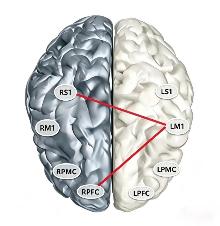
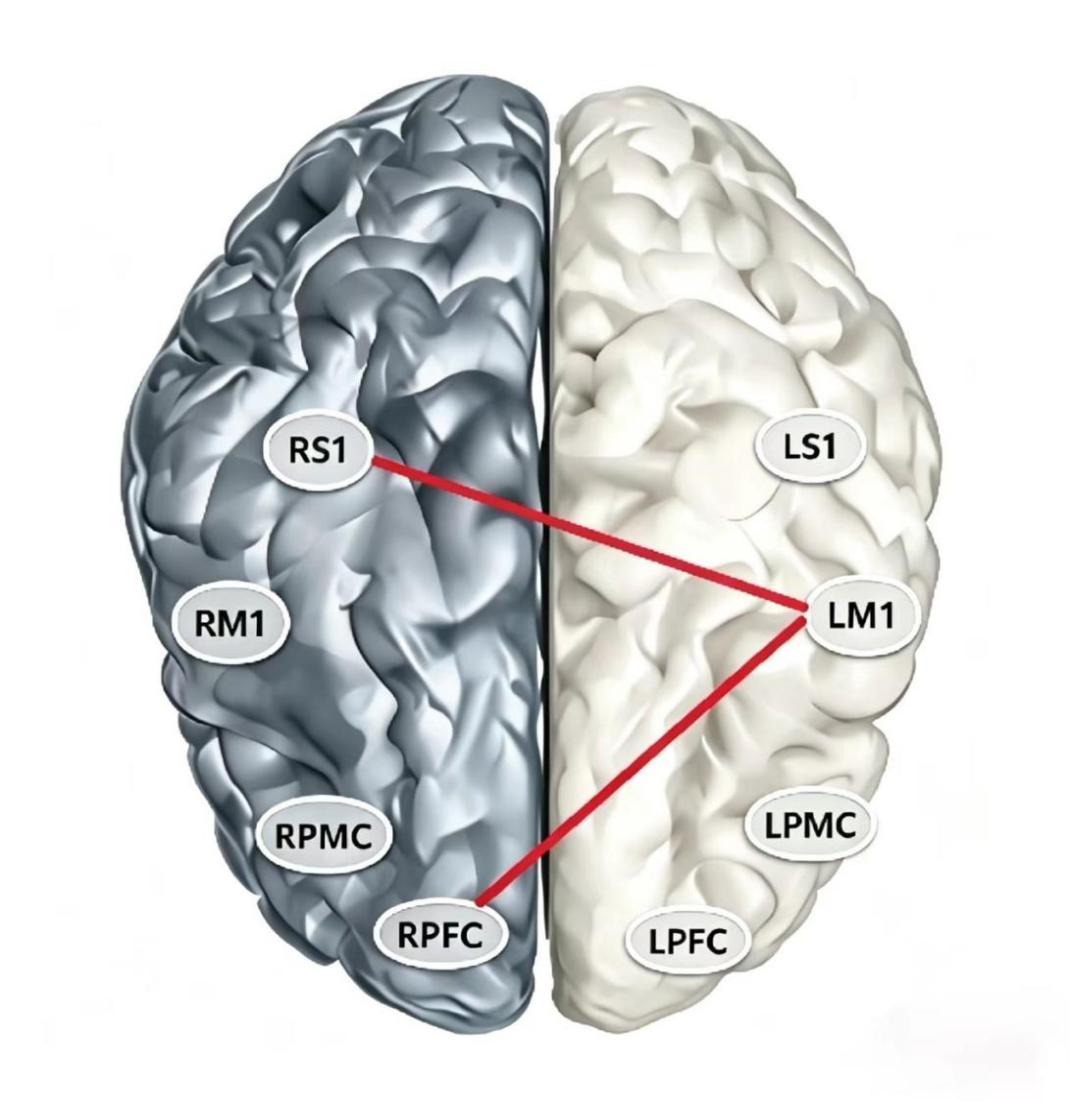
Figure 1
FC in the experimental group post-training"
| [1] | Gerstl J V E, Blitz S E, Qu Q R, et al. Global, regional, and national economic consequences of stroke[J]. Stroke, 2023, 54(9): 2380-2389. |
| [2] | Pollock A, Gray C, Culham E, et al. Interventions for improving sit-to-stand ability following stroke[J]. Cochrane Database Syst Rev, 2014, 2014(5): CD007232. |
| [3] | 周哲, 沈夏锋, 沈小花, 等. 椅面前倾对脑卒中偏瘫患者坐-站转移的影响[J]. 中国康复理论与实践, 2020, 26(7): 825-829. |
| Zhou Z, Shen X F, Shen X H, et al. Effect of chair inclination forward on sit-to-stand for hemiplegics after stroke[J]. Chin J Rehabil Theory Pract, 2020, 26(7): 825-829. | |
| [4] | Zhao Y N, Han P P, Zhang X Y, et al. Applications of functional near-infrared spectroscopy (fNIRS) neuroimaging during rehabilitation following stroke: a review[J]. Med Sci Monit, 2024, 30: e943785. |
| [5] | 中华医学会神经病学分会. 中国各类主要脑血管病诊断要点2019[J]. 中华神经科杂志, 2019, 52(9): 710-715. |
| Chinese Society of Neurology, Chinese Stroke Society. Diagnostic criteria of cerebrovascular diseases in China (version 2019)[J]. Chin J Neurol, 2019, 52(9): 710-715. | |
| [6] | Ng J C M, Ho M W K. Does self-initiated sit-to-stand training with an assistive device regain the independence of sit-to-stand in stroke patient? A single-blinded randomized controlled trial [J]. J Rehabil Assist Technol Eng, 2020, 7: 2055668319866053. |
| [7] | 刘立明, 瓮长水, 王娜, 等. 5次坐立试验对老年人运动功能的评估价值[J]. 中国康复理论与实践, 2010, 16(4): 359-361. |
| Liu L M, Weng C S, Wang N, et al. Five-times sit-to-stand test on physical performance for older people[J]. Chin J Rehabil Theory Pract, 2010, 16(4): 359-361. | |
| [8] | 瓮长水, 王军, 王刚, 等. Berg平衡量表在脑卒中患者中的内在信度和同时效度[J]. 中国康复医学杂志, 2007, 22(8): 688-690, 717. |
| Weng C S, Wang J, Wang G, et al. Assessments of internal reliability and concurrent validity of Berg Balance Scale in stroke patients[J]. Chin J Rehabil Med, 2007, 22(8): 688-690, 717. | |
| [9] | 陆佳敏, 闫思念, 陈逸浩, 等. 脑卒中后认知障碍患者静息态脑网络特征的功能性近红外光谱研究[J]. 中国康复理论与实践, 2022, 28(4): 447-452. |
| Lu J M, Yan S N, Chen Y H, et al. Characteristics of resting brain network for patients with cognitive impairment after stroke using functional near-infrared spectroscopy[J]. Chin J Rehabil Theory Pract, 2022, 28(4): 447-452. | |
| [10] | 姜林鸿, 刘晓丹, 孙萍萍, 等. 运动想象训练对卒中后患者上肢运动功能恢复的影响及静息态fNIRS脑网络特征研究[J]. 中国康复医学杂志, 2023, 38(11): 1505-1513. |
| Jiang L H, Liu X D, Sun P P, et al. Effects of motor imagery training on the recovery of upper extremity motor function in poststroke patients and characteristics of resting-state fNIRS brain network[J]. Chin J Rehabil Med, 2023, 38(11): 1505-1513. | |
| [11] |
Logan A, Freeman J, Kent B, et al. Standing Practice In Rehabilitation Early after stroke (SPIRES): a functional standing frame programme (prolonged standing and repeated sit to stand) to improve function and quality of life and reduce neuromuscular impairment in people with severe sub-acute stroke: a protocol for a feasibility randomised controlled trial[J]. Pilot Feasibility Stud, 2018, 4: 66.
doi: 10.1186/s40814-018-0254-z |
| [12] |
McDonald C, Mayor J J V, Lennon O. Neurophysiological insights into sit-to-stand post stroke[J]. Front Neurosci, 2025, 19: 1646498.
doi: 10.3389/fnins.2025.1646498 |
| [13] | 黄旭, 孟庆华, 鲍春雨, 等. 中风偏瘫患者坐-站转移过程中的生物力学分析[J]. 医用生物力学, 2021, 36(3): 479-484. |
| Huang X, Meng Q H, Bao C Y, et al. Biomechanical analysis of stroke hemiplegic patients during sit-to-stand transfer[J]. J Med Biomech, 2021, 36(3): 479-484. | |
| [14] | De Sousa D G, Harvey L A, Dorsch S, et al. Two weeks of intensive sit-to-stand training in addition to usual care improves sit-to-stand ability in people who are unable to stand up independently after stroke: a randomised trial[J]. J Physiother, 2019, 65(3): 152-158. |
| [15] | Amala S, Chippala P. Effect of sit-to-stand training on balance, muscle strength, and activities of daily living in patients with stroke: a randomised controlled trial[J]. J Clin Diagn Res, 2024, 18(2): 5-8. |
| [16] |
Josop N A, Mohd Nordin N A, Ahmad M A. Evaluating the effectiveness of different prescriptions of sit-to-stand training in post-stroke rehabilitation: a systematic review and meta-analysis[J]. Medicine, 2025, 104(45): e45625.
doi: 10.1097/MD.0000000000045625 |
| [17] | Harington T, Comley-White N, Roos R. Energy expenditure and effort of patients with stroke during sit to stand: a pilot study[J]. S Afr J Physiother, 2024, 80(1): 1-6. |
| [18] | 吴雪娇, 郑洁皎, 夏汶, 等. 脑卒中偏瘫患者坐-站转移生物力学分析研究进展[J]. 中国康复理论与实践, 2018, 24(3): 290-295. |
| Wu X J, Zheng J J, Xia W, et al. Advance in biomechanical analysis of sit-to-stand movement in hemiplegic stroke patients (review)[J]. Chin J Rehabil Theory Pract, 2018, 24(3): 290-295. | |
| [19] | 刘孟, 倪朝民, 陈进, 等. 早期坐-站转移训练对亚急性脑卒中偏瘫患者平衡功能的影响[J]. 中国康复, 2015, 30(5): 335-338. |
| Liu M, Ni C M, Chen J, et al. Balance outcomes after early sit-to-stand training in subacute stroke patients[J]. Chin J Rehabil, 2015, 30(5): 335-338. | |
| [20] | 江帆, 朱其凤, 付水生. 强化坐-站训练对脑卒中患者平衡、步行及日常生活活动能力的影响[J]. 广西医科大学学报, 2017, 34(8): 1209-1212. |
| Jiang F, Zhu Q F, Fu S S. The effects of intensive sit-to-stand training on activities of daily living in patients with stroke[J]. J Guangxi Med Univ, 2017, 34(8): 1209-1212. | |
| [21] |
Onursal Kılınç Ö, De Ridder R, Kılınç M, et al. Trunk and lower extremity biomechanics during sit-to-stand after stroke: a systematic review[J]. Ann Phys Rehabil Med, 2023, 66(3): 101676.
doi: 10.1016/j.rehab.2022.101676 |
| [22] | Boukadida A, Piotte F, Dehail P, et al. Determinants of sit-to-stand tasks in individuals with hemiparesis post stroke: a review[J]. Ann Phys Rehabil Med, 2015, 58(3): 167-172. |
| [23] |
Suriyaamarit D, Boonyong S. Comparison of the effects of chair height and anterior seat inclination on sit-to-stand ability in children with spastic diplegic cerebral palsy[J]. J Biomech, 2020, 113: 110098.
doi: 10.1016/j.jbiomech.2020.110098 |
| [24] |
Hamaoui A, Hassaïne M, Zanone P G. Sitting on a sloping seat does not reduce the strain sustained by the postural chain[J]. PLoS One, 2015, 10(1): e0116353.
doi: 10.1371/journal.pone.0116353 |
| [25] | Qi Y, Xu Y, Wang H, et al. Network reorganization for neurophysiological and behavioral recovery following stroke[J]. Cent Nerv Syst Agents Med Chem, 2024, 24(2): 117-128. |
| [26] | Bhattacharjee S, Kashyap R, Abualait T, et al. The role of primary motor cortex: more than movement execution[J]. J Mot Behav, 2021, 53(2): 258-274. |
| [27] | Ariani G, Pruszynski J A, Diedrichsen J. Motor planning brings human primary somatosensory cortex into action-specific preparatory states[J]. eLife, 2022, 11: e69517. |
| [28] |
Liang J, Huang J, Luo Z, et al. Brain network mechanism on cognitive control task in the elderly with brain aging: a functional near infrared spectroscopy study[J]. Front Hum Neurosci, 2023, 17: 1154798.
doi: 10.3389/fnhum.2023.1154798 |
| [1] | Huang Xuli, Wang Pingzhi, Luo Tian'e. Comparison of cortical hemodynamic responses between real-time and video-based action observation therapy in patients with stroke: a functional near-infrared spectroscopy study [J]. Chinese Journal of Rehabilitation Theory and Practice, 2026, 32(9): 1041-1051. |
| [2] | Su Panpan, He Chuan, Qiongji , Meng Dianhuai. Comparison of static balance characteristics under different standing postures in older patients with post-stroke hemiplegia [J]. Chinese Journal of Rehabilitation Theory and Practice, 2026, 32(9): 1052-1060. |
| [3] | Feng Xiaojuan, Huang Fubiao, Li Dongyue, Zhou Mingyi, Niu Yuxuan, Ismaili McGee Pireti, Wang Xixian, Wang Zile. Development and feasibility study of a self-stabilizing home-based functional interactive training device [J]. Chinese Journal of Rehabilitation Theory and Practice, 2026, 32(9): 1068-1077. |
| [4] | Yan Jiazheng, Luo Xiaoqin, Liu Rihua, Yu Ying, Qi Fengxue. Non-invasive brain stimulation techniques for balance function after stroke: a network meta-analysis [J]. Chinese Journal of Rehabilitation Theory and Practice, 2026, 32(8): 903-915. |
| [5] | Liu Shan, Xu Kunyao, Zhou Zhimeng, Zhou Lingyun, Zeng Mao, He Sha, Dai Luoyang, Qin Ting, Hu Qinglin, Yang Jiahai, Li Rui. Effects of different electromagnetic stimulation protocols on hand function and activities of daily living for stroke patients: a network meta-analysis [J]. Chinese Journal of Rehabilitation Theory and Practice, 2026, 32(8): 916-926. |
| [6] | Zhou Jie, He Zhicheng, Zhang Xiaoyu, Wang Xue, Liu Damei, Song Ning, Wu Jun. Effect of visuomotor integration training on unilateral spatial neglect after stroke [J]. Chinese Journal of Rehabilitation Theory and Practice, 2026, 32(7): 745-751. |
| [7] | Huang Yaohui, Ye Xiangming, Liu Yong, Tang Pei, Lu Yishu. Effect of repetitive transcranial magnetic stimulation on prolonged disorders of consciousness after stroke [J]. Chinese Journal of Rehabilitation Theory and Practice, 2026, 32(7): 752-759. |
| [8] | Shan Guixiang, Du Jubao, Cao Lei, Ye Linlin, Jiang Chunjing, Zhang Ye, Ma Huijuan, Song Weiqun. Characteristics of diaphragmatic function in stroke patients based on ultrasound [J]. Chinese Journal of Rehabilitation Theory and Practice, 2026, 32(7): 760-767. |
| [9] | Zhang Fei, Fu Boxun, Shen Hui, Chen Jin. Effect of action observation therapy based on mirror neuron system combined with low-frequency repetitive transcranial magnetic stimulation on post-stroke unilateral spatial neglect [J]. Chinese Journal of Rehabilitation Theory and Practice, 2026, 32(7): 768-775. |
| [10] | Fan Liubo, Shan Tingting, Liu Baohua, Luo Mimi, Zhang Luding, Wang Minghui. Effect of different doses of Botulinum toxin type A injected under ultrasound guidance combined with modified catheter-balloon localization for post-stroke cricopharyngeal dysfunction: a randomized controlled trial [J]. Chinese Journal of Rehabilitation Theory and Practice, 2026, 32(7): 776-787. |
| [11] | Zhou Guangxue, Xu Ning, Shi Bin. Effect of virtual reality combined with occupational therapy on upper limb motor function in patients with stroke: a meta-analysis [J]. Chinese Journal of Rehabilitation Theory and Practice, 2026, 32(7): 788-796. |
| [12] | Dun Shibo, Li Yuzhou. Effect of blood flow restriction training on lower-limb motor function after stroke: a meta-analysis [J]. Chinese Journal of Rehabilitation Theory and Practice, 2026, 32(7): 797-806. |
| [13] | Yuan Yiyi, Tian Wuchao, Zhang Xianbin, Chao Qiang, Li Yongsheng, Liu Guixin, Wu Wanqing, Wang Pu. Effect of dual task training on mobility and balance in stroke patients: a meta-analysis [J]. Chinese Journal of Rehabilitation Theory and Practice, 2026, 32(7): 807-816. |
| [14] | GUAN Yujie, LIU Keyan, YANG Keqin, LIANG Yulin, ZHANG Jinpeng, ZHAO Bin. Effect of cluster scalp acupuncture combined with Taijiquan on brain functional connectivity and network topology for patients with post-stroke depression [J]. Chinese Journal of Rehabilitation Theory and Practice, 2026, 32(6): 621-630. |
| [15] | LI Xinyuan, ZHENG Jiejiao, ZHANG Tingyu, WU Xuejiao, LIANG Xiaoxiao. Effect of intermittent theta burst stimulation on lower extremity motor function and balance function in stroke patients: a meta-analysis [J]. Chinese Journal of Rehabilitation Theory and Practice, 2026, 32(6): 631-644. |
| Viewed | ||||||
|
Full text |
|
|||||
|
Abstract |
|
|||||
|
||
