



Chinese Journal of Rehabilitation Theory and Practice ›› 2026, Vol. 32 ›› Issue (9): 1078-1086.doi: 10.3969/j.issn.1006-9771.2026.09.010
Previous Articles Next Articles
Zhou Huiling( ), Zeng Jiayan, Chen Bing
Received:2026-03-18
Revised:2026-07-07
Accepted:2026-07-08
Published:2026-09-25
Online:2026-09-20
Contact:
Zhou Huiling
E-mail:zero_8456@163.com
CLC Number:
Zhou Huiling, Zeng Jiayan, Chen Bing. Quality of life among vocational rehabilitation patients with mild work-related disability and its association with return-to-work outcomes[J]. Chinese Journal of Rehabilitation Theory and Practice, 2026, 32(9): 1078-1086.
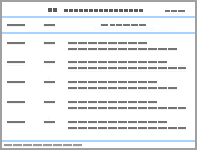
Table 1
General characteristics of the sample (n = 343)"
| 变量 | 原岗位复工组(n = 201) | 新岗位复工组(n = 79) | 未复工组(n = 63) | |
|---|---|---|---|---|
| 年龄/岁 | 40.43±9.70 | 39.97±10.17 | 42.22±11.20 | |
| 性别/n | 男 | 150 | 66 | 51 |
| 女 | 51 | 13 | 12 | |
| 学历/n | 小学及以下 | 18 | 10 | 12 |
| 初中~高中 | 128 | 65 | 45 | |
| 大专及以上 | 55 | 4 | 6 | |
| 工种/n | 行政及文职人员 | 28 | 5 | 8 |
| 一线工人 | 113 | 56 | 36 | |
| 商业服务业人员 | 35 | 13 | 13 | |
| 专业技术人员 | 25 | 5 | 6 | |
| 参保地/n | 广州 | 153 | 62 | 48 |
| 省直及其他地市 | 48 | 17 | 15 | |
| 诊断/n | 骨折 | 130 | 50 | 41 |
| 手外伤 | 45 | 21 | 12 | |
| 关节及软组织损伤 | 19 | 5 | 6 | |
| 其他a | 7 | 3 | 4 | |
| 职业康复时长/d | 39.17±12.44 | 43.24±13.14 | 49.10±12.60 | |
| 病程(入院时)/n | ≤ 0.5年 | 77 | 30 | 15 |
| 0.5~1年 | 72 | 27 | 28 | |
| 1年以上 | 52 | 22 | 20 | |
| 病程(出院时)/n | ≤ 0.5年 | 49 | 19 | 9 |
| 0.5~1年 | 90 | 36 | 28 | |
| 1年以上 | 62 | 24 | 26 | |
| 就业意愿/n | 考虑前 | 43 | 16 | 29 |
| 考虑 | 126 | 48 | 34 | |
| 准备 | 4 | 5 | 0 | |
| 行动 | 28 | 10 | 0 | |
| 工作安置服务/n | 现场安置b | 16 | 58 | 18 |
| 远程安置c | 185 | 21 | 45 | |
| 损失工作日/d | 252(184.00,425.00) | 275(192.00,451.00) | 699(582.00,850.00) | |
Table 2
Comparison of SF-36 scores before and after comprehensive vocational rehabilitation intervention (n = 343)"
| 维度 | 干预前 | 干预后 | 生活质量变化方向(提升例数/下降例数) | Z值 | P值 |
|---|---|---|---|---|---|
| PF | 60.00 (40.00, 80.00) | 70.00 (50.00, 80.00) | 提升(184/105) | -4.534 | < 0.001 |
| RP | 0.00 (0.00, 25.00) | 0.00 (0.00, 50.00) | 提升(96/65) | -3.225 | 0.001 |
| BP | 46.00 (33.50, 57.00) | 46.00 (37.00, 69.00) | 提升(158/93) | -4.697 | < 0.001 |
| GH | 50.00 (40.00, 65.00) | 51.00 (40.00, 66.00) | 提升(152/143) | -0.699 | 0.485 |
| VT | 55.00 (45.00, 70.00) | 55.00 (45.00, 70.00) | 提升(144/140) | -0.933 | 0.351 |
| SF | 50.00 (37.50, 62.50) | 62.50 (50.00, 75.00) | 提升(148/103) | -2.709 | 0.007 |
| RE | 33.33 (0.00, 66.67) | 33.33 (0.00, 100.00) | 提升(109/74) | -3.185 | 0.001 |
| MH | 64.00 (52.00, 76.00) | 64.00 (52.00, 80.00) | 提升(157/141) | -0.366 | 0.715 |
Table 3
Generalized linear model analysis of SF-36 dimensional scores after intervention (Gamma Distribution, Log Link)"
| 维度 | 模型Omnibus χ2 (P) | 干预前得分B (95%CI) | 干预前得分P值 | 其他显著协变量(P值) |
|---|---|---|---|---|
| PF | 177.280 (< 0.001) | 0.012 (0.010~0.014) | < 0.001 | — |
| RP | 7.969 (0.093) | 0.003 (0.000~0.005) | 0.023 | — |
| BP | 118.855 (< 0.001) | 0.011 (0.009~0.013) | < 0.001 | 病程(0.003)、学历(0.026) |
| GH | 158.485 (< 0.001) | 0.013 (0.011~0.015) | < 0.001 | — |
| VT | 164.895 (< 0.001) | 0.013 (0.011~0.015) | < 0.001 | 病程(0.049) |
| SF | 92.107 (< 0.001) | 0.009 (0.007~0.011) | < 0.001 | 学历(0.047) |
| RE | 13.274 (0.010) | 0.002 (0.001~0.004) | < 0.001 | — |
| MH | 157.267 (< 0.001) | 0.010 (0.009~0.012) | < 0.001 | — |
Table 4
Scores of SF-36 dimensions (at discharge) and inter-group comparison for different groups"
| 维度 | 原岗位复工组 (n = 201) | 新岗位复工组 (n = 79) | 未复工组 (n = 63) | Kruskal-Wallis H检验 | Mann-Whitney U检验两两比较P值 | |||
|---|---|---|---|---|---|---|---|---|
| H值 | P值 | a | b | c | ||||
| PF | 70.00 (52.50, 82.50) | 70.00 (55.00, 80.00) | 50.00 (25.00, 70.00) | 24.256 | < 0.001 | 1.000 | < 0.001 | < 0.001 |
| RP | 0.00 (0.00, 50.00) | 0.00 (0.00, 50.00) | 0.00 (0.00, 25.00) | 9.941 | 0.007 | 0.195 | 0.010 | 0.854 |
| BP | 57.00 (46.00, 69.50) | 46.00 (37.00, 69.00) | 46.00 (24.50, 57.00) | 15.185 | 0.001 | 0.831 | < 0.001 | 0.040 |
| GH | 55.00 (43.00, 66.00) | 51.00 (40.00, 65.00) | 40.00 (35.00, 56.00) | 13.902 | 0.001 | 1.000 | 0.001 | 0.043 |
| VT | 60.00 (50.00, 70.00) | 55.00 (45.00, 70.00) | 55.00 (40.00, 65.00) | 10.835 | 0.004 | 0.372 | 0.004 | 0.375 |
| SF | 62.50 (50.00, 75.00) | 50.00 (50.00, 75.00) | 50.00 (25.00, 62.50) | 16.587 | < 0.001 | 0.789 | < 0.001 | 0.028 |
| RE | 66.67 (0.00, 100.00) | 33.33 (0.00, 100.00) | 33.33 (0.00, 66.67) | 4.479 | 0.107 | 1 | 1 | 1 |
| MH | 68.00 (56.00, 80.00) | 60.00 (52.00, 76.00) | 60.00 (52.00, 72.00) | 16.768 | < 0.001 | 0.59 | < 0.001 | 0.431 |
Table 5
Multiclass logistic regression model parameter estimation for resumption of work (non-return to work as reference)"
| 变量 | 原岗位vs.未复工 | 新岗位vs.未复工 | ||
|---|---|---|---|---|
| Exp(B) (95%CI) | P值 | Exp(B) (95%CI) | P值 | |
| 就业意愿(准备) | ||||
| 就业意愿(考虑前) | 3×10⁻⁸(3×10⁻⁹~3×10⁻⁷) | < 0.001 | 2×10⁻⁸(6×10⁻⁹~7×10⁻⁸) | < 0.001 |
| 就业意愿(考虑) | 8×10⁻⁸(1×10⁻⁸~6×10⁻⁷) | < 0.001 | 2×10⁻⁸(2×10⁻⁹~2×10⁻⁸) | — |
| 就业意愿(行动) | 9.104(< 0.001~上限不可估) | 0.999 | 2.998(< 0.001~上限不可估) | 1.000 |
| 学历(大专及以上) | ||||
| 学历(小学及以下) | 0.025(0.003~0.199) | < 0.001 | 0.312(0.031~3.184) | 0.326 |
| 学历(初中/高中) | 0.039(0.007~0.206) | < 0.001 | 0.713(0.096~5.290) | 0.741 |
| 损失工作日(线性项) | 0.981(0.976~0.986) | < 0.001 | 0.986(0.980~0.991) | < 0.001 |
| 损失工作日(二次项) | 1.000(1.000~1.000) | < 0.001 | 1.000(1.000~1.000) | < 0.001 |
| 出院时 | ||||
| PF | 1.005(0.978~1.033) | 0.708 | 1.006(0.976~1.037) | 0.693 |
| RP | 1.009(0.989~1.028) | 0.380 | 1.007(0.986~1.028) | 0.553 |
| BP | 0.998(0.962~1.036) | 0.925 | 0.980(0.941~1.021) | 0.332 |
| GH | 0.995(0.960~1.031) | 0.780 | 0.999(0.964~1.035) | 0.944 |
| VT | 0.980(0.939~1.022) | 0.341 | 0.991(0.947~1.038) | 0.709 |
| SF | 1.006(0.978~1.035) | 0.688 | 1.014(0.981~1.048) | 0.401 |
| RE | 0.984(0.968~1.000) | 0.047 | 0.985(0.969~1.002) | 0.077 |
| MH | 1.044(0.998~1.093) | 0.063 | 1.011(0.963~1.061) | 0.661 |
| HT | 1.772(1.184~2.651) | 0.005 | 1.693(1.104~2.597) | 0.016 |
| 性别(女) | ||||
| 性别(男) | 0.469(0.128~1.727 | 0.255 | 0.757(0.194~2.947) | 0.688 |
| 工种(专业技术人员) | ||||
| 工种(行政及文职人员) | 0.072(0.008~0.681) | 0.022 | 0.107(0.008~1.382) | 0.087 |
| 工种(一线工人) | 0.553(0.111~2.756) | 0.470 | 0.489(0.079~3.030) | 0.442 |
| 工种(商业服务业人员) | 0.557(0.087~3.579) | 0.537 | 0.499(0.064~3.915) | 0.508 |
| 参保地(省直及其他地市) | ||||
| 参保地(广州) | 0.639(0.204~2.005) | 0.443 | 0.559(0.168~1.859) | 0.343 |
| 安置服务(远程安置) | ||||
| 安置服务(现场安置) | 0.110(0.031~0.391) | 0.001 | 7.065(2.230~22.380) | 0.001 |
| [1] | 中华人民共和国人力资源和社会保障部. 2024年度人力资源和社会保障事业发展统计公报[EB/OL]. (2025-06-13)[2026-05-03]. https://www.mohrss.gov.cn/xxgk2020/fdzdgknr/ghtj/tj/ndtj/202506/t20250616_543689.html. |
| [2] | 刘晓敏, 徐艳文, 卢讯文. 肢体骨折工伤患者就业意愿转变现象及对复工的影响[J]. 中国康复医学杂志, 2023, 38(2): 212-215. |
| Liu X M, Xu Y W, Lu X W. Phenomenon of employment willingness change and its influence on return to work among patients with work-related limb fractures[J]. Chin J Rehabil Med, 2023, 38(2): 212-215. | |
| [3] | 李鲁, 王红妹, 沈毅. SF-36健康调查量表中文版的研制及其性能测试[J]. 中华预防医学杂志, 2002, 36(2): 38-42. |
| Li L, Wang H M, Shen Y. Development and psychometric tests of a Chinese version of the SF-36 Health Survey Scales[J]. Chin J Prev Med, 2002, 36(2): 38-42. | |
| [4] | 周慧玲, 陈冰, 曾嘉彦, 等. 中文版SF-36量表在广东职业康复患者中信效度研究[J]. 康复学报, 2018, 28(3): 12-15. |
| Zhou H L, Chen B, Zeng J Y, et al. Reliability and validity of the Chinese Version of SF-36 Scale in Guangdong occupational rehabilitation[J]. J Rehabil, 2018, 28(3): 12-15. | |
| [5] | 陈阳, 王洁, 赵政晔, 等. 1型神经纤维瘤病伴脊柱侧凸患者术前SRS-22、SF-36问卷心理健康评分分析[J]. 中华骨与关节外科杂志, 2025, 18(6): 540-544. |
| Chen Y, Wang J, Zhao Z Y, et al. Analysis of preoperative mental health scores of SRS-22 and SF-36 questionnaire in patients with scoliosis secondary to neurofibromatosis type 1[J]. Chin J Bone Joint Surg, 2025, 18(6): 540-544. | |
| [6] | 周慧玲, 曾嘉彦, 陈冰. 广东省工伤职业康复者SF-36量表评价参考值[J]. 中国康复医学杂志, 2020, 35(6): 726-729. |
| Zhou H L, Zeng J Y, Chen B. Reference values of SF-36 scale for occupational rehabilitation injured workers in Guangdong province[J]. Chin J Rehabil Med, 2020, 35(6): 726-729. | |
| [7] | 中华人民共和国国务院. 工伤保险条例:国务院令第375号[EB/OL]. (2010-12-20)[2026-05-06]. https://www.mohrss.gov.cn/xxgk2020/fdzdgknr/zcfg/fg/202011/t20201103_394950.html. |
| [8] | GB/T 16180-2014 劳动能力鉴定职工工伤与职业病致残等级[S]. |
| GB/T 16180-2014 Standard for identify work ability: Gradation of disability caused by work-related injuries and occupational diseases[S]. | |
| [9] | 周慧玲, 蔡东星, 邱梓瑜, 等. 广东地区工伤职业康复者复工特点及影响因素分析[J]. 中国康复医学杂志, 2019, 34(6): 711-713. |
| Zhou H L, Cai D X, Qiu Z Y, et al. Analysis on characteristics and influencing factors of return to work of occupational rehabilitation patients with work injuries in Guangdong[J]. Chin J Rehabil Med, 2019, 34(6): 711-713. | |
| [10] | 邱梓瑜, 黄茹, 何文珊, 等. 广州轻中型颅脑损伤患者复工影响因素及职业康复策略研究[J]. 中国康复, 2025, 40(11): 699-704. |
| Qiu Z Y, Huang R, He W S, et al. Influencing factors of return to work and vocational rehabilitation strategies for patients with mild-to-moderate traumatic brain injury in Guangzhou[J]. Chin J Rehabil, 2025, 40(11): 699-704. | |
| [11] | 徐艳文, 罗筱媛, 卢讯文, 等. 林氏就业准备量表在工伤职业康复中信度和效度的研究[J]. 中国康复理论与实践, 2014, 20(6): 592-596. |
| Xu Y W, Luo X Y, Lu X W, et al. Reliability and validity of the Lam Assessment of Employment Readiness for Injured Workers[J]. Chin J Rehabil Theory Pract, 2014, 20(6): 592-596. | |
| [12] | 周慧玲, 卢讯文, 徐艳文, 等. 现场工作安置对一线工伤者复工率及出院后误工时间的影响[J]. 中国康复, 2018, 33(5): 405-407. |
| Zhou H L, Lu X W, Xu Y W, et al. Effects of on-site work placement on return-to-work rate and post-discharge work absence time of frontline workers with occupational injuries[J]. Chin J Rehabil, 2018, 33(5): 405-407. | |
| [13] |
Van Berkel R, Breit E. Organizational practices and their outcomes for employees with disabilities: a review and synthesis of quantitative studies[J]. J Occup Rehabil, 2026, 36(1): 117-130.
doi: 10.1007/s10926-025-10283-6 |
| [14] |
Gross T, Morell S, Amsler F. Medically graded reduced capacity to work (RCW) following significant injury as explained by Patient Related Outcome Measures (PROMs): a prospective trauma center evaluation[J]. Disabil Health J, 2021, 14(4): 101114.
doi: 10.1016/j.dhjo.2021.101114 |
| [15] | 张晨瑶, 吴晓蕾, 史梦龙, 等. "以患者为中心"临床结局评估的选择与开发[J]. 中国循证医学杂志, 2024, 24(4): 472-477. |
| Zhang C Y, Wu X L, Shi M L, et al. Selecting and developing clinical outcome assessments in patient-focused drug development[J]. Chin J Evid Based Med, 2024, 24(4): 472-477. | |
| [16] | 祖力亚尔·塔力甫, 褚宏宇, 赵艺皓, 等. 中国人口康复服务需要、供给与利用:基于多源数据的实证分析[J]. 中国康复, 2026, 41(2): 104-111. |
| Talifu Z L Y E, Chu H Y, Zhao Y H, et al. Need, supply, and utilization of rehabilitation services in China: an empirical analysis based on multi-source data[J]. Chin J Rehabil, 2026, 41(2): 104-111. | |
| [17] |
Margheritti S, Corthésy-Blondin L, Vila Masse S, et al. Work-related psychosocial risk and protective factors influencing sickness absence: a systematic literature review[J]. J Occup Rehabil, 2026, 36(1): 1-22.
doi: 10.1007/s10926-024-10265-0 |
| [18] | 郑玄波. 坚持以人民为中心发展思想推动实现工伤康复事业高质量发展[J]. 中国人力资源社会保障, 2024(8): 10-11. |
| [19] | 张元鸣飞, 张华, 杨延砚, 等. 2021-2023年我国重点病种早期康复介入情况:基于医院质量监测系统病案首页数据[J]. 中国康复医学杂志, 2025, 40(11): 1707-1712. |
| Zhang Y M F, Zhang H, Yang Y Y, et al. Early rehabilitation intervention of key diseases in China from 2021 to 2023: based on medical record homepage data of hospital quality monitoring system[J]. Chin J Rehabil Med, 2025, 40(11): 1707-1712. | |
| [20] |
陈园月, 朱军, 胡晶军, 等. 工伤康复的介入时间和康复时间及其相关因素[J]. 中国康复理论与实践, 2025, 31(3): 348-355.
doi: 10.3969/j.issn.1006-9771.2025.03.012 |
| Chen Y Y, Zhu J, Hu J J, et al. Intervention time and rehabilitation duration of work-related injury rehabilitation and related influencing factors[J]. Chin J Rehabil Theory Pract, 2025, 31(3): 348-355. | |
| [21] |
Dobson K G, Chien Y C, Carnide N, et al. Uncovering mental health profiles of workers with a physically disabling injury or illness using the complete state mental health framework[J]. J Occup Rehabil, 2025, 35(4): 929-944.
doi: 10.1007/s10926-024-10254-3 |
| [22] | 冯兰芳, 卢讯文, 钟巍, 等. 参与式人体工效学干预对腰背损伤患者复工意愿的影响[J]. 中国康复医学杂志, 2024, 39(7): 995-1000. |
| Feng L F, Lu X W, Zhong W, et al. Effects of participatory ergonomic intervention on the willingness to return to work in patients with back injuries[J]. Chin J Rehabil Med, 2024, 39(7): 995-1000. | |
| [23] |
Hellström L, Christensen T N, Bojesen A B, et al. Predictors of return to work for people with anxiety or depression participating in a randomized trial investigating the effect of a supported employment intervention[J]. J Occup Rehabil, 2023, 33(1): 61-70.
doi: 10.1007/s10926-022-10046-7 |
| [24] |
Abedi M, Aplin T, Gane E, et al. Exploring the perspectives of key stakeholders in returning to work after minor to serious road traffic injuries: a qualitative study[J]. J Occup Rehabil, 2023, 33(1): 93-106.
doi: 10.1007/s10926-022-10051-w |
| [25] |
Bartoníčková D, Gurková E, Zeleníková R, et al. Return to work after ischaemic stroke in young adults: a scoping review[J]. Cent Eur J Public Health, 2024, 32(2): 108-118.
doi: 10.21101/cejph.a7936 |
| [26] |
Pearce G, O'Donnell J, Pimentel R, et al. Interventions to facilitate return to work after stroke: a systematic review[J]. Int J Environ Res Public Health, 2023, 20(15): 6469.
doi: 10.3390/ijerph20156469 |
| [27] |
Chen N Y C, Dong Y H, Kua Z L J. Addressing mood and fatigue in return-to-work programmes after stroke: a systematic review[J]. Front Neurol, 2023, 14: 1145705.
doi: 10.3389/fneur.2023.1145705 |
| [28] |
Neuman B J, Wang K Y, Harris A B, et al. Return to work after adult spinal deformity surgery[J]. Spine Deform, 2023, 11(1): 197-204.
doi: 10.1007/s43390-022-00552-2 pmid: 36219391 |
| [29] | 莫航沣, 陈亚萍, 韩慧, 等. 临床预测模型研究方法与步骤[J]. 中国循证医学杂志, 2024, 24(2): 228-236. |
| Mo H F, Chen Y P, Han H, et al. Methods and procedures of clinical predictive model[J]. Chin J Evid Based Med, 2024, 24(2): 228-236. | |
| [30] | 李笑丛, 王闯世, 郝军, 等. 临床预测模型校准与更新方法介绍及R软件实现[J]. 中国循证医学杂志, 2023, 23(1): 112-119. |
| Li X C, Wang C S, Hao J, et al. An introduction to the calibration and update methods of clinical prediction models and its implementation by R software[J]. Chin J Evid Based Med, 2023, 23(1): 112-119. | |
| [31] |
Snippen N C, de Vries H J, Roelen C A M, et al. The associations between illness perceptions and expectations about return to work of workers with chronic diseases and their significant others: a dyadic analysis[J]. J Occup Rehabil, 2023, 33(1): 189-200.
doi: 10.1007/s10926-022-10062-7 |
| [1] | HUANG Ru, QIU Ziyu, CAI Dongxing, LU Xunwen, GAO Chaoquan. Effect of intelligent work simulation training combined with activity pacing on brain injury patients with headache [J]. Chinese Journal of Rehabilitation Theory and Practice, 2026, 32(2): 215-221. |
| [2] | WOO Chi Wood, NG Mang Kit, CHAN Tsz Ying, YANG Yaru. Case management based on the ICF vocational rehabilitation core set [J]. Chinese Journal of Rehabilitation Theory and Practice, 2025, 31(2): 209-217. |
| [3] | WOO Chi Wood, NG Mang Kit, CHAN Tsz Ying, YANG Yaru. Reconstruction of comprehensive vocational rehabilitation service process based on ICF: conceptual framework and approaches [J]. Chinese Journal of Rehabilitation Theory and Practice, 2024, 30(12): 1383-1390. |
| [4] | WANG Sheng-nan, QIU Zhuo-ying, SUN Hong-wei, ZOU Min, LI An-qiao. Vocational Rehabilitation for People with Intellectual Disability: Theoretical Framework, Approaches and Services [J]. 《Chinese Journal of Rehabilitation Theory and Practice》, 2019, 25(1): 22-28. |
| [5] | LU Jia-ni, BAI Zhong-fei, SHI Xiao-yu, SHU Tian, WANG Hui-fang. Effects of Baltimore Therapeutic Equipment on Traumatic Upper Extremity Injury from Work [J]. 《Chinese Journal of Rehabilitation Theory and Practice》, 2018, 24(1): 107-111. |
| [6] | XU Yan-wen;LUO Xiao-yuan;LU Xun- wen;et al.. Reliability and Validity of the Lam Assessment of Employment Readiness for Injured Workers [J]. 《Chinese Journal of Rehabilitation Theory and Practice》, 2014, 20(6): 592-596. |
| [7] | XIONG Guo-xing;XU Wen-lei;ZHENG De-jin;et al.. Effect of Vocational Rehabilitation on Satisfaction of Disabled Persons in Workplaces [J]. 《Chinese Journal of Rehabilitation Theory and Practice》, 2013, 19(1): 91-93. |
| [8] | LI Yong;CHEN Yao-hong;SHAO Cui-xia;et al.. Effect of Vocational Rehabilitation and Related Factors in Adult Mental Retarded Persons in Beijing [J]. 《Chinese Journal of Rehabilitation Theory and Practice》, 2011, 17(5): 415-417. |
| [9] | XIAO Ju-ying;ZHENG Jian.. U.S. Rehabilitation Act: Its Enlightenment for China [J]. 《Chinese Journal of Rehabilitation Theory and Practice》, 2011, 17(5): 478-480. |
| [10] | XIONG Guo-xing;XU Wen-lei;MENG Yue;et al.. Comparision on Work Fatigue between the Disabled and the Healthy [J]. 《Chinese Journal of Rehabilitation Theory and Practice》, 2011, 17(12): 1193-1195. |
| [11] | CHEN Yao-hong;LI Yong;SHI Ji-liang;et al. A Scale of Vocational Rehabilitation for Adult with Intellectual Disability [J]. 《Chinese Journal of Rehabilitation Theory and Practice》, 2010, 16(8): 771-773. |
| [12] | XIONG Guo-xing;MENG Yue;XU Wen-lei;et al. Investigation of Job Satisfaction in the Disabled People [J]. 《Chinese Journal of Rehabilitation Theory and Practice》, 2010, 16(11): 1076-1079. |
| [13] | WANG Lianping;ZHU Ping. Application of Vocational Rehabilitation after Working Injury [J]. 《Chinese Journal of Rehabilitation Theory and Practice》, 2009, 15(05): 489-490. |
| [14] | Henry D. Wong . The Future of Disability Policy and Vocational Rehabilitation in the United States [J]. 《Chinese Journal of Rehabilitation Theory and Practice》, 2006, 12(09): 742-744. |
| [15] | LI Kui-cheng;TANG Dan. Effect of work modeling training on returning to work for injured workers [J]. 《Chinese Journal of Rehabilitation Theory and Practice》, 2005, 11(09): 735-736. |
| Viewed | ||||||
|
Full text |
|
|||||
|
Abstract |
|
|||||
|
||
