



Chinese Journal of Rehabilitation Theory and Practice ›› 2026, Vol. 32 ›› Issue (9): 1100-1107.doi: 10.3969/j.issn.1006-9771.2026.09.012
Previous Articles Next Articles
Su Benyue1,2,3( ), Wang Baoqian1,2,3,4, Sheng Min1,5
Received:2026-06-06
Revised:2026-08-05
Accepted:2026-08-07
Published:2026-09-25
Online:2026-09-20
Contact:
Su Benyue
E-mail:subenyue@sohu.com
Supported by:CLC Number:
Su Benyue, Wang Baoqian, Sheng Min. Soft labeling and dynamic weighting prediction for locomotion transition perception in intelligent lower-limb prostheses facing continuous intent[J]. Chinese Journal of Rehabilitation Theory and Practice, 2026, 32(9): 1100-1107.
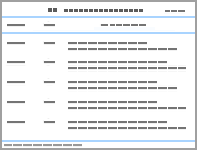
Table 1
Information of subjects"
| 编号 | 性别 | 年龄/岁 | 身高/cm | 体质量/kg |
|---|---|---|---|---|
| Sub01 | 男 | 24 | 183 | 83 |
| Sub02 | 男 | 27 | 180 | 70 |
| Sub03 | 男 | 26 | 180 | 85 |
| Sub04 | 男 | 30 | 172 | 65 |
| Sub05 | 女 | 22 | 172 | 59 |
| Sub06 | 女 | 26 | 161 | 60 |
| Sub07 | 女 | 25 | 165 | 48 |
Table 2
21 types of locomotion pattern"
| 模式类别 | 运动模式 | 运动模式描述 |
|---|---|---|
| 转换模式 | 行走—上楼 | 平地行走到上楼转换 |
| 行走—上坡 | 平地行走到上坡转换 | |
| 行走—下楼 | 平地行走到下楼转换 | |
| 行走—下坡 | 平地行走到下坡转换 | |
| 行走—站立 | 平地行走到站立转换 | |
| 上楼—行走 | 上楼到平地行走转换 | |
| 上坡—行走 | 上坡到平地行走转换 | |
| 下楼—行走 | 下楼到平地行走转换 | |
| 下坡—行走 | 下坡到平地行走转换 | |
| 站立—行走 | 站立到平地行走转换 | |
| 坐—站立 | 坐到站立转换 | |
| 站立—坐 | 站立到坐转换 | |
| 稳态模式 | 行走 | 平地行走 |
| 上楼 | 稳步上台阶 | |
| 上坡 | 稳步上坡 | |
| 下楼 | 稳步下台阶 | |
| 下坡 | 稳步下坡 | |
| 右转弯 | 平地右转弯 | |
| 左转弯 | 平地左转弯 | |
| 坐 | 保持坐姿 | |
| 站立 | 保持站立 |
Table 3
Main performance metrics"
| 方法 | 准确率/% | 加权F1/% | 过渡帧F1/% | 过渡帧MSE |
|---|---|---|---|---|
| 硬标签CE | 93.66±0.73 | 93.47±0.76 | — | — |
| 硬标签CE+TC | 93.94±0.65 | 93.72±0.71 | — | — |
| 软标签CE (γ = 0) | 93.89±0.64 | 93.65±0.67 | 78.17±2.10 | 0.00790 |
| 软标签CE+TAW (γ = 2) | 94.03±0.66 | 93.81±0.69 | 78.71±1.82 | 0.00755 |
| MSE (γ = 0) | 93.99±0.60 | 93.77±0.63 | 77.95±1.38 | 0.00789 |
| MSE+TAW (γ = 2) | 94.03±0.58 | 93.80±0.60 | 78.40±1.64 | 0.00742 |
Table 4
Performance of different soft-label methods on steady-state frames and transitional frames"
| 方法 | 稳态帧准确率 | 过渡帧准确率 | 稳态帧F1 | 过渡帧F1 |
|---|---|---|---|---|
| 软标签CE (γ = 0) | 96.70 | 78.64 | 96.53 | 78.17 |
| 软标签CE+TAW (γ = 2) | 96.76 | 79.13 | 96.61 | 78.71 |
| MSE (γ = 0) | 96.88 | 78.40 | 96.72 | 77.95 |
| MSE+TAW (γ = 2) | 96.81 | 78.89 | 96.66 | 78.40 |
Figure 1
Probability transition curve from standing to flat-ground walking"
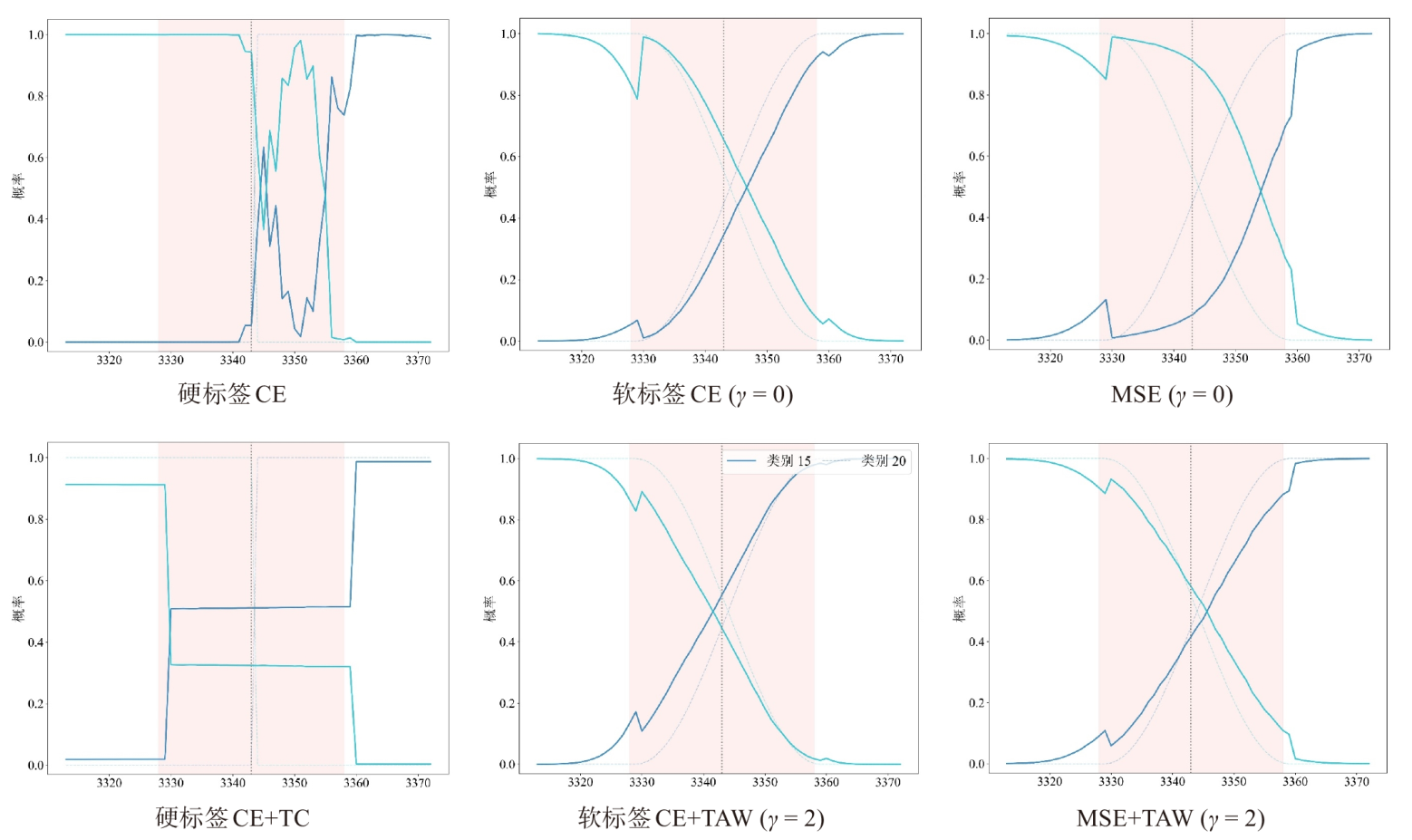
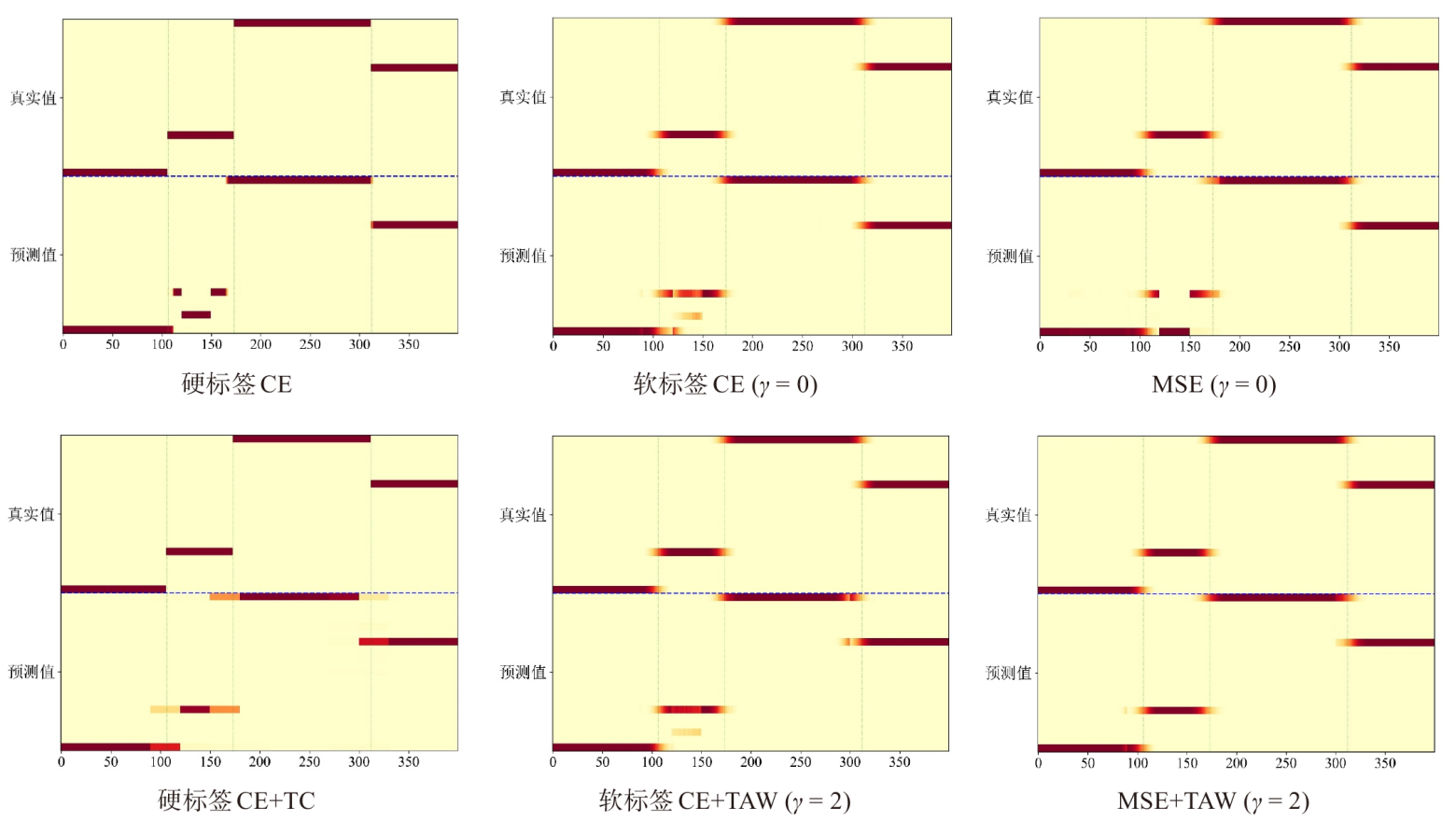
Figure 2
Heat map of probability evolution"
| [1] |
Sullivan L M, Cowan M, Gabert L, et al. Unified control of a powered knee-ankle prosthesis enables walking, stairs, transitions, and other daily ambulation activities[J]. IEEE Trans Neural Syst Rehabil Eng, 2025, 33: 3024-3039.
doi: 10.1109/TNSRE.2025.3595496 |
| [2] | 黄品高. 智能下肢假肢运动意图的感测与识别关键技术研究[D]. 深圳: 中国科学院大学(中国科学院深圳先进技术研究院), 2020. |
| Huang P G. Study on the key technologies of motion intention sensing and recognition of intelligent lower limb prostheses[D]. Shenzhen: The University of Chinese Academy of Sciences (Shenzhen Institutes of Advanced Technology, Chinese Academy of Sciences), 2020. | |
| [3] | 唐易, 陈奕希, 喻洪流, 等. 一种面向下肢假肢的运动意图识别方法及验证[J]. 信息与控制, 2023, 52(5): 598-606. |
| Tang Y, Chen Y X, Yu H L, et al. Research and verification of a motion intention recognition method for lower limb prosthesis[J]. Inform Control, 2023, 52(5): 598-606. | |
| [4] | 顾洪, 李伟达, 李娟. 智能膝关节假肢研究现状及发展趋势[J]. 中国康复理论与实践, 2016, 22(9): 1080-1085. |
| Gu H, Li W D, Li J. State-of-the-art and development of intelligent knee prosthesis (review)[J]. Chin J Rehabil Theory Pract, 2016, 22(9): 1080-1085. | |
| [5] | 王启宁, 郑恩昊, 陈保君, 等. 面向人机融合的智能动力下肢假肢研究现状与挑战[J]. 自动化学报, 2016, 42(12): 1780-1793. |
| Wang Q N, Zheng E H, Chen B J, et al. Recent progress and challenges of robotic lower-limb prostheses for human-robot integration[J]. Acta Automat Sinic, 2016, 42(12): 1780-1793. | |
| [6] |
Tang C Y, Xu Z Y, Occhipinti E, et al. From brain to movement: wearables-based motion intention prediction across the human nervous system[J]. Nano Energy, 2023, 115: 108712.
doi: 10.1016/j.nanoen.2023.108712 |
| [7] |
张意彬, 吕杰, 喻洪流. 基于模糊逻辑算法的智能膝关节假肢步态相位识别[J]. 中国康复理论与实践, 2023, 29(8): 896-902.
doi: 10.3969/j.issn.1006-9771.2023.08.005 |
| Zhang Y B, Lü J, Yu H L. Gait phase recognition in intelligent above-knee prosthesis based on fuzzy logic algorithm[J]. Chin J Rehabil Theory Pract, 2023, 29(8): 896-902. | |
| [8] | 孙为双, 路知远, 公维军, 等. 表面肌电信号在脑卒中手功能康复机器人中的研究进展[J]. 中国康复医学杂志, 2025, 40(5): 790-794. |
| [9] | 张尧. 智能动力膝关节假肢的人体运动意图识别技术研究[D]. 长春: 吉林大学, 2024. |
| Zhang Y. Research on human locomotion intent recognition technology for intelligent powered knee prosthesis[D]. Changchun: Jilin University, 2024. | |
| [10] | Li J, Gu X, Qiu S, et al. A survey of wearable lower extremity neurorehabilitation exoskeleton: sensing, gait dynamics, and human-robot collaboration[J]. IEEE Trans Syst Man Cybernetics Syst, 2024, 54(6): 3675-3693. |
| [11] |
杨平, 陈浩源, 高睿馨, 等. 基于低成本惯性测量单元和力敏电阻的足部三维运动数据建模[J]. 中国康复理论与实践, 2024, 30(10): 1224-1231.
doi: 10.3969/j.issn.1006-9771.2024.10.013 |
| Yang P, Chen H Y, Gao R X, et al. Three-dimensional modeling of foot motion based on low-cost inertial measurement unit and force sensing resistor[J]. Chin J Rehabil Theory Pract, 2024, 30(10): 1224-1231. | |
| [12] |
Wang E, Chen X, Li Y, et al. Lower limb motion intent recognition based on sensor fusion and fuzzy multitask learning[J]. IEEE Trans Fuzzy Syst, 2024, 32(5): 2903-2914.
doi: 10.1109/TFUZZ.2024.3364382 |
| [13] |
Su B Y, Wang J, Liu S Q, et al. A CNN-based method for intent recognition using inertial measurement units and intelligent lower limb prosthesis[J]. IEEE Trans Neural Syst Rehabil Eng, 2019, 27(5): 1032-1042.
doi: 10.1109/TNSRE.7333 |
| [14] | 盛敏, 夏安琦, 王可林, 等. 基于几何与物理特征融合的智能下肢假肢运动意图识别[J]. 控制与决策, 2022, 37(4): 953-961. |
| Sheng M, Xia A Q, Wang K L, et al. Movement intention recognition of intelligent lower limb prosthesis based on the fusion of geometric and physical features[J]. Control Decision, 2022, 37(4): 953-961. | |
| [15] | 盛敏, 刘双庆, 王婕, 等. 基于GMM-HMM模型的智能下肢假肢运动意图识别[J]. 仪器仪表学报, 2019, 40(5): 169-178. |
| Sheng M, Liu S Q, Wang J, et al. Motion intent recognition of intelligent lower limb prosthesis based on GMM-HMM[J]. Chin J Sci Instrument, 2019, 40(5): 169-178. | |
| [16] |
苏本跃, 张利, 何清旋, 等. 基于小波特征匹配的短时人体行为识别[J]. 系统仿真学报, 2023, 35(1): 158-168.
doi: 10.16182/j.issn1004731x.joss.22-0176 |
| Su B Y, Zhang L, He Q X, et al. Short-time human activity recognition based on wavelet features matching[J]. J Syst Simulat, 2023, 35(1): 158-168. | |
| [17] | 苏本跃, 王婕, 刘双庆, 等. 惯性动捕数据驱动下的智能下肢假肢运动意图识别方法[J]. 自动化学报, 2020, 46(7): 1517-1530. |
| Su B Y, Wang J, Liu S Q, et al. An improved motion intent recognition method for intelligent lower limb prosthesis driven by inertial motion capture data[J]. Acta Automat Sinic, 2020, 46(7): 1517-1530. | |
| [18] | 苏本跃, 宗文杰, 刘文瑶, 等. 基于足底动力相数据和小波变换自适应分解的下肢意图识别方法[J]. 控制与决策, 2025, 40(10): 3005-3018. |
| Su B Y, Zong W J, Liu W Y, et al. Lower limb prosthesis intention recognition method based on powered plantarflexion phase data and wavelet transform adaptive decomposition[J]. Control Decision, 2025, 40(10): 3005-3018. | |
| [19] |
苏本跃, 刘文瑶, 宗文杰, 等. 基于自适应时序对齐的智能下肢假肢运动意图识别[J]. 中国康复理论与实践, 2025, 31(9): 1101-1115.
doi: 10.3969/j.issn.1006-9771.2025.09.014 |
| Su B Y, Liu W Y, Zong W J, et al. Adaptive temporal alignment-based motion intention recognition for intelligent lower-limb prostheses[J]. Chin J Rehabil Theory Pract, 2025, 31(9): 1101-1115. | |
| [20] |
Cheng S H, Laubscher C A, Gregg R D, et al. Controlling powered prosthesis kinematics over continuous inter-leg transitions between walking and stair ascent/descent[J]. IEEE Trans Neural Syst Rehabil Eng, 2024, 32: 3891-3901.
doi: 10.1109/TNSRE.2024.3485643 |
| [21] |
Ma X, Liu Y, Zhang X, et al. Real-time continuous locomotion mode recognition and transition prediction for human with lower limb exoskeleton[J]. IEEE J Biomed Health Inform, 2025, 29(2): 1074-1086.
doi: 10.1109/JBHI.2024.3462826 |
| [22] | Xue D F, Wang Q N. Noninvasive human-prosthesis interfaces for locomotion intent recognition: a review[J]. Cyborg Bionic Syst, 2021, 2021: 9863761. |
| [23] |
Batista P G, Vieira A C, Gaspar P D. Robotic prostheses and neuromuscular interfaces: a review of design and technological trends[J]. Machines, 2025, 13(9): 804.
doi: 10.3390/machines13090804 |
| [24] |
Wu J, Maurenbrecher H, Schaer A, et al. Human gait-labeling uncertainty and a hybrid model for gait segmentation[J]. Front Neurosci, 2022, 16: 976594.
doi: 10.3389/fnins.2022.976594 |
| [25] |
Haque M R, Islam M R, Sazonov E, et al. Swing-phase detection of locomotive mode transitions for smooth multi-functional robotic lower-limb prosthesis control[J]. Front Robot AI, 2024, 11: 1267072.
doi: 10.3389/frobt.2024.1267072 |
| [26] | Zheng E, Wan J, Gao S, et al. Adaptive locomotion transition recognition with wearable sensors for lower limb robotic prosthesis[J]. IEEE/ASME Trans Mechatron, 2024, 29(5): 3481-3492. |
| [27] | Chen Z H, Zhang T Y. Evaluation of basic sports actions for students based on DTW posture matching algorithm[J]. Syst Soft Comput, 2025, 7: 200196. |
| [28] |
Wang X M, Bai S P, Li L R, et al. Enhancing locomotion-mode recognition and transition prediction with (bio)mechanical sensor fusion for intelligent prosthetic knees[J]. IEEE J Biomed Health Inform, 2025, 29(11): 7955-7968.
doi: 10.1109/JBHI.2025.3583319 |
| [29] |
Huang H, Zhang F, Hargrove L J, et al. Continuous locomotion-mode identification for prosthetic legs based on neuromuscular-mechanical fusion[J]. IEEE Trans Biomed Eng, 2011, 58(10): 2867-2875.
doi: 10.1109/TBME.2011.2161671 pmid: 21768042 |
| [30] |
Young A J, Simon A M, Fey N P, et al. Intent recognition in a powered lower limb prosthesis using time history information[J]. Ann Biomed Eng, 2014, 42(3): 631-641.
doi: 10.1007/s10439-013-0909-0 pmid: 24052324 |
| [31] | 杜妍辰, 杨良栋, 汪晓铭, 等. 基于肌压信号与惯性测量单元的下肢运动意图识别[J]. 信息与控制, 2024, 53(6): 761-773. |
| Du Y C, Yang L D, Wang X M, et al. Recognition of lower limb movement intention based on force myography signal and inertial measurement unit[J]. Inform Control, 2024, 53(6): 761-773. | |
| [32] |
Liu Y X, Gutierrez-Farewik E M. Joint kinematics, kinetics and muscle synergy patterns during transitions between locomotion modes[J]. IEEE Trans Biomed Eng, 2023, 70(3): 1062-1071.
doi: 10.1109/TBME.2022.3208381 |
| [33] |
Hu N H, Englebienne G, Lou Z Y, et al. Learning to recognize human activities using soft labels[J]. IEEE Trans Pattern Anal Mach Intell, 2017, 39(10): 1973-1984.
doi: 10.1109/TPAMI.2016.2621761 |
| [1] | SU Benyue, LIU Wenyao, ZONG Wenjie, WANG Baoqian, SHENG Min. Adaptive temporal alignment-based motion intention recognition for intelligent lower-limb prostheses [J]. Chinese Journal of Rehabilitation Theory and Practice, 2025, 31(9): 1101-1115. |
| [2] | YANG Ping, CHEN Haoyuan, GAO Ruixin, WANG Xinping, Philip ROWE. Three-dimensional modeling of foot motion based on low-cost inertial measurement unit and force sensing resistor [J]. Chinese Journal of Rehabilitation Theory and Practice, 2024, 30(10): 1224-1231. |
| [3] | YANG Bo;FU Cheng-long. Inertial Measurement Unit and Fall Risk Assessment in the Elderly (review) [J]. 《Chinese Journal of Rehabilitation Theory and Practice》, 2015, 21(07): 780-784. |
| Viewed | ||||||
|
Full text |
|
|||||
|
Abstract |
|
|||||
|
||
