



Chinese Journal of Rehabilitation Theory and Practice ›› 2026, Vol. 32 ›› Issue (9): 1108-1116.doi: 10.3969/j.issn.1006-9771.2026.09.013
Guo Xuxia1, Yu Hengrui1, Lu Yucheng2, Yang Sichuang3, Long Yu3, Li Jiawei1, Chen Lin3( ), Nong Feiyu4, Long Yaobin4
Received:2026-03-17
Revised:2026-07-06
Accepted:2026-07-06
Published:2026-09-25
Online:2026-09-20
Contact:
Chen Lin
E-mail:gxdxcl@163.com
Supported by:CLC Number:
Guo Xuxia, Yu Hengrui, Lu Yucheng, Yang Sichuang, Long Yu, Li Jiawei, Chen Lin, Nong Feiyu, Long Yaobin. An explainable artificial intelligence-driven motor rehabilitation assessment system based on perception-cognition decoupling: design and validation[J]. Chinese Journal of Rehabilitation Theory and Practice, 2026, 32(9): 1108-1116.
Figure 1
Integrated analysis framework for gait health assessment"
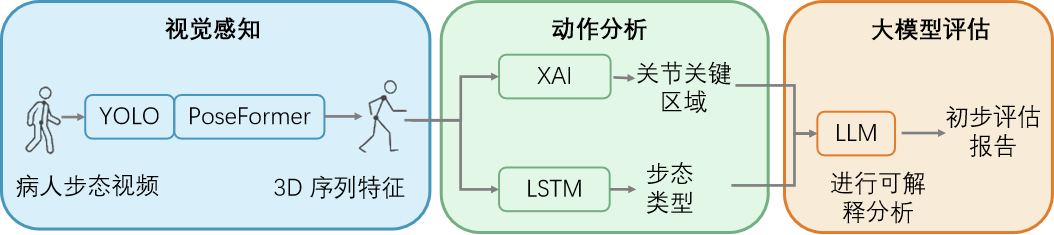
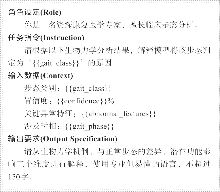
Figure 2
Prompt setting"
Table 1
Information of subjects"
| 编号 | 性别 | 年龄/岁 | 原发病 | 身高/cm | 体质量/kg |
|---|---|---|---|---|---|
| sub01 | 男 | 21 | 健康 | 178 | 75 |
| sub02 | 男 | 36 | 前交叉韧带断裂 | 172 | 70 |
| sub03 | 男 | 52 | 右侧股骨骨折 | 178 | 70 |
| sub04 | 女 | 78 | 脑出血 | 160 | 52 |
| sub05 | 男 | 47 | 脑梗死 | 173 | 78 |
| sub06 | 男 | 40 | 脑出血 | 180 | 85 |
| sub07 | 男 | 52 | 脑出血 | 170 | 76 |
| sub08 | 男 | 57 | 脑梗死 | 171 | 74 |
Table 2
2D pose accuracy"
| 指标 | 数值 | 定性评估 |
|---|---|---|
| 有效检测率 | 100% | 每帧都能成功检测到人体,无漏检,系统鲁棒性强 |
| 平均置信度 | 0.819 | > 0.7,可接受,对检测结果有信心 |
| 可见关键点数 | 13.8/17 | 平均每帧有81%的关节点可见,遮挡较少,输入质量高 |
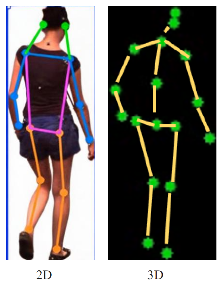
Figure 3
Pose Recognition"
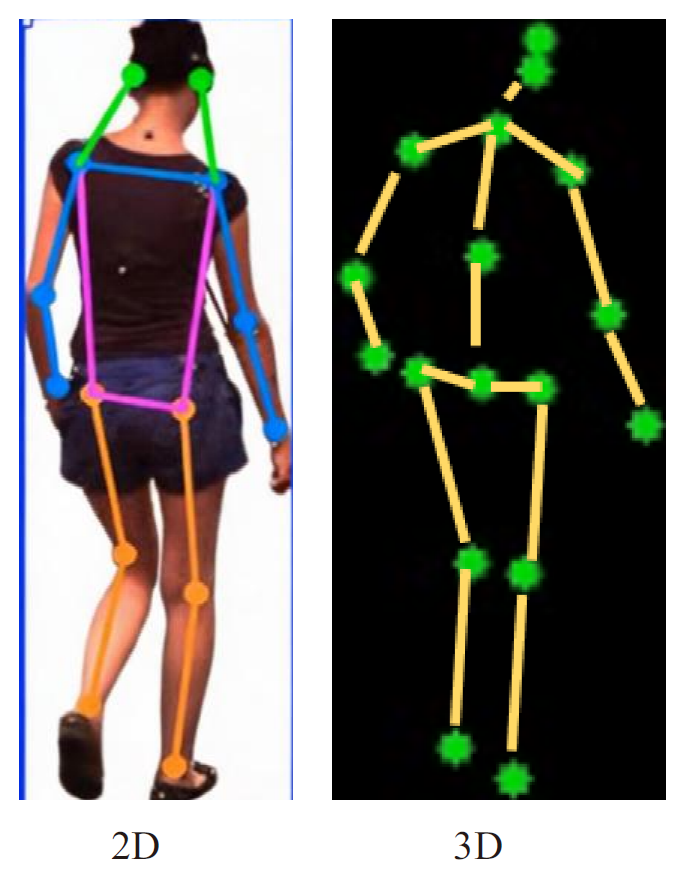
Table 3
Classification performance of LSTM classifier"
| 指标 | 总体 | 正常 | 异常 | 病理性 |
|---|---|---|---|---|
| 准确率 | 0.941 | - | - | - |
| 精确率 | 0.948 | 0.994 | 0.865 | 1.000 |
| 召回率 | 0.941 | 0.886 | 1.000 | 0.981 |
| F1分数 | 0.941 | 0.937 | 0.928 | 0.991 |
| 支持数 | 356 | 175 | 128 | 53 |
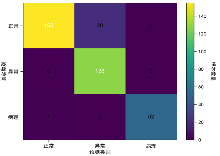
Figure 4
Confusion matrix of LSTM classifier on test set"
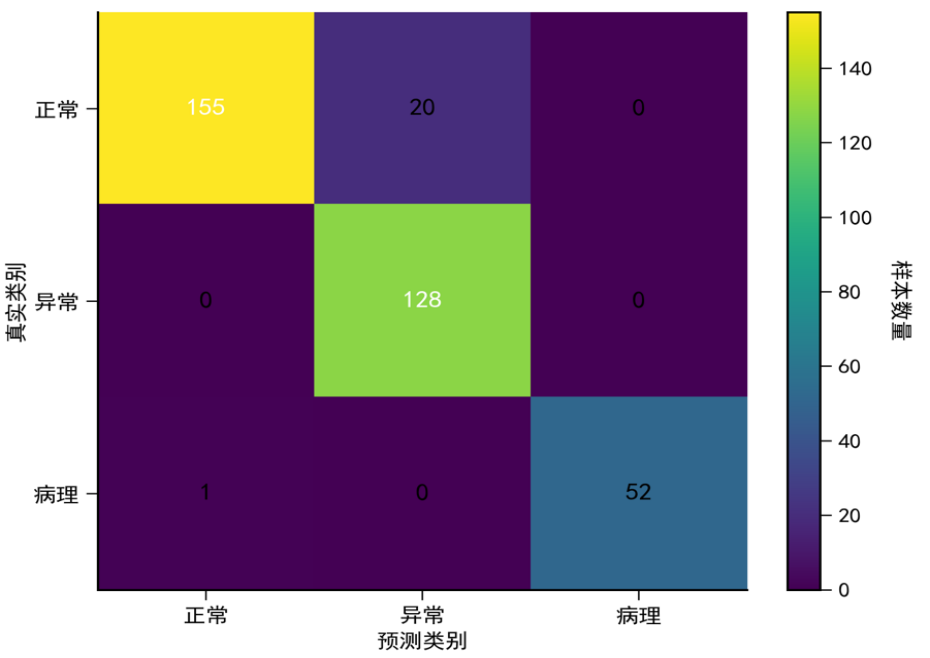
Table 4
System execution log for a typical gait sample"
| 阶段 | 时间戳 | 输出 |
|---|---|---|
| LSTM分类 | 03:41:02,054 | 异常,置信度0.974 |
| XAI贡献度分析 | 03:41:02,054 | 关键关节:躯干 |
| 生物力学特征提取 | - | 躯干前倾角均值75.4°,标准差3.7°;支撑相占比0.53 |
| 语义提示生成 | 03:41:02,054 | 模型将该步态分类为异常,置信度97.4%。关键关节为躯干。躯干前倾角度增加70.4°,且支撑相时间缩短至0.53 |
| LLM医学解释生成 | 03:41:17,762 | 成功返回结构化自然语言解释 |
Table 5
Abnormal gait patterns"
| 类型 | 特征描述 |
|---|---|
| 单一型 | 对称步态+单一部位代偿(足弓/躯干) |
| 双维型 | 对称或轻度不对称+单一平面偏移+支撑延长 |
| 复合型 | 显著不对称+多平面躯干代偿+支撑相严重失衡 |
Table 6
Agreement between system outputs and physician assessments"
| 编号 | 主要表现 | 类型 | 关键量化指标 | 医生评估要点 | 是否一致 |
|---|---|---|---|---|---|
| sub01 | 显著不对称,骨盆代偿下降 | 复合型 | 躯干前倾24.2°;支撑相占比0.963(左长右短) | 右臀中肌无力,Trendelenburg征(+),支撑时间不等 | 是 |
| sub02 | 轻度对称异常,足弓塌陷 | 单一型 | 躯干前倾15.9°;支撑相占比0.961;膝内扣0.1° | 核心稳定性下降,静态足弓指数低,双侧支撑一致 | 是 |
| sub03 | 步长不对称伴支撑期延长 | 双维型 | 步长不对称;躯干侧弯6.1°;单侧支撑相明显延长 | 步长不对称,躯干侧弯5°,单侧支撑相明显延长 | 是 |
| sub04 | 步长不对称伴躯干代偿倾斜 | 双维型 | 躯干前倾13.5°;躯干侧弯5.4°;单侧支撑相明显延长 | 步长不对称,躯干前倾10°伴轻度侧弯,支撑相延长 | 是 |
| sub05 | 步态对称但躯干侧偏 | 单一型 | 躯干前倾9.5°;单侧支撑相明显延长 | 躯干前倾10°,单侧支撑相代偿性延长 | 是 |
| sub06 | 对称步态伴明显侧弯 | 双维型 | 步长对称,躯干侧弯8.7°;单侧相支撑明显延长 | 躯干侧弯10°,单侧支撑相明显延长 | 是 |
| sub07 | 不对称步态伴轻度侧弯 | 双维型 | 步长不对称;躯干前倾5.1°,侧弯6.3°;单侧支撑相明显延长 | 步长不对称,躯干侧弯5°及单侧支撑相延长 | 是 |
| sub08 | 复合不对称与前倾代偿 | 复合型 | 步长不对称;躯干前倾13.3°侧弯6.5°;单侧支撑明显延长 | 步长不对称,躯干前倾10°,侧弯5°及单侧支撑延长 | 是 |
| [1] |
Beard J R, Officer A M, Cassels A K. The world report on ageing and health[J]. Gerontologist, 2016, 56(S2): S163-S166.
doi: 10.1093/geront/gnw037 |
| [2] |
Fan C, Yang B, Li X, et al. Temporal-frequency-phase feature classification using 3D-convolutional neural networks for motor imagery and movement[J]. Front Neurosci, 2023, 17: 1250991.
doi: 10.3389/fnins.2023.1250991 |
| [3] |
Ngiam K Y, Khor I W. Big data and machine learning algorithms for health-care delivery[J]. Lancet Oncol, 2019, 20(5): e262-e273.
doi: 10.1016/S1470-2045(19)30149-4 |
| [4] |
Kidziński Ł, Yang B, Hicks J L, et al. Deep neural networks enable quantitative movement analysis using single-camera videos[J]. Nat Commun, 2020, 11(1): 4054.
doi: 10.1038/s41467-020-17807-z pmid: 32792511 |
| [5] | 丁德波, 史耀群. 基于时空图卷积网络与多层次特征融合的快递员3D人体姿态估计[J]. 传感技术学报, 2025, 38(8): 1457-1462. |
| Ding D B, Shi Y Q. 3D human pose estimation of couriers based on spatio-temporal graph convolutional networks with multi-level feature fusion[J]. Chin J Sensor Actuator, 2025, 38(8): 1457-1462. | |
| [6] |
Cao Z, Hidalgo G, Simon T, et al. OpenPose: realtime multi-person 2D pose estimation using part affinity fields[J]. IEEE Trans Pattern Anal Mach Intell, 2021, 43(1): 172-186.
doi: 10.1109/TPAMI.34 |
| [7] |
Stenum J, Rossi C, Roemmich R T. Two-dimensional video-based analysis of human gait using pose estimation[J]. PLoS Comput Biol, 2021, 17(4): e1008935.
doi: 10.1371/journal.pcbi.1008935 |
| [8] |
Uhlrich S D, Falisse A, Kidziński Ł, et al. OpenCap: human movement dynamics from smartphone videos[J]. PLoS Comput Biol, 2023, 19(10): e1011462.
doi: 10.1371/journal.pcbi.1011462 |
| [9] | 张堃, 张鹏程, 陈孝豪, 等. 基于三维姿态估计的智能康复运动检测系统应用研究[J]. 仪器仪表学报, 2025, 46(6): 181-193. |
| Zhang K, Zhang P C, Chen X H, et al. Application research of intelligent rehabilitation exercise detection system based on 3D human pose estimation[J]. Chin J Sci Instrument, 2025, 46(6): 181-193. | |
| [10] |
Needham L, Evans M, Wade L, et al. The development and evaluation of a fully automated markerless motion capture workflow[J]. J Biomech, 2022, 144: 111338.
doi: 10.1016/j.jbiomech.2022.111338 |
| [11] | 程相鑫, 张烁, 杜松骏, 等. 基于IMU信号的人工智能上肢多关节运动状态识别系统构建:卒中后人工智能运动功能评估与检测系统建设前导研究[J]. 中国卒中杂志, 2025, 20(4): 401-409. |
| Cheng X X, Zhang S, Du S J, et al. Construction of an artificial intelligence upper limb multi-joint motion state recognition system based on IMU signals: a preliminary study for the development of an artificial intelligence motor function assessment and detection system after stroke[J]. Chin J Stroke, 2025, 20(4): 401-409. | |
| [12] |
Singhal K, Azizi S, Tu T, et al. Large language models encode clinical knowledge[J]. Nature, 2023, 620(7972): 172-180.
doi: 10.1038/s41586-023-06291-2 |
| [13] |
Bedi S, Liu Y, Orr-Ewing L, et al. Testing and evaluation of health care applications of large language models: a systematic review[J]. JAMA, 2025, 333(4): 319-328.
doi: 10.1001/jama.2024.21700 |
| [14] | Yin S, Fu C, Zhao S, et al. A survey on multimodal large language models[J]. Natl Sci Rev, 2024, 11(12): nwae403. |
| [15] | Wang C, Li S, Lin N, et al. Application of large language models in medical training evaluation: using ChatGPT as a standardized patient: multimetric assessment[J]. J Med Internet Res, 2025, 27: e59435. |
| [16] |
Esteva A, Robicquet A, Ramsundar B, et al. A guide to deep learning in healthcare[J]. Nat Med, 2019, 25(1): 24-29.
doi: 10.1038/s41591-018-0316-z pmid: 30617335 |
| [17] |
Goetz L, Seedat N, Vandersluis R, et al. Generalization: a key challenge for responsible AI in patient-facing clinical applications[J]. NPJ Digit Med, 2024, 7(1): 126.
doi: 10.1038/s41746-024-01127-3 pmid: 38773304 |
| [18] | 周鑫源, 邱敏, 商江峰, 等. 基于深度学习的甲状腺结节超声图像计算机辅助诊断研究进展[J]. 生物医学工程学杂志, 2025, 42(5): 1069-1075. |
| Zhou X Y, Qiu M, Shang J F, et al. Research progress on deep learning-based computer-aided diagnosis of thyroid nodules using ultrasound imaging[J]. J Biomed Eng, 2025, 42(5): 1069-1075. | |
| [19] | 宁文卓. 基于深度学习的人体姿态识别方法研究[D]. 大连: 大连交通大学, 2025. |
| Ning W Z. Research on human pose recognition method based on deep learning[D]. Dalian: Dalian Jiaotong University, 2025. | |
| [20] | 赵兴鹏, 徐航, 常朋发, 等. 基于多域协同训练的半监督雷达人体动作识别方法[J]. [网络首发]. 雷达学报(中英文), 2026. https://link.cnki.net/urlid/10.1030.TN.20260305.2140.002. |
| Zhao X P, Xu H, Chang P F, et al. A semisupervised radar-based human action recognition method via multidomain collaborative training[J]. [ahead of print]. J Radars, 2026. https://link.cnki.net/urlid/10.1030.TN.20260305.2140.002. | |
| [21] | 石欣, 黄良文, 梁飞, 等. 基于肌电信号的跨被试不变特征运动模式识别[J]. 仪器仪表学报, 2026, 47(2): 244-255. |
| Shi X, Huang L W, Liang F, et al. Cross-subject invariant feature-based motion pattern recognition using sEMG[J]. Chin J Sci Instrument, 2026, 47(2): 244-255. | |
| [22] | 宋永坤, 游文杰, 岳磊, 等. 结合时空特征的超宽带MIMO雷达图像人体轮廓恢复与动作识别方法[J]. [网络首发]. 雷达学报(中英文), 2026. https://link.cnki.net/urlid/10.1030.tn.20260123.1013.010. |
| Song Y K, You W J, Yue L, et al. Human contour restoration and action recognition in ultra-wideband radar imaging based on spatio-temporal features[J]. [ahead of print]. J Radars, 2026. https://link.cnki.net/urlid/10.1030.tn.20260123.1013.010. | |
| [23] | 郑屹, 黄向, 秦菲儿, 等. 2D/3D生成式人工智能技术发展及创意产业应用[J]. 中国图象图形学报, 2025, 30(6): 1953-1984. |
| Zheng Y, Huang X, Qin F E, et al. Development of 2D/3D generative artificial intelligence technology and its applications in creative industries[J]. J Image Graph, 2025, 30(6): 1953-1984. | |
| [24] | 郭卓涛, 张凯, 查国春, 等. 腰椎融合对全髋关节置换后中期疗效影响的匹配对照试验[J]. 中国组织工程研究, 2023, 27(36): 5801-5805. |
| Guo Z T, Zhang K, Zha G C, et al. A matched controlled trial of the effect of lumbar fusion on mid-term outcomes after total hip arthroplasty[J]. Chin J Tissue Eng Res, 2023, 27(36): 5801-5805. | |
| [25] | 徐大涛, 全文静, 周辉宇, 等. 基于深度神经网络和逐层相关性传播技术探究"高-低"里程跑者步态模式差异[J]. 医用生物力学, 2022, 37(6): 1151-1157. |
| Xu D T, Quan W J, Zhou H Y, et al. Exploration of gait pattern differences between high-mileage and low-mileage runners based on deep neural network and layer-wise relevance propagation[J]. J Med Biomech, 2022, 37(6): 1151-1157. | |
| [26] | 马腾, 王毓萱, 侯志民, 等. 动力大腿假肢控制技术研究进展及发展趋势[J]. 机器人, 2026, 48(2): 395-413. |
| Ma T, Wang Y X, Hou Z M, et al. Research progress and development trend of powered transfemoral prosthesis control technology[J]. Robot, 2026, 48(2): 395-413. | |
| [27] | 郑蕾, 李涵, 何健, 等. 基于机器学习的高温防护涂层智能化设计与性能预测[J]. [网络首发]. 北京航空航天大学学报, 2026. https://doi.org/10.13700/j.bh.1001-5965.2025.0911. |
| Zheng L, Li H, He J, et al. Intelligent design and performance prediction of high-temperature protective coatings based on machine learning[J]. [ahead of print]. J Beijing Univ Aeronaut Astronaut, 2026. https://doi.org/10.13700/j.bh.1001-5965.2025.0911. | |
| [28] |
王福东, 黄诗雅, 赵宏宇. 急性缺血性脑卒中患者首次运动康复治疗时间对运动功能的影响研究[J]. 中国全科医学, 2018, 21(25): 3089-3094.
doi: 10.12114/j.issn.1007-9572.2018.25.012 |
| Wang F D, Huang S Y, Zhao H Y. Effect of timing of initiating exercise rehabilitation on the prognosis of motor function in acute ischemic stroke[J]. Chin Gener Pract, 2018, 21(25): 3089-3094. | |
| [29] |
万盛华, 徐兴业, 甘乐, 等. 基于多模态大模型辅助视频动作生成的预训练世界模型[J]. 计算机科学, 2026, 53(1): 51-57.
doi: 10.11896/jsjkx.250800033 |
| Wan S H, Xu X Y, Gan L, et al. Pre-training world models from videos with generated actions by multi-modal large models[J]. Comput Sci, 2026, 53(1): 51-57. | |
| [30] | 刘天华, 张维彦, 刘井平, 等. 面向大语言模型的序列知识评测与优化[J]. [网络首发]. 计算机科学, 2026. https://link.cnki.net/urlid/50.1075.TP.20260319.1707.011. |
| Liu T H, Zhang W Y, Liu J P, et al. Sequential knowledge evaluation and optimization for large language models[J]. [ahead of print]. Comput Sci, 2026. https://link.cnki.net/urlid/50.1075.TP.20260319.1707.011. | |
| [31] |
蔡锦添, 郝耀辉, 陈鑫, 等. 基于大模型的全球航展知识图谱构建与问答系统框架研究[J]. 计算机工程与应用, 2026, 62(9): 108-121.
doi: 10.3778/j.issn.1002-8331.2507-0068 |
|
Cai J T, Hao Y H, Chen X, et al. Research on framework of global airshow knowledge graph construction and question-answering system based on large language models[J]. Comput Eng Appl, 2026, 62(9): 108-121.
doi: 10.3778/j.issn.1002-8331.2507-0068 |
|
| [32] |
蔡华年, 费思先, 张忆晨, 等. 基于导纳控制的双边康复机器人运动辅助分析[J]. 中国康复理论与实践, 2023, 29(9): 1104-1109.
doi: 10.3969/j.issn.1006-9771.2023.09.015 |
| Cai H N, Fei S X, Zhang Y C, et al. Motion assistance analysis for robot-assisted tele-rehabilitation based on bilateral admittance control[J]. Chin J Rehabil Theory Prac, 2023, 29(9): 1104-1109. | |
| [33] | 马超, 邹子炀, 范杰. 基于RoBERTa模型的民机运维数据语料要素识别[J]. 科学技术与工程, 2026, 26(2): 701-707. |
| Ma C, Zou Z Y, Fan J. Identification of corpus elements for civil aircraft operation and maintenance data based on roberta model[J]. Sci Technol Eng, 2026, 26(2): 701-707. | |
| [34] | 唐文胜, 熊露, 陈明, 等. LLM与多智能体协同的计算机类本科毕业论文智能评级框架[J]. [网络首发]. 计算机应用, 2026. https://link.cnki.net/urlid/51.1307.TP.20251224.1122.002. |
| Tang W S, Xiong L, Chen M, et al. Intelligent rating framework for computer undergraduate graduation thesis via LLM and multi-agent collaboration[J]. [ahead of print]. J Comput Appl, 2026. https://link.cnki.net/urlid/51.1307.TP.20251224.1122.002. | |
| [35] | 杨浩, 徐旻, 彭荷玲, 等. 大语言模型在智能病历内涵质控中的应用研究[J]. 西安交通大学学报(医学版), 2026, 47(3): 477-485. |
| Yang H, Xu M, Peng H L, et al. Application of large language models in intelligent intrinsic quality control of electronic medical records[J]. J Xi'an Jiaotong Univ (Med Sci), 2026, 47(3): 477-485. | |
| [36] | 范文仲, 徐李璐邑. 云边协同智能算力网络建设与城市发展创新[J]. 城市问题, 2025(7): 15-24. |
| Fan W Z, Xu L L Y. Cloud-edge collaborative artificial intelligent computing power network development and urban innovation[J]. Urban Problem, 2025(7): 15-24. |
| [1] | Liu Hua, Ma Xin, Li Jing, Wang Liyuan, Wang Li. Comparison master's training programs in sports rehabilitation based on rehabilitation competency framework [J]. Chinese Journal of Rehabilitation Theory and Practice, 2026, 32(8): 984-992. |
| [2] | LIU Hua, LI Jing, WANG Liyuan, MA Xin, WANG Li. Application of presentation-assimilation-discussion-based classroom-community collaborative teaching in sports rehabilitation therapy under sports-medicine integration [J]. Chinese Journal of Rehabilitation Theory and Practice, 2026, 32(4): 482-487. |
| [3] | Sports Rehabilitation Group, Committee of Rehabilitation Medicine Education, Chinese Association of Rehabilitation Medicine, QIAN Jinghua, LIAO Yuanpeng, WANG Lin, ZHANG Qiuxia, BAO Wenli, ZHANG Haifeng. Internship system for the undergraduate program in sports rehabilitation based on World Health Organization rehabilitation competency framework [J]. Chinese Journal of Rehabilitation Theory and Practice, 2026, 32(2): 241-248. |
| [4] | CHEN Jian, LI Zheheng, WANG Dingxuan. Current status of talent cultivation in sports rehabilitation in China: based on World Health Organization rehabilitation competency framework [J]. Chinese Journal of Rehabilitation Theory and Practice, 2026, 32(1): 110-116. |
| [5] | LIU Fangchao, ZHANG Yuanmingfei, WU Meiqi, ZHOU Mouwang, LI Tao. Validity of key points detection technology of artificial intelligence in gait kinematics analysis [J]. Chinese Journal of Rehabilitation Theory and Practice, 2025, 31(3): 249-253. |
| [6] | YANG Ping, CHEN Haoyuan, GAO Ruixin, WANG Xinping, Philip ROWE. Three-dimensional modeling of foot motion based on low-cost inertial measurement unit and force sensing resistor [J]. Chinese Journal of Rehabilitation Theory and Practice, 2024, 30(10): 1224-1231. |
| [7] | Wu-jie HUANG,Hong LIU,Ya-ping LI,Zheng JIANG. Effect of Pain Relief on Gait Characteristics of Patients with Chronic Nonspecific Low Back Pain [J]. 《Chinese Journal of Rehabilitation Theory and Practice》, 2021, 27(2): 197-202. |
| [8] | Ming-ming GAO,Ze-jia HE,Xiao-ping YUN,Zhou LONG,Cheng WANG,Xiang-dong WANG. Agreement of Spatiotemporal Gait Characteristics between Gaitboter Gait Analysis System and Noraxon Gait Analysis System [J]. 《Chinese Journal of Rehabilitation Theory and Practice》, 2021, 27(2): 216-221. |
| [9] | ZHAO Can,WEI Rui-han,ZHAO Wen,JI Run,RAO Jia-sheng,YANG Zhao-yang,LI Xiao-guang. Evaluation of Residual Stepping Ability in Monkeys with Spinal Cord Injury [J]. 《Chinese Journal of Rehabilitation Theory and Practice》, 2020, 26(6): 648-653. |
| [10] | LIU Hong, HOU Mei-jin, HUANG Wu-jie, Lin Rong, Jiang Zheng. Researches of Three-dimensional Gait Analysis for Chronic Nonspecific Low Back Pain (review) [J]. 《Chinese Journal of Rehabilitation Theory and Practice》, 2019, 25(8): 882-885. |
| [11] | PANG Dong-qing, LIU Jie-sheng, LIU Jin-song, WU Wei-hong. Effect of Sensomotor Insole on Gait and Energy Expenditure for Children with Cerebral Palsy [J]. 《Chinese Journal of Rehabilitation Theory and Practice》, 2019, 25(8): 971-975. |
| [12] | GUO Yong-liang, LU Jian-jun, FENG Zhong-rui, LIU Meng-jiao, LIU Chu-rong. Features of Gait Festination for Patients with Parkinson's Disease: A Three-Dimensional Gait Analysis [J]. 《Chinese Journal of Rehabilitation Theory and Practice》, 2019, 25(7): 832-835. |
| [13] | LI Dai, YU Hong, LIANG Zi-xuan, HUANG Hong-shi, SHI Hai-hua, LIU Xiao-min, AO Ying-fang. Initiatory Application of Three-dimensional Asymmetry on Anterior-cruciate-ligament Rupture Gait Analysis [J]. 《Chinese Journal of Rehabilitation Theory and Practice》, 2018, 24(8): 956-962. |
| [14] | LIU Yi, XIAO Nong, MAO Zhen-sha. Brain Cell Injuries and Behavioral Changes in Rats with Kernicterus [J]. 《Chinese Journal of Rehabilitation Theory and Practice》, 2016, 22(6): 640-644. |
| [15] | ZHAO Wen;RAO Jia-sheng;ZHAO Can;WEI Rui-han;YANG Zhao-yang;LI Xiao-guang;. Three-dimensional Hindlimb Gait Data Toolkit for Healthy and Spinal Cord Injured Rhesus Monkey [J]. 《Chinese Journal of Rehabilitation Theory and Practice》, 2015, 21(07): 760-765. |
| Viewed | ||||||
|
Full text |
|
|||||
|
Abstract |
|
|||||
|
||
