



Chinese Journal of Rehabilitation Theory and Practice ›› 2026, Vol. 32 ›› Issue (10): 1177-1185.doi: 10.3969/j.issn.1006-9771.2026.10.006
Previous Articles Next Articles
Liu Jiesheng1a,2, Feng Yukun1a, He Zejia1b, Hong Yi1a, Wang Fangyong1a, Zhang Junwei1a( ), Liu Baoge2()
Received:2026-02-24
Revised:2026-05-04
Accepted:2026-08-05
Published:2026-10-25
Online:2026-10-23
Contact:
Zhang Junwei, Liu Baoge
E-mail:13910158172@163.com;baogeliuttyy@163.com
Supported by:CLC Number:
Liu Jiesheng, Feng Yukun, He Zejia, Hong Yi, Wang Fangyong, Zhang Junwei, Liu Baoge. Effect of elastic band three-dimensional correction therapy on adolescent idiopathic scoliosis based on surface electromyography[J]. Chinese Journal of Rehabilitation Theory and Practice, 2026, 32(10): 1177-1185.

Table 1
Comparison of baseline data between two groups"
| 变量 | 对照组(n = 21) | 试验组(n = 21) | χ2/t值 | P值 |
|---|---|---|---|---|
| 年龄/岁 | 10.6±1.3 | 10.1±1.2 | 1.042 | 0.301 |
| 性别(女/男)/n | 13/8 | 15/6 | 0.427 | 0.513 |
| 身高/cm | 146.0±5.7 | 143.1±5.5 | 1.747 | 0.089 |
| 体质量/kg | 35.4±3.2 | 33.7±2.9 | 1.784 | 0.082 |
| Cobb角/° | 16.5±3.2 | 15.1±2.5 | 1.600 | 0.118 |
| 侧凸类型(主胸弯/双主弯/胸腰弯或腰弯)/n | 8/6/7 | 10/5/6 | 0.390 | 0.823 |
Table 2
Comparison of RMS values of sEMG in various muscles during resting state and different training exercises"
| 位置 | 动作 | 侧别 | t值 | P值 | 位置 | 动作 | 侧别 | t值 | P值 | ||
|---|---|---|---|---|---|---|---|---|---|---|---|
| 凸侧 | 凹侧 | 凸侧 | 凹侧 | ||||||||
| T7竖脊肌 | 静息态 | 13.74±8.60 | 11.27±5.78 | 1.092 | 0.282 | 腹外斜肌 | 静息态 | 8.29±1.80 | 7.16±2.00 | 1.924 | 0.062 |
| I-A | 40.32±6.37 | 9.91±7.58 | 14.075 | < 0.001 | I-A | 16.72±7.52 | 11.68±8.93 | 1.978 | 0.055 | ||
| I-B | 9.92±2.34 | 10.75±3.18 | -0.963 | 0.342 | I-B | 15.37±8.64 | 31.13±11.39 | -5.052 | < 0.001 | ||
| II-A | 39.55±10.86 | 48.30±13.07 | 2.361 | 0.024 | II-A | 28.16±7.85 | 32.68±0.63 | 1.667 | 0.104 | ||
| II-B | 51.97±22.73 | 35.40±25.64 | 2.216 | 0.033 | II-B | 33.11±8.45 | 28.07±10.23 | 1.741 | 0.090 | ||
| III-A | 89.76±55.20 | 71.46±38.42 | 1.247 | 0.220 | III-A | 7.32±0.95 | 7.04±1.20 | 0.838 | 0.408 | ||
| III-B | 66.72±28.63 | 90.57±34.17 | 2.452 | 0.019 | III-B | 8.19±2.20 | 8.69±2.70 | 0.658 | 0.515 | ||
| III-C | 105.27±38.52 | 70.38±38.21 | 2.947 | 0.005 | III-C | 10.23±3.60 | 7.90±4.70 | 1.804 | 0.079 | ||
| T12竖脊肌 | 静息态 | 12.03±4.89 | 10.71±5.06 | 0.860 | 0.395 | 臀大肌 | 静息态 | 4.25±3.72 | 6.64±4.15 | -1.965 | 0.057 |
| I-A | 18.75±9.85 | 12.43±11.25 | 1.939 | 0.060 | I-A | 9.45±4.52 | 11.23±5.73 | -1.117 | 0.271 | ||
| I-B | 11.70±1.52 | 12.00±2.06 | -0.537 | 0.594 | I-B | 16.28±5.17 | 18.68±6.84 | -1.283 | 0.208 | ||
| II-A | 21.12±3.82 | 22.31±4.56 | 0.917 | 0.365 | II-A | 11.58±4.30 | 9.23±5.70 | 1.508 | 0.140 | ||
| II-B | 18.88±5.18 | 16.62±6.73 | 1.220 | 0.230 | II-B | 12.89±2.43 | 12.17±3.17 | 0.826 | 0.414 | ||
| III-A | 93.48±22.30 | 86.32±26.45 | 0.948 | 0.349 | III-A | 26.03±12.15 | 31.17±14.82 | 1.229 | 0.227 | ||
| III-B | 52.90±35.26 | 84.51±41.83 | 2.648 | 0.012 | III-B | 32.14±8.31 | 23.92±12.67 | 2.486 | 0.018 | ||
| III-C | 70.20±32.00 | 83.60±38.50 | 1.227 | 0.228 | III-C | 18.44±11.80 | 25.73±16.50 | 1.647 | 0.109 | ||
| L3竖脊肌 | 静息态 | 6.67±4.79 | 5.09±3.21 | 1.260 | 0.216 | 臀中肌 | 静息态 | 6.54±1.53 | 7.37±1.87 | 1.574 | 0.123 |
| I-A | 31.63±13.74 | 10.77±15.92 | 2.367 | 0.023 | I-A | 15.25±8.12 | 19.98±10.05 | -1.678 | 0.102 | ||
| I-B | 11.90±6.72 | 16.00±8.45 | -1.740 | 0.090 | I-B | 25.17±5.83 | 22.60±7.46 | 1.244 | 0.221 | ||
| II-A | 27.14±7.82 | 33.22±10.38 | 2.144 | 0.039 | II-A | 18.22±3.15 | 17.13±4.02 | 0.978 | 0.334 | ||
| II-B | 13.26±12.30 | 21.94±16.80 | 1.910 | 0.064 | II-B | 21.39±5.13 | 19.12±6.87 | 1.213 | 0.233 | ||
| III-A | 90.36±21.38 | 66.67±25.92 | 3.231 | 0.003 | III-A | 14.61±7.16 | 24.10±8.92 | 3.802 | < 0.001 | ||
| III-B | 69.95±59.84 | 135.37±70.22 | 3.249 | 0.002 | III-B | 35.36±13.72 | 23.11±16.55 | 2.612 | 0.013 | ||
| III-C | 97.62±10.30 | 92.58±12.75 | 1.409 | 0.167 | III-C | 31.06±16.50 | 40.51±20.01 | 1.670 | 0.103 | ||
| 腹直肌 | 静息态 | 5.60±1.50 | 4.99±0.90 | 1.598 | 0.119 | 半腱肌 | 静息态 | 3.96±5.69 | 7.24±7.03 | -1.662 | 0.105 |
| I-A | 11.96±3.27 | 6.10±4.28 | 5.060 | < 0.001 | I-A | 12.75±6.28 | 16.01±7.94 | -1.476 | 0.148 | ||
| I-B | 5.82±1.43 | 6.08±1.97 | -0.489 | 0.627 | I-B | 28.24±5.36 | 26.06±6.93 | 1.140 | 0.262 | ||
| II-A | 22.21±7.06 | 18.60±9.13 | 1.433 | 0.160 | II-A | 9.42±2.15 | 8.34±2.83 | 1.393 | 0.172 | ||
| II-B | 22.16±16.70 | 16.43±11.80 | 1.284 | 0.207 | II-B | 28.44±14.69 | 17.34±19.02 | 2.117 | 0.041 | ||
| III-A | 15.64±5.93 | 9.87±8.47 | 2.557 | 0.015 | III-A | 37.64±18.25 | 50.30±22.68 | 1.993 | 0.053 | ||
| III-B | 7.46±4.50 | 10.63±7.50 | 1.661 | 0.107 | III-B | 58.97±11.50 | 56.8±14.01 | 0.655 | 0.517 | ||
| III-C | 10.15±3.85 | 7.61±4.92 | 1.863 | 0.070 | III-C | 67.23±27.53 | 42.07±26.18 | 3.035 | 0.004 | ||
Table 3
Comparison of Cobb angles between two groups pre- and post-treatment 单位:°"
| 组别 | n | 测试 | t值 | P值 | |
|---|---|---|---|---|---|
| 对照组 | 20 | 前测 | 16.5±3.2 | -1.057 | 0.297 |
| 后测 | 18.3±4.9 | ||||
| 试验组 | 21 | 前测 | 15.1±2.5 | 3.306 | 0.002 |
| 后测 | 12.3±7.2 | ||||
| 治疗前两组均值差 | -1.4±2.9 | -1.580 | 0.122 | ||
| 治疗后两组均值差 | -6.0±6.2 | -3.102 | 0.004 |
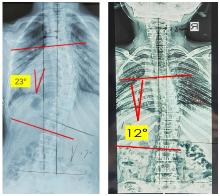
Figure 1
Case 1"
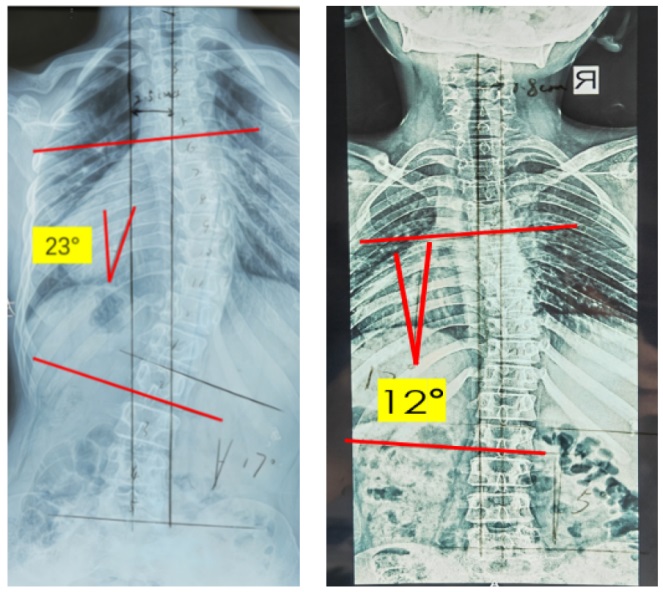
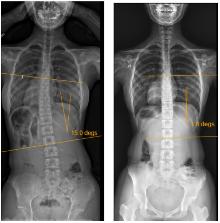
Figure 2
Case 2"
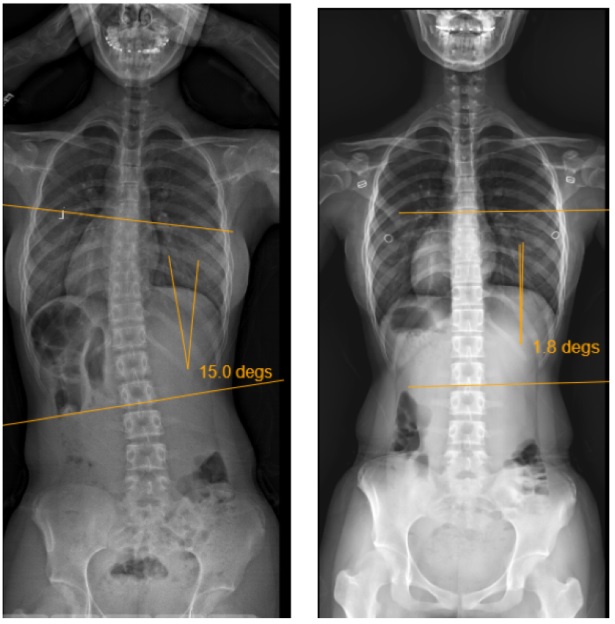
Table 4
Comparison of SRS-22 score between two groups pre- and post- treatment"
| 变量 | 组别 | n | 测试 | t值 | P值 | |
|---|---|---|---|---|---|---|
| 功能 | 对照组 | 20 | 前测 | 4.29±0.46 | -0.758 | 0.453 |
| 后测 | 4.40±0.50 | |||||
| 试验组 | 21 | 前测 | 4.19±0.68 | -0.970 | 0.338 | |
| 后测 | 4.38±0.59 | |||||
| 治疗前两组均值差 | -0.10±0.58 | -0.552 | 0.579 | |||
| 治疗后两组均值差 | -0.02±0.55 | -0.120 | 0.907 | |||
| 疼痛 | 对照组 | 20 | 前测 | 4.19±0.60 | -0.647 | 0.521 |
| 后测 | 4.30±0.47 | |||||
| 试验组 | 21 | 前测 | 4.14±0.79 | -0.940 | 0.354 | |
| 后测 | 4.33±0.48 | |||||
| 治疗前两组均值差 | -0.05±0.70 | -0.227 | 0.821 | |||
| 治疗后两组均值差 | 0.03±0.48 | 0.202 | 0.841 | |||
| 自我感觉 | 对照组 | 20 | 前测 | 4.48±0.68 | -1.534 | 0.134 |
| 后测 | 4.75±0.44 | |||||
| 试验组 | 21 | 前测 | 4.67±0.48 | -1.041 | 0.304 | |
| 后测 | 4.81±0.40 | |||||
| 治疗前两组均值差 | 0.19±0.59 | 1.038 | 0.306 | |||
| 治疗后两组均值差 | 0.06±0.42 | 0.457 | 0.650 | |||
| 心理健康 | 对照组 | 20 | 前测 | 4.29±0.90 | 0.890 | 0.388 |
| 后测 | 4.10±0.31 | |||||
| 试验组 | 21 | 前测 | 4.10±0.62 | -2.161 | 0.037 | |
| 后测 | 4.48±0.51 | |||||
| 治疗前两组均值差 | 0.19±0.77 | 0.790 | 0.434 | |||
| 治疗后两组均值差 | 0.38±0.42 | 2.873 | 0.007 | |||
| 满意度 | 对照组 | 4.20±0.52 | -4.194 | < 0.001 | ||
| 试验组 | 4.81±0.40 |
| [1] |
Veis Karami M, Aboutorabi A, Ebrahimzadeh K, et al. The effect of orthotic interventions on balance performance in adolescent idiopathic scoliosis: a systematic literature review[J]. Assist Technol, 2020, 32(5): 260-267.
doi: 10.1080/10400435.2018.1539419 pmid: 30601092 |
| [2] | 王彦辉, 陈学明, 袁鑫, 等. 北京市通州区中学生脊柱侧凸流行病学调查[J]. 中国脊柱脊髓杂志, 2018, 28(7): 667-669. |
| Wang Y H, Chen X M, Yuan X, et al. The epidemiological investigation of adolescent scoliosis in Beijing Tongzhou district[J]. Chin J Spine Spinal Cord, 2018, 28(7): 667-669. | |
| [3] | 杜青, 励建安, 周璇, 等. 青少年特发性脊柱侧凸康复治疗卫生经济学初步研究[J]. 中国康复医学杂志, 2013, 28(7): 615-618. |
| Du Q, Li J A, Zhou X, et al. A preliminary study of the cost-effect evaluation on rehabilitation in patients with adolescent idiopathic scoliosis[J]. Chin J Rehabil Med, 2013, 28(7): 615-618. | |
| [4] | 黄剑平, 姜乃夫, 李沅衡, 等. 高密度表面肌电对青少年特发性脊柱侧凸患者竖脊肌协同活动的评估[J]. 中国脊柱脊髓杂志, 2021, 31(6): 502-509, 519. |
| Huang J P, Jiang N F, Li Y H, et al. Assessment of coordinated activity of the erector spinae muscles based on high-density surface electromyogram in adolescent idiopathic scoliosis patients[J]. Chin J Spine Spinal Cord, 2021, 31(6): 502-509, 519. | |
| [5] | 杜青, 周璇, 励建安, 等. 青少年特发性脊柱侧凸腰腹部肌群表面肌电信号特征研究[J]. 中华物理医学与康复杂志, 2013, 35(8): 612-616. |
| Du Q, Zhou X, Li J A, et al. Lumbo-abdominal muscle activity while standing in adolescents with idiopathic scoliosis[J]. Chin J Phys Med Rehabil, 2013, 35(8): 612-616. | |
| [6] |
Zetterberg C, Bjork R, Ortengren R, et al. Electromyography of the paravertebral muscles in idiopathic scoliosis: measurements of amplitude and spectral changes under load[J]. Acta Orthop Scand, 1984, 55(3): 304-309.
doi: 10.3109/17453678408992362 pmid: 6741480 |
| [7] | 袁望舒, 陈丽霞, 沈建雄, 等. 青少年特发性脊柱侧凸患者顶椎椎旁肌表面肌电信号与Cobb角及轴向躯干旋转角的相关性[J]. 中国组织工程研究, 2019, 23(24): 3824-3828. |
| Yuan W S, Chen L X, Shen J X, et al. Correlation of surface electromyogram signals of the apex vertebral paraspinal muscle with Cobb angle and axial trunk rotation angle in adolescent idiopathic scoliosis patients[J]. Chin J Tissue Eng Res, 2019, 23(24): 3824-3828. | |
| [8] |
Marti C L, Glassman S D, Knott P T, et al. Scoliosis Research Society members attitudes towards physical therapy and physiotherapeutic scoliosis specific exercises for adolescent idiopathic scoliosis[J]. Scoliosis, 2015, 10: 16.
doi: 10.1186/s13013-015-0041-z pmid: 26056527 |
| [9] |
Yuan W, Shi W, Chen L, et al. Digital physiotherapeutic scoliosis-specific exercises for adolescent idiopathic scoliosis: a randomized clinical trial[J]. JAMA Netw Open, 2025, 8(2): e2459929.
doi: 10.1001/jamanetworkopen.2024.59929 |
| [10] |
Baumann A N, Orellana K, Oleson C J, et al. The impact of patient scoliosis-specific exercises for adolescent idiopathic scoliosis: a systematic review and meta-analysis of randomized controlled trials with subgroup analysis using observational studies[J]. Spine Deform, 2024, 12(3): 545-559.
doi: 10.1007/s43390-023-00810-x pmid: 38243155 |
| [11] | Karavidas N, Iakovidis P, Chatziprodromidou I, et al. Physiotherapeutic scoliosis-specific exercises (PSSE-Schroth) can reduce the risk for progression during early growth in curves below 25°: prospective control study[J]. Eur J Phys Rehabil Med, 2024, 60(2): 331-339. |
| [12] |
Ma K, Wang C, Huang Y, et al. The effects of physiotherapeutic scoliosis-specific exercise on idiopathic scoliosis in children and adolescents: a systematic review and meta-analysis[J]. Physiotherapy, 2023, 121: 46-57.
doi: 10.1016/j.physio.2023.07.005 pmid: 37820462 |
| [13] | Białek M, Piorun S, Białek-Kucharska E, et al. Comparison of objective and subjective indicators in patients with idiopathic scoliosis undergoing PSSE therapy: retrospective observational[J]. Medicina (Kaunas), 2026, 62(4): 652. |
| [14] | Schreiber S, Whibley D, Somers E C. Schroth physiotherapeutic scoliosis-specific exercise (PSSE) trials: systematic review of methods and recommendations for future research[J]. Children (Basel), 2023, 10(6): 954. |
| [15] | 连昊. 弹力带抗阻训练结合旋转成角呼吸法对中轻度特发性脊柱侧凸患者治疗的实验研究[D]. 太原: 山西大学, 2023. |
| [16] | 刘文洁, 梁佳佳, 孙姣姣, 等. 椎旁肌电刺激治疗青少年特发性脊柱侧凸的研究进展[J]. 中国脊柱脊髓杂志, 2024, 34(12): 1315-1321. |
| Liu W J, Liang J J, Sun J J, et al. Research progress in the treatment of adolescent idiopathic scoliosis by paravertebral muscle electrical stimulation[J]. Chin J Spine Spinal Cord, 2024, 34(12): 1315-1321. | |
| [17] |
Hresko M T. Clinical practice. Idiopathic scoliosis in adolescents[J]. N Engl J Med, 2013, 368(9): 834-841.
doi: 10.1056/NEJMcp1209063 |
| [18] |
Schmid A B, Dyer L, Böni T, et al. Paraspinal muscle activity during symmetrical and asymmetrical weight training in idiopathic scoliosis[J]. J Sport Rehabil, 2010, 19(3): 315-327.
doi: 10.1123/jsr.19.3.315 pmid: 20811080 |
| [19] |
Cheung J, Veldhuizen A G, Halberts J P, et al. Geometric and electromyographic assessments in the evaluation of curve progression in idiopathic scoliosis[J]. Eur Spine J, 2005, 14(2): 130-137.
doi: 10.1007/s00586-004-0780-7 pmid: 15368104 |
| [20] | Cassidy J, Brandell B, Nykoliation J, et al. The role of paraspinal muscles in the pathogenesis of idiopathic scoliosis: a preliminary EMG study[J]. J Can Chiropr Assoc, 1987, 31(4): 179-184. |
| [21] | Kwok G, Yip J, Cheung M C, et al. Evaluation of myoelectric activity of paraspinal muscles in adolescents with idiopathic scoliosis during habitual standing and sitting[J]. Biomed Res Int, 2015, 2015: 958450. |
| [22] |
Wang Y, Wang S, Gu M, et al. Paraspinal muscles activities in S-shaped adolescent idiopathic scoliosis during physiotherapeutic scoliosis specific exercise: a case-control study[J]. BMC Musculoskelet Disord, 2025, 26(1): 167.
doi: 10.1186/s12891-025-08423-3 |
| [23] |
Cheung J, Veldhuizen A G, Halberts J P, et al. Geometric and electromyographic assessments in the evaluation of curve progression in idiopathic scoliosis[J]. Spine (Phila Pa 1976), 2006, 31(3): 322-329.
pmid: 16449906 |
| [24] |
Fan Y, To M K T, Yeung E H K, et al. Electromyographic discrepancy in paravertebral muscle activity predicts early curve progression of untreated adolescent idiopathic scoliosis[J]. Asian Spine J, 2023, 17(5): 922-932.
doi: 10.31616/asj.2023.0199 pmid: 37690987 |
| [25] |
Wilson J M, Loenneke J P, Jo E, et al. The effects of endurance, strength, and power training on muscle fiber type shifting[J]. J Strength Cond Res, 2012, 26(6): 1724-1729.
doi: 10.1519/JSC.0b013e318234eb6f pmid: 21912291 |
| [26] |
Stetkarova I, Zamecnik J, Bocek V, et al. Electrophysiological and histological changes of paraspinal muscles in adolescent idiopathic scoliosis[J]. Eur Spine J, 2016, 25(10): 3146-3153.
pmid: 27246349 |
| [27] | 李祁伟, 周永德, 吉士俊. 实验性脊柱侧弯椎旁肌肌纤维型分布的观察[J]. 中国医科大学学报, 2002, 31(z1): 16-18. |
| Li Q W, Zhou Y D, Ji S J. Effect of experimental scoliosis on the distribution of muscular fiber types in paravertebral muscles[J]. J China Med Univ, 2002, 31(z1): 16-18. | |
| [28] |
Zhang T, Li B, Sui W, et al. The neurogenic abnormalities of paraspinal muscles lead to asymmetry of fibre types in adolescent idiopathic scoliosis[J]. J Cell Mol Med, 2025, 29(10): e70619.
doi: 10.1111/jcmm.v29.10 |
| [29] | Wang Y, Pessin J E. Mechanisms for fiber-type specificity of skeletal muscle atrophy[J]. Curr Opin Clin Nutr Metab Care, 2013, 16(3): 243-250. |
| [30] | 吴亮, 邱勇, 王斌, 等. 特发性脊柱侧凸患者两侧椎旁肌中肌梭与运动终板病理学变化的对比研究[J]. 中国脊柱脊髓杂志, 2008, 18(3): 222-226. |
| Wu L, Qiu Y, Wang B, et al. Comparison of pathological changes of muscle spindle and motor end-plate in bilateral paravertebral muscle in adolescent idiopathic scoliosis[J]. Chin J Spine Spinal Cord, 2008, 18(3): 222-226. | |
| [31] | Peng Y, Wang S R, Qiu G X, et al. Research progress on the etiology and pathogenesis of adolescent idiopathic scoliosis[J]. Chin Med J (Engl), 2020, 133(4): 483-493. |
| [32] |
Liang R, Yip J, Fan Y, et al. Electromyographic analysis of paraspinal muscles of scoliosis patients using machine learning approaches[J]. Int J Environ Res Public Health, 2022, 19(3): 1177.
doi: 10.3390/ijerph19031177 |
| [33] | 王楚怀, 许轶, 梁崎, 等. 青少年特发性脊柱侧弯症患者椎旁肌表面肌电信号测试方法选择与比较[J]. 中华物理医学与康复杂志, 2009, 31(11): 753-755. |
| Wang C H, Xu Y, Liang Q, et al. A comparison of surface electromyographic signals recorded from the paraspinal muscles of adolescents with idiopathic scoliosis during three loading tests[J]. Chin J Phys Med Rehabil, 2009, 31(11): 753-755. | |
| [34] | Haksever B, Soylu C, Demir D, et al. Unraveling the muscle activation equation: 3D scoliosis-specific exercises and muscle response in adolescent idiopathic scoliosis[J]. Appl Sci (Basel), 2024, 14(16): 6984. |
| [35] | 张娟娟, 蒋楠楠, 吴亚军, 等. Schroth疗法联合核心力量训练改善轻度青少年特发性脊柱侧凸患者的侧凸角度[J]. 中国组织工程研究, 2025, 29(27): 5876-5882. |
| Zhang J J, Jiang N N, Wu Y J, et al. Schroth therapy combined with core strength training improves scoliosis angle in patients with mild adolescent idiopathic scoliosis[J]. Chin J Tissue Eng Res, 2025, 29(27): 5876-5882. | |
| [36] | 陈阳, 王洁, 朱源棚, 等. Schroth疗法治疗青少年特发性脊柱侧凸的meta分析[J]. 中华骨科杂志, 2025, 45(7): 429-435. |
| Chen Y, Wang J, Zhu Y P, et al. Schroth therapy for adolescent idiopathic scoliosis: a meta-analysis[J]. Chin J Orthop, 2025, 45(7): 429-435. | |
| [37] |
聂丹宁, 史曙生, 陶昱如. 本体感觉神经肌肉促进技术联合螺旋稳定肌肉链训练治疗青少年特发性脊柱侧弯的临床效果研究[J]. 中国全科医学, 2025, 28(24): 3032-3042.
doi: 10.12114/j.issn.1007-9572.2024.0562 |
| Nie D N, Shi S S, Tao Y R. Clinical effect of proprioceptive neuromuscular facilitation technique combined with spiral stabilizing muscle chain training in the treatment of adolescent idiopathic scoliosis[J]. Chin Gen Pract, 2025, 28(24): 3032-3042. | |
| [38] | 王孙成. 通督调脊推拿术配合Schroth脊柱矫正疗法治疗青少年特发性脊柱侧弯45例[J]. 浙江中医杂志, 2025, 60(6): 545-546. |
| Wang S C. Treatment of 45 cases of adolescent idiopathic scoliosis with Tongdu Tiaoji massage combined with Schroth spinal correction therapy[J]. Zhejiang J Tradit Chin Med, 2025, 60(6): 545-546. | |
| [39] | 曾红梅, 罗霄, 徐洋, 等. 中医正骨手法结合施罗斯训练对青少年特发性脊柱侧弯的临床效果观察[J]. 中医康复, 2025, 2(6): 30-34. |
| Zeng H M, Luo X, Xu Y, et al. The therapeutic effect of TCM bone-setting techniques combined with Schroth training on adolescent idiopathic scoliosis[J]. Tradit Chin Med Rehabil, 2025, 2(6): 30-34. | |
| [40] | 孙岩, 张雅萍, 孙运强, 等. Schroth康复锻炼计划对特发性脊柱侧凸青少年患者脊柱和足部的矫正效果[J]. 颈腰痛杂志, 2024, 45(1): 87-91. |
| Sun Y, Zhang Y P, Sun Y Q, et al. Effect of Schroth rehabilitation exercise program on alignment of spine and foot in adolescent patients with idiopathic scoliosis[J]. J Cervicodynia Lumbodynia, 2024, 45(1): 87-91. | |
| [41] | 王开乐, 周佳华, 李佳佳, 等. 核心肌群训练纠正轻度青少年特发性脊柱侧弯[J]. 中国矫形外科杂志, 2024, 32(17): 1613-1617. |
| Wang K L, Zhou J H, Li J J, et al. Core muscle training to correct mild adolescent idiopathic scoliosis[J]. Orthop J China, 2024, 32(17): 1613-1617. | |
| [42] | Tsai Y T, Leong C P, Huang Y C, et al. The electromyographic responses of paraspinal muscles during isokinetic exercise in adolescents with idiopathic scoliosis with a Cobb's angle less than fifty degrees[J]. Chang Gung Med J, 2010, 33(5): 540-550. |
| [43] |
Becker L, Li Z, Wang Z, et al. Adolescent idiopathic scoliosis is associated with muscle area asymmetries in the lumbar spine[J]. Eur Spine J, 2023, 32(11): 3979-3986.
doi: 10.1007/s00586-023-07921-z pmid: 37698695 |
| [1] | Wei Tongtong, Tian Yifan, Chen Ting, Yao Qi, Hu Jianmin. Application of ICF in visual impairment rehabilitation: a scoping review [J]. Chinese Journal of Rehabilitation Theory and Practice, 2026, 32(9): 1025-1032. |
| [2] | Chi Qianqian, Zhang Xiaonian, Zhu Xiaomin, Sun Wanyue, Zhang Xin, Zhou Jin, Bu Hongwei, Zhai Lei, Zhang Xin, Ling Zirui, Chen Hongyu. Effect of standardized rehabilitation unit on traumatic brain injury [J]. Chinese Journal of Rehabilitation Theory and Practice, 2026, 32(9): 1033-1040. |
| [3] | Feng Xiaojuan, Huang Fubiao, Li Dongyue, Zhou Mingyi, Niu Yuxuan, Ismaili McGee Pireti, Wang Xixian, Wang Zile. Development and feasibility study of a self-stabilizing home-based functional interactive training device [J]. Chinese Journal of Rehabilitation Theory and Practice, 2026, 32(9): 1068-1077. |
| [4] | Zhou Huiling, Zeng Jiayan, Chen Bing. Quality of life among vocational rehabilitation patients with mild work-related disability and its association with return-to-work outcomes [J]. Chinese Journal of Rehabilitation Theory and Practice, 2026, 32(9): 1078-1086. |
| [5] | Guo Xuxia, Yu Hengrui, Lu Yucheng, Yang Sichuang, Long Yu, Li Jiawei, Chen Lin, Nong Feiyu, Long Yaobin. An explainable artificial intelligence-driven motor rehabilitation assessment system based on perception-cognition decoupling: design and validation [J]. Chinese Journal of Rehabilitation Theory and Practice, 2026, 32(9): 1108-1116. |
| [6] | Youth Working Committee of Chinese Association of Rehabilitation Medicine, Lymphedema Expert Committee of Peripheral Vascular Committee of Chinese Society of Microcirculation, Integrated Nursing Professional Committee for Tumor Rehabilitation of Chinese Anti-Cancer Association, Community Rehabilitation Working Committee of Chinese Association of Rehabilitation Medicine. Chinese expert consensus on rehabilitation and management of axillary web syndrome following breast cancer surgery (2025) [J]. Chinese Journal of Rehabilitation Theory and Practice, 2026, 32(8): 869-881. |
| [7] | Youth Working Committee of Chinese Association of Rehabilitation Medicine, Lymphedema Expert Committee of Peripheral Vascular Committee of Chinese Society of Microcirculation, Integrated Nursing Professional Committee for Tumor Rehabilitation of Chinese Anti-Cancer Association. Chinese expert consensus on identification and diagnostic criteria for axillary web syndrome after breast cancer surgery [J]. Chinese Journal of Rehabilitation Theory and Practice, 2026, 32(8): 882-891. |
| [8] | Liang Yanhua, Zhang Tong, Zhang Qi, Zhou Tiantian, Zhang Yanqing, Yue Qing, Li Sijia. Effect of rehabilitation robot training on abdominal muscle thickness and balance ability in children with hemiplegia [J]. Chinese Journal of Rehabilitation Theory and Practice, 2026, 32(8): 927-937. |
| [9] | Tian Jingxiao, Ai Jiaming, Min Hongwei, Zhao Kecong, Zhang Baocui, Jiang Hong, Yang Wei, Liu Jun'e. Formulation and initial validation of a daily goal-management-based exercise intervention for total knee arthroplasty patients [J]. Chinese Journal of Rehabilitation Theory and Practice, 2026, 32(8): 959-967. |
| [10] | Liu Hua, Ma Xin, Li Jing, Wang Liyuan, Wang Li. Comparison master's training programs in sports rehabilitation based on rehabilitation competency framework [J]. Chinese Journal of Rehabilitation Theory and Practice, 2026, 32(8): 984-992. |
| [11] | Li Jinmeng, Liu Junna, Chen Qiang, Bi Hongyan. Application of telemedicine, wearables and artificial intelligence in pulmonary rehabilitation for chronic obstructive pulmonary disease from 2011 to 2025: a bibliometric analysis [J]. Chinese Journal of Rehabilitation Theory and Practice, 2026, 32(7): 829-840. |
| [12] | Ma Ying, Ren Jun, Wang Shoujian, Zhou Xin, He Tianxiang, Kong Lingjun, Fang Min. Development and preliminary internal validation of a prediction model for brace treatment failure in adolescent idiopathic scoliosis using pretreatment and initial brace-fitting information [J]. Chinese Journal of Rehabilitation Theory and Practice, 2026, 32(7): 850-860. |
| [13] | Zhang Yishan, Song Jiajia, Hou Tianyu, Meng Lijun. Ethical challenges and governance prospects in rehabilitation engineering [J]. Chinese Journal of Rehabilitation Theory and Practice, 2026, 32(7): 861-868. |
| [14] | LI Xinyuan, ZHENG Jiejiao, ZHANG Tingyu, WU Xuejiao, LIANG Xiaoxiao. Effect of intermittent theta burst stimulation on lower extremity motor function and balance function in stroke patients: a meta-analysis [J]. Chinese Journal of Rehabilitation Theory and Practice, 2026, 32(6): 631-644. |
| [15] | GUO Ziyang, CAO Ming. Researches on community-based rehabilitation for people with disabilities: a bibliometric analysis from 1987 to 2025 [J]. Chinese Journal of Rehabilitation Theory and Practice, 2026, 32(6): 665-676. |
| Viewed | ||||||
|
Full text |
|
|||||
|
Abstract |
|
|||||
|
||
