



Chinese Journal of Rehabilitation Theory and Practice ›› 2026, Vol. 32 ›› Issue (10): 1233-1240.doi: 10.3969/j.issn.1006-9771.2026.10.012
Meng Tingting1,2, He Han2( )
Received:2026-05-08
Revised:2026-08-19
Accepted:2026-08-19
Published:2026-10-25
Online:2026-10-23
Contact:
He Han
E-mail:important365@126.com
Supported by:CLC Number:
Meng Tingting, He Han. Cultivation pathway for postgraduate students in rehabilitation therapy under the orientation of talent demand[J]. Chinese Journal of Rehabilitation Theory and Practice, 2026, 32(10): 1233-1240.

Table 1
Rehabilitation positions recruiting"
| 岗位类型 | 在招岗位数 |
|---|---|
| 康复医师 | 2149 |
| 康复治疗师 | 1391 |
| 其他类型 | 16 |
| 有效样本数 | 3556 |
Table 2
Minimum educational requirement for recruiting rehabilitation therapists"
| 最低学历 | 在招岗位数 |
|---|---|
| 中专 | 14 |
| 大专 | 609 |
| 本科 | 557 |
| 硕士 | 91 |
| 博士 | 14 |
| 有效样本数 | 1285 |
Table 3
Minimum educational requirement for recruiting rehabilitation therapists in different types of hospitals"
| 最低学历要求 | 公立医院人数 | 民营医院人数 |
|---|---|---|
| 中专 | 1 | 8 |
| 大专 | 75 | 436 |
| 本科 | 284 | 215 |
| 硕士 | 71 | 15 |
| 博士 | 12 | 2 |
| 有效样本数 | 443 | 676 |
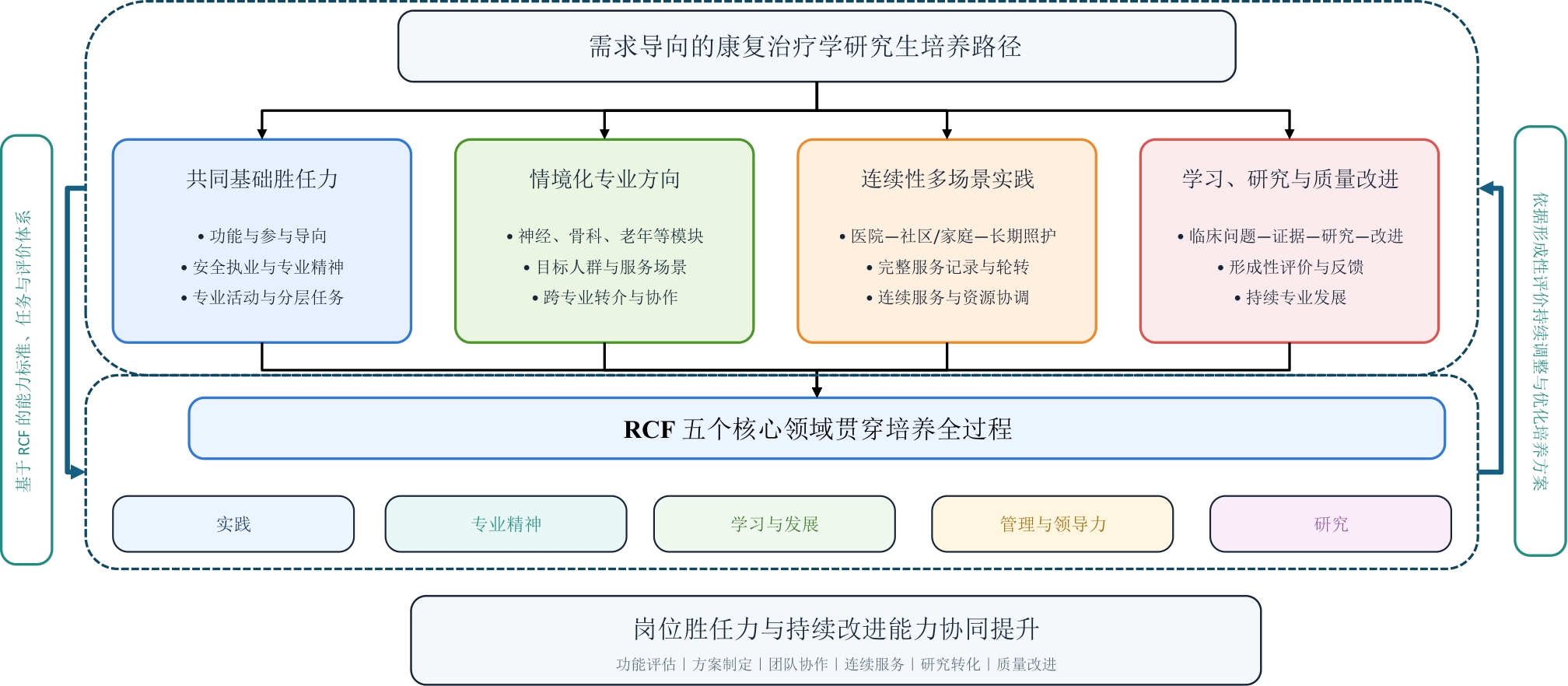
Figure 1
Demand-oriented framework of postgraduate education in rehabilitation therapy"
| [1] | 戴赢, 曹坤, 卢丽丽, 等. 区域联动的康复全病程管理体系构建与探讨[J]. 医院管理论坛, 2025, 42(11): 57-59. |
| Dai Y, Cao K, Lu L L, et al. Construction and exploration of a regionally linked full-course rehabilitation management system[J]. Hosp Manag Forum, 2025, 42(11): 57-59. | |
| [2] |
Katangwe T J. Breaking barriers to rehabilitation for children with disabilities in low and middle income countries: a call for multifaceted, context-specific action[J]. Dev Med Child Neurol, 2026, 68: 1334-1335.
doi: 10.1111/dmcn.v68.10 |
| [3] | 刘厚莲. 中国老年人口健康状况变动:基于第六次、第七次全国人口普查数据的分析[J]. 老龄科学研究, 2023, 11(2): 1-14. |
| Liu H L. An analysis on the health status of the elderly population in China: based on data from the 6th and 7th population census[J]. Sci Res Aging, 2023, 11(2): 1-14. | |
| [4] | 王晓芳, 蔡憐环, 李丽蓉, 等. 医疗护理员整体照护模式在康复专科医院的应用效果[J]. 中国医药科学, 2025, 15(21): 147-151. |
| Wang X F, Cai L H, Li L R, et al. Practice of integrated care model delivered by medical nursing assistants in a specialized rehabilitation hospital[J]. Chin Med Pharm, 2025, 15(21): 147-151. | |
| [5] | Skoumal M, Honegger M, Grund S, et al. Geriatric rehabilitation in Germany, Austria, and Switzerland (DACH region): a current state analysis[J]. [ahead of print]. Eur Geriatr Med, 2026. doi: 10.1007/s41999-026-01461-7. |
| [6] | 陶玉秀, 马茹兰, 冯霞. 数字孪生在远程康复中的应用前景[J]. 中国康复, 2026, 41(3): 177-181. |
| Tao Y X, Ma R L, Feng X. The application prospect of digital twin in telerehabilitation[J]. Chin J Rehabil, 2026, 41(3): 177-181. | |
| [7] | 顾薇. 高职教学融入健康教育的路径探索:基于《"健康中国2030"规划纲要》[J]. 辽宁高职学报, 2025, 27(9): 52-55. |
| Gu W. Exploration of the path of integrating health education into higher vocational teaching[J]. J Liaoning High Vocat, 2025, 27(9): 52-55. | |
| [8] | 国家卫生健康委员会. 国家卫生健康委关于印发"十四五"卫生健康人才发展规划的通知[A/OL]. (2022-08-15)[2026-06-11]. https://www.nhc.gov.cn/renshi/c100028/202208/de05282a6de94034808105701b898a8f.shtml. |
| [9] | 国家卫生健康委, 国家发展改革委, 教育部, 等. 关于印发加快推进康复医疗工作发展意见的通知[A/OL]. (2021-06-08)[2026-06-11]. https://www.gov.cn/zhengce/zhengceku/2021-06/17/content_5618767.htm. |
| [10] | 人力资源和社会保障部, 民政部, 国家卫生健康委, 等. 关于推进工伤康复事业高质量发展的指导意见[A/OL]. (2023-08-17)[2026-06-11]. https://www.gov.cn/zhengce/zhengceku/202311/content_6916432.htm. |
| [11] | 国家卫生健康委办公厅. 关于开展康复医疗服务试点工作的通知[A/OL]. (2021-10-21)[2026-06-11]. https://www.nhc.gov.cn/yzygj/c100068/202110/45f547d11f58401793da6e03d51a6a5f.shtml. |
| [12] |
Katz L W, Asiello J D, Packel A, et al. Applying the rehabilitation treatment specification system in rehabilitation: a scoping review[J]. Arch Phys Med Rehabil, 2026, 107(7): 1790-1801.
doi: 10.1016/j.apmr.2025.11.031 |
| [13] | Touhami D, Ryan R, Engeda E H, et al. Implementation strategies for rehabilitation services in health systems: an overview of systematic reviews[J]. Cochrane Database Syst Rev, 2026, 2(2): CD016324. |
| [14] | Flexman J A, Ng J, Campbell P A, et al. Improving access to dementia care through AI-powered cognitive rehabilitation therapy[J]. Alzheimers Dement, 2025, 21(S9): 110589. |
| [15] |
杨延砚, 邱卓英, 于博洋, 等. 基于世界卫生组织康复胜任力架构的康复医师胜任力调查[J]. 中国康复理论与实践, 2023, 29(11): 1241-1248.
doi: 10.3969/j.issn.1006-9771.2023.11.001 |
| Yang Y Y, Qiu Z Y, Yu B Y, et al. Survey of rehabilitation competency of Chinese rehabilitation physicians using WHO rehabilitation competency framework[J]. Chin J Rehabil Theory Pract, 2023, 29(11): 1241-1248. | |
| [16] | World Health Organization. Rehabilitation competency framework[M]. Geneva: World Health Organization, 2020. |
| [17] |
荣先凤, 李方晖, 谭嘉俐. 基于世界卫生组织康复胜任力架构建设运动康复专业[J]. 中国康复理论与实践, 2024, 30(6): 639-647.
doi: 10.3969/j.issn.1006-9771.2024.06.003 |
| Rong X F, Li F H, Tan J L. Construction of exercise rehabilitation specialty based on World Health Organization rehabilitation competency framework[J]. Chin J Rehabil Theory Pract, 2024, 30(6): 639-647. | |
| [18] | 卫生部. 关于印发《综合医院康复医学科基本标准(试行)》的通知[A/OL]. (2011-05-19)[2026-06-11]. https://www.nhc.gov.cn/zwgkzt/wsbysj/201105/51787.shtml. |
| [19] | 国家统计信息中心. 中国卫生健康统计年鉴[DB/OL]. (2026-04-03)[2026-06-11]. https://www.nhc.gov.cn/mohwsbwstjxxzx/tjtjnj/202604/155ab0f98dfd4b12874f08f828df1452.shtml. |
| [20] |
刘京宇, 杨延砚, 张元鸣飞, 等. 2023年度国家康复医学专业医疗服务与质量安全报告[J]. 中国康复理论与实践, 2025, 31(1): 1-20.
doi: 10.3969/j.issn.1006-9771.2025.01.001 |
| Liu J Y, Yang Y Y, Zhang Y M F, et al. 2023 national report on rehabilitation medicine services, quality and safety in medical care system[J]. Chin J Rehabil Theory Pract, 2025, 31(1): 1-20. | |
| [21] |
李新, 孙洁, 武亮, 等. 医体融合背景下康复治疗从业人员调查[J]. 中国康复理论与实践, 2020, 26(4): 487-492.
doi: 10.3969/j.issn.1006-9771.2020.04.018 |
| Li X, Sun J, Wu L, et al. Investigation on rehabilitation therapists practitioners under medical-exercise integration in China[J]. Chin J Rehabil Theory Pract, 2020, 26(4): 487-492. | |
| [22] | 卢迪迪. 康复机构从业人员现状及需求分析[J]. 中国康复理论与实践, 2019, 25(7): 859-864. |
| Lu D D. Current situation and demand analysis of rehabilitation personnel by stratified sampling[J]. Chin J Rehabil Theory Pract, 2019, 25(7): 859-864. | |
| [23] | 邹立瑜, 徐勤毅, 丁磊, 等. 医学技术专业学位研究生培养路径探索:以上海交通大学为例[J]. 中国高等医学教育, 2024(9): 80-83. |
| Zou L Y, Xu Q Y, Ding L, et al. Exploring the training pathways for professional-degree graduate students in medical technology: a case study of Shanghai Jiao Tong University[J]. China High Med Educ, 2024(9): 80-83. | |
| [24] |
曾斌, 郭霜, 叶海燕, 等. 基于世界卫生组织胜任力架构的康复治疗学本科实习生研究胜任力调查[J]. 中国康复理论与实践, 2025, 31(5): 548-552.
doi: 10.3969/j.issn.1006-9771.2025.05.007 |
| Zeng B, Guo S, Ye H Y, et al. Investigation for research competency of undergraduate interns in rehabilitation therapy using WHO rehabilitation competency framework[J]. Chin J Rehabil Theory Pract, 2025, 31(5): 548-552. | |
| [25] |
邱卓英, 郭键勋, 孙宏伟, 等. 世界卫生组织康复胜任力架构及其在康复领域的系统应用:理论架构、方法和应用领域[J]. 中国康复理论与实践, 2022, 28(3): 265-274.
doi: 10.3969/j.issn.1006-9771.2022.03.002 |
| Qiu Z Y, Kwok J K F, Sun H W, et al. Systematic implementation of world health organization rehabilitation competency framework in rehabilitation: conceptual framework, approaches and application[J]. Chin J Rehabil Theory Pract, 2022, 28(3): 265-274. | |
| [26] |
冯蕾, 吕军, 王晓茜, 等. 基于世界卫生组织康复胜任力架构探讨我国儿童康复治疗师胜任力和专业活动[J]. 中国康复理论与实践, 2024, 30(7): 752-759.
doi: 10.3969/j.issn.1006-9771.2024.07.002 |
| Feng L, Lü J, Wang X Q, et al. Competency and professional activities for Chinese pediatric rehabilitation therapists based on World Health Organization rehabilitation competency framework[J]. Chin J Rehabil Theory Pract, 2024, 30(7): 752-759. | |
| [27] |
Kendra G, Eric S, Colette W. Competencies in context: adapting the World Health Organization rehabilitation competency framework for entry-level physical therapy practice[J]. Arch Phys Med Rehabil, 2026, 107(2): 198-206.
doi: 10.1016/j.apmr.2025.06.008 |
| [28] |
陈岚卿, 吕军, 王晓茜, 等. 华东三省市儿童康复治疗师胜任力及专业活动研究[J]. 中国康复理论与实践, 2024, 30(7): 760-767.
doi: 10.3969/j.issn.1006-9771.2024.07.003 |
| Chen L Q, Lü J, Wang X Q, et al. Competency and professional activities of pediatric rehabilitation therapists in three provinces/cities of East China[J]. Chin J Rehabil Theory Pract, 2024, 30(7): 760-767. | |
| [29] | Beamish N F, Cunningham S, Footer C, et al. Entry-to-practice rehabilitation competencies and the rehabilitation competency framework: a gap analysis[J]. Arch Rehabil Res Clin Transl, 2024, 6(4): 100364. |
| [30] |
Tawiah A K, Stokes E, Wieler M, et al. Evaluating the importance of a core competency and capability framework for advanced practice physiotherapy: a cross-sectional survey[J]. Physiother Theory Pract, 2025, 41(4): 721-733.
doi: 10.1080/09593985.2024.2368593 |
| [31] |
唐乐天, 刘妤姝, 马可, 等. 基于世界卫生组织康复胜任力架构构建我国康复核心专业本科教学内容体系[J]. 中国康复理论与实践, 2023, 29(11): 1276-1285.
doi: 10.3969/j.issn.1006-9771.2023.11.005 |
| Tang L T, Liu Y S, Ma K, et al. Systematic construction of undergraduate curriculum for rehabilitation based on WHO rehabilitation competency framework[J]. Chin J Rehabil Theory Pract, 2023, 29(11): 1276-1285. | |
| [32] | 宫健伟, 王冉冉, 朱嘉卉, 等. "学科交叉融合"理念下康复医学研究生培养的思考与实践[J]. 中国继续医学教育, 2023, 15(23): 1-4. |
| Gong J W, Wang R R, Zhu J H, et al. Thinking and practice of postgraduate training in rehabilitation medicine under the concept of "interdisciplinary integration"[J]. Chin Contin Med Educ, 2023, 15(23): 1-4. | |
| [33] |
胡龙, 余航. 暑期小学期临床实践教学对康复治疗学专业学生共情能力培养的实践研究[J]. 中国康复理论与实践, 2026, 32(1): 117-124.
doi: 10.3969/j.issn.1006-9771.2026.01.013 |
| Hu L, Yu H. Effect of summer short-term clinical practice teaching on empathy ability in rehabilitation therapy students[J]. Chin J Rehabil Theory Pract, 2026, 32(1): 117-124. | |
| [34] |
陈健, 李哲恒, 王定宣. 基于世界卫生组织康复胜任力架构的中国运动康复专业人才培养现状分析[J]. 中国康复理论与实践, 2026, 32(1): 110-116.
doi: 10.3969/j.issn.1006-9771.2026.01.012 |
| Chen J, Li Z H, Wang D X. Current status of talent cultivation in sports rehabilitation in China: based on World Health Organization rehabilitation competency framework[J]. Chin J Rehabil Theory Pract, 2026, 32(1): 110-116. | |
| [35] | 刘杰, 陈倩, 吴宗辉, 等. 新质生产力赋能康复医学人才培养:何以可能,何以可为?[J]. 保健医学研究与实践, 2024, 21(5): 12-18. |
| Liu J, Chen Q, Wu Z H, et al. Empowerment of rehabilitation medicine talent cultivation by new-quality productive forces: possibilities and actions[J]. Health Med Res Prac, 2024, 21(5): 12-18. | |
| [36] | 夏宝妹, 陈寒昱, 李永, 等. 康复治疗专业生理学课程的教学改革思考[J]. 中国中医药现代远程教育, 2019, 17(2): 6-8. |
| Xia B M, Chen H Y, Li Y, et al. Thoughts on the teaching reform of physiological course in rehabilitation therapy[J]. Chin Mod Dist Educ Tradit Chin Med, 2019, 17(2): 6-8. | |
| [37] |
Zhou S, Zhang Y, Yang Y, et al. Implementing the WHO rehabilitation competency framework in undergraduate medical education: a context-specific adaptation for neurorehabilitation training[J]. Front Neurol, 2025, 16: 1704836.
doi: 10.3389/fneur.2025.1704836 |
| [38] |
Mocke M, Unger M, Hanekom S. Validation of the World Health Organization rehabilitation competency framework: an illustration using physiotherapy[J]. Clin Rehabil, 2025, 39(1): 88-98.
doi: 10.1177/02692155241300271 pmid: 39654493 |
| [1] | Liu Hua, Ma Xin, Li Jing, Wang Liyuan, Wang Li. Comparison master's training programs in sports rehabilitation based on rehabilitation competency framework [J]. Chinese Journal of Rehabilitation Theory and Practice, 2026, 32(8): 984-992. |
| [2] | WEI Yongli, DING Junhang, ZHOU Ping, YANG Xiaoman, WANG Zhen, YU Fujie, DUAN Fangfang, GUAN Enjing. Construction of undergraduate rehabilitation engineering curriculum system based on World Health Organization rehabilitation competency framework [J]. Chinese Journal of Rehabilitation Theory and Practice, 2026, 32(6): 731-738. |
| [3] | LIU Hua, LI Jing, WANG Liyuan, MA Xin, WANG Li. Application of presentation-assimilation-discussion-based classroom-community collaborative teaching in sports rehabilitation therapy under sports-medicine integration [J]. Chinese Journal of Rehabilitation Theory and Practice, 2026, 32(4): 482-487. |
| [4] | AN Le, QIN Xiaoxia, GU Bin, HU Guobing, TIAN Weiyi. A competency model for "dual-qualified" teachers in vocational undergraduate rehabilitation therapy programs based on the integration of rehabilitation competency framework and multi-source standards [J]. Chinese Journal of Rehabilitation Theory and Practice, 2026, 32(3): 258-269. |
| [5] | LIU Xia, ZHANG Yuanmin, GE Shuhui, LIU Jinmei, SUN Chenming, WANG Yuanhui, LIU Jing, LI Wenfu. Cultivation mode of rehabilitation therapy talents in local colleges and universities under the background of New Medicine [J]. Chinese Journal of Rehabilitation Theory and Practice, 2026, 32(3): 276-285. |
| [6] | Sports Rehabilitation Group, Committee of Rehabilitation Medicine Education, Chinese Association of Rehabilitation Medicine, QIAN Jinghua, LIAO Yuanpeng, WANG Lin, ZHANG Qiuxia, BAO Wenli, ZHANG Haifeng. Internship system for the undergraduate program in sports rehabilitation based on World Health Organization rehabilitation competency framework [J]. Chinese Journal of Rehabilitation Theory and Practice, 2026, 32(2): 241-248. |
| [7] | CHEN Jian, LI Zheheng, WANG Dingxuan. Current status of talent cultivation in sports rehabilitation in China: based on World Health Organization rehabilitation competency framework [J]. Chinese Journal of Rehabilitation Theory and Practice, 2026, 32(1): 110-116. |
| [8] | HU Long, YU Hang. Effect of summer short-term clinical practice teaching on empathy ability in rehabilitation therapy students [J]. Chinese Journal of Rehabilitation Theory and Practice, 2026, 32(1): 117-124. |
| [9] | LIANG Fei, CHEN Ximei, QI Jing, WANG Shurong, LIANG Yongsheng. Functioning, vocational competency and career development of college students with disabilities based on ICF and RCF [J]. Chinese Journal of Rehabilitation Theory and Practice, 2025, 31(8): 922-929. |
| [10] | DONG Yuanjun, LOU Xin, SUN Rui, WANG Wenshuai, LIU Xiaoqin, XIA Xue, YANG Yaru, WANG Zhongyan, QIU Zhuoying. Cultivating key competencies of teamwork and interprofessional practice for rehabilitation psychology professionals based on RCF [J]. Chinese Journal of Rehabilitation Theory and Practice, 2025, 31(8): 939-946. |
| [11] | CAO Jing, LIU Jing, ZHANG Xiaoyan, GAO Shaoyu. Construction of competency evaluation indicator system for special education teachers based on World Health Organization rehabilitation competency framework [J]. Chinese Journal of Rehabilitation Theory and Practice, 2025, 31(6): 621-627. |
| [12] | WU Aihong, ZHANG Qing, WU Jiaming, XIE Junxia, WU Dang. Construction of a competency-based and functioning-oriented training curriculum system for inclusive education teachers in primary and secondary schools [J]. Chinese Journal of Rehabilitation Theory and Practice, 2025, 31(5): 539-547. |
| [13] | ZENG Bin, GUO Shuang, YE Haiyan, YE Jinqun, XU Zihan, XU Guangqing, ZHANG Lei. Investigation for research competency of undergraduate interns in rehabilitation therapy using WHO rehabilitation competency framework [J]. Chinese Journal of Rehabilitation Theory and Practice, 2025, 31(5): 548-552. |
| [14] | ZHANG Qing, WU Jiaming, JIA Wenrong, YU Fayou. Competency framework and contents for primary and secondary school teachers in inclusive education settings based on RCF and ICF [J]. Chinese Journal of Rehabilitation Theory and Practice, 2025, 31(4): 406-414. |
| [15] | GUAN Shan, SUN Meili, GUAN Yi, XUE Yifan, ZHONG Yuliang⁴, LI Xinqin. Developing a curriculum framework for vocational competency in college students with disabilities: based on RCF and ICF [J]. Chinese Journal of Rehabilitation Theory and Practice, 2025, 31(4): 415-422. |
| Viewed | ||||||
|
Full text |
|
|||||
|
Abstract |
|
|||||
|
||
