



《Chinese Journal of Rehabilitation Theory and Practice》 ›› 2022, Vol. 28 ›› Issue (1): 38-43.doi: 10.3969/j.issn.1006-9771.2022.01.006
Previous Articles Next Articles
WANG Ya'nan1,2,ZHANG Tong1,2( ),DU Xuejing1,2,ZHU Xiaomin1,2,LIU Yuanmin1,2
Received:2021-11-08
Revised:2021-12-02
Published:2022-01-25
Online:2022-02-11
Contact:
ZHANG Tong
E-mail:zt61611@sohu.com
CLC Number:
WANG Ya'nan,ZHANG Tong,DU Xuejing,ZHU Xiaomin,LIU Yuanmin. Correlation between gait parameters and balance in stroke hemiplegic patients[J]. 《Chinese Journal of Rehabilitation Theory and Practice》, 2022, 28(1): 38-43.
"
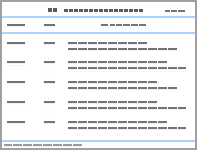
| 项目 | Ⅳ期组 (n = 38) | Ⅴ期组 (n = 38) | t/χ2值 | P值 |
|---|---|---|---|---|
| 性别(男/女)/n | 22/16 | 20/18 | 0.213 | 0.645 |
| 年龄/岁 | 39.45±7.50 | 40.66±10.07 | -0.594 | 0.554 |
| 体质量/kg | 67.97±8.80 | 70.18±5.59 | -2.189 | 0.195 |
| 身高/m | 1.71±0.08 | 1.73±0.06 | -1.507 | 0.136 |
| BMI/kg·m-2 | 23.10±1.22 | 23.31±1.36 | -0.735 | 0.464 |
| 性质(出血/梗死)/n | 10/28 | 16/22 | 2.105 | 0.147 |
| 偏瘫侧(左/右)/n | 16/22 | 19/19 | 0.477 | 0.490 |
"
| 项目 | Ⅳ期组(n = 38) | Ⅴ期组(n = 38) | t值 | P值 | |
|---|---|---|---|---|---|
| 平衡检测仪 | 前后/mm | 89.4±23.7 | 113.9±19.6 | 4.908 | < 0.001 |
| 内外/mm | 118.3±26.2 | 152.6±19.1 | 4.834 | < 0.001 | |
| 内外比/% | 1.4±0.3 | 1.1±0.1 | -4.088 | < 0.001 | |
| SEBT患侧支撑 | 前/% | 41.4±10.7 | 53.9±7.7 | 5.937 | < 0.001 |
| 后内/% | 56.9±11.8 | 69.9±8.1 | 5.585 | < 0.001 | |
| 后外/% | 46.4±12.6 | 59.1±10.0 | 4.876 | < 0.001 | |
| SEBT健侧支撑 | 前/% | 52.5±8.3 | 63.3±6.8 | 6.206 | < 0.001 |
| 后内/% | 70.5±11.2 | 79.5±8.6 | 3.937 | < 0.001 | |
| 后外/% | 57.1±10.6 | 68.8±12.7 | 4.345 | < 0.001 | |
| 步态分析 | 步速/cm·s-1 | 45.7±17.5 | 73.5±19.1 | 6.630 | < 0.001 |
| 步频/min-1 | 74.5±19.4 | 96.8±14.6 | 5.655 | < 0.001 | |
| 步长RI | 1.22±0.11 | 1.07±0.06 | -7.422 | < 0.001 | |
| 支撑期RI | 0.94±0.11 | 0.98±0.07 | 2.322 | 0.023 | |
| 摆动期RI | 1.16±0.34 | 1.02±0.10 | -2.268 | 0.026 | |
| 髋屈曲RI | 0.68±0.15 | 0.87±0.14 | 6.025 | < 0.001 | |
| 膝屈曲RI | 0.61±0.21 | 0.79±0.15 | 4.318 | < 0.001 | |
"
| 项目 | Ⅳ期组(n = 38) | Ⅴ期组(n = 38) | |||||||||||||||
|---|---|---|---|---|---|---|---|---|---|---|---|---|---|---|---|---|---|
| 步速 | 步频 | 步长RI | 支撑期RI | 摆动期RI | 髋关节屈曲RI | 膝关节屈曲RI | 步速 | 步频 | 步长RI | 支撑期RI | 摆动期RI | 髋关节屈曲RI | 膝关节屈曲RI | ||||
| 平衡检测 仪 | 前后 | r | 0.631 | 0.504 | -0.273 | 0.028 | -0.335 | 0.575 | 0.666 | 0.608 | 0.357 | -0.285 | -0.095 | 0.064 | 0.369 | 0.523 | |
| P | < 0.001 | 0.001 | 0.098 | 0.867 | 0.040 | < 0.001 | < 0.001 | < 0.001 | 0.028 | 0.083 | 0.569 | 0.701 | 0.023 | 0.001 | |||
| 内外 | r | 0.673 | 0.484 | -0.313 | -0.010 | -0.297 | 0.545 | 0.674 | 0.657 | 0.317 | -0.356 | -0.245 | 0.288 | 0.222 | 0.124 | ||
| P | < 0.001 | 0.002 | 0.056 | 0.951 | 0.071 | < 0.001 | < 0.001 | < 0.001 | 0.053 | 0.028 | 0.139 | 0.079 | 0.181 | 0.457 | |||
| 内外 | r | -0.692 | -0.602 | 0.292 | -0.130 | 0.510 | -0.723 | -0.540 | -0.335 | -0.229 | 0.104 | -0.095 | 0.097 | -0.206 | -0.063 | ||
| 比 | P | < 0.001 | < 0.001 | 0.075 | 0.438 | 0.001 | < 0.001 | < 0.001 | 0.040 | 0.166 | 0.533 | 0.570 | 0.563 | 0.215 | 0.705 | ||
| SEBT 患侧支撑 | 前 | r | 0.775 | 0.656 | -0.503 | 0.296 | -0.445 | 0.726 | 0.506 | 0.825 | 0.638 | -0.147 | -0.112 | 0.161 | 0.145 | 0.422 | |
| P | < 0.001 | < 0.001 | 0.001 | 0.071 | 0.005 | < 0.001 | 0.001 | < 0.001 | < 0.001 | 0.379 | 0.503 | 0.334 | 0.385 | 0.008 | |||
| 后内 | r | 0.726 | 0.588 | -0.467 | 0.251 | -0.375 | 0.526 | 0.631 | 0.682 | 0.389 | -0.239 | -0.036 | 0.090 | 0.031 | 0.247 | ||
| P | < 0.001 | < 0.001 | 0.003 | 0.128 | 0.020 | 0.001 | < 0.001 | < 0.001 | 0.016 | 0.148 | 0.829 | 0.589 | 0.582 | 0.135 | |||
| 后外 | r | 0.740 | 0.644 | -0.542 | 0.235 | -0.361 | 0.606 | 0.509 | 0.658 | 0.408 | -0.260 | 0.061 | -0.103 | 0.126 | 0.329 | ||
| P | < 0.001 | < 0.001 | < 0.001 | 0.155 | 0.026 | < 0.001 | 0.001 | < 0.001 | 0.011 | 0.115 | 0.716 | 0.537 | 0.449 | 0.044 | |||
| SEBT 健侧支撑 | 前 | r | 0.740 | 0.596 | -0.579 | 0.364 | -0.330 | 0.578 | 0.326 | 0.630 | 0.578 | -0.039 | -0.122 | 0.181 | 0.046 | 0.348 | |
| P | < 0.001 | < 0.001 | < 0.001 | 0.025 | 0.043 | < 0.001 | 0.045 | < 0.001 | < 0.001 | 0.817 | 0.466 | 0.278 | 0.783 | 0.032 | |||
| 后内 | r | 0.727 | 0.539 | -0.503 | 0.211 | -0.260 | 0.537 | 0.525 | 0.674 | 0.432 | -0.284 | -0.144 | 0.189 | 0.023 | 0.345 | ||
| P | < 0.001 | < 0.001 | 0.001 | 0.204 | 0.114 | 0.001 | 0.001 | < 0.001 | 0.007 | 0.084 | 0.389 | 0.255 | 0.889 | 0.034 | |||
| 后外 | r | 0.756 | 0.670 | -0.613 | 0.109 | -0.294 | 0.683 | 0.531 | 0.832 | 0.401 | -0.330 | -0.106 | 0.080 | 0.121 | 0.333 | ||
| P | < 0.001 | < 0.001 | < 0.001 | 0.515 | 0.073 | < 0.001 | 0.001 | < 0.001 | 0.013 | 0.043 | 0.526 | 0.635 | 0.469 | 0.041 | |||
| [1] | 王陇德, 刘建民, 杨弋, 等. 我国脑卒中防治仍面临巨大挑战: «中国脑卒中防治报告 2018»概要[J]. 中国循环杂志, 2019, 34(2):105-119. |
| WANG L D, LIU J M, YANG Y, et al. The prevention and treatment of stroke still face huge challenges: Brief Report on Stroke Prevention and Treatment in China, 2018[J]. Chin Circ J, 2019, 34(2):105-119. | |
| [2] |
MIYATA K, HASEGAWA S, IWAMOTO H, et al. Comparing the measurement properties and relationship to gait speed recovery of the Mini-Balance Evaluation Systems Test and the Berg Balance Scale in ambulatory individuals with subacute stroke[J]. Phys Ther Res, 2020, 23(1):72-78.
doi: 10.1298/ptr.E10004 |
| [3] |
TERUI Y, SUTO E, KONNO Y, et al. Evaluation of gait symmetry using a triaxial accelerometer in stroke patients[J]. NeuroRehabilitation, 2018, 42(2):173-180.
doi: 10.3233/NRE-172235 |
| [4] |
SCHINKEL-IVY A, WONG J S, MANSFIELD A. Balance confidence is related to features of balance and gait in individuals with chronic stroke[J]. J Stroke Cerebrovasc Dis, 2017, 26(2):237-245.
doi: 10.1016/j.jstrokecerebrovasdis.2016.07.022 |
| [5] |
BOWER K, THILARAJAH S, PUA Y H, et al. Dynamic balance and instrumented gait variables are independent predictors of falls following stroke[J]. J Neuroeng Rehabil, 2019, 16(1):3.
doi: 10.1186/s12984-018-0478-4 |
| [6] |
BALABAN B, TOK F. Gait disturbances in patients with stroke[J]. PM R, 2014, 6(7):635-642.
doi: 10.1016/j.pmrj.2013.12.017 |
| [7] |
GOR-GARCÍA-FOGEDA M D, CANO DE LA CUERDA R, CARRATALÁ TEJADA M, et al. Observational gait assessments in people with neurological disorders: a systematic review[J]. Arch Phys Med Rehabil, 2016, 97(1):131-140.
doi: 10.1016/j.apmr.2015.07.018 |
| [8] |
FERRARELLO F, BIANCHI V A, BACCINI M, et al. Tools for observational gait analysis in patients with stroke: a systematic review[J]. Phys Ther, 2013, 93(12):1673-1685.
doi: 10.2522/ptj.20120344 |
| [9] |
ZUKOWSKI L A, FELD J A, GIULIANI C A, et al. Relationships between gait variability and ambulatory activity post stroke[J]. Top Stroke Rehabil, 2019, 26(4):255-260.
doi: 10.1080/10749357.2019.1591038 |
| [10] |
AN C M, SON Y L, PARK Y H, et al. Relationship between dynamic balance and spatiotemporal gait symmetry in hemiplegic patients with chronic stroke[J]. Hong Kong Physiother J, 2017, 37:19-24.
doi: 10.1016/j.hkpj.2017.01.002 |
| [11] | 刘郑, 倪朝民, 刘孟, 等. 脑卒中偏瘫患者步态与站立平衡功能间的相关性研究[J]. 中华物理医学与康复杂志, 2016, 38(4):250-253. |
| LIU Z, NI Z M, LIU M, et al. Relationships between gait and standing balance in hemiplegia[J]. Chin J Phys Med Rehabil, 2016, 38(4):250-253. | |
| [12] |
LEWEK M D, BRADLEY C E, WUTZKE C J, et al. The relationship between spatiotemporal gait asymmetry and balance in individuals with chronic stroke[J]. J Appl Biomech, 2014, 30(1):31-36.
doi: 10.1123/jab.2012-0208 |
| [13] | 恽晓平. 康复疗法评定学[M]. 北京: 华夏出版社, 2014: 239-282. |
| YUN X P. Evaluation and Assessment for Rehabilitation Therapy [M]. Beijing: Huaxia Publishing House, 2014: 239-282. | |
| [14] | 中华神经科学会, 中华神经外科学会. 各类脑血管疾病的诊断要点[J]. 中华神经科杂志, 1996, 29(6):379-380. |
| Chinese Society of Neurology, Chinese Neurosurgical Society. Diagnosis of cerebral vascular disease[J]. Chin J Neurol, 1996, 29(6):379-380. | |
| [15] | 宋桂芸, 张璞, 恽晓平, 等. 平衡仪静态平衡功能参数正常参考值的建立及权重分析[J]. 中国康复理论与实践, 2015, 21(9):1069-1073. |
| SONG G Y, ZHANG P, YUN X P, et al. Measure static balance function with Active Balancer EAB-100: reference values and clinical significance[J]. Chin J Rehabil Theory Pract, 2015, 21(9):1069-1073. | |
| [16] | 王亚囡, 张通, 刘元旻, 等. 星状伸展平衡测试评定脑卒中患者动态平衡的信度和效度[J]. 中国康复理论与实践, 2021, 27(5):604-608. |
| WANG Y N, ZHANG T, LIU Y M, et al. Validity and reliability of Star Excursion Balance Test for dynamic balance assessment in stroke patients[J]. Chin J Rehabil Theory Pract, 2021, 27(5):604-608. | |
| [17] |
GLAVE A P, DIDIER J J, WEATHERWAX J, et al. Testing postural stability: are the Star Excursion Balance Test and Biodex Balance System Limits of Stability Tests consistent?[J]. Gait Posture, 2016, 43:225-227.
doi: 10.1016/j.gaitpost.2015.09.028 |
| [18] | 王康玲, 黄杰斌, 吴文, 等. 一种便携式步态分析系统的信度研究[J]. 中国康复医学杂志, 2016, 31(7):761-764. |
| WANG K L, HUANG J B, WU W, et al. Research on reliability of parameters taken by a portable gait anaiysis system[J]. Chin J Rehabil Med, 2016, 31(7):761-764. | |
| [19] | 林英杰, 吴建宁, 林丽辉, 等. 人体步态对称性量化评价方法研究进展[J]. 中国生物医学工程学报, 2019, 38(2):222-232. |
| LIN Y J, WU J N, LIN L H, et al. Research progress of the quantitative evaluation methods in human gait symmetry[J]. Chin J Biomed Eng, 2019, 38(2):222-232. | |
| [20] |
LITTLE V L, PERRY L A, MERCADO M W V, et al. Gait asymmetry pattern following stroke determines acute response to locomotor task[J]. Gait Posture, 2020, 77:300-307.
doi: 10.1016/j.gaitpost.2020.02.016 |
| [21] | 朱晓敏, 刘元旻, 杜雪晶, 等. 功能性伸展测试临床应用进展[J]. 中国康复理论与实践, 2021, 27(5):583-587. |
| ZHU X M, LIU Y M, DU X J, et al. Advance in application of Functional Reach Test (review)[J]. Chin J Rehabil Theory Pract, 2021, 27(5):583-587. | |
| [22] | 纪树荣. 运动疗法技术学[M]. 北京: 华夏出版社, 2011: 330-346. |
| JI S R. The Technology of Therapeutic Exercises [M]. Beijing: Huaxia Publishing House, 2011: 330-346. | |
| [23] |
MENTIPLAY B F, WILLIAMS G, TAN D, et al. Gait velocity and joint power generation after stroke: contribution of strength and balance[J]. Am J Phys Med Rehabil, 2019, 98(10):841-849.
doi: 10.1097/PHM.0000000000001122 |
| [24] |
QUAN M, XUN P, WANG R, et al. Walking pace and the risk of stroke: a meta-analysis of prospective cohort studies[J]. J Sport Health Sci, 2020, 9(6):521-529.
doi: 10.1016/j.jshs.2019.09.005 |
| [25] |
LEE J, JEON J, LEE D, et al. Effect of trunk stabilization exercise on abdominal muscle thickness, balance and gait abilities of patients with hemiplegic stroke: a randomized controlled trial[J]. NeuroRehabilitation, 2020, 47(4):435-442.
doi: 10.3233/NRE-203133 |
| [26] |
HENDRICKSON J, PATTERSON K K, INNESS E L, et al. Relationship between asymmetry of quiet standing balance control and walking post-stroke[J]. Gait Posture, 2014, 39(1):177-181.
doi: 10.1016/j.gaitpost.2013.06.022 |
| [27] |
WONSETLER E C, BOWDEN M G. A systematic review of mechanisms of gait speed change post-stroke. Part 1: spatiotemporal parameters and asymmetry ratios[J]. Top Stroke Rehabil, 2017, 24(6):435-446.
doi: 10.1080/10749357.2017.1285746 |
| [28] | GUZIK A, DRUŻBICKI M, PRZYSADA G, et al. Relationships between walking velocity and distance and the symmetry of temporospatial parameters in chronic post-stroke subjects[J]. Acta Bioeng Biomech, 2017, 19(3):147-154. |
| [29] |
SZOPA A, DOMAGALSKA-SZOPA M, LASEK-BAL A, et al. The link between weight shift asymmetry and gait disturbances in chronic hemiparetic stroke patients[J]. Clin Interv Aging, 2017, 12:2055-2062.
doi: 10.2147/CIA |
| [30] |
OGIHARA H, TSUSHIMA E, KAMO T, et al. Kinematic gait asymmetry assessment using joint angle data in patients with chronic stroke-A normalized cross-correlation approach[J]. Gait Posture, 2020, 80:168-173.
doi: 10.1016/j.gaitpost.2020.05.042 |
| [31] |
SIJOBERT B, AZEVEDO C, PONTIER J, et al. A sensor-based multichannel FES system to control knee joint and reduce stance phase asymmetry in post-stroke gait[J]. Sensors (Basel), 2021, 21(6):2134.
doi: 10.3390/s21062134 |
| [1] | ZHU Lili, ZHAO Jiaxin, CHENG Xue, WANG Huijuan, CHEN Xiaoxia. Experiences and needs of stroke patients during rehabilitation: a qualitative meta-synthesis [J]. Chinese Journal of Rehabilitation Theory and Practice, 2026, 32(3): 286-293. |
| [2] | LIU Ping, ZHOU Nan, XUE Xiaojie, SHAO Weibo. Application of rehabilitation therapy techniques for post-stroke dysphagia: a bibliometric analysis [J]. Chinese Journal of Rehabilitation Theory and Practice, 2026, 32(3): 294-303. |
| [3] | YANG Ling, WANG Qinglei, WANG Jie, XU Wenjie, WANG Tong, GUO Chuan, QIAN Xue. Activation patterns and mechanism in the prefrontal cortex of post-stroke anxiety patients: a study using functional near-infrared spectroscopy [J]. Chinese Journal of Rehabilitation Theory and Practice, 2026, 32(3): 329-336. |
| [4] | LIANG Guanjun, XU Huanlan, ZHANG Hewei, ZHANG Dali, GU Qin, LI Mingdi. Changes in balance and lower limb biomechanics of spastic hemiplegia under different visual deprivation and task conditions [J]. Chinese Journal of Rehabilitation Theory and Practice, 2026, 32(3): 345-355. |
| [5] | ZHANG Liyin. Depression in Parkinson's disease and its association with cognition, balance and quality of life [J]. Chinese Journal of Rehabilitation Theory and Practice, 2026, 32(2): 174-180. |
| [6] | HAN Xuejiao, SHI Jipeng, WEI Jinpeng, ZHU Tianrui, XU Hongqi, HE Muhan. Association of physical activity and balance ability with disability: a cross-sectional study based on NHANES [J]. Chinese Journal of Rehabilitation Theory and Practice, 2026, 32(1): 1-12. |
| [7] | ZHANG Jihui, YI Longyue, YANG Yuanbin. Associated factors of balance dysfunction and its correlation with functional lower limb muscle strength in middle-aged and older adults: an analysis based on CHARLS database [J]. Chinese Journal of Rehabilitation Theory and Practice, 2026, 32(1): 13-22. |
| [8] | YUE Yuan, ZHANG Tong, LIU Yuanmin, WANG Ya'nan. Effect of lower extremity exoskeleton robots on balance and walking function of patients with post-stroke cerebellar ataxia [J]. Chinese Journal of Rehabilitation Theory and Practice, 2026, 32(1): 23-29. |
| [9] | WU Cheng, ZHANG Yunfeng, WANG Weining, YU Kewei, ZHANG Yanzheng, SHEN Jiarong, WU Yi. Effect of elbow-wrist functional orthosis on plantar pressure and balance function in stroke patients with hemiplegia [J]. Chinese Journal of Rehabilitation Theory and Practice, 2026, 32(1): 30-39. |
| [10] | ZHANG Junfeng, CHEN Hao, DU Yuzheng, LI Chen, YU Tao, YANG Yuanqing. Non-pharmacological management for post-stroke spasticity from 2004 to 2024: a bibliometric analysis [J]. Chinese Journal of Rehabilitation Theory and Practice, 2026, 32(1): 45-58. |
| [11] | GAO Kaixiang, LU Haitao. Research in neurorehabilitation from 2015 to 2024: a bibliometric analysis [J]. Chinese Journal of Rehabilitation Theory and Practice, 2026, 32(1): 59-68. |
| [12] | WEI Jingyi, WANG Xiaojing, WANG Ran, WEI Chen, MA Sai, LIU Xihua. Effect of acupuncture synchronized speech training on post-stroke motor aphasia [J]. Chinese Journal of Rehabilitation Theory and Practice, 2025, 31(9): 1000-1008. |
| [13] | WANG Xiaojing, WEI Jingyi, WEI Chen, WANG Ran, MA Sai, LIU Xihua. Effect of synchronous acupuncture and articulation training on spastic dysarthria after stroke [J]. Chinese Journal of Rehabilitation Theory and Practice, 2025, 31(9): 1009-1016. |
| [14] | ZHOU Xinyue, YE Ruixue, MA Yaqi, XU Ying, CAO Longyao, WANG Yulong. Researches on central post-stroke pain: a bibliometric analysis [J]. Chinese Journal of Rehabilitation Theory and Practice, 2025, 31(9): 1038-1049. |
| [15] | GAO Yunhan, HOU Shanshan, WANG Xinyu, ZHU Chongtian. Effect of brain-computer interface on upper limb motor dysfunction in stroke patients based on functional near-infrared spectroscopy [J]. Chinese Journal of Rehabilitation Theory and Practice, 2025, 31(9): 1066-1073. |
| Viewed | ||||||
|
Full text |
|
|||||
|
Abstract |
|
|||||
|
||
