



《Chinese Journal of Rehabilitation Theory and Practice》 ›› 2022, Vol. 28 ›› Issue (11): 1241-1246.doi: 10.3969/j.issn.1006-9771.2022.11.001
Previous Articles Next Articles
LI Jingyue1,2,ZHANG Tong1,2( ),WANG Ya'nan1,2,WANG Chen3
Received:2022-09-08
Revised:2022-10-20
Published:2022-11-25
Online:2022-12-20
Contact:
ZHANG Tong
E-mail:zt61611@sohu.com
Supported by:CLC Number:
LI Jingyue,ZHANG Tong,WANG Ya'nan,WANG Chen. Application of three-dimensional dynamic capture system and surface electromyography in upper extremity motor evaluation for stroke patients with hemiplegia[J]. 《Chinese Journal of Rehabilitation Theory and Practice》, 2022, 28(11): 1241-1246.
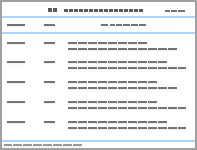
"
| 项目 | n | 性别(男/女)/n | 年龄/岁 | 利手(左/右)/n |
|---|---|---|---|---|
| 对照组 | 40 | 18/22 | 64.63±4.87 | 4/36 |
| 偏瘫组 | 40 | 23/17 | 64.80±5.88 | 2/38 |
| χ2/t值 | 1.251 | -0.145 | 0.721 | |
| P值 | 0.263 | 0.885 | 0.675 |
"
| 关节运动 | 对照组(n = 40) | 偏瘫组(n = 40) | t值 | P值 |
|---|---|---|---|---|
| 肩关节内旋 | 3.09±2.31 | 43.63±4.82 | -47.988 | < 0.001 |
| 肩关节屈曲 | -138.48±1.40 | -150.34±6.76 | 10.890 | < 0.001 |
| 肩关节内收 | 51.75±8.15 | 29.69±7.85 | 12.330 | < 0.001 |
| 肘关节伸展 | 145.67±0.94 | 152.50±8.23 | -3.648 | < 0.001 |
| 腕关节屈曲 | -33.83±16.11 | -40.14±6.05 | 2.321 | 0.024 |
| 腕关节尺偏 | 0.06±12.50 | 11.93±25.85 | -2.613 | 0.011 |
| 前臂旋前 | 48.47±2.47 | 40.02±7.94 | 6.426 | < 0.001 |
"
| 关节运动 | r值 | 95%CI | P值 |
|---|---|---|---|
| 肩关节内旋 | 0.133 | -0.198~0.410 | 0.415 |
| 肩关节屈曲 | -0.246 | -0.462~-0.014 | 0.126 |
| 肩关节内收 | -0.161 | -0.465~0.164 | 0.320 |
| 肘关节伸展 | -0.050 | -0.344~0.227 | 0.757 |
| 腕关节屈曲 | 0.172 | -0.087~0.429 | 0.289 |
| 腕关节尺偏 | -0.287 | -0.521~0.040 | 0.073 |
| 前臂旋前 | -0.067 | -0.336~0.254 | 0.683 |
"
| 肌肉 | 对照组(n = 40) | 偏瘫组(n = 40) | t值 | P值 |
|---|---|---|---|---|
| 上斜方肌 | 235.49±73.19 | 103.11±53.68 | 9.206 | < 0.001 |
| 三角肌前部 | 287.70±89.26 | 160.04±102.63 | 5.936 | < 0.001 |
| 三角肌中部 | 248.27±93.09 | 100.45±63.14 | 8.311 | < 0.001 |
| 三角肌后部 | 52.94±21.52 | 53.00±44.02 | -0.008 | 0.993 |
| 肱二头肌 | 42.48±10.99 | 36.21±15.69 | 2.068 | 0.042 |
| 肱三头肌 | 33.52±23.81 | 46.97±21.49 | -2.652 | 0.010 |
| 胸大肌 | 106.69±30.69 | 46.86±14.38 | 11.164 | < 0.001 |
| 旋前圆肌 | 13.29±4.32 | 10.61±3.92 | 2.908 | 0.005 |
| 肱桡肌 | 28.42±14.19 | 17.99±8.25 | 4.025 | < 0.001 |
| 指伸肌 | 92.92±49.63 | 34.96±19.07 | 6.894 | < 0.001 |
"
| 肌肉 | r值 | 95%CI | P值 |
|---|---|---|---|
| 上斜方肌 | -0.585 | -0.768~-0.340 | < 0.001 |
| 三角肌前部 | -0.171 | -0.537~0.225 | 0.291 |
| 三角肌中部 | -0.229 | -0.576~0.179 | 0.154 |
| 三角肌后部 | -0.060 | -0.453~0.330 | 0.713 |
| 肱二头肌 | 0.184 | -0.045~0.449 | 0.257 |
| 肱三头肌 | 0.067 | -0.202~0.383 | 0.683 |
| 胸大肌 | -0.051 | -0.379~0.245 | 0.755 |
| 旋前圆肌 | 0.589 | 0.362~0.765 | < 0.001 |
| 肱桡肌 | -0.162 | -0.432~0.242 | 0.318 |
| 指伸肌 | 0.035 | -0.277~0.426 | 0.830 |
"
| 自变量 | B | 标准误 | β | t值 | P值 |
|---|---|---|---|---|---|
| (常量) | 51.876 | 1.818 | 28.529 | < 0.001 | |
| 上斜方肌 | -0.026 | 0.008 | -0.407 | -3.119 | 0.004 |
| 旋前圆肌 | 0.366 | 0.115 | 0.416 | 3.180 | 0.003 |
| [1] |
FRYKBERG G E, GRIP H, ALT MURPHY M. How many trials are needed in kinematic analysis of reach-to-grasp? A study of the drinking task in persons with stroke and non-disabled controls[J]. J Neuroeng Rehabil, 2021, 18(1): 101.
doi: 10.1186/s12984-021-00895-3 |
| [2] |
AMANO Y, NOMA T, ETOH S, et al. Reaching exercise for chronic paretic upper extremity after stroke using a novel rehabilitation robot with arm-weight support and concomitant electrical stimulation and vibration: before-and-after feasibility trial[J]. Biomed Eng Online, 2020, 19(1): 28.
doi: 10.1186/s12938-020-00774-3 pmid: 32375788 |
| [3] |
LAFFONT I, FROGER J, JOURDAN C, et al. Rehabilitation of the upper arm early after stroke: video games versus conventional rehabilitation. A randomized controlled trial[J]. Ann Phys Rehabil Med, 2020, 63(3): 173-180.
doi: S1877-0657(19)30188-5 pmid: 31830535 |
| [4] | 李志斌, 冯尚武, 叶锦萍, 等. 虚拟现实训练结合作业疗法对脑卒中患者偏瘫上肢功能的影响[J]. 中国康复, 2019, 34(10): 532-534. |
| LI Z B, FENG S W, YE J P, et al. Chin J Rehabil, 2019, 34(10): 532-534. | |
| [5] | 杨玺. 用于脑卒中上肢功能评定三种量表的效果评价[D]. 南京: 东南大学, 2017. |
| YANG X. The effectiveness evaluation of three assessment scales for the upper extremity of stroke patients[D]. Nanjing: Southeast University, 2017. | |
| [6] | 罗春, 谢斌, 黄真, 等. 微型传感器运动捕获系统结合同步表面肌电对脑卒中偏瘫患者上肢够物功能的定量评估[J]. 中华物理医学与康复杂志, 2017, 39(4): 253-258. |
| LUO C, XIE B, HUANG Z, et al. Quantitative analysis of the reaching ability of stroke survivors with synchronous surface electromyography[J]. Chin J Phys Med Rehabil, 2017, 39(4): 253-258. | |
| [7] | 钱叶叶, 吴毅. 脑卒中后上肢及手运动功能定量评定方法的研究进展[J]. 中华物理医学与康复杂志, 2019, 41(6): 469-472. |
| QIAN Y Y, WU Y. Chin J Phys Med Rehabil, 2019, 41(6): 469-472. | |
| [8] |
HANSEN G M, KERSTING U G, PEDERSEN A R, et al. Three-dimensional kinematics of shoulder function in stroke patients: inter- and intra-rater reliability[J]. Electromyogr Kinesiol, 2019, 47: 35-42.
doi: 10.1016/j.jelekin.2019.05.006 |
| [9] |
FEINGOLD-POLAK R, YELKIN A, EDELMAN S, et al. The effects of an object's height and weight on force calibration and kinematics when post-stroke and healthy individuals reach and grasp[J]. Sci Rep, 2021, 11(1): 20559.
doi: 10.1038/s41598-021-00036-9 |
| [10] |
SCHWARZ A, VEERBEEK J M, HELD J P O, et al. Measures of interjoint coordination post-stroke across different upper limb movement tasks[J]. Front Bioeng Biotechnol, 2021, 8: 620805.
doi: 10.3389/fbioe.2020.620805 |
| [11] |
BUTLER E E, ROSE J. The pediatric upper limb motion index and a temporal-spatial logistic regression: quantitative analysis of upper limb movement disorders during the Reach & Grasp Cycle[J]. J Biomech, 2012, 45(6): 945-951.
doi: 10.1016/j.jbiomech.2012.01.018 |
| [12] | 孙志成, 王彤. 三维运动分析系统在康复医学评估检测中的应用进展[J]. 中国康复医学杂志, 2018, 33(2): 234-238. |
| SUN Z C, WANG T. Chin J Rehabil Med, 2018, 33(2): 234-238. | |
| [13] | 唐晓晓, 洪永锋, 毛晶, 等. 早期不同康复策略对脑卒中患者偏瘫侧上肢功能恢复的影响[J]. 中国康复医学杂志, 2022, 37(6): 779-783. |
| TANG X X, HONG Y F, MAO J, et al. Chin J Rehabil Med, 2022, 37(6): 779-783. | |
| [14] | 毛玉瑢, 王琪, 邢从容, 等. 健康中老年人利手和非利手侧饮水动作的三维运动学研究[J]. 中国康复医学杂志, 2016, 31(3): 286-290. |
| MAO Y R, WANG Q, XING C R, et al. Three-dimensional kinematic analysis of upper limb between dominant and nondominant hand drinking water activity of healthy subjects[J]. Chin J Rehabil Med, 2016, 31(3): 286-290. | |
| [15] | 罗梦, 周国平, 杨路, 等. 表面肌电图在脑卒中后运动功能障碍康复中的应用[J]. 中国康复, 2017, 32(1): 67-70. |
| LUO M, ZHOU G P, YANG L, et al. Chin J Rehabil, 2017, 32(1): 67-70. | |
| [16] | 李素姣, 吴坤, 孟巧玲, 等. 脑卒中患者上肢功能智能评估系统研究进展[J]. 生物医学工程学杂志, 2022, 39(3): 620-626, 632. |
| LI S J, WU K, MENG Q L, et al. Research progress on intelligent assessment system for upper limb function of stroke patients[J]. J Biomed Eng, 2022, 39(3): 620-626, 632. | |
| [17] | 田亚星, 洪永锋, 阚秀丽, 等. 徒手感觉刺激对脑卒中偏瘫患者手指痉挛效果的表面肌电图观察[J]. 中国康复理论与实践, 2022, 28(5): 515-519. |
| TIAN Y X, HONG Y F, KAN X L, et al. Effects of manual digitorum sensory stimulation on spasticity of fingers for stroke patients: a surface electromyography study[J]. Chin J Rehabil Theory Pract, 2022, 28(5): 515-519. | |
| [18] | 中华医学会神经病学分会, 中华医学会神经病学分会脑血管病学组. 中国脑血管病一级预防指南2019[J]. 中华神经科杂志, 2019, 52(9): 684-709. |
| Chinese Society of Neurology, Chinese Stroke Society. Guidelines for the Primary Prevention of Cerebrovascular Diseases in China 2019[J]. Chin J Neurol, 2019, 52(9): 684-709. | |
| [19] |
SADARANGANI G P, JIANG X, SIMPSON L A, et al. Force myography for monitoring grasping in individuals with stroke with mild to moderate upper-extremity impairments: a preliminary investigation in a controlled environment[J]. Front Bioeng Biotechnol, 2017, 5: 42.
doi: 10.3389/fbioe.2017.00042 |
| [20] | 王胤杰, 沈林勇, 章亚男. 基于运动捕捉仪的人体上肢运动轨迹参数的测量与分析[J]. 机电工程, 2012, 29(7): 841-845. |
| WANG Y J, SHEN L Y, ZHANG Y N. Measurements and analysis of upper-limb motion parameters based on motion capture[J]. J Mech Electr Eng, 2012, 29(7): 841-845. | |
| [21] |
ADAMS R J, LICHTER M D, KREPKOVICH E T, et al. Assessing upper extremity motor function in practice of virtual activities of daily living[J]. IEEE Trans Neural Syst Rehabil Eng, 2015, 23(2): 287-296.
doi: 10.1109/TNSRE.2014.2360149 |
| [22] |
YE F, YANG B, NAM C, et al. A data-driven investigation on surface electromyography based clinical assessment in chronic stroke[J]. Front Neurorobot, 2021, 15: 648855.
doi: 10.3389/fnbot.2021.648855 |
| [23] | 付丽, 高晓平, 张旭, 等. 脑卒中后偏瘫上肢康复过程中表面肌电分析[J]. 中华物理医学与康复杂志, 2016, 38(5): 356-361. |
| FU L, GAO X P, ZHANG X, et al. Surface-electromyographic analysis of the upper extremity muscles can aid in the rehabilitation of hemiparetic stroke survivors[J]. Chin J Phys Med Rehabil, 2016, 38(5): 356-361. | |
| [24] |
WEBBER C M, SHIN A Y, KAUFMAN K R. Kinematic profiles during activities of daily living in adults with traumatic brachial plexus injuries[J]. Clin Biomech (Bristol, Avon), 2019, 70: 209-216.
doi: 10.1016/j.clinbiomech.2019.10.010 |
| [25] |
HUSSAIN N, ALT MURPHY M, SUNNERHAGEN K S. Upper limb kinematics in stroke and healthy controls using target-to-target task in virtual reality[J]. Front Neurol, 2018, 9: 300.
doi: 10.3389/fneur.2018.00300 pmid: 29867717 |
| [26] |
CACIOPPO M, MARIN A, RAUSCENT H, et al. A new child-friendly 3D bimanual protocol to assess upper limb movement in children with unilateral cerebral palsy: development and validation[J]. J Electromyogr Kinesiol, 2020, 55: 102481.
doi: 10.1016/j.jelekin.2020.102481 |
| [27] |
NIECHWIEJ-SZWEDO E, NOUREDANESH M, TUNG J. Test-retest repeatability reveals a temporal kinematic signature for an upper limb precision grasping task in adults[J]. Hum Mov Sci, 2021, 75: 102721.
doi: 10.1016/j.humov.2020.102721 |
| [28] | PAN B, HUANG Z, JIN T, et al. Motor function assessment of upper limb in stroke patients[J]. J Healthc Eng, 2021, 2021: 6621950. |
| [29] | 靳婷婷, 潘冰玉, 黄真, 等. 脑卒中偏瘫患者未受累侧上肢够物动作的生物力学研究[J]. 中华物理医学与康复杂志, 2017, 39(10): 732-737. |
| JIN T T, PAN B Y, HUANG Z, et al. Hemiplegia affects the biomechanics of reaching with the unaffected upper limb[J]. Chin J Phys Med Rehabil, 2017, 39(10): 732-737. | |
| [30] | 朱琳, 席艳玲, 黄海霞, 等. 机器人辅助训练对脑卒中患者上肢屈肌痉挛的疗效观察及表面肌电图分析[J]. 中国康复医学杂志, 2020, 35(8): 954-958. |
| ZHU L, XI Y L, HUANG H X, et al. Analysis of surface electromyography of robot-assissted training for upper limb flexor spasm in stroke patients[J]. Chin J Rehabil Med, 2020, 35(8): 954-958. | |
| [31] | 缪永娟, 干峥, 沈显山, 等. 间歇性θ节律刺激对脑梗死患者偏瘫侧肱二、三头肌表面肌电信号及其功能的影响[J]. 中国康复医学杂志, 2020, 35(4): 440-446. |
| MIAO Y J, GAN Z, SHEN X S, et al. The effect of intermittent θ burst stimulation on sEMG and function of biceps brachii and triceps in patients with cerebral infarction[J]. Chin J Rehabil Med, 2020, 35(4): 440-446. | |
| [32] | 蔡丹娴. 虚拟现实辅助训练对卒中亚急性期偏瘫上肢运动功能康复的临床研究[D]. 广州: 南方医科大学, 2020. |
| CAI D X. Clinical research on virtual reality assisted training for upper limb motor function rehabilitation in subacute stroke[D]. Guangzhou: Southern Medical University, 2020. | |
| [33] | ROH J, BEER R F, LAI A, et al. The effects of selective muscle weakness on muscle coordination in the human arm[J]. Appl Bionics Biomech, 2018, 2018: 5637568. |
| [34] | 王群, 谢斌, 黄真, 等. 脑卒中偏瘫患者上肢运动功能障碍的生物力学机制研究[J]. 中华物理医学与康复杂志, 2017, 39(10): 727-731. |
| WANG Q, XIE B, HUANG Z, et al. The biomechanics of hemiplegic stroke survivors upper limb motor function[J]. Chin J Phys Med Rehabil, 2017, 39(10): 727-731. | |
| [35] | 程霜霜. 脑卒中患者痉挛上肢肌肉协调性的表面肌电研究[D]. 合肥: 安徽医科大学, 2017. |
| CHENG S S. Surface electromyographic examination of spastic upper limb muscles coordination in stroke patients[D]. Hefei: Anhui Medical University, 2017. | |
| [36] | 李丽芳, 毛玉瑢, 黄东锋, 等. 运动速度和目标位置影响上肢伸手触碰运动:三维运动检测及表面肌电分析[J]. 中国组织工程研究, 2016, 20(42): 6357-6362. |
| LI L F, MAO Y R, HUANG D F, et al. Velocity and target location influence the upper limb reaching movements: three-dimensional motion analysis combined with surface electromyograph[J]. Chin J Tissue Eng Res, 2016, 20(42): 6357-6362. | |
| [37] | ISRAELY S, LEISMAN G, CARMELI E. Improvement in arm and hand function after a stroke with task-oriented training[J]. BMJ Case Rep, 2017, 2017: bcr2017219250. |
| [38] | 蒋倩如, 刘克敏. 肩胛动力障碍及康复治疗的进展[J]. 中国康复理论与实践, 2021, 27(11): 1307-1311. |
| JIANG Q R, LIU K M. Advance in scapular dyskinesis and its rehabilitation management (review)[J]. Chin J Rehabil Theory Pract, 2021, 27(11): 1307-1311. | |
| [39] | 何龙龙, 黄国志, 曾庆, 等. 脑卒中偏瘫患者手功能的表面肌电图评价[J]. 中国康复理论与实践, 2018, 24(12): 1388-1392. |
| HE L L, HUANG G Z, ZENG Q, et al. Application of surface electromyography in evaluation of hand function for stroke patients with hemiplegia[J]. Chin J Rehabil Theory Pract, 2018, 24(12): 1388-1392. |
| [1] | ZHU Lili, ZHAO Jiaxin, CHENG Xue, WANG Huijuan, CHEN Xiaoxia. Experiences and needs of stroke patients during rehabilitation: a qualitative meta-synthesis [J]. Chinese Journal of Rehabilitation Theory and Practice, 2026, 32(3): 286-293. |
| [2] | LIU Ping, ZHOU Nan, XUE Xiaojie, SHAO Weibo. Application of rehabilitation therapy techniques for post-stroke dysphagia: a bibliometric analysis [J]. Chinese Journal of Rehabilitation Theory and Practice, 2026, 32(3): 294-303. |
| [3] | YANG Ling, WANG Qinglei, WANG Jie, XU Wenjie, WANG Tong, GUO Chuan, QIAN Xue. Activation patterns and mechanism in the prefrontal cortex of post-stroke anxiety patients: a study using functional near-infrared spectroscopy [J]. Chinese Journal of Rehabilitation Theory and Practice, 2026, 32(3): 329-336. |
| [4] | YUE Yuan, ZHANG Tong, LIU Yuanmin, WANG Ya'nan. Effect of lower extremity exoskeleton robots on balance and walking function of patients with post-stroke cerebellar ataxia [J]. Chinese Journal of Rehabilitation Theory and Practice, 2026, 32(1): 23-29. |
| [5] | WU Cheng, ZHANG Yunfeng, WANG Weining, YU Kewei, ZHANG Yanzheng, SHEN Jiarong, WU Yi. Effect of elbow-wrist functional orthosis on plantar pressure and balance function in stroke patients with hemiplegia [J]. Chinese Journal of Rehabilitation Theory and Practice, 2026, 32(1): 30-39. |
| [6] | ZHANG Junfeng, CHEN Hao, DU Yuzheng, LI Chen, YU Tao, YANG Yuanqing. Non-pharmacological management for post-stroke spasticity from 2004 to 2024: a bibliometric analysis [J]. Chinese Journal of Rehabilitation Theory and Practice, 2026, 32(1): 45-58. |
| [7] | GAO Kaixiang, LU Haitao. Research in neurorehabilitation from 2015 to 2024: a bibliometric analysis [J]. Chinese Journal of Rehabilitation Theory and Practice, 2026, 32(1): 59-68. |
| [8] | WEI Jingyi, WANG Xiaojing, WANG Ran, WEI Chen, MA Sai, LIU Xihua. Effect of acupuncture synchronized speech training on post-stroke motor aphasia [J]. Chinese Journal of Rehabilitation Theory and Practice, 2025, 31(9): 1000-1008. |
| [9] | WANG Xiaojing, WEI Jingyi, WEI Chen, WANG Ran, MA Sai, LIU Xihua. Effect of synchronous acupuncture and articulation training on spastic dysarthria after stroke [J]. Chinese Journal of Rehabilitation Theory and Practice, 2025, 31(9): 1009-1016. |
| [10] | ZHOU Xinyue, YE Ruixue, MA Yaqi, XU Ying, CAO Longyao, WANG Yulong. Researches on central post-stroke pain: a bibliometric analysis [J]. Chinese Journal of Rehabilitation Theory and Practice, 2025, 31(9): 1038-1049. |
| [11] | GAO Yunhan, HOU Shanshan, WANG Xinyu, ZHU Chongtian. Effect of brain-computer interface on upper limb motor dysfunction in stroke patients based on functional near-infrared spectroscopy [J]. Chinese Journal of Rehabilitation Theory and Practice, 2025, 31(9): 1066-1073. |
| [12] | LOU Yantao, WANG Jiawei, XIAO Xiaofei, LI Yanhui. Comparison of effect of cold therapy at different temperature on upper limb delayed onset muscle soreness in young men [J]. Chinese Journal of Rehabilitation Theory and Practice, 2025, 31(9): 1074-1082. |
| [13] | GAO Fei, LIU Lixu, HU Xueyan, WU Xiaoli, YANG Lingyu, YANG Yuqi, YE Changqing, DU Xiaoxia. Effect of unilateral or bilateral transcranial direct current stimulation on post-stroke dysphagia [J]. Chinese Journal of Rehabilitation Theory and Practice, 2025, 31(9): 993-999. |
| [14] | ZHANG Ziang, CHEN Jing, SHEN Mengru, GENG Zongxiao, HAN Xue, ZHAO Xu, XU Lei. Comparison of effect of different types of exercise on gait and balance for stroke patients [J]. Chinese Journal of Rehabilitation Theory and Practice, 2025, 31(8): 896-905. |
| [15] | WANG Xiaofeng, HU Mengqiao, WANG Yan, WEI Kun, XU Wenzhu, REN Dan, MA Ye. Effect of exoskeleton robot-assisted gait training on lower limb function after stroke and spinal cord injury: a systematic review [J]. Chinese Journal of Rehabilitation Theory and Practice, 2025, 31(8): 914-921. |
| Viewed | ||||||
|
Full text |
|
|||||
|
Abstract |
|
|||||
|
||
