



《Chinese Journal of Rehabilitation Theory and Practice》 ›› 2022, Vol. 28 ›› Issue (11): 1349-1354.doi: 10.3969/j.issn.1006-9771.2022.11.015
Previous Articles Next Articles
CHI Qianqian1,2,ZHANG Yue1,2,ZHANG Xiaonian1,2( )
)
Received:2021-10-12
Revised:2022-07-25
Published:2022-11-25
Online:2022-12-20
Contact:
ZHANG Xiaonian
E-mail:youthzxn@163.com
Supported by:CLC Number:
CHI Qianqian,ZHANG Yue,ZHANG Xiaonian. Effects of horse-riding simulator exercise on post-stroke ataxia[J]. 《Chinese Journal of Rehabilitation Theory and Practice》, 2022, 28(11): 1349-1354.
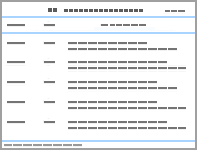
"
| 项目 | 对照组 (n = 27) | 治疗组 (n = 22) | χ2/t值 | P值 |
|---|---|---|---|---|
| 性别(男/女)/n | 25/2 | 20/2 | 0.000 | 1.000 |
| 年龄/岁 | 58.81±11.17 | 54.45±11.66 | 1.333 | 0.189 |
| 病程/d | 90.15±93.89 | 88.73±85.82 | 0.055 | 0.957 |
| 性质(梗死/出血)/n | 22/5 | 17/5 | 0.000 | 0.994 |
"
| 组别 | n | 治疗前 | 治疗后 | t值 | P值 |
|---|---|---|---|---|---|
| 对照组 | 27 | 34.59±9.13 | 24.04±8.35 | 17.845 | < 0.001 |
| 治疗组 | 22 | 35.86±12.34 | 21.59±11.27 | 13.553 | < 0.001 |
| t值 | 0.414 | -0.873 | |||
| P值 | 0.681 | 0.387 |
"
| 组别 | n | 治疗前 | 治疗后 | t值 | P值 |
|---|---|---|---|---|---|
| 对照组 | 27 | 9.09±1.72 | 10.50±1.57 | -6.019 | < 0.001 |
| 治疗组 | 22 | 8.48±2.06 | 10.07±1.71 | -9.465 | < 0.001 |
| t值 | 1.107 | 0.901 | |||
| P值 | 0.274 | 0.372 |
"
| 组别 | n | 治疗前 | 治疗后 | t值 | P值 |
|---|---|---|---|---|---|
| 对照组 | 27 | 24.09±12.21 | 41.73±9.11 | -13.906 | < 0.001 |
| 治疗组 | 22 | 20.26±10.02 | 32.52±10.06 | -21.011 | < 0.001 |
| t值 | 1.207 | 3.323 | |||
| P值 | 0.234 | 0.002 |
"
| 组别 | n | 治疗前 | 治疗后 | t值 | P值 |
|---|---|---|---|---|---|
| 对照组 | 27 | 24.14±4.59 | 29.73±2.66 | -10.487 | < 0.001 |
| 治疗组 | 22 | 22.70±4.57 | 27.74±3.12 | -15.406 | < 0.001 |
| t值 | 1.089 | 2.366 | |||
| P值 | 0.282 | 0.022 |
"
| 组别 | n | 治疗前 | 治疗后 | t值 | P值 |
|---|---|---|---|---|---|
| 对照组 | 27 | 50.13±6.25 | 38.14±8.79 | 10.555 | < 0.001 |
| 治疗组 | 22 | 51.34±5.06 | 42.66±5.87 | 23.826 | < 0.001 |
| t值 | -0.749 | -2.212 | |||
| P值 | 0.457 | 0.031 |
"
| 组别 | n | 治疗前 | 治疗后 | t值 | P值 |
|---|---|---|---|---|---|
| 对照组 | 27 | 57.73±16.81 | 76.36±13.47 | -7.847 | < 0.001 |
| 治疗组 | 22 | 59.07±11.35 | 73.33±13.80 | -15.046 | < 0.001 |
| t值 | -0.334 | 0.773 | |||
| P值 | 0.740 | 0.443 |
| [1] |
SHINOMIYA Y. Development and muscle strength training evaluation for horseback riding therapeutic equipment[J]. J Robotics Mechatronics, 2002, 14(6): 597-603.
doi: 10.20965/jrm.2002.p0597 |
| [2] | BENDA W, MCGIBBON N H, GRANT K L. Improvements in muscle symmetry in children with cerebral palsy after equine-assisted therapy (hippotherapy)[J]. J Altern Conplement Med, 2003, 9(6): 817-825. |
| [3] | CHERNG R J, HWANG A, LIAO H F, et al. The effectiveness of therapeutic horseback riding in children with spastic cerebral palsy[J]. Adapt Phys Act Q, 2004, 32(2): 103-121. |
| [4] |
MCGIBBON N H, BENDA W, DUNCAN B R, et al. Immediate and long-term effects of hippotherapy on symmetry of adductor muscle activity and functional ability in children with spastic cerebral palsy[J]. Arch Phys Med Rehabil, 2009, 90(6): 966-974.
doi: 10.1016/j.apmr.2009.01.011 |
| [5] |
STERBA J A, ROGERS B T, FRANCE A P, et al. Horseback riding in children with cerebral palsy: effect on gross motor function[J]. Dev Med Child Neurol, 2002, 44(5): 301-308.
doi: 10.1017/s0012162201002122 pmid: 12033715 |
| [6] |
ZHAI X, ZHANG X, YIN Q, et al. Application of DFA in research on the effect of horseback riding therapy on postural control complexity of hemiplegic patients[J]. Panminerva Med, 2020. DOI: 10.23736/S0031-0808.20.03870-7.
doi: 10.23736/S0031-0808.20.03870-7 |
| [7] |
ANDERSON K, BEHM D G. Trunk muscle activity increases with unstable squat movements[J]. Can J Appl Physiol, 2005, 30(1): 33-45.
pmid: 15855681 |
| [8] |
LEE N G, YOU J S H, YI C H, et al. Best core stabilization for anticipatory postural adjustment and falls in hemiparetic stroke[J]. Arch Phys Med Rehabil, 2018, 99(11): 2168-2174.
doi: 10.1016/j.apmr.2018.01.027 |
| [9] |
RICHARD A, VAN HAMME A, DREVELLE X, et al. Contribution of the supplementary motor area and the cerebellum to the anticipatory postural adjustments and execution phases of human gait initiation[J]. Neuroscience, 2017, 358: 181-189.
doi: S0306-4522(17)30452-9 pmid: 28673716 |
| [10] |
GRAMIGNA V, PELLEGRINO G, CERASA A, et al. Near-infrared spectroscopy in gait disorders: Is it time to begin?[J]. Neurorehabil Neural Repair, 2017, 31(5): 402-412.
doi: 10.1177/1545968317693304 pmid: 28196453 |
| [11] |
TASSEEL-PONCHE S, YELNIK A P, BONAN I V. Motor strategies of postural control after hemispheric stroke[J]. Neurophysiol Clin, 2015, 45(4-5): 327-333.
doi: 10.1016/j.neucli.2015.09.003 |
| [12] | 温子星, 徐欣, 潘景文, 等. 预测性姿势调节对人体站立受扰后姿势响应影响的研究[J]. 中国康复医学杂志, 2016, 31(10): 1104-1110. |
| WEN Z X, XU X, PAN J W, et al. Influence of anticipatory postural adjustment on postural response to standing postural perturbations[J]. Chin J Rehabil Med, 2016, 31(10): 1104-1110. | |
| [13] |
SOUSA A S, SILVA A, TAVARES J M. Biomechanical and neurophysiological mechanisms related to postural control and efficiency of movement: a review[J]. Somatosens Mot Res, 2012, 29(4): 131-143.
doi: 10.3109/08990220.2012.725680 pmid: 23094940 |
| [14] |
CLAUDINO R, DOS SANTOS E C, SANTOS M J. Compensatory but not anticipatory adjustments are altered in older adults during lateral postural perturbations[J]. Clin Neurophysiol, 2013, 124(8): 1628-1637.
doi: 10.1016/j.clinph.2013.02.111 pmid: 23601702 |
| [15] | 渡部和彦, 王芸. 老年人的身体平衡能力与"外部干扰适应理论"[J]. 体育科学, 2014, 34(2): 54-59. |
| WATANABE K, WANG Y. The characteristic of upright balance in elderly and methodology of the coaching: background of "Disturbance and Adaptation Theory"[J]. Chin Sport Sci, 2014, 34(2): 54-59. | |
| [16] |
MARTINEZ K M, MILLE M L, ZHANG Y, et al. Stepping in persons poststroke: comparison of voluntary and perturbation-induced responses[J]. Arch Phys Med Rehabi, 2013, 94(12): 2425-2432.
doi: 10.1016/j.apmr.2013.06.030 |
| [17] |
CHANG W H, TANG P F, WANG Y H, et al. Role of the premotor cortex in leg selection and anticipatory postural adjustments associated with a rapid stepping task in patients with stroke[J]. Gait Posture, 2010, 32(4): 487-493.
doi: 10.1016/j.gaitpost.2010.07.007 |
| [18] |
MIHARA M, MIYAI I, HATTORI N, et al. Cortical control of postural balance in patients with hemiplegic stroke[J]. NeuroReport, 2012, 23(5): 314-319.
doi: 10.1097/WNR.0b013e328351757b pmid: 22357394 |
| [19] |
FUJIMOTO H, MIHARA M, HATTORI N, et al. Cortical changes underlying balance recovery in patients with hemiplegic stroke[J]. NeuroImage, 2014, 85(Pt 1): 547-554.
doi: 10.1016/j.neuroimage.2013.05.014 |
| [20] |
PEREIRA S, SILVA C C, FERREIRA S, et al. Anticipatory postural adjustments during sitting reach movement in post-stroke subjects[J]. J Electromyogr Kinesiol, 2014, 24(1): 165-171.
doi: 10.1016/j.jelekin.2013.10.001 |
| [21] |
MCCOMBE WALLER S, YANG C L, MAGDER L, et al. Impaired motor preparation and execution during standing reach in people with chronic stroke[J]. Neurosci Lett, 2016, 630: 38-44.
doi: S0304-3940(16)30496-7 pmid: 27436481 |
| [22] |
POLLOCK C L, CARPENTER M G, HUNT M A, et al. Physiological arousal accompanying postural responses to external perturbations after stroke[J]. Clin Neurophysiol, 2017, 128(6): 935-944.
doi: S1388-2457(17)30096-2 pmid: 28407522 |
| [23] |
SOUSA A S, SILVA A, SANTOS R. Ankle anticipatory postural adjustments during gait initiation in healthy and post-stroke subjects[J]. Clin Biomech (Bristol, Avon), 2015, 30(9): 960-965.
doi: 10.1016/j.clinbiomech.2015.07.002 |
| [24] |
ANDERSON K G, BEHM D G. Maintenance of EMG activity and loss of force output with instability[J]. J Strength Cond Res, 2004, 18(3): 637-640.
pmid: 15320684 |
| [25] |
LU C, AMUNDSEN HUFFMASTER S L, HARVEY J C, et al. Anticipatory postural adjustment patterns during gait initiation across the adult lifespan[J]. Gait Posture, 2017, 57: 182-187.
doi: S0966-6362(17)30233-3 pmid: 28651215 |
| [26] |
AJACHANDRAKUMAR R, FRASER J E, SCHINKEL-IVY A, et al. Atypical anticipatory postural adjustments during gait initiation among individuals with sub-acute stroke[J]. Gait Posture, 2017, 52(1): 325-331.
doi: 10.1016/j.gaitpost.2016.12.020 |
| [27] |
YIOU E, CADERBY T, HUSSEIN T. Adaptability of anticipatory postural adjustments associated with voluntary movement[J]. World J Orthop, 2012, 3(6): 75-86.
doi: 10.5312/wjo.v3.i6.75 pmid: 22720267 |
| [28] | 李欣, 桑德春, 朴春花, 等. 骑马治疗改善脑卒中偏瘫患者平衡功能的研究[J]. 中国康复理论与实践, 2009, 15(11): 1051-1053. |
| LI X, SANG D C, PIAO C H, et al. Effects of mechanical horseback riding on balance ability in stroke patients[J]. Chin J Rehabil Theory Pract, 2009, 15(11): 1051-1053. | |
| [29] | 郭紫琦, 袁淑娟. 脑卒中患者平衡评定量表的研究进展[J]. 临床与病理杂志, 2021, 41(10): 2481-2486. |
| GUO Z Q, YUAN S J. Research advance of balance assessment scale in stroke patients[J]. J Clin Pathol Res, 2021, 41(10): 2481-2486. | |
| [30] | 瓮长水, 田哲, 李敏, 等. 起立行走计时测试在评定脑卒中患者功能性移动能力中的价值[J]. 中国康复理论与实践, 2004, 10(12): 733-735. |
| WENG C S, TIAN Z, LI M, et al. The value of the Timed "Up & Go" Test at the evaluation of functional mobility in stroke patients[J]. Chin J Rehabil Theory Pract, 2004, 10(12): 733-735. | |
| [31] | 陈琳, 郗海涛, 黄红云. 世界神经病联合会国际合作共济失调量表介绍[J]. 中国组织工程研究与临床康复, 2007, 39(11): 8005-8007. |
| CHEN L, XI H T, HUANG H Y. Introduction of the World Federation of Neurology's International Cooperative Ataxia Rating Scale[J]. J Clin Rehabil Tissue Eng Res, 2007, 39(11): 8005-8007. | |
| [32] |
ARIENTI C, LAZZARINI S G, POLLOCK A, et al. Rehabilitation interventions for improving balance following stroke: an overview of systematic reviews[J]. PLoS One, 2019, 14(7): e0219781.
doi: 10.1371/journal.pone.0219781 |
| [33] |
SUNG Y H, KIM C J, YU B K, et al. A hippotherapy simulator is effective to shift weight bearing toward the affected side during gait in patients with stroke[J]. NeuroRehabilitation, 2013, 33(3): 407-412.
doi: 10.3233/NRE-130971 |
| [34] |
RUGGERI A, DANCEL A, JOHNSON R, et al. The effect of motor and physical activity intervention on motor outcomes of children with autism spectrum disorder: a systematic review[J]. Autism, 2020, 24(3): 544-568.
doi: 10.1177/1362361319885215 pmid: 31782658 |
| [35] | HEMACHITHRA C, MEENA N, RAMANATHAN R, et al. Immediate effect of horse riding simulator on adductor spasticity in children with cerebral palsy: a randomized controlled trial[J]. Physiother Res Int, 2020, 25(1): e1809. |
| [36] |
PAN C Y, CHANG Y K, TSAI C L, et al. Effects of physical activity intervention on motor proficiency and physical fitness in children with ADHD: an exploratory study[J]. J Atten Disord, 2017, 21(9): 783-795.
doi: 10.1177/1087054714533192 |
| [37] |
BAILLET H, LEROY D, VÉRIN E, et al. Effect of mechanical horse practice as new postural training in patients with neurological disorders: a pilot study[J]. Front Psychol, 2019, 10: 1035.
doi: 10.3389/fpsyg.2019.01035 pmid: 31133944 |
| [38] |
KIM S K, HWANGBO G. The effects of horse-riding simulator exercise on balance in elderly with knee osteoarthritis[J]. J Phys Ther Sci, 2017, 29(3): 387-389.
doi: 10.1589/jpts.29.387 |
| [39] |
KIM S K, KIM S G, HWANGBO G. The effect of horse-riding simulator exercise on the gait, muscle strength and muscle activation in elderly people with knee osteoarthritis[J]. J Phys Ther Sci, 2017, 29(4): 693-696.
doi: 10.1589/jpts.29.693 |
| [40] |
NOH H J, KIM C M, PARK J W. A study on muscle activity based on the ankle posture for effective exercise with indoor horse riding machine[J]. J Phys Ther Sci, 2019, 31(2): 170-174.
doi: 10.1589/jpts.31.170 |
| [41] | COLLADO-MATEO D, LAVÍN-PÉREZ A M, FUENTES GARCÍA J P, et al. Effects of equine-assisted therapies or horse-riding simulators on chronic pain: a systematic review and meta-analysis[J]. Medicina (Kaunas), 2020, 56(9): 444. |
| [42] |
D'CUNHA N M, ISBEL S, MCKUNE A J, et al. Activities outside of the care setting for people with dementia: a systematic review[J]. BMJ Open, 2020, 10(10): e040753.
doi: 10.1136/bmjopen-2020-040753 |
| [43] |
HILLIERE C, COLLADO-MATEO D, VILLAFAINA S, et al. Benefits of hippotherapy and horse riding simulation exercise on healthy older adults: a systematic review[J]. PM R, 2018, 10(10): 1062-1072.
doi: 10.1016/j.pmrj.2018.03.019 |
| [44] |
BORGES M B S, WERNECK M J D S, DA SILVA M D L, et al. Therapeutic effects of a horse riding simulator in children with cerebral palsy[J]. Arq Neuropsiquiatr, 2011, 69(5): 799-804.
doi: 10.1590/S0004-282X2011000600014 |
| [45] |
PARK J, LEE S, LEE J, et al. The effects of horseback riding simulator exercise on postural balance of chronic stroke patients[J]. J Phys Ther Sci, 2013, 25(9): 1169-1172.
doi: 10.1589/jpts.25.1169 pmid: 24259938 |
| [46] |
GRANACHER U, LACROIX A, MUEHLBAUER T, et al. Effects of core instability strength training on trunk muscle strength, spinal mobility, dynamic balance and functional mobility in older adults[J]. Gerontology, 2013, 59(2): 105-113.
doi: 10.1159/000343152 pmid: 23108436 |
| [47] |
VERHEYDEN G, NIEUWBOER A, DE WIT L, et al. Trunk performance after stroke: an eye catching predictor of functional outcome[J]. J Neurol Neurosurg Psychiatry, 2007, 78(7): 694-698.
pmid: 17178824 |
| [48] |
MCGEE M C, REESE N B. Immediate effects of a hippotherapy session on gait parameters in children with spastic cerebral palsy[J]. Pediatr Phys Ther, 2009, 21(2): 212-218.
doi: 10.1097/PEP.0b013e3181a39532 pmid: 19440132 |
| [49] |
BERTOTI D B. Effect of therapeutic horseback riding on posture in children with cerebral palsy[J]. Phys Ther, 1988, 68(10): 1505-1512.
pmid: 3174832 |
| [50] |
KIM Y N, LEE D K. Effects of horse-riding exercise on balance, gait, and activities of daily living in stroke patients[J]. J Phys Ther Sci, 2015, 27(3): 607-609.
doi: 10.1589/jpts.27.607 |
| [51] |
ALGHADIR A H, AL-EISA E S, ANWER S, et al. Reliability, validity, and responsiveness of three scales for measuring balance in patients with chronic stroke[J]. BMC Neurol, 2018, 18(1): 141.
doi: 10.1186/s12883-018-1146-9 pmid: 30213258 |
| [52] |
LI J, ZHONG D, YE J, et al. Rehabilitation for balance impairment in patients after stroke: a protocol of a systematic review and network meta-analysis[J]. BMJ Open, 2019, 9(7): e026844.
doi: 10.1136/bmjopen-2018-026844 |
| [53] |
HARUYAMA K, KAWAKAMI M, OTSUKA T. Effect of core stability training on trunk function, standing balance, and mobility in stroke patients[J]. Neurorehabil Neural Repair, 2017, 31(3): 240-249.
doi: 10.1177/1545968316675431 pmid: 27821673 |
| [54] |
VAN CRIEKINGE T, TRUIJEN S, SCHRÖDER J, et al. The effectiveness of trunk training on trunk control, sitting and standing balance and mobility post-stroke: a systematic review and meta-analysis[J]. Clin Rehabil, 2019, 33(6): 992-1002.
doi: 10.1177/0269215519830159 pmid: 30791703 |
| [1] | ZHU Lili, ZHAO Jiaxin, CHENG Xue, WANG Huijuan, CHEN Xiaoxia. Experiences and needs of stroke patients during rehabilitation: a qualitative meta-synthesis [J]. Chinese Journal of Rehabilitation Theory and Practice, 2026, 32(3): 286-293. |
| [2] | LIU Ping, ZHOU Nan, XUE Xiaojie, SHAO Weibo. Application of rehabilitation therapy techniques for post-stroke dysphagia: a bibliometric analysis [J]. Chinese Journal of Rehabilitation Theory and Practice, 2026, 32(3): 294-303. |
| [3] | YANG Ling, WANG Qinglei, WANG Jie, XU Wenjie, WANG Tong, GUO Chuan, QIAN Xue. Activation patterns and mechanism in the prefrontal cortex of post-stroke anxiety patients: a study using functional near-infrared spectroscopy [J]. Chinese Journal of Rehabilitation Theory and Practice, 2026, 32(3): 329-336. |
| [4] | YUE Yuan, ZHANG Tong, LIU Yuanmin, WANG Ya'nan. Effect of lower extremity exoskeleton robots on balance and walking function of patients with post-stroke cerebellar ataxia [J]. Chinese Journal of Rehabilitation Theory and Practice, 2026, 32(1): 23-29. |
| [5] | WU Cheng, ZHANG Yunfeng, WANG Weining, YU Kewei, ZHANG Yanzheng, SHEN Jiarong, WU Yi. Effect of elbow-wrist functional orthosis on plantar pressure and balance function in stroke patients with hemiplegia [J]. Chinese Journal of Rehabilitation Theory and Practice, 2026, 32(1): 30-39. |
| [6] | ZHANG Junfeng, CHEN Hao, DU Yuzheng, LI Chen, YU Tao, YANG Yuanqing. Non-pharmacological management for post-stroke spasticity from 2004 to 2024: a bibliometric analysis [J]. Chinese Journal of Rehabilitation Theory and Practice, 2026, 32(1): 45-58. |
| [7] | GAO Kaixiang, LU Haitao. Research in neurorehabilitation from 2015 to 2024: a bibliometric analysis [J]. Chinese Journal of Rehabilitation Theory and Practice, 2026, 32(1): 59-68. |
| [8] | WEI Jingyi, WANG Xiaojing, WANG Ran, WEI Chen, MA Sai, LIU Xihua. Effect of acupuncture synchronized speech training on post-stroke motor aphasia [J]. Chinese Journal of Rehabilitation Theory and Practice, 2025, 31(9): 1000-1008. |
| [9] | WANG Xiaojing, WEI Jingyi, WEI Chen, WANG Ran, MA Sai, LIU Xihua. Effect of synchronous acupuncture and articulation training on spastic dysarthria after stroke [J]. Chinese Journal of Rehabilitation Theory and Practice, 2025, 31(9): 1009-1016. |
| [10] | ZHOU Xinyue, YE Ruixue, MA Yaqi, XU Ying, CAO Longyao, WANG Yulong. Researches on central post-stroke pain: a bibliometric analysis [J]. Chinese Journal of Rehabilitation Theory and Practice, 2025, 31(9): 1038-1049. |
| [11] | GAO Yunhan, HOU Shanshan, WANG Xinyu, ZHU Chongtian. Effect of brain-computer interface on upper limb motor dysfunction in stroke patients based on functional near-infrared spectroscopy [J]. Chinese Journal of Rehabilitation Theory and Practice, 2025, 31(9): 1066-1073. |
| [12] | GAO Fei, LIU Lixu, HU Xueyan, WU Xiaoli, YANG Lingyu, YANG Yuqi, YE Changqing, DU Xiaoxia. Effect of unilateral or bilateral transcranial direct current stimulation on post-stroke dysphagia [J]. Chinese Journal of Rehabilitation Theory and Practice, 2025, 31(9): 993-999. |
| [13] | ZHANG Ziang, CHEN Jing, SHEN Mengru, GENG Zongxiao, HAN Xue, ZHAO Xu, XU Lei. Comparison of effect of different types of exercise on gait and balance for stroke patients [J]. Chinese Journal of Rehabilitation Theory and Practice, 2025, 31(8): 896-905. |
| [14] | WANG Xiaofeng, HU Mengqiao, WANG Yan, WEI Kun, XU Wenzhu, REN Dan, MA Ye. Effect of exoskeleton robot-assisted gait training on lower limb function after stroke and spinal cord injury: a systematic review [J]. Chinese Journal of Rehabilitation Theory and Practice, 2025, 31(8): 914-921. |
| [15] | ZHANG Zihan, GUAN Jinzhi, HUANG Xing, ZHOU Li, ZHANG Yaxuan, ZHANG Mengyuan, CHANG Jingling. Characteristics of time-domain and time-frequency of Chinese word-picture matching task-related electroencephalogram in patients with post-stroke aphasia [J]. Chinese Journal of Rehabilitation Theory and Practice, 2025, 31(8): 947-957. |
| Viewed | ||||||
|
Full text |
|
|||||
|
Abstract |
|
|||||
|
||
