



《Chinese Journal of Rehabilitation Theory and Practice》 ›› 2023, Vol. 29 ›› Issue (1): 98-103.doi: 10.3969/j.issn.1006-9771.2023.01.015
Previous Articles Next Articles
LI Xiuli1,2, LI Shan1,2, FENG Mengchen1,2, HUANG Fubiao1,2( )
)
Received:2021-12-22
Revised:2022-04-15
Published:2023-01-25
Online:2023-02-17
Contact:
HUANG Fubiao, E-mail: huangfubiao123@126.com
Supported by:CLC Number:
LI Xiuli, LI Shan, FENG Mengchen, HUANG Fubiao. Effects of upper limb exergames on functional recovery in stroke patients with mild cognitive impairment[J]. 《Chinese Journal of Rehabilitation Theory and Practice》, 2023, 29(1): 98-103.
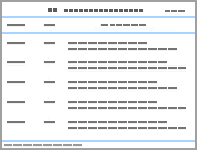
"
| 项目 | 对照组 (n = 25) | 试验组 (n = 25) | t/Z/χ2值 | P值 |
|---|---|---|---|---|
| 性别(男/女)/n | 20/5 | 17/8 | 0.936 | 0.333 |
| 年龄/岁 | 51.8±12.0 | 52.0±11.1 | 0.061 | 0.914 |
| 病程/d | 40(35.5, 48) | 40(21, 62) | -0.563 | 0.573 |
| 受教育年限/年 | 15(12, 16) | 15(12, 17.5) | -0.437 | 0.662 |
| MoCA总分 | 18.04±2.46 | 17.8±2.8 | -1.743 | 0.081 |
| 卒中类型(梗死/出血)/n | 10/15 | 12/13 | 0.325 | 0.569 |
| 脑损伤侧(右/左)/n | 11/14 | 11/14 | 0.000 | 1.000 |
"
| 项目 | 对照组(n = 25) | 试验组(n = 25) | t/Z值a | P值a | t/Z值b | P值b | t/Z值c | P值c | t/Z值d | P值d | ||
|---|---|---|---|---|---|---|---|---|---|---|---|---|
| 治疗前 | 治疗后 | 治疗前 | 治疗后 | |||||||||
| 视空间执行能力 | 4.0(3.0,4.0) | 4.0(3.0,4.0) | 3.0(3.0,4.0) | 4.0(3.0,5.0) | -2.449 | 0.014 | -3.162 | 0.002 | -0.459 | 0.646 | -2.134 | 0.033 |
| 命名 | 3.0(3.0,3.0) | 3.0(3.0,3.0) | 3.0(3.0,3.0) | 3.0(3.0,3.0) | -1.000 | 0.317 | -1.414 | 0.157 | -0.467 | 0.641 | -1.429 | 0.153 |
| 注意力 | 3.0(3.0,4.0) | 4.0(3.0,4.0) | 3.0(3.0,4.0) | 3.0(3.0,4.0) | -2.646 | 0.008 | -2.646 | 0.008 | -0.386 | 0.700 | -2.086 | 0.037 |
| 语言流畅 | 2.0(1.0,2.0) | 2.0(1.0,2.0) | 1.0(1.0,2.0) | 2.0(1.0,2.0) | -2.000 | 0.046 | -2.646 | 0.008 | -0.264 | 0.792 | -1.982 | 0.048 |
| 抽象思维 | 1.0(1.0,1.0) | 1.0(1.0,1.0) | 1.0(1.0,1.0) | 1.0(1.0,2.0) | -1.414 | 0.157 | -2.646 | 0.008 | -0.241 | 0.810 | -1.402 | 0.161 |
| 延迟记忆 | 1.0(0.0,2.0) | 2.0(1.0,2.0) | 1.0(0.0,2.0) | 2.0(1.0,3.0) | -3.606 | < 0.001 | -4.184 | < 0.001 | -0.264 | 0.792 | -2.306 | 0.021 |
| 定向力 | 5.0(4.5,5.0) | 5.0(5.0,5.0) | 5.0(4.0,5.0) | 5.0(5.0,6.00) | -2.236 | 0.025 | -3.606 | < 0.001 | -0.705 | 0.481 | -2.060 | 0.039 |
| 总分 | 18.04±2.458 | 18.76±2.83 | 17.80±2.80 | 20.52±3.27 | -3.354 | 0.001 | -12.364 | < 0.001 | -0.322 | 0.749 | 3.565 | 0.001 |
"
| 组别 | n | 治疗前 | 治疗后 | Z值 | P值 |
|---|---|---|---|---|---|
| 对照组 | 25 | 12.0(9.5,22.0) | 20.0(12.5,30.5) | -4.383 | < 0.001 |
| 试验组 | 25 | 18.0(12.5,35.5) | 27.0(21.0,50.0) | -4.379 | < 0.001 |
| Z值 | -1.477 | -2.294 | |||
| P值 | 0.140 | 0.022 |
"
| 组别 | n | 治疗前 | 治疗后 | t值 | P值 |
|---|---|---|---|---|---|
| 对照组 | 25 | 43.21±8.71 | 49.96±10.89 | -10.246 | < 0.001 |
| 试验组 | 25 | 42.54±6.24 | 53.17±7.48 | -8.544 | < 0.001 |
| t值 | -0.305 | 1.190 | |||
| P值 | 0.762 | 0.241 |
| [1] |
FEIGIN V L, STARK B A, JOHNSON C O, et al. Global, regional, and national burden of stroke and its risk factors, 1990-2019: a systematic analysis for the Global Burden of Disease Study 2019[J]. Lancet Neurol, 2021, 20(10): 795-820.
doi: 10.1016/S1474-4422(21)00252-0 pmid: 34487721 |
| [2] |
VEERBEEK J M, KWAKKEL G, VAN WEGEN E E, et al. Early prediction of outcome of activities of daily living after stroke: a systematic review[J]. Stroke, 2011, 42(5): 1482-1488.
doi: 10.1161/STROKEAHA.110.604090 pmid: 21474812 |
| [3] |
LO J W, CRAWFORD J D, DESMOND D W, et al. Profile of and risk factors for poststroke cognitive impairment in diverse ethnoregional groups[J]. Neurology, 2019, 93(24): e2257-e2271.
doi: 10.1212/WNL.0000000000008612 |
| [4] |
STOLWYK R J, MIHALJCIC T, WONG D K, et al. Poststroke cognitive impairment negatively impacts activity and participation outcomes: a systematic review and meta-analysis[J]. Stroke, 2021, 52(2): 748-760.
doi: 10.1161/STROKEAHA.120.032215 pmid: 33493048 |
| [5] |
ROHDE D, GAYNOR E, LARGE M, et al. The impact of cognitive impairment on poststroke outcomes: a 5-year follow-up[J]. J Geriatr Psychiatry Neurol, 2019, 32(5): 275-281.
doi: 10.1177/0891988719853044 |
| [6] | GIBSON E, KOH C L, EAMES S, et al. Occupational therapy for cognitive impairment in stroke patients[J]. Cochrane Database Syst Rev, 2022, 3(3): D6430. |
| [7] | 吴保平, 郭霞, 刘晨, 等. 作业疗法对脑卒中后患者上肢运动功能康复效果的Meta分析[J]. 中国老年学杂志, 2014(22): 6349-6351. |
| WU B P, GUO X, LIU C, et al. Meta-analysis of the effects of occupational therapy on upper limb motor function rehabilitation in stroke patients[J]. Chin J Gerontol, 2014(22): 6349-6351. | |
| [8] | 杜振峰, 蔡琛. 计算机辅助认知训练联合作业治疗对脑卒中认知障碍患者的康复研究[J]. 中国实用神经疾病杂志, 2020, 23(23): 2074-2080. |
| DU Z F, CAI C. Rehabilitation study of computer-assisted cognitive training combined with occupational therapy on patients with cognitive impairment after stroke[J]. Chin J Pract Nerv Dis, 2020, 23(23): 2074-2080. | |
| [9] | 孙妙璇, 周颖, 林玲, 等. 加拿大作业表现量表在脑卒中患者作业治疗中的应用[J]. 重庆医学, 2021, 50(10): 1733-1736. |
| SUN M X, ZHOU Y, LIN L, et al. Application of Canadian Occupational Performance Measure in occupational therapy of patients with stroke[J]. Chongqing Med, 2021, 50(10): 1733-1736. | |
| [10] | 蔡琛, 孙秋芳, 葛继晖. 作业治疗联合头皮针在卒中认知障碍患者康复中的应用效果[J]. 慢性病学杂志, 2022, 23(4): 579-582. |
| CAI C, SUN Q F, GE J H. Effect of occupational therapy combined with scalp acupuncture in rehabilitation of stroke patients with cognitive impairment[J]. Chron Pathematol J, 2022, 23(4): 579-582. | |
| [11] | ZHAO Y, FENG H, WU X, et al. Effectiveness of exergaming in improving cognitive and physical function in people with mild cognitive impairment or dementia: systematic review[J]. JMIR Serious Games, 2020, 8(2): e16841. |
| [12] | ABD-ALRAZAQ A, ALAJLANI M, ALHUWAIL D, et al. The effectiveness and safety of serious games for improving cognitive abilities among elderly people with cognitive impairment: systematic review and meta-analysis[J]. JMIR Serious Games, 2022, 10(1): e34592. |
| [13] |
DOUMAS I, EVERARD G, DEHEM S, et al. Serious games for upper limb rehabilitation after stroke: a meta-analysis[J]. J Neuroeng Rehabil, 2021, 18(1): 100.
doi: 10.1186/s12984-021-00889-1 pmid: 34130713 |
| [14] | MURA G, CARTA M G, SANCASSIANI F, et al. Active exergames to improve cognitive functioning in neurological disabilities: a systematic review and meta-analysis[J]. Eur J Phys Rehabil Med, 2018, 54(3): 450-462. |
| [15] |
TOSTO-MANCUSO J, TABACOF L, HERRERA J E, et al. Gamified neurorehabilitation strategies for post-stroke motor recovery: challenges and advantages[J]. Curr Neurol Neurosci Rep, 2022, 22(3): 183-195.
doi: 10.1007/s11910-022-01181-y |
| [16] |
HENRIQUE P, COLUSSI E L, DE MARCHI A. Effects of exergame on patients' balance and upper limb motor function after stroke: a randomized controlled trial[J]. J Stroke Cerebrovasc Dis, 2019, 28(8): 2351-2357.
doi: S1052-3057(19)30268-X pmid: 31204204 |
| [17] |
GELINEAU A, PERROCHON A, ROBIN L, et al. Measured and perceived effects of upper limb home-based exergaming interventions on activity after stroke: a systematic review and meta-analysis[J]. Int J Environ Res Public Health, 2022, 19(15): 9112.
doi: 10.3390/ijerph19159112 |
| [18] | 宋卓君, 甄橙. 知识与话语权:脑卒中在ICD-11中疾病分类改变原因剖析[J]. 医学与哲学, 2021, 42(22): 77-81. |
| SONG Z J, ZHEN C. Knowledge and discourse power: analysis of causes of disease classification changes in stroke in ICD-11[J]. Med Philosophy, 2021, 42(22): 77-81. | |
| [19] | 王善梅, 许允帅, 钱丽菊, 等. ICD-11精神、行为及神经发育障碍分类主要变化[J]. 中国神经精神疾病杂志, 2020, 46(1): 43-45. |
| WANG S M, XU Y S, QIAN L J, et al. ICD-11 Major changes in classification of mental, behavioral and neurodevelopmental disorders[J]. Chin J Nerv Ment Dis, 2020, 46(1): 43-45. | |
| [20] |
BERTANI R, MELEGARI C, DE COLA M C, et al. Effects of robot-assisted upper limb rehabilitation in stroke patients: a systematic review with meta-analysis[J]. Neurol Sci, 2017, 38(9): 1561-1569.
doi: 10.1007/s10072-017-2995-5 pmid: 28540536 |
| [21] |
HEBERT D, LINDSAY M P, MCINTYRE A, et al. Canadian stroke best practice recommendations: stroke rehabilitation practice guidelines, update 2015[J]. Int J Stroke, 2016, 11(4): 459-484.
doi: 10.1177/1747493016643553 pmid: 27079654 |
| [22] |
NOROUZI-GHEIDARI N, HERNANDEZ A, ARCHAMBAULT P S, et al. Feasibility, safety and efficacy of a virtual reality exergame system to supplement upper extremity rehabilitation post-stroke: a pilot randomized clinical trial and proof of principle[J]. Int J Environ Res Public Health, 2020, 17(1): 113.
doi: 10.3390/ijerph17010113 |
| [23] |
KARAMIANS R, PROFFITT R, KLINE D, et al. Effectiveness of virtual reality- and gaming-based interventions for upper extremity rehabilitation poststroke: a meta-analysis[J]. Arch Phys Med Rehabil, 2020, 101(5): 885-896.
doi: 10.1016/j.apmr.2019.10.195 |
| [24] | MAIER M, BALLESTER B R, VERSCHURE P. Principles of neurorehabilitation after stroke based on motor learning and brain plasticity mechanisms[J]. Front Syst Neurosci, 2019, 17(13): 74. |
| [25] |
WU X, GUARINO P, LO A C, et al. Long-term effectiveness of intensive therapy in chronic stroke[J]. Neurorehabil Neural Repair, 2016, 30(6): 583-590.
doi: 10.1177/1545968315608448 pmid: 26450442 |
| [26] |
WILSON P H, ROGERS J M, VOGEL K, et al. Home-based (virtual) rehabilitation improves motor and cognitive function for stroke patients: a randomized controlled trial of the elements (EDNA-22) system[J]. J Neuroeng Rehabil, 2021, 18(1): 165.
doi: 10.1186/s12984-021-00956-7 pmid: 34823545 |
| [27] |
YEN H Y, CHIU H L. Virtual reality exergames for improving older adults' cognition and depression: a systematic review and meta-analysis of randomized control trials[J]. J Am Med Dir Assoc, 2021, 22(5): 995-1002.
doi: 10.1016/j.jamda.2021.03.009 |
| [28] |
HUANG X, ZHAO X, LI B, et al. Comparative efficacy of various exercise interventions on cognitive function in patients with mild cognitive impairment or dementia: a systematic review and network meta-analysis[J]. J Sport Health Sci, 2022, 11(2): 212-223.
doi: 10.1016/j.jshs.2021.05.003 |
| [29] | CAI H, LI G, HUA S, et al. Effect of exercise on cognitive function in chronic disease patients: a meta-analysis and systematic review of randomized controlled trials[J]. Clin Interv Aging, 2017, 11(12): 773-783. |
| [30] |
DEMURTAS J, SCHOENE D, TORBAHN G, et al. Physical activity and exercise in mild cognitive impairment and dementia: an umbrella review of intervention and observational studies[J]. J Am Med Dir Assoc, 2020, 21(10): 1415-1422.
doi: S1525-8610(20)30737-4 pmid: 32981668 |
| [31] |
WATERS A, ZOU L, JUNG M, et al. Acute exercise and sustained attention on memory function[J]. Am J Health Behav, 2020, 44(3): 326-332.
doi: 10.5993/AJHB.44.3.5 pmid: 32295680 |
| [32] |
ANDERSON-HANLEY C, BARCELOS N M, ZIMMERMAN E A, et al. The Aerobic and Cognitive Exercise Study (ACES) for community-dwelling older adults with or at-risk for Mild Cognitive Impairment (MCI): neuropsychological, neurobiological and neuroimaging outcomes of a randomized clinical trial[J]. Front Aging Neurosci, 2018, 10: 76.
doi: 10.3389/fnagi.2018.00076 |
| [33] | SHEN X, LUO L, WANG F, et al. An Enriched environment enhances angiogenesis surrounding the cingulum in ischaemic stroke rats[J]. Neural Plast, 2020, 2020: 8840319. |
| [34] |
VAN PRAAG H. Neurogenesis and exercise: past and future directions[J]. Neuromolecular Med, 2008, 10(2): 128-140.
doi: 10.1007/s12017-008-8028-z |
| [35] |
BAVELIER D, GREEN C S, POUGET A, et al. Brain plasticity through the life span: learning to learn and action video games[J]. Annu Rev Neurosci, 2012, 35: 391-416.
doi: 10.1146/annurev-neuro-060909-152832 pmid: 22715883 |
| [36] | 赵德福, 景俊, 方琪, 等. 重复经颅磁刺激结合上肢机器人虚拟情景训练对脑卒中患者认知功能的研究[J]. 中国康复, 2020, 35(6): 295-298. |
| ZHAO D F, JING J, FANG Q, et al. Repetitive transcranial magnetic stimulation combined with upper limb robot virtual scenario training for stroke patients with cognitive impairment[J]. Chin J Rehabil, 2020, 35(6): 295-298. | |
| [37] | 顾琦, 田湉, 张芳芳, 等. 上肢康复机器人辅助治疗对改善脑卒中单侧忽略的疗效观察[J]. 中国康复医学杂志, 2020, 35(2): 166-170. |
| GU Q, TIAN T, ZHANG F F, et al. Therapeutic effectiveness of upper limb rehabilitation robot-aided training on the unilateral neglect by stroke[J]. Chin J Rehabil Med, 2020, 35(2): 166-170. |
| [1] | ZHU Lili, ZHAO Jiaxin, CHENG Xue, WANG Huijuan, CHEN Xiaoxia. Experiences and needs of stroke patients during rehabilitation: a qualitative meta-synthesis [J]. Chinese Journal of Rehabilitation Theory and Practice, 2026, 32(3): 286-293. |
| [2] | LIU Ping, ZHOU Nan, XUE Xiaojie, SHAO Weibo. Application of rehabilitation therapy techniques for post-stroke dysphagia: a bibliometric analysis [J]. Chinese Journal of Rehabilitation Theory and Practice, 2026, 32(3): 294-303. |
| [3] | YANG Ling, WANG Qinglei, WANG Jie, XU Wenjie, WANG Tong, GUO Chuan, QIAN Xue. Activation patterns and mechanism in the prefrontal cortex of post-stroke anxiety patients: a study using functional near-infrared spectroscopy [J]. Chinese Journal of Rehabilitation Theory and Practice, 2026, 32(3): 329-336. |
| [4] | YUE Yuan, ZHANG Tong, LIU Yuanmin, WANG Ya'nan. Effect of lower extremity exoskeleton robots on balance and walking function of patients with post-stroke cerebellar ataxia [J]. Chinese Journal of Rehabilitation Theory and Practice, 2026, 32(1): 23-29. |
| [5] | WU Cheng, ZHANG Yunfeng, WANG Weining, YU Kewei, ZHANG Yanzheng, SHEN Jiarong, WU Yi. Effect of elbow-wrist functional orthosis on plantar pressure and balance function in stroke patients with hemiplegia [J]. Chinese Journal of Rehabilitation Theory and Practice, 2026, 32(1): 30-39. |
| [6] | ZHANG Junfeng, CHEN Hao, DU Yuzheng, LI Chen, YU Tao, YANG Yuanqing. Non-pharmacological management for post-stroke spasticity from 2004 to 2024: a bibliometric analysis [J]. Chinese Journal of Rehabilitation Theory and Practice, 2026, 32(1): 45-58. |
| [7] | GAO Kaixiang, LU Haitao. Research in neurorehabilitation from 2015 to 2024: a bibliometric analysis [J]. Chinese Journal of Rehabilitation Theory and Practice, 2026, 32(1): 59-68. |
| [8] | WEI Jingyi, WANG Xiaojing, WANG Ran, WEI Chen, MA Sai, LIU Xihua. Effect of acupuncture synchronized speech training on post-stroke motor aphasia [J]. Chinese Journal of Rehabilitation Theory and Practice, 2025, 31(9): 1000-1008. |
| [9] | WANG Xiaojing, WEI Jingyi, WEI Chen, WANG Ran, MA Sai, LIU Xihua. Effect of synchronous acupuncture and articulation training on spastic dysarthria after stroke [J]. Chinese Journal of Rehabilitation Theory and Practice, 2025, 31(9): 1009-1016. |
| [10] | ZHOU Xinyue, YE Ruixue, MA Yaqi, XU Ying, CAO Longyao, WANG Yulong. Researches on central post-stroke pain: a bibliometric analysis [J]. Chinese Journal of Rehabilitation Theory and Practice, 2025, 31(9): 1038-1049. |
| [11] | GAO Yunhan, HOU Shanshan, WANG Xinyu, ZHU Chongtian. Effect of brain-computer interface on upper limb motor dysfunction in stroke patients based on functional near-infrared spectroscopy [J]. Chinese Journal of Rehabilitation Theory and Practice, 2025, 31(9): 1066-1073. |
| [12] | GAO Fei, LIU Lixu, HU Xueyan, WU Xiaoli, YANG Lingyu, YANG Yuqi, YE Changqing, DU Xiaoxia. Effect of unilateral or bilateral transcranial direct current stimulation on post-stroke dysphagia [J]. Chinese Journal of Rehabilitation Theory and Practice, 2025, 31(9): 993-999. |
| [13] | ZHANG Ziang, CHEN Jing, SHEN Mengru, GENG Zongxiao, HAN Xue, ZHAO Xu, XU Lei. Comparison of effect of different types of exercise on gait and balance for stroke patients [J]. Chinese Journal of Rehabilitation Theory and Practice, 2025, 31(8): 896-905. |
| [14] | WANG Xiaofeng, HU Mengqiao, WANG Yan, WEI Kun, XU Wenzhu, REN Dan, MA Ye. Effect of exoskeleton robot-assisted gait training on lower limb function after stroke and spinal cord injury: a systematic review [J]. Chinese Journal of Rehabilitation Theory and Practice, 2025, 31(8): 914-921. |
| [15] | ZHANG Zihan, GUAN Jinzhi, HUANG Xing, ZHOU Li, ZHANG Yaxuan, ZHANG Mengyuan, CHANG Jingling. Characteristics of time-domain and time-frequency of Chinese word-picture matching task-related electroencephalogram in patients with post-stroke aphasia [J]. Chinese Journal of Rehabilitation Theory and Practice, 2025, 31(8): 947-957. |
| Viewed | ||||||
|
Full text |
|
|||||
|
Abstract |
|
|||||
|
||
