



《Chinese Journal of Rehabilitation Theory and Practice》 ›› 2023, Vol. 29 ›› Issue (2): 151-155.doi: 10.3969/j.issn.1006-9771.2023.02.003
Previous Articles Next Articles
XU Hanlin1, HU Guojiong1( ), ZHENG Shaocheng1, ZENG Xiaowen1, ZENG Xianhua1, SHAO Wenqi2
Received:2022-11-14
Revised:2022-12-19
Published:2023-02-25
Online:2023-03-16
Contact:
HU Guojiong
E-mail:johnwen1958@163.com
CLC Number:
XU Hanlin, HU Guojiong, ZHENG Shaocheng, ZENG Xiaowen, ZENG Xianhua, SHAO Wenqi. Correlation between knee hyperextension gait and lower limb muscle activation in stroke patients with hemiplegia[J]. 《Chinese Journal of Rehabilitation Theory and Practice》, 2023, 29(2): 151-155.
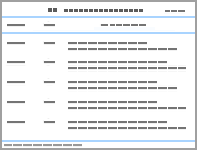
"
| 项目 | 对照组 (n = 24) | 试验组 (n = 24) | χ2/t值 | P值 |
|---|---|---|---|---|
| 性别(男/女)/n | 22/2 | 21/3 | 0.223 | 0.637 |
| 年龄/岁 | 47.17±12.38 | 48.50±14.62 | 0.341 | 0.735 |
| 身高/m | 1.70±0.05 | 1.71±0.08 | 0.412 | 0.682 |
| 体质量/kg | 71.42±9.97 | 72.46±11.25 | 0.339 | 0.736 |
| BMI/(kg·m-2) | 24.64±2.57 | 24.79±3.31 | 0.184 | 0.855 |
| 偏瘫侧(左/右)/n | 11/13 | |||
| 卒中性质(缺血/出血)/n | 17/7 |
"
| 关节 | 对照组(n = 24) | 试验组(n = 24) | t值 | P值 |
|---|---|---|---|---|
| 骨盆 | 1.98±6.39 | 9.29±7.22 | 3.712 | 0.001 |
| 髋 | -14.81±9.06 | 2.50±9.74 | 6.376 | < 0.001 |
| 膝 | -5.34±3.50 | -9.29±4.32 | -3.483 | 0.001 |
| 踝 | 4.50±3.53 | -5.87±5.93 | -7.372 | < 0.001 |
"
| 肌肉 | 对照组 (n = 24) | 试验组 (n = 24) | t值 | P值 | |
|---|---|---|---|---|---|
| 臀大肌 | 16.72±7.23 | 39.30±19.53 | 5.312 | < 0.001 | |
| 股内侧肌 | 13.30±14.27 | 27.40±17.31 | 3.080 | 0.003 | |
| 股二头肌 | 14.39±17.13 | 34.68±18.62 | 3.928 | < 0.001 | |
| 腓肠肌内侧头 | 42.36±18.08 | 28.80±13.92 | -3.556 | 0.001 | |
"
| 变量 | 对照组 | 试验组 | ||
|---|---|---|---|---|
| r值 | P值 | r值 | P值 | |
| 臀大肌激活度 | 0.127 | 0.555 | -0.532 | 0.008 |
| 股二头肌激活度 | 0.120 | 0.578 | 0.045 | 0.834 |
| 股内侧肌激活度 | 0.035 | 0.871 | 0.104 | 0.630 |
| 腓肠肌内侧头激活度 | -0.021 | 0.922 | 0.264 | 0.213 |
| 踝关节角度 | 0.686 | < 0.001 | 0.754 | < 0.001 |
| 髋关节角度 | 0.029 | 0.893 | -0.012 | 0.956 |
| 骨盆角度 | -0.001 | 0.997 | -0.068 | 0.752 |
| [1] |
HANKEY G J. Stroke[J]. Lancet, 2017, 389(10069): 641-654.
doi: S0140-6736(16)30962-X pmid: 27637676 |
| [2] |
HELD J P O, YU K, PYLES C, et al. Augmented reality-based rehabilitation of gait impairments: case report[J]. JMIR mHealth and uHealth, 2020, 8(5): e17804.
doi: 10.2196/17804 |
| [3] |
HUANG S J, YU X M, WANG K, et al. Short-step adjustment and proximal compensatory strategies adopted by stroke survivors with knee extensor spasticity for obstacle crossing[J]. Front Bioeng Biotechnol, 2020, 8: 939.
doi: 10.3389/fbioe.2020.00939 |
| [4] |
GEERARS M, MINNAAR-VAN DER FEEN N, HUISSTEDE B M A. Treatment of knee hyperextension in post-stroke gait. A systematic review[J]. Gait Posture, 2022, 91: 137-148.
doi: 10.1016/j.gaitpost.2021.08.016 |
| [5] |
YU H X. Observation of the therapeutic effect of correcting foot varus on improving knee hyperextension and gait in patients after stroke[J]. Curr Neurovasc Res, 2021, 18(3): 314-317.
doi: 10.2174/1567202618666210923150711 |
| [6] |
BEYAERT C, VASA R, FRYKBERG G E. Gait post-stroke: pathophysiology and rehabilitation strategies[J]. Neurophys Clin, 2015, 45(4/5): 335-355.
doi: 10.1016/j.neucli.2015.09.005 |
| [7] |
SHANKARANARAYANA A M, GURURAJ S, NATARAJAN M, et al. Gait training interventions for patients with stroke in India: a systematic review[J]. Gait Posture, 2021, 83: 132-140.
doi: 10.1016/j.gaitpost.2020.10.012 pmid: 33137637 |
| [8] |
SUNDEMO D, MIKKELSEN C, CRISTIANI R, et al. Contralateral knee hyperextension is associated with increased anterior tibial translation and fewer meniscal injuries in the anterior cruciate ligament-injured knee[J]. Knee Surg Sports Traumatol Arthrosc, 2018, 26(10): 3020-3028.
doi: 10.1007/s00167-018-5047-7 |
| [9] |
DALAL K K, JOSHUA A M, NAYAK A, et al. Effectiveness of prowling with proprioceptive training on knee hyperextension among stroke subjects using videographic observation: a randomised controlled trial[J]. Gait Posture, 2018, 61: 232-237.
doi: 10.1016/j.gaitpost.2018.01.018 |
| [10] |
TANG L, LIU S, GAN L, et al. Effects of dry needling intervention on lower limb dysfunction after stroke: study protocol for a randomised controlled trial[J]. BMJ Open, 2022, 12(10): e062494.
doi: 10.1136/bmjopen-2022-062494 |
| [11] |
APPASAMY M, DE WITT M E, PATEL N, et al. Treatment strategies for genu recurvatum in adult patients with hemiparesis: a case series[J]. PM R, 2015, 7(2): 105-112.
doi: 10.1016/j.pmrj.2014.10.015 |
| [12] | SOUISSI H, ZORY R, BREDIN J, et al. Co-contraction around the knee and the ankle joints during post-stroke gait[J]. Eur J Phys Rehabil Med, 2018, 54(3): 380-387. |
| [13] |
WANG W, LI K, YUE S, et al. Associations between lower-limb muscle activation and knee flexion in post-stroke individuals: a study on the stance-to-swing phases of gait[J]. PLoS One, 2017, 12(9): e0183865.
doi: 10.1371/journal.pone.0183865 |
| [14] |
SANTOS G F, JAKUBOWITZ E, PRONOST N, et al. Predictive simulation of post-stroke gait with functional electrical stimulation[J]. Sci Rep, 2021, 11(1): 21351.
doi: 10.1038/s41598-021-00658-z pmid: 34725376 |
| [15] |
SIJOBERT B, AZEVEDO C, PONTIER J, et al. A sensor-based multichannel FES system to control knee joint and reduce stance phase asymmetry in post-stroke gait[J]. Sensors, 2021, 21(6): 2134.
doi: 10.3390/s21062134 |
| [16] |
HOMAN K, YAMAMOTO K, KADOYA K, et al. Comprehensive validation of a wearable foot sensor system for estimating spatiotemporal gait parameters by simultaneous three-dimensional optical motion analysis[J]. BMC Sport Sci Med Rehabil, 2022, 14(1): 71.
doi: 10.1186/s13102-022-00461-x |
| [17] |
AGOSTINI V, GHISLIERI M, ROSATI S, et al. Surface electromyography applied to gait analysis: how to improve its impact in clinics?[J]. Front Neurol, 2020, 11: 994.
doi: 10.3389/fneur.2020.00994 pmid: 33013656 |
| [18] |
DIERICK F, SCHREIBER C, LAVALLéE P, et al. Asymptomatic genu recurvatum reshapes lower limb sagittal joint and elevation angles during gait at different speeds[J]. Knee, 2021, 29: 457-468.
doi: 10.1016/j.knee.2021.02.003 pmid: 33743261 |
| [19] |
DESCHAMPS K, EERDEKENS M, GEENTJENS J, et al. A novel approach for the detection and exploration of joint coupling patterns in the lower limb kinetic chain[J]. Gait Posture, 2018, 62: 372-377.
doi: S0966-6362(18)30306-0 pmid: 29625413 |
| [20] | 曾进胜, 刘鸣, 崔丽英. 中国各类主要脑血管病诊断要点2019[J]. 中华神经科杂志, 2019, 52(9): 710-715. |
| ZENG J S, LIU M, CUI L Y. Diagnostic Criteria of Cerebrovascular Diseases in China (version 2019)[J]. Chin J Neurol, 2019, 52(9): 710-715. | |
| [21] |
DANIILIDIS K, JAKUBOWITZ E, THOMANN A, et al. Does a foot-drop implant improve kinetic and kinematic parameters in the foot and ankle?[J]. Arch Orthop Trauma Surg, 2017, 137(4): 499-506.
doi: 10.1007/s00402-017-2652-8 |
| [22] | WANG T, ZHONG R, LIU S, et al. Effects of nonelastic taping and dual task on kinematics and kinetics of the ankle joint[J]. J Healthcare Eng, 2021, 2021: 8866453. |
| [23] |
BAE D Y, KIM S Y, PARK S R, et al. Effects of non-paretic arm movements during bridge exercises on trunk muscle activity in stroke patients[J]. J Phys Ther Sci, 2019, 31(4): 291-294.
doi: 10.1589/jpts.31.291 |
| [24] |
KAZEMINIA M, RAJATI F, RAJATI M. The effect of pelvic floor muscle-strengthening exercises on low back pain: a systematic review and meta-analysis on randomized clinical trials[J]. [ahead of print]. Neurol Sci, 2022. doi: 10.1007/s10072-022-06430-z.
doi: 10.1007/s10072-022-06430-z |
| [25] |
BUCKTHORPE M, STRIDE M, VILLA F D. Assessing and treating gluteus maximus weakness: a clinical commentary[J]. Int J Sport Phys Ther, 2019, 14(4): 655-669.
doi: 10.26603/ijspt20190655 |
| [26] | 邱继宏, 于涛, 刘卉. 脑卒中患者膝过伸原因和康复治疗方法研究进展[J]. 中国康复医学杂志, 2019, 34(6): 746-751. |
| QIU J H, YU T, LIU H. Chin J Rehabil Med, 2019, 34(6): 746-751. | |
| [27] |
LI S, FRANCISCO G E, ZHOU P. Post-stroke hemiplegic gait: new perspective and insights[J]. Front Physiol, 2018, 9: 1021.
doi: 10.3389/fphys.2018.01021 pmid: 30127749 |
| [28] | 徐光青, 兰月, 毛玉瑢, 等. 影响脑卒中偏瘫患者步行能力的三维运动学因素分析[J]. 中华物理医学与康复杂志, 2010, 32(9): 673-676. |
| XU G Q, LAN Y, MAO Y R, et al. The influence of three-dimensional kinematic factors on the walking capacity of hemiparetic stroke patients[J]. Chin J Phys Med Rehabil, 2010, 32(9): 673-676. | |
| [29] |
CHOW J W, STOKIC D S. Relations between knee and ankle muscle coactivation and temporospatial gait measures in patients without hypertonia early after stroke[J]. Exp Brain Res, 2020, 238(12): 2909-2919.
doi: 10.1007/s00221-020-05936-2 pmid: 33063171 |
| [30] |
CHANTRAINE F, SCHREIBER C, KOLANOWSKI E, et al. Control of stroke-related genu recurvatum with prolonged timing of dorsiflexor functional electrical stimulation: a case study[J]. J Neurol Phys Ther, 2016, 40(3): 209-215.
doi: 10.1097/NPT.0000000000000137 pmid: 27164309 |
| [31] |
BŁAŻKIEWICZ M, WISZOMIRSKA I, KACZMARCZYK K, et al. Mechanisms of compensation in the gait of patients with drop foot[J]. Clin Biomech, 2017, 42: 14-19.
doi: 10.1016/j.clinbiomech.2016.12.014 |
| [32] | 姜亚斌, 邹任玲, 刘建, 等. 表面肌电信号的下肢痉挛信号特征分析与识别[J]. 电子科技, 2017, 30(11): 38-41. |
| JIANG Y B, ZOU R L, LIU J, et al. Feature analysis and recognition of lower limb spasm signal of surface EMG signal[J]. Electron Sci Tech, 2017, 30(11): 38-41. |
| [1] | ZHU Lili, ZHAO Jiaxin, CHENG Xue, WANG Huijuan, CHEN Xiaoxia. Experiences and needs of stroke patients during rehabilitation: a qualitative meta-synthesis [J]. Chinese Journal of Rehabilitation Theory and Practice, 2026, 32(3): 286-293. |
| [2] | LIU Ping, ZHOU Nan, XUE Xiaojie, SHAO Weibo. Application of rehabilitation therapy techniques for post-stroke dysphagia: a bibliometric analysis [J]. Chinese Journal of Rehabilitation Theory and Practice, 2026, 32(3): 294-303. |
| [3] | YANG Ling, WANG Qinglei, WANG Jie, XU Wenjie, WANG Tong, GUO Chuan, QIAN Xue. Activation patterns and mechanism in the prefrontal cortex of post-stroke anxiety patients: a study using functional near-infrared spectroscopy [J]. Chinese Journal of Rehabilitation Theory and Practice, 2026, 32(3): 329-336. |
| [4] | LIANG Guanjun, XU Huanlan, ZHANG Hewei, ZHANG Dali, GU Qin, LI Mingdi. Changes in balance and lower limb biomechanics of spastic hemiplegia under different visual deprivation and task conditions [J]. Chinese Journal of Rehabilitation Theory and Practice, 2026, 32(3): 345-355. |
| [5] | YUE Yuan, ZHANG Tong, LIU Yuanmin, WANG Ya'nan. Effect of lower extremity exoskeleton robots on balance and walking function of patients with post-stroke cerebellar ataxia [J]. Chinese Journal of Rehabilitation Theory and Practice, 2026, 32(1): 23-29. |
| [6] | WU Cheng, ZHANG Yunfeng, WANG Weining, YU Kewei, ZHANG Yanzheng, SHEN Jiarong, WU Yi. Effect of elbow-wrist functional orthosis on plantar pressure and balance function in stroke patients with hemiplegia [J]. Chinese Journal of Rehabilitation Theory and Practice, 2026, 32(1): 30-39. |
| [7] | ZHANG Junfeng, CHEN Hao, DU Yuzheng, LI Chen, YU Tao, YANG Yuanqing. Non-pharmacological management for post-stroke spasticity from 2004 to 2024: a bibliometric analysis [J]. Chinese Journal of Rehabilitation Theory and Practice, 2026, 32(1): 45-58. |
| [8] | GAO Kaixiang, LU Haitao. Research in neurorehabilitation from 2015 to 2024: a bibliometric analysis [J]. Chinese Journal of Rehabilitation Theory and Practice, 2026, 32(1): 59-68. |
| [9] | WEI Jingyi, WANG Xiaojing, WANG Ran, WEI Chen, MA Sai, LIU Xihua. Effect of acupuncture synchronized speech training on post-stroke motor aphasia [J]. Chinese Journal of Rehabilitation Theory and Practice, 2025, 31(9): 1000-1008. |
| [10] | WANG Xiaojing, WEI Jingyi, WEI Chen, WANG Ran, MA Sai, LIU Xihua. Effect of synchronous acupuncture and articulation training on spastic dysarthria after stroke [J]. Chinese Journal of Rehabilitation Theory and Practice, 2025, 31(9): 1009-1016. |
| [11] | ZHOU Xinyue, YE Ruixue, MA Yaqi, XU Ying, CAO Longyao, WANG Yulong. Researches on central post-stroke pain: a bibliometric analysis [J]. Chinese Journal of Rehabilitation Theory and Practice, 2025, 31(9): 1038-1049. |
| [12] | GAO Yunhan, HOU Shanshan, WANG Xinyu, ZHU Chongtian. Effect of brain-computer interface on upper limb motor dysfunction in stroke patients based on functional near-infrared spectroscopy [J]. Chinese Journal of Rehabilitation Theory and Practice, 2025, 31(9): 1066-1073. |
| [13] | GAO Fei, LIU Lixu, HU Xueyan, WU Xiaoli, YANG Lingyu, YANG Yuqi, YE Changqing, DU Xiaoxia. Effect of unilateral or bilateral transcranial direct current stimulation on post-stroke dysphagia [J]. Chinese Journal of Rehabilitation Theory and Practice, 2025, 31(9): 993-999. |
| [14] | ZHANG Ziang, CHEN Jing, SHEN Mengru, GENG Zongxiao, HAN Xue, ZHAO Xu, XU Lei. Comparison of effect of different types of exercise on gait and balance for stroke patients [J]. Chinese Journal of Rehabilitation Theory and Practice, 2025, 31(8): 896-905. |
| [15] | WANG Xiaofeng, HU Mengqiao, WANG Yan, WEI Kun, XU Wenzhu, REN Dan, MA Ye. Effect of exoskeleton robot-assisted gait training on lower limb function after stroke and spinal cord injury: a systematic review [J]. Chinese Journal of Rehabilitation Theory and Practice, 2025, 31(8): 914-921. |
| Viewed | ||||||
|
Full text |
|
|||||
|
Abstract |
|
|||||
|
||
