



《Chinese Journal of Rehabilitation Theory and Practice》 ›› 2023, Vol. 29 ›› Issue (2): 223-230.doi: 10.3969/j.issn.1006-9771.2023.02.011
Previous Articles Next Articles
LIU Mingyue, FAN Yalei, ZHANG Meng, SONG Xueyi, LI Zhe2,3( )
)
Received:2022-08-12
Revised:2023-01-06
Published:2023-02-25
Online:2023-03-16
Contact:
LI Zhe
E-mail:Lizhe.1974@163.com
Supported by:CLC Number:
LIU Mingyue, FAN Yalei, ZHANG Meng, SONG Xueyi, LI Zhe. Brain-computer interface technology for stroke in the past decade: a visualized analysis[J]. 《Chinese Journal of Rehabilitation Theory and Practice》, 2023, 29(2): 223-230.
"
"

"
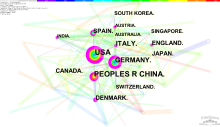
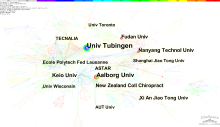
| 排名 | 国家 | 发文量 | 中心性 |
|---|---|---|---|
| 1 | 美国 | 118 | 0.31 |
| 2 | 中国 | 110 | 0.15 |
| 3 | 德国 | 89 | 0.26 |
| 4 | 意大利 | 56 | 0.16 |
| 5 | 日本 | 45 | 0.05 |
"

"
| 排名 | 机构 | 频次 | 中心性 |
|---|---|---|---|
| 1 | 图宾根大学(德国) | 46 | 0.41 |
| 2 | 奥尔堡大学(丹麦) | 30 | 0.09 |
| 3 | 庆应义塾大学(日本) | 20 | 0.06 |
| 4 | 南洋理工大学(新加坡) | 17 | 0.10 |
| 5 | 复旦大学(中国) | 15 | 0.09 |
"

"
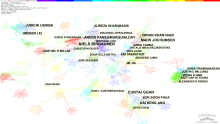
| 排名 | 作者 | 频次 | 中心性 |
|---|---|---|---|
| 1 | Niels Birbaumer | 27 | 0.16 |
| 2 | Cuntai Guan | 20 | 0.14 |
| 3 | Mads Jochumsen | 20 | 0.08 |
| 4 | Junichi Ushiba | 18 | 0.04 |
| 5 | Kai Keng Ang | 18 | 0.11 |
"

"
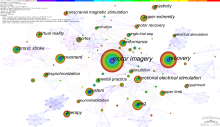
| 排名 | 关键词 | 频次 | 中心性 |
|---|---|---|---|
| 1 | motor imagery | 223 | 0.12 |
| 2 | recovery | 177 | 0.11 |
| 3 | EEG | 79 | 0.33 |
| 4 | movement | 68 | 0.11 |
| 5 | functional electrical stimulation | 66 | 0.30 |
| 6 | system | 61 | 0.19 |
| 7 | chronic stroke | 54 | 0.15 |
| 8 | therapy | 54 | 0.11 |
| 9 | upper extremity | 47 | 0.13 |
| 10 | performance | 46 | 0.03 |
"

"
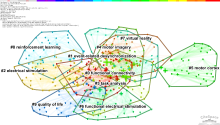
| 聚类号 | 聚类中包含的主要关键词 |
|---|---|
| #0 | motor recovery; functional connectivity; neural plasticity; motor impairment; noninvasive brain stimulation; cortex activity; feedback |
| #1 | event-related desynchronization; electroencephalogram; selection; pattern; independent component analysis |
| #2 | upper extremity; electrical stimulation; plasticity; gait rehabilitation; walking; mu rhythm |
| #3 | mental practice; task analysis; reorganization; cortical potential; mechanism; movement intention |
| #4 | motor imagery; transcranial magnetic stimulation; spremotor cortex; fMRI; self regulation |
| #5 | neurofeedback; motor cortex; hand function; functional near-infrared spectroscopy |
| #6 | modulation; functional electrical stimulation; induced movement therapy; neural plasticity; beta oscillation |
| #7 | virtual reality; cognition; cortical control; functional recovery |
| #8 | chronic stroke; reinforcement learning; motor cortex; moter evoked potentials |
| #9 | quality of life; functional restoration; soft robotics |
"
"
| 排名 | 第一作者 | 年份 | 题目 | 频次 | 中心性 |
|---|---|---|---|---|---|
| 1 | Ramos-Murguialday A | 2013 | Brainmachine interface in chronic stroke rehabilitation: a controlled study | 124 | 0.09 |
| 2 | Biasiucci A | 2018 | Brain-actuated functional electrical stimulation elicits lasting arm motor recovery after stroke | 93 | 0.01 |
| 3 | Pichiorri F | 2015 | Brain-computer interface boosts motor imagery practice during stroke recovery | 88 | 0.04 |
| 4 | Cervera M A | 2018 | Brain-computer interfaces for post-stroke motor rehabilitation: a meta-analysis | 82 | 0.02 |
| 5 | Ang K K | 2015 | A randomized controlled trial of EEG-based motor imagery brain-computer interface robotic rehabilitation for stroke | 70 | 0.02 |
"
| 排名 | 期刊名称 | 国家 | 频次 | 中心性 |
|---|---|---|---|---|
| 1 | Clin Neurophysiol | 英国 | 409 | 0.02 |
| 2 | Stroke | 美国 | 380 | 0.03 |
| 3 | J Neural Eng | 英国 | 378 | 0.06 |
| 4 | J Neuroeng Rehabil | 英国 | 371 | 0.07 |
| 5 | IEEE T Neur Sys Reh | 美国 | 357 | 0.06 |
| [1] |
WU S, WU B, LIU M, et al. Stroke in China: advances and challenges in epidemiology, prevention, and management[J]. Lancet Neurol, 2019, 18(4): 394-405.
doi: S1474-4422(18)30500-3 pmid: 30878104 |
| [2] |
STINEAR C M, LANG C E, ZEILER S, et al. Advances and challenges in stroke rehabilitation[J]. Lancet Neurol, 2020, 19(4): 348-360.
doi: S1474-4422(19)30415-6 pmid: 32004440 |
| [3] |
MCLEAN D E. Medical complications experienced by a cohort of stroke survivors during inpatient, tertiary-level stroke rehabilitation[J]. Arch Phys Med Rehabil, 2004, 85(2): 466-469.
doi: 10.1016/S0003-9993(03)00484-2 |
| [4] | 陈树耿, 贾杰. 脑机接口在脑卒中手功能康复中的应用进展[J]. 中国康复理论与实践, 2017, 23(1): 23-26. |
| CHEN S G, JIA J. Advances in the application of brain-computer interface in stroke hand function rehabilitation[J]. Chin J Rehabil Theory Pract, 2017, 23(1): 23-26. | |
| [5] |
GAO X, WANG Y, CHEN X, et al. Interface, interaction, and intelligence in generalized brain computer interfaces[J]. Trends Cogn Sci, 2021, 25(8): 671-684.
doi: 10.1016/j.tics.2021.04.003 |
| [6] |
BIASIUCCI A, LEEB R, ITURRATE I, et al. Brain-actuated functional electrical stimulation elicits lasting arm motor recovery after stroke[J]. Nat Commun, 2018, 9(1): 2421.
doi: 10.1038/s41467-018-04673-z pmid: 29925890 |
| [7] |
LI X, MA E, QU H. Knowledge mapping of hospitality research: a visual analysis using CiteSpace[J]. Int J Hosp Manag, 2017, 60(7): 77-93.
doi: 10.1016/j.ijhm.2016.10.006 |
| [8] |
XU A H, SUN Y X. Research hotspots and effectiveness of repetitive transcranial magnetic stimulation in stroke rehabilitation[J]. Neural Regen Res, 2020, 15(11): 2089-2097.
doi: 10.4103/1673-5374.282269 |
| [9] | CHEN C. The structure and dynamics of cocitation clusters:a multiple-perspective cocitation analysis[J]. Wiley Inter Sci, 2009, 7(61): 1386-1409. |
| [10] |
CHEN C. Searching for intellectual turning points: progressive knowledge domain visualization[J]. Proc Natl Acad Sci USA, 2004, 101(Suppl 1): 5303-5310.
doi: 10.1073/pnas.0307513100 |
| [11] |
LIU Z, YIN Y, LIU W, et al. Visualizing the intellectual structure and evolution of innovation systems research: a bibliometric analysis[J]. Scientometrics, 2015, 103(1): 135-158.
doi: 10.1007/s11192-014-1517-y |
| [12] |
POO M M, DU J L, IP N Y, et al. China brain project: basic neuroscience, brain diseases, and brain-inspired computing[J]. Neuron, 2016, 92(3): 591-596.
doi: 10.1016/j.neuron.2016.10.050 |
| [13] |
BUCH E, WEBER C, COHEN L G, et al. Think to move: a neuromagnetic brain-computer interface (BCI) system for chronic stroke[J]. Stroke, 2008, 39(3): 910-917.
doi: 10.1161/STROKEAHA.107.505313 pmid: 18258825 |
| [14] |
CHAUDHARY U, BIRBAUMER N, RAMOS-MURGUIALDAY A. Brain-computer interfaces for communication and rehabilitation[J]. Nat Rev Neurol, 2016, 12(9): 513-525.
doi: 10.1038/nrneurol.2016.113 pmid: 27539560 |
| [15] |
CHAUDHARY U, BIRBAUMER N, CURADO M R. Brain-machine interface (BMI) in paralysis[J]. Ann Phys Rehabil Med, 2015, 58(1): 9-13.
doi: S1877-0657(14)01835-1 pmid: 25623294 |
| [16] |
CHAUDHARY U, BIRBAUMER N, RAMOS-MURGUIALDAY A. Brain-computer interfaces in the completely locked-in state and chronic stroke[J]. Prog Brain Res, 2016, 228: 131-161.
doi: 10.1016/bs.pbr.2016.04.019 pmid: 27590968 |
| [17] |
CHEN S, CAO L, SHU X, et al. Longitudinal electroencephalography analysis in subacute stroke patients during intervention of brain-computer interface with exoskeleton feedback[J]. Front Neurosci, 2020, 14: 809.
doi: 10.3389/fnins.2020.00809 |
| [18] |
LI M, LIU Y, WU Y, et al. Neurophysiological substrates of stroke patients with motor imagery-based brain-computer interface training[J]. Int J Neurosci, 2014, 124(6): 403-415.
doi: 10.3109/00207454.2013.850082 pmid: 24079396 |
| [19] |
CERVERA M A, SOEKADAR S R, USHIBA J, et al. Brain-computer interfaces for post-stroke motor rehabilitation: a meta-analysis[J]. Ann Clin Transl Neurol, 2018, 5(5): 651-663.
doi: 10.1002/acn3.2018.5.issue-5 |
| [20] |
JOHNSON N N, CAREY J, EDELMAN B J, et al. Combined rTMS and virtual reality brain-computer interface training for motor recovery after stroke[J]. J Neural Eng, 2018, 15(1): 016009.
doi: 10.1088/1741-2552/aa8ce3 |
| [21] |
DING Q, LIN T, WU M, et al. Influence of iTBS on the acute neuroplastic change after BCI training[J]. Front Cell Neurosci, 2021, 15: 653487.
doi: 10.3389/fncel.2021.653487 |
| [22] |
SHU X, CHEN S, CHAI G, et al. Neural modulation by repetitive transcranial magnetic stimulation (rTMS) for BCI enhancement in stroke patients[J]. Annu Int Conf IEEE Eng Med Biol Soc, 2018, 2018: 2272-2275.
doi: 10.1109/EMBC.2018.8512860 pmid: 30440859 |
| [23] |
ANG K K, GUAN C, PHUA K S, et al. Facilitating effects of transcranial direct current stimulation on motor imagery brain-computer interface with robotic feedback for stroke rehabilitation[J]. Arch Phys Med Rehabil, 2015, 96(3 Suppl): S79-S87.
doi: 10.1016/j.apmr.2014.08.008 |
| [24] |
IRIMIA D C, CHO W, ORTNER R, et al. Brain-computer interfaces with multi-sensory feedback for stroke rehabilitation: a case study[J]. Artif Organs, 2017, 41(11): E178-E184.
doi: 10.1111/aor.2017.41.issue-11 |
| [25] |
RAMOS-MURGUIALDAY A, BROETZ D, REA M, et al. Brain-machine interface in chronic stroke rehabilitation: a controlled study[J]. Ann Neurol, 2013, 74(1): 100-108.
doi: 10.1002/ana.v74.1 |
| [26] |
PICHIORRI F, MORONE G, PETTI M, et al. Brain-computer interface boosts motor imagery practice during stroke recovery[J]. Ann Neurol, 2015, 77(5): 851-865.
doi: 10.1002/ana.24390 pmid: 25712802 |
| [27] |
ANG K K, CHUA K S G, PHUA K S, et al. A randomized controlled trial of EEG-based motor imagery brain-computer interface robotic rehabilitation for stroke[J]. Clin EEG Neurosci, 2015, 46(4): 310-320.
doi: 10.1177/1550059414522229 pmid: 24756025 |
| [28] |
RASHID M, SULAIMAN N, P P ABDUL MAJEED A, et al. Current status, challenges, and possible solutions of EEG-based brain-computer interface: a comprehensive review[J]. Front Neurorobot, 2020, 14: 25.
doi: 10.3389/fnbot.2020.00025 |
| [29] |
MCCRIMMON C M, KING C E, WANG P T, et al. Brain-controlled functional electrical stimulation for lower-limb motor recovery in stroke survivors[J]. Annu Int Conf IEEE Eng Med Biol Soc, 2014, 2014: 1247-1250.
doi: 10.1109/EMBC.2014.6943823 pmid: 25570191 |
| [30] |
MCCRIMMON C M, KING C E, WANG P T, et al. Brain-controlled functional electrical stimulation therapy for gait rehabilitation after stroke: a safety study[J]. J Neuroeng Rehabil, 2015, 11(12): 57.
doi: 10.1186/1743-0003-11-57 |
| [31] |
DO A H, WANG P T, KING C E, et al. Brain-computer interface controlled functional electrical stimulation device for foot drop due to stroke[J]. Annu Int Conf IEEE Eng Med Biol Soc, 2012, 2012: 6414-6417.
doi: 10.1109/EMBC.2012.6347462 pmid: 23367397 |
| [32] |
TAKAHASHI M, TAKEDA K, OTAKA Y, et al. Event related desynchronization-modulated functional electrical stimulation system for stroke rehabilitation: a feasibility study[J]. J Neuroeng Rehabil, 2012, 16(9): 56.
doi: 10.1186/s12984-019-0531-y |
| [33] |
ROST N S, BRODTMANN A, PASE M P, et al. Post-stroke cognitive impairment and dementia[J]. Circ Res, 2022, 130(8): 1252-1271.
doi: 10.1161/CIRCRESAHA.122.319951 pmid: 35420911 |
| [34] |
TOPPI J, MATTIA D, ANZOLIN A, et al. Time varying effective connectivity for describing brain network changes induced by a memory rehabilitation treatment[J]. Annu Int Conf IEEE Eng Med Biol Soc, 2014, 2014: 6786-6789.
doi: 10.1109/EMBC.2014.6945186 pmid: 25571554 |
| [35] | KOBER S E, SCHWEIGER D, WITTE M, et al. Specific effects of EEG based neurofeedback training on memory functions in post-stroke victims[J]. J Neuroeng Rehabil, 2015, 1(12): 107. |
| [36] | CARELLI L, SOLCA F, FAINI A, et al. Brain-computer interface for clinical purposes: cognitive assessment and rehabilitation[J]. Biomed Res Int, 2017, 2017: 1695290. |
| [37] |
MANE R, CHOUHAN T, GUAN C. BCI for stroke rehabilitation: motor and beyond[J]. J Neural Eng, 2020, 17(4): 041001.
doi: 10.1088/1741-2552/aba162 |
| [38] | MANE R, WU Z, WANG D. Poststroke motor, cognitive and speech rehabilitation with brain-computer interface: a perspective review[J]. Stroke Vasc Neurol, 2022, 2022: 001506. |
| [1] | QIAN Liguo, WU Tongxuan, ZHANG Qiaoyun, XING Jian, YANG Yanyan. Design and application effect of continuing education case library combined with case-based learning for rehabilitation therapists [J]. Chinese Journal of Rehabilitation Theory and Practice, 2026, 32(3): 249-257. |
| [2] | AN Le, QIN Xiaoxia, GU Bin, HU Guobing, TIAN Weiyi. A competency model for "dual-qualified" teachers in vocational undergraduate rehabilitation therapy programs based on the integration of rehabilitation competency framework and multi-source standards [J]. Chinese Journal of Rehabilitation Theory and Practice, 2026, 32(3): 258-269. |
| [3] | LIU Hua, WANG Liyuan, MA Xin, LI Jing, WANG Li. OBE-CDIO model of teaching for curriculum of exercise rehabilitation training [J]. Chinese Journal of Rehabilitation Theory and Practice, 2026, 32(3): 270-275. |
| [4] | LIU Xia, ZHANG Yuanmin, GE Shuhui, LIU Jinmei, SUN Chenming, WANG Yuanhui, LIU Jing, LI Wenfu. Cultivation mode of rehabilitation therapy talents in local colleges and universities under the background of New Medicine [J]. Chinese Journal of Rehabilitation Theory and Practice, 2026, 32(3): 276-285. |
| [5] | ZHU Lili, ZHAO Jiaxin, CHENG Xue, WANG Huijuan, CHEN Xiaoxia. Experiences and needs of stroke patients during rehabilitation: a qualitative meta-synthesis [J]. Chinese Journal of Rehabilitation Theory and Practice, 2026, 32(3): 286-293. |
| [6] | LIU Ping, ZHOU Nan, XUE Xiaojie, SHAO Weibo. Application of rehabilitation therapy techniques for post-stroke dysphagia: a bibliometric analysis [J]. Chinese Journal of Rehabilitation Theory and Practice, 2026, 32(3): 294-303. |
| [7] | PU Xinyu, WANG Jingxuan, WANG Hujun, XIU Anda, WANG Yingpeng. Application of repetitive peripheral magnetic stimulation in rehabilitation therapy: a bibliometric analysis [J]. Chinese Journal of Rehabilitation Theory and Practice, 2026, 32(3): 304-316. |
| [8] | SUN Kui, HUANG Hailun, LIU Yongai, GAO Heng. Brain-computer interface technology in treatment for spinal cord injury: a bibliometric analysis [J]. Chinese Journal of Rehabilitation Theory and Practice, 2026, 32(3): 317-328. |
| [9] | YANG Ling, WANG Qinglei, WANG Jie, XU Wenjie, WANG Tong, GUO Chuan, QIAN Xue. Activation patterns and mechanism in the prefrontal cortex of post-stroke anxiety patients: a study using functional near-infrared spectroscopy [J]. Chinese Journal of Rehabilitation Theory and Practice, 2026, 32(3): 329-336. |
| [10] | ZHANG Wenjing, LI Hao, YUAN Jiajia, HU Huaining. Effect of tele-supervised home-based pulmonary music therapy on chronic obstructive pulmonary disease [J]. Chinese Journal of Rehabilitation Theory and Practice, 2026, 32(3): 337-344. |
| [11] | WU Shicai. Theoretical construction and practical exploration of rehabilitation ethics management [J]. Chinese Journal of Rehabilitation Theory and Practice, 2026, 32(2): 125-131. |
| [12] | HE Zhaonan, ZHANG Tingting, HE Zhaoke, MENG Lijun. Topic mining and content analysis of rehabilitation ethics research in China based on BERTopic model [J]. Chinese Journal of Rehabilitation Theory and Practice, 2026, 32(2): 132-141. |
| [13] | MENG Lijun. Challenges and reflections on ethical review of rehabilitation research for children with disabilities [J]. Chinese Journal of Rehabilitation Theory and Practice, 2026, 32(2): 142-150. |
| [14] | LI Shuiyan, LI Xiang, LI Yanhui, LU Yimeng, LI Dujuan, YANG Xiaoliang, XIE Qiuyou. Application of airway clearance techniques in critical care rehabilitation: a bibliometric analysis [J]. Chinese Journal of Rehabilitation Theory and Practice, 2026, 32(2): 162-173. |
| [15] | XIA Yan, XU Siwei, ZHU Yanyan, WANG Fengli, LIANG Sijie, LI Jingye, MEI Guangyan, XIANG Jie. Effect of personalized home-based rehabilitation under digital health model on Parkinson's disease [J]. Chinese Journal of Rehabilitation Theory and Practice, 2026, 32(2): 181-190. |
| Viewed | ||||||
|
Full text |
|
|||||
|
Abstract |
|
|||||
|
||
