



《Chinese Journal of Rehabilitation Theory and Practice》 ›› 2023, Vol. 29 ›› Issue (8): 954-960.doi: 10.3969/j.issn.1006-9771.2023.08.013
Previous Articles Next Articles
LIU Yang1, ZHANG Peng1, HUANG Ying2, CHEN Han2, XU Chen1, LI Min1( )
)
Received:2023-04-25
Revised:2023-06-29
Published:2023-08-25
Online:2023-10-09
Contact:
LI Min
E-mail:limin52267@tmmu.com
Supported by:CLC Number:
LIU Yang, ZHANG Peng, HUANG Ying, CHEN Han, XU Chen, LI Min. Path analysis of mediating effect of perceived stress affecting impact of event in rehabilitation patients with traumatic injury[J]. 《Chinese Journal of Rehabilitation Theory and Practice》, 2023, 29(8): 954-960.
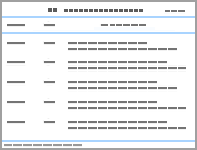
"
| 变量 | 评分 |
|---|---|
| 知觉压力 | 23.91±9.35 |
| 情绪调节困难 | 80.92±21.79 |
| 沉思 | 20.16±6.41 |
| 睡眠 | 22.43±7.42 |
| 事件影响程度 | 28.51±18.89 |
"
| 变量 | 知觉压力 | 情绪调节困难 | 沉思 | 睡眠 | 事件影响程度 |
|---|---|---|---|---|---|
| 知觉压力 | 1 | ||||
| 情绪调节困难 | 0.656a | 1 | |||
| 沉思 | 0.447a | 0.487a | 1 | ||
| 睡眠 | 0.539a | 0.585a | 0.447a | 1 | |
| 事件影响程度 | 0.467a | 0.582a | 0.581a | 0.684a | 1 |
"
| 变量 | 整体拟合指数 | 回归系数显著性 | ||||||
|---|---|---|---|---|---|---|---|---|
| 结果变量 | 预测变量 | R | R2 | F | β | t值 | ||
| 事件影响程度 | 0.51 | 0.26 | 21.47c | |||||
| 性别 | 0.11 | 0.78 | ||||||
| 年龄 | 0.29 | 2.68 | ||||||
| 知觉压力 | 0.49 | 7.39c | ||||||
| 情绪调节困难 | 0.68 | 0.46 | 53.46c | |||||
| 性别 | -0.08 | -0.65 | ||||||
| 年龄 | 0.30 | 3.27 | ||||||
| 知觉压力 | 0.70 | 12.38c | ||||||
| 沉思 | 0.52 | 0.27 | 16.99c | |||||
| 性别 | 0.05 | 0.32 | ||||||
| 年龄 | -0.05 | -0.48 | ||||||
| 知觉压力 | 0.21 | 2.35a | ||||||
| 情绪调节困难 | 0.35 | 4.09c | ||||||
| 睡眠 | 0.65 | 0.42 | 27.19c | |||||
| 性别 | -0.08 | -0.60 | ||||||
| 年龄 | 0.22 | 2.24 | ||||||
| 知觉压力 | 0.29 | 3.64c | ||||||
| 情绪调节困难 | 0.30 | 3.85c | ||||||
| 沉思 | 0.18 | 2.75b | ||||||
| 事件影响程度 | 0.77 | 0.59 | 44.41c | |||||
| 性别 | 0.17 | 1.53 | ||||||
| 年龄 | 0.07 | 0.88 | ||||||
| 知觉压力 | -0.04 | -0.55 | ||||||
| 情绪调节困难 | 0.18 | 2.66b | ||||||
| 沉思 | 0.30 | 5.37c | ||||||
| 睡眠 | 0.45 | 7.26c | ||||||
"
| 项目 | 效应值 | Boot标准误 | 95%CI | 效应占比/% | |
|---|---|---|---|---|---|
| 下限 | 上限 | ||||
| 直接效应 | -0.0385 | 0.0699 | -0.1763 | 0.0993 | |
| 总间接效应 | 0.5265 | 0.0694 | 0.3903 | 0.6633 | 100.00 |
| 间接效应1 | 0.1285 | 0.0503 | 0.0317 | 0.2287 | 24.41 |
| 间接效应2 | 0.0627 | 0.0317 | 0.0036 | 0.1287 | 11.91 |
| 间接效应3 | 0.1307 | 0.0428 | 0.0521 | 0.2205 | 24.82 |
| 间接效应4 | 0.0731 | 0.0249 | 0.0313 | 0.1287 | 13.88 |
| 间接效应5 | 0.0952 | 0.0311 | 0.0378 | 0.1612 | 18.08 |
| 间接效应6 | 0.0167 | 0.0112 | 0.0003 | 0.0426 | 3.17 |
| 间接效应7 | 0.0195 | 0.0092 | 0.0042 | 0.0400 | 3.70 |

"

| [1] |
TANG E H M, BEDFORD L E, YU E Y T, et al. Unintentional injury burden in Hong Kong: results from a representative population-based survey[J]. Int J Environ Res Public Health, 2021, 18(16): 8826.
doi: 10.3390/ijerph18168826 |
| [2] | 赵海峰, 董超群, 汤妍, 等. 意外创伤者早期自我表露与创伤后成长的关系研究[J]. 护理学杂志, 2020, 35(1): 57-60. |
| ZHAO H F, DONG C Q, TANG Y, et al. Relationship between self-disclosure and post-traumatic growth among patients at the early stage of accidental trauma[J]. J Nurs Sci, 2020, 35(1): 57-60. | |
| [3] | POZZATO I, CRAIG A, GOPINATH B, et al. Biomarkers of autonomic regulation for predicting psychological distress and functional recovery following road traffic injuries: protocol for a prospective cohort study[J]. BMJ Open, 2019, 9(4): e24391. |
| [4] |
ALI A M, AL-AMER R, KUNUGI H, et al. The Arabic version of the Impact of Event Scale-revised: psychometric evaluation among psychiatric patients and the general public within the context of COVID-19 outbreak and quarantine as collective traumatic events[J]. J Pers Med, 2022, 12(5): 681.
doi: 10.3390/jpm12050681 |
| [5] |
XUE M, YUAN Y, CHEN H, et al. Perceived stress and symptoms of post-traumatic stress disorder in nurses: a moderated mediation model of maladaptive cognitive emotional regulation and psychological capital[J]. Front Psychiatry, 2022, 13: 902558.
doi: 10.3389/fpsyt.2022.902558 |
| [6] |
ESKILDSEN A, FENTZ H N, ANDERSEN L P, et al. Perceived stress, disturbed sleep, and cognitive impairments in patients with work-related stress complaints: a longitudinal study[J]. Stress, 2017, 20(4): 371-378.
doi: 10.1080/10253890.2017.1341484 pmid: 28605986 |
| [7] | JEFTIC A, IKIZER G, TUOMINEN J, et al. Connection between the COVID-19 pandemic, war trauma reminders, perceived stress, loneliness, and PTSD in Bosnia and Herzegovina[J]. [ahead of print]. Curr Psychol, 2021. doi: 10.1007/s12144-022-02876-8. |
| [8] |
FORBES C N, TULL M T, RAPPORT D, et al. Emotion dysregulation prospectively predicts posttraumatic stress disorder symptom severity 3 months after trauma exposure[J]. J Trauma Stress, 2020, 33(6): 1007-1016.
doi: 10.1002/jts.v33.6 |
| [9] |
HUA Z, MA D, XIA X. Emotional dysregulation and time structure mediate the link between perceived stress and insomnia among unemployed young people in China: a cross-sectional study[J]. Int J Environ Res Public Health, 2022, 19(19): 11883.
doi: 10.3390/ijerph191911883 |
| [10] |
PENCEA I, MUNOZ A P, MAPLES-KELLER J L, et al. Emotion dysregulation is associated with increased prospective risk for chronic PTSD development[J]. J Psychiatr Res, 2020, 121: 222-228.
doi: S0022-3956(19)30946-X pmid: 31865212 |
| [11] |
SHNAIDER P, BOYD J E, CAMERON D H, et al. The relationship between emotion regulation difficulties and PTSD outcomes during group cognitive processing therapy for PTSD[J]. Psychol Serv, 2021, 19(4): 751-759.
doi: 10.1037/ser0000546 pmid: 34726458 |
| [12] | HAYES J P, VANELZAKKER M B, SHIN L M. Emotion and cognition interactions in PTSD: a review of neurocognitive and neuroimaging studies[J]. Front Integr Neurosci, 2012, 6: 89. |
| [13] |
PUGACH C P, CAMPBELL A A, WISCO B E. Emotion regulation in posttraumatic stress disorder (PTSD): rumination accounts for the association between emotion regulation difficulties and PTSD severity[J]. J Clin Psychol, 2019, 76(3): 508-525.
doi: 10.1002/jclp.v76.3 |
| [14] |
EHRING T, EHLERS A. Does rumination mediate the relationship between emotion regulation ability and posttraumatic stress disorder?[J]. Eur J Psychotraumatol, 2014, 5(1): 23547.
doi: 10.3402/ejpt.v5.23547 |
| [15] |
ZETSCHE U, EHRING T, EHLERS A. The effects of rumination on mood and intrusive memories after exposure to traumatic material: an experimental study[J]. J Behav Ther Exp Psychiatry, 2009, 40(4): 499-514.
doi: 10.1016/j.jbtep.2009.07.001 |
| [16] |
MOULDS M L, BISBY M A, WILD J, et al. Rumination in posttraumatic stress disorder: a systematic review[J]. Clin Psychol Rev, 2020, 82: 101910.
doi: 10.1016/j.cpr.2020.101910 |
| [17] |
LIND M J, BAYLOR A, OVERSTREET C M, et al. Relationships between potentially traumatic events, sleep disturbances, and symptoms of PTSD and alcohol use disorder in a young adult sample[J]. Sleep Med, 2017, 34: 141-147.
doi: S1389-9457(17)30114-4 pmid: 28522083 |
| [18] | 严由伟, 刘明艳, 唐向东, 等. 压力反应、压力应对与睡眠质量关系述评[J]. 心理科学进展, 2010, 18(11): 1734-1746. |
| YAN Y W, LIU M Y, TANG X D, et al. Review on the relationship between stress response, stress coping and sleep quality[J]. Adv Psychol Sci, 2010, 18(11): 1734-1746. | |
| [19] |
GERMAIN A, BUYSSE D J, NOFZINGER E. Sleep-specific mechanisms underlying posttraumatic stress disorder: integrative review and neurobiological hypotheses[J]. Sleep Med Rev, 2008, 12(3): 185-195.
doi: 10.1016/j.smrv.2007.09.003 pmid: 17997114 |
| [20] | 杨廷忠. 社会转型中城市人群心理压力研究[J]. 中华流行病学杂志, 2002, 23(6): 473-474. |
| YANG T Z. A study on the psychological stress of urban population in social transformation[J]. Chin J Epidemiol, 2002, 23(6): 473-474. | |
| [21] | 王力, 柳恒超, 杜卫, 等. 情绪调节困难量表在中国人群中的初步测试[J]. 中国健康心理学杂志, 2007, 15(4): 336-340. |
| WANG L, LIU H C, DU W, et al. Test of Difficulties in Emotion Regulation Scale in Chinese people[J]. Chin J Health Psychol, 2007, 15(4): 336-340. | |
| [22] |
TREYNOR W, GONZALEZ R, NOLEN-HOEKSEMA S. Rumination reconsidered: a psychometric analysis[J]. Cognit Ther Res, 2003, 27(3): 247-259.
doi: 10.1023/A:1023910315561 |
| [23] | 李建明. 睡眠状况自评量表(SRSS)简介[J]. 中国健康心理学杂志, 2012, 20(12): 1851. |
| LI J M. Seff-rating Scale of Sleep (SRSS)[J]. Chin J Health Psychol, 2012, 20(12): 1851. | |
| [24] | 黄国平, 张亚林, 向慧, 等. 事件影响量表-修订版(IES-R)在女性犯人中的信度、效度分析[J]. 中国心理卫生杂志, 2006, 20(1): 28-31. |
| HUANG G P, ZHANG Y L, XIANG H, et al. The Chinese version of the Impact of Event Scale-revised: reliability and validity[J]. Chin Mental Health J, 2006, 20(1): 28-31. | |
| [25] | 邓稳根, 黎小瑜, 陈勃, 等. 国内心理学文献中共同方法偏差检验的现状[J]. 江西师范大学学报(自然科学版), 2018, 42(5): 447-453. |
| DENG W G, LI X Y, CHEN B, et al. Analysis on application of common methods bias test to psychological studies during recent five years in China[J]. J Jiangxi Normal Univy (Nat Sci), 2018, 42(5): 447-453. | |
| [26] | 项少茜, 周雪来, 金聪慧. 意外伤害导致骨科手术患者事件影响程度调查研究[J]. 中国卫生统计, 2022, 39(1): 115-117. |
| XIANG S Q, ZHOU X L, JIN C H. Investigation on the degree of impact of accidents on orthopedic surgery patients[J]. Chin J Health Statistic, 2022, 39(1): 115-117. | |
| [27] |
CHERRY M L, WILCOX M M. Decreasing perceived and academic stress through emotion regulation and nonjudging with trauma-exposed college students[J]. Int J Stress Manag, 2020, 27(2): 101-110.
doi: 10.1037/str0000138 |
| [28] |
GORI A, TOPINO E, MUSETTI A. The relationship among anxiety, worry, perceived stress, defense mechanisms, and high levels of post-traumatic stress symptoms: a discriminant analytic approach[J]. J Pers Med, 2023, 13(2): 237.
doi: 10.3390/jpm13020237 |
| [29] |
ROOS L E, KNIGHT E L, BEAUCHAMP K G, et al. Acute stress impairs inhibitory control based on individual differences in parasympathetic nervous system activity[J]. Biol Psychol, 2017, 125: 58-63.
doi: S0301-0511(17)30049-2 pmid: 28268165 |
| [30] |
MILLON E M, SHORS T J. How mental health relates to everyday stress, rumination, trauma and interoception in women living with HIV: a factor analytic study[J]. Learn Motiv, 2021, 73: 101680.
doi: 10.1016/j.lmot.2020.101680 |
| [31] |
BASTA M, CHROUSOS G P, VELA-BUENO A, et al. Chronic insomnia and stress system[J]. Sleep Med Clin, 2007, 2(2): 279-291.
doi: 10.1016/j.jsmc.2007.04.002 pmid: 18071579 |
| [32] |
NG R M K, BHUGRA D. Relationship between filial piety, meta-cognitive beliefs about rumination and response style theory in depressed Chinese patients[J]. Asian J Psychiatr, 2008, 1(2): 28-32.
doi: 10.1016/j.ajp.2008.09.009 pmid: 23050992 |
| [33] |
MEI S, LIANG L, REN H, et al. Association between perceived stress and post-traumatic stress disorder among medical staff during the COVID-19 epidemic in Wuhan city[J]. Front Public Health, 2021, 9: 666460.
doi: 10.3389/fpubh.2021.666460 |
| [34] |
BABSON K A, FELDNER M T. Temporal relations between sleep problems and both traumatic event exposure and PTSD: a critical review of the empirical literature[J]. J Anxiety Disord, 2010, 24(1): 1-15.
doi: 10.1016/j.janxdis.2009.08.002 pmid: 19716676 |
| [35] |
GERMAIN A. Sleep disturbances as the hallmark of PTSD: where are we now?[J]. Am J Psychiatr, 2013, 170(4): 372-382.
doi: 10.1176/appi.ajp.2012.12040432 |
| [36] |
LIU X, WEN X, ZHANG Q, et al. Buffering traumatic reactions to COVID-19: mindfulness moderates the relationship between the severity of the pandemic and posttraumatic stress symptoms[J]. Psychol Trauma, 2023, 15(3): 474-482.
doi: 10.1037/tra0001227 |
| [1] | QIAN Liguo, WU Tongxuan, ZHANG Qiaoyun, XING Jian, YANG Yanyan. Design and application effect of continuing education case library combined with case-based learning for rehabilitation therapists [J]. Chinese Journal of Rehabilitation Theory and Practice, 2026, 32(3): 249-257. |
| [2] | AN Le, QIN Xiaoxia, GU Bin, HU Guobing, TIAN Weiyi. A competency model for "dual-qualified" teachers in vocational undergraduate rehabilitation therapy programs based on the integration of rehabilitation competency framework and multi-source standards [J]. Chinese Journal of Rehabilitation Theory and Practice, 2026, 32(3): 258-269. |
| [3] | LIU Hua, WANG Liyuan, MA Xin, LI Jing, WANG Li. OBE-CDIO model of teaching for curriculum of exercise rehabilitation training [J]. Chinese Journal of Rehabilitation Theory and Practice, 2026, 32(3): 270-275. |
| [4] | LIU Xia, ZHANG Yuanmin, GE Shuhui, LIU Jinmei, SUN Chenming, WANG Yuanhui, LIU Jing, LI Wenfu. Cultivation mode of rehabilitation therapy talents in local colleges and universities under the background of New Medicine [J]. Chinese Journal of Rehabilitation Theory and Practice, 2026, 32(3): 276-285. |
| [5] | ZHU Lili, ZHAO Jiaxin, CHENG Xue, WANG Huijuan, CHEN Xiaoxia. Experiences and needs of stroke patients during rehabilitation: a qualitative meta-synthesis [J]. Chinese Journal of Rehabilitation Theory and Practice, 2026, 32(3): 286-293. |
| [6] | LIU Ping, ZHOU Nan, XUE Xiaojie, SHAO Weibo. Application of rehabilitation therapy techniques for post-stroke dysphagia: a bibliometric analysis [J]. Chinese Journal of Rehabilitation Theory and Practice, 2026, 32(3): 294-303. |
| [7] | PU Xinyu, WANG Jingxuan, WANG Hujun, XIU Anda, WANG Yingpeng. Application of repetitive peripheral magnetic stimulation in rehabilitation therapy: a bibliometric analysis [J]. Chinese Journal of Rehabilitation Theory and Practice, 2026, 32(3): 304-316. |
| [8] | ZHANG Wenjing, LI Hao, YUAN Jiajia, HU Huaining. Effect of tele-supervised home-based pulmonary music therapy on chronic obstructive pulmonary disease [J]. Chinese Journal of Rehabilitation Theory and Practice, 2026, 32(3): 337-344. |
| [9] | WU Shicai. Theoretical construction and practical exploration of rehabilitation ethics management [J]. Chinese Journal of Rehabilitation Theory and Practice, 2026, 32(2): 125-131. |
| [10] | HE Zhaonan, ZHANG Tingting, HE Zhaoke, MENG Lijun. Topic mining and content analysis of rehabilitation ethics research in China based on BERTopic model [J]. Chinese Journal of Rehabilitation Theory and Practice, 2026, 32(2): 132-141. |
| [11] | MENG Lijun. Challenges and reflections on ethical review of rehabilitation research for children with disabilities [J]. Chinese Journal of Rehabilitation Theory and Practice, 2026, 32(2): 142-150. |
| [12] | LI Shuiyan, LI Xiang, LI Yanhui, LU Yimeng, LI Dujuan, YANG Xiaoliang, XIE Qiuyou. Application of airway clearance techniques in critical care rehabilitation: a bibliometric analysis [J]. Chinese Journal of Rehabilitation Theory and Practice, 2026, 32(2): 162-173. |
| [13] | XIA Yan, XU Siwei, ZHU Yanyan, WANG Fengli, LIANG Sijie, LI Jingye, MEI Guangyan, XIANG Jie. Effect of personalized home-based rehabilitation under digital health model on Parkinson's disease [J]. Chinese Journal of Rehabilitation Theory and Practice, 2026, 32(2): 181-190. |
| [14] | QI Li, ZHANG Lei, QI Yi, FENG Lijun, LIU Dongmei, MA Huina. Effect of cardiopulmonary rehabilitation exercise on old patients with chronic obstructive pulmonary disease and chronic heart failure [J]. Chinese Journal of Rehabilitation Theory and Practice, 2026, 32(2): 191-197. |
| [15] | HUANG Ru, QIU Ziyu, CAI Dongxing, LU Xunwen, GAO Chaoquan. Effect of intelligent work simulation training combined with activity pacing on brain injury patients with headache [J]. Chinese Journal of Rehabilitation Theory and Practice, 2026, 32(2): 215-221. |
| Viewed | ||||||
|
Full text |
|
|||||
|
Abstract |
|
|||||
|
||
