



Chinese Journal of Rehabilitation Theory and Practice ›› 2026, Vol. 32 ›› Issue (10): 1143-1153.doi: 10.3969/j.issn.1006-9771.2026.00.004
Previous Articles Next Articles
Che Furong1, Pan Yi1, Qi Senjie1, Wen Xiaoni2( )
Received:2026-07-01
Revised:2026-08-03
Accepted:2026-08-05
Published:2026-10-25
Online:2026-08-21
Contact:
Wen Xiaoni
E-mail:weniweni@163.com
Supported by:CLC Number:
Che Furong, Pan Yi, Qi Senjie, Wen Xiaoni. Effects of whole body vibration training at different vibration frequencies on balance and gait in stroke patients: a meta-analysis[J]. Chinese Journal of Rehabilitation Theory and Practice, 2026, 32(10): 1143-1153.

Table 1
PICO framework"
| 人群(Population) | 干预(Intervention) | 比较(Comparison) | 结局(Outcome) |
|---|---|---|---|
| 脑卒中患者 立位平衡Ⅱ级及以上 年龄、性别、病程不限 | 干预方式 WBV 联合干预 常规康复训练或药物治疗 干预参数 干预频率、振幅、频次、疗程 | 与对照组比较 不同干预频率比较 | 有效性 Berg平衡量表 功能性步行量表 计时起立-行走测试 安全性 不良反应 |
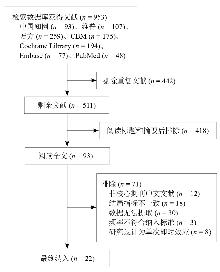
Figure 1
Flowchart of literature screening"
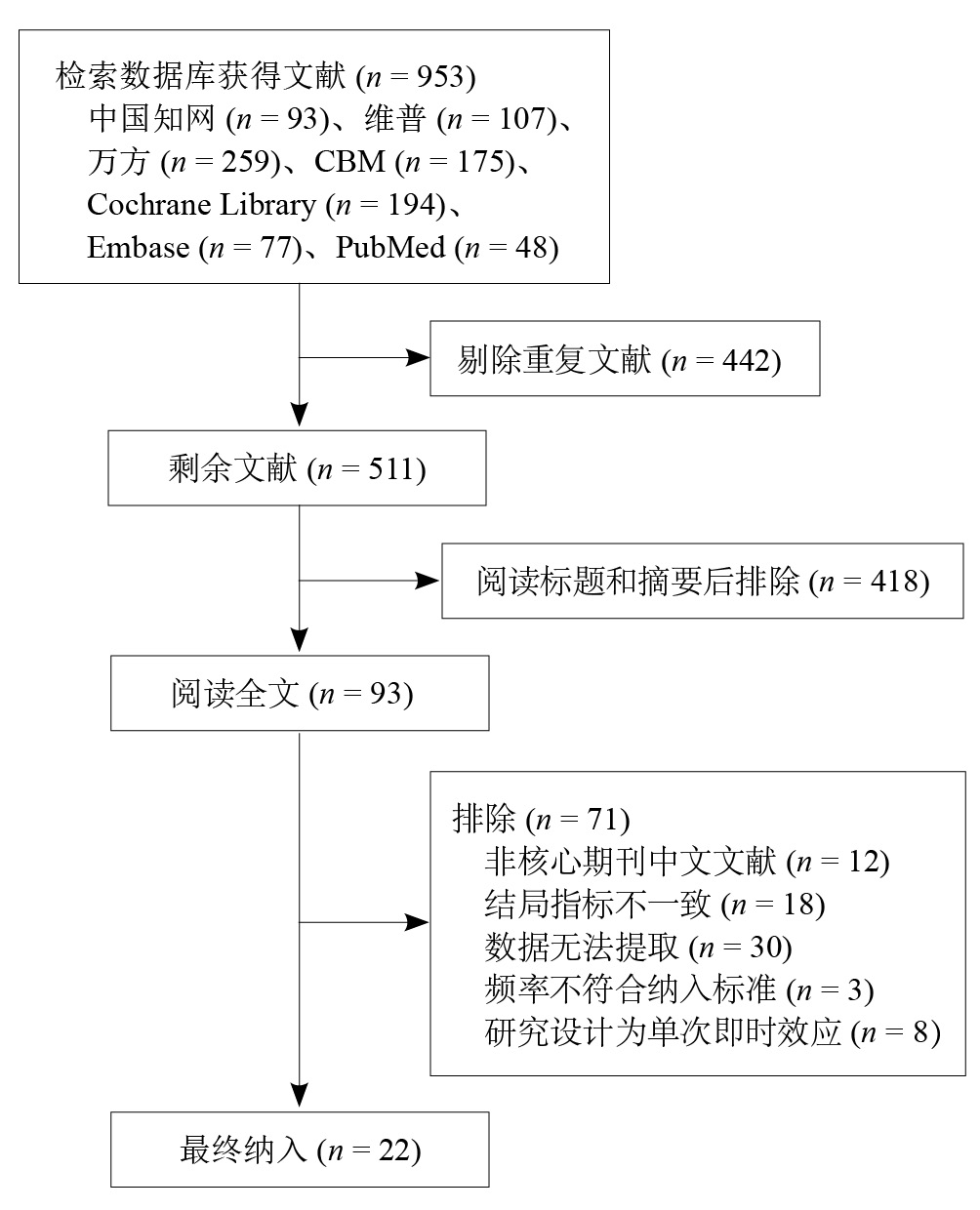
Table 2
Scores of PEDro Scale of included studies"
| 纳入文献 | 纳入与排除标准 | 随机分配 | 分配隐藏 | 基线相似 | 被试施盲 | 治疗师施盲 | 评估者施盲 | 退出率≤15% | 意向治疗分析 | 组间统计比较 | 点测量和差异值 | 总分 |
|---|---|---|---|---|---|---|---|---|---|---|---|---|
| 马飞翔等[ | √ | √ | √ | √ | √ | √ | √ | √ | 7 | |||
| 涂美等[ | √ | √ | √ | √ | √ | √ | √ | √ | 7 | |||
| 王盛等[ | √ | √ | √ | √ | √ | √ | 5 | |||||
| 宋云锋等[ | √ | √ | √ | √ | √ | √ | √ | 6 | ||||
| 金振华等[ | √ | √ | √ | √ | √ | √ | √ | √ | 7 | |||
| 魏巍等[ | √ | √ | √ | √ | √ | √ | √ | 6 | ||||
| 肖悦等[ | √ | √ | √ | √ | √ | √ | √ | 6 | ||||
| 胡川等[ | √ | √ | √ | √ | √ | √ | √ | 6 | ||||
| 张国兴等[ | √ | √ | √ | √ | √ | √ | √ | 6 | ||||
| 金振华等[ | √ | √ | √ | √ | √ | √ | √ | 6 | ||||
| 李岩等[ | √ | √ | √ | √ | √ | √ | √ | 6 | ||||
| 王伟国等[ | √ | √ | √ | √ | √ | √ | √ | 6 | ||||
| 毛璐熙等[ | √ | √ | √ | √ | √ | √ | √ | 6 | ||||
| 冯兵等[ | √ | √ | √ | √ | √ | √ | √ | 6 | ||||
| Irshad等[ | √ | √ | √ | √ | √ | √ | √ | √ | 7 | |||
| Lee等[ | √ | √ | √ | √ | √ | √ | 5 | |||||
| Lee等[ | √ | √ | √ | √ | √ | √ | √ | √ | √ | 8 | ||
| Burq等[ | √ | √ | √ | √ | √ | √ | √ | √ | 7 | |||
| Marín等[ | √ | √ | √ | √ | √ | √ | √ | √ | √ | 8 | ||
| van Nes等[ | √ | √ | √ | √ | √ | √ | √ | √ | √ | √ | 9 | |
| Brogårdh等[ | √ | √ | √ | √ | √ | √ | √ | √ | √ | √ | 9 | |
| Lau等[ | √ | √ | √ | √ | √ | √ | √ | √ | √ | 8 |
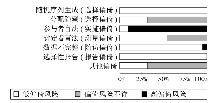
Figure 2
Risk of bias"
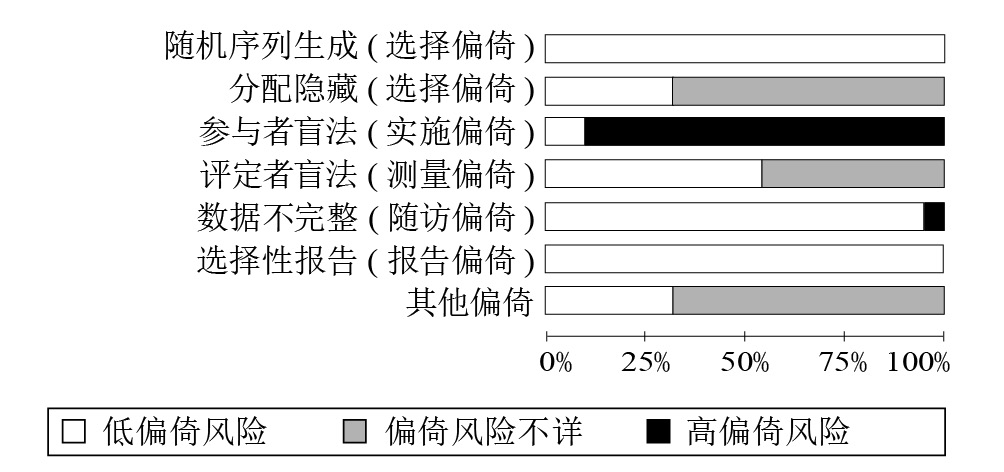
Figure 3
Bias assessment of included literatures"
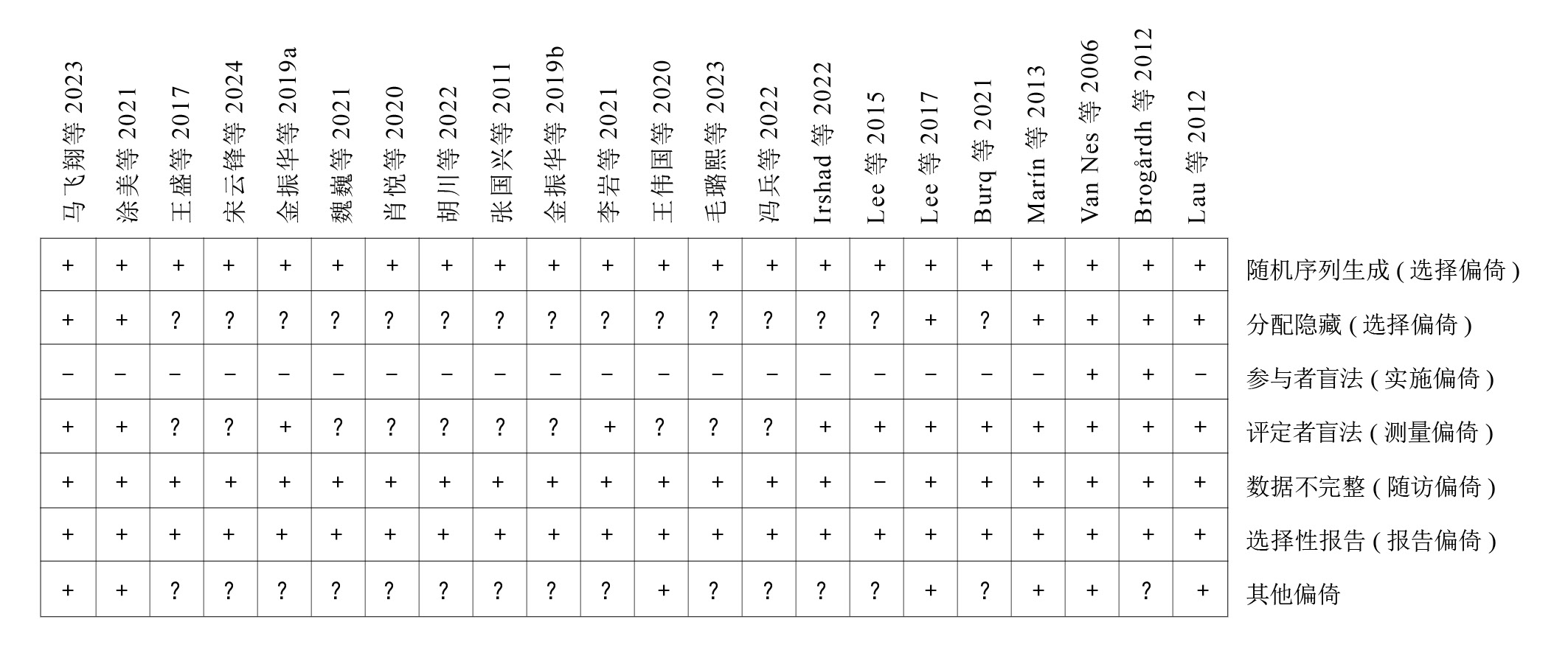
Table 3
Basic characteristics of the included literatures"
| 纳入文献 | n(男/女) | 年龄/岁 | 病程 | 干预措施 | 疗程 | 评价指标 | ||||
|---|---|---|---|---|---|---|---|---|---|---|
| C | T | C | T | C | T | C | T | |||
| 马飞翔等[ | 13/7 | 13/9 | 50.90±7.14 | 51.14±6.80 | (107.90±35.52) d | (103.09±33.48) d | Ⅱ、Ⅲ | Ⅱ+7 Hz、3 mm的WBV | 每周10次,4周 | ①③ |
| 14/6 | 49.35±8.10 | (101.30±26.88) d | Ⅱ+15 Hz、3 mm的WBV | |||||||
| 涂美等[ | 17 | 16 | 55.4±4.5 | 53.9±3.8 | (10.0±2.3)个月 | (11.4±4.4)个月 | Ⅱ | Ⅱ+5 Hz、2 mm的WBV | 每周5次,6周 | ③ |
| 17 | 55.6±4.3 | (11.7±3.1)个月 | Ⅱ+5 Hz、2 mm的WBV | |||||||
| 16 | 57.2±4.0 | (11.1±2.1)个月 | Ⅱ+5 Hz、2 mm的WBV | |||||||
| 王盛等[ | 8/6 | 9/6 | 62.50±7.78 | 57.67±11.55 | (19.00±4.47) d | (21.50±5.71) d | Ⅱ、Ⅲ | Ⅱ+起始2 Hz、4 mm的WBV | 每周5次,3周 | ① |
| 宋云锋等[ | 36/32 | 35/23 | 49.76±7.55 | 49.43±7.12 | — | — | Ⅰ、Ⅱ | Ⅰ+Ⅱ+20~35 Hz、2 mm的WBV | 每周5次,12周 | ① |
| 金振华等[ | 17/17 | 18/15 | 61.09±4.34 | 60.55±4.59 | (67.79±4.03) d | (67.18±5.45) d | Ⅱ | Ⅱ+20 Hz、4 mm的WBV | 6周 | ② |
| 魏巍等[ | 19/11 | 18/12 | 50.28±6.17 | 49.62±8.48 | (79.58±37.26) d | (82.72±30.81) d | Ⅰ、Ⅱ | Ⅰ、Ⅱ+30 Hz、2 mm的WBV | 每周6次,4周 | ① |
| 肖悦等[ | 9/6 | 8/7 | 59.13±10.88 | 60.93±9.98 | (2.26±1.57)个月 | (2.63±1.53)个月 | Ⅱ、Ⅲ | Ⅱ+5/10/5 Hz、4 mm的WBV | 每周6次,2周 | ③ |
| 胡川等[ | 13/10 | 14/9 | 62.42±9.34 | 60.35±11.63 | (3.23±1.76)个月 | (3.41±1.48)个月 | Ⅱ | Ⅱ+5~8 Hz、2 mm的WBV | 每周5次,4周 | ③ |
| 张国兴等[ | 6/4 | 7/3 | 59.5±11.9 | 60.7±10.3 | (40.1±9.2) d | (38.54±10.3) d | Ⅱ、Ⅳ | Ⅱ+Ⅳ+20 Hz、5 mm的WBV | 6周 | ①② |
| 金振华等[ | 16/19 | 18/17 | 55.0±4.7 | 55.0±4.8 | (63.5±5.0) d | (63.7±6.0) d | Ⅱ、Ⅴ | Ⅱ+Ⅴ+20 Hz、3 mm的WBV | 每周5次,6周 | ①② |
| 李岩等[ | 12/13 | 18/7 | 61.92±5.64 | 62.64±7.02 | (53.28±11.72) d | (53.68±8.88) d | Ⅱ、Ⅲ | Ⅱ+12 Hz、2 mm的WBV | 每周5次,8周 | ① |
| 王伟国等[ | 26/17 | 27/16 | 59.83±6.52 | 60.15±7.8 | — | — | Ⅱ | Ⅱ+5~8 Hz、2.5 mm的WBV | 每周6次,12周 | ① |
| 毛璐熙等[ | 52/18 | 55/15 | 48.64±8.25 | 50.51±9.86 | (38.15±6.68) d | (40.53±6.17) d | Ⅱ | Ⅱ+8/20/20 Hz的WBV(间歇/连续) | 每周5次,4周 | ①② |
| 冯兵等[ | 26/22 | 27/21 | 62.22±6.18 | 62.22±5.23 | (45.50±6.80) d | (44.50±7.60) d | Ⅱ | Ⅱ+15 Hz、5 mm的WBV | 每周5次,4周 | ① |
| Irshad等[ | 25/18 | 23/20 | — | — | — | — | Ⅱ、Ⅵ | Ⅱ+30/40/50 Hz、2.5/3.5/8 mm的WBV | 每周5次,6周 | ①③ |
| Lee等[ | 6/3 | 8/4 | 56.0±9.1 | 59.3±13.2 | (18.0±10.9)个月 | (19.0±9.1)个月 | Ⅱ | Ⅱ+1~3 Hz、30 mm的WBV | 每周3次,6周 | ①③ |
| Lee等[ | 7/8 | 8/7 | 64.4±14.8 | 59.1±16.9 | (25.3±12.2) d | (18.4±6.9) d | Ⅱ | Ⅱ(单次)+40 Hz的WBV | 每周5次,2周 | ①② |
| Burq等[ | 19/13 | 21/11 | 55.06±11.48 | 54.56±8.85 | (10.82±5.15)个月 | (14.46±12.14)个月 | Ⅱ | Ⅱ+20 Hz、3 mm的WBV | 每周6次,2周 | ③ |
| Marín等[ | 5/4 | 6/5 | 64.4±7.6 | 62.4±10.7 | (4.3±3.0)年 | (4.3±2.0)年 | Ⅱ、Ⅲ | Ⅱ+5~21 Hz、4~6 mm的WBV | 12周,17次 | ① |
| van Nes等[ | 14/12 | 16/11 | 62.6±7.6 | 59.7±12.3 | (34.2±11.1) d | (38.9±9.2) d | Ⅱ、Ⅶ | Ⅱ+30 Hz、3 mm的WBV | 每周5次,6周 | ①② |
| Brogardh等[ | 12/3 | 13/3 | 63.9±5.8 | 61.3±8.5 | (33.1±29.2)个月 | (37.4±31.8)个月 | Ⅲ | 25 Hz、3.75 mm的WBV | 每周2次,6周 | ①③ |
| Lau等[ | 32/9 | 26/15 | 57.4±11.1 | 57.3±11.3 | (5.3±4.2)年 | (4.6±3.5)年 | Ⅷ | Ⅷ+20~30 Hz、0.44~0.60 mm的WBV | 每周3次,8周 | ① |
Table 4
Results of meta-analysis"
| 结局指标 | 纳入研究数/n | 样本量/n | 异质性检验 | Meta分析结果 | 效应模型 | ||
|---|---|---|---|---|---|---|---|
| I2值 | P值 | WMD(95%CI) | P值 | ||||
| BBS | 17[ | 1062 | 89.3% | < 0.001 | 4.761(3.220~6.302) | < 0.001 | 随机 |
| FAC | 5[ | 327 | 77.2% | 0.002 | 0.537(0.239~0.835) | < 0.001 | 随机 |
| TUGT | 8[ | 406 | 70.3% | 0.001 | -2.329(-3.889~-0.769) | 0.003 | 随机 |
Table 5
Results of subgroup analysis"
| 结局指标 | 亚组 | 纳入研究数/n | 样本量/n | 异质性检验 | Meta分析结果 | 亚组间比较 | ||||
|---|---|---|---|---|---|---|---|---|---|---|
| I2值 | P值 | Z值 | WMD(95%CI) | P值 | Q值 | P值 | ||||
| BBS | 低频 | 10[ | 594 | 79.2% | < 0.001 | 7.645 | 5.603 (4.166~7.039) | < 0.001 | 1.420 | 0.233 |
| 高频 | 7[ | 468 | 93.9% | < 0.001 | 1.962 | 3.374 (0.003~6.745) | 0.050 | |||
| 低剂量 | 9[ | 509 | 89.5% | < 0.001 | 2.946 | 3.814 (1.277~6.352) | 0.003 | 1.810 | 0.178 | |
| 高剂量 | 7[ | 533 | 85.4% | < 0.001 | 7.069 | 5.887 (4.255~7.519) | < 0.001 | |||
| FAC | 低频 | 4[ | 297 | 62.3% | 0.047 | 5.408 | 0.660 (0.421~0.899) | < 0.001 | 8.070 | 0.005 |
| 高频 | 1[ | 30 | - | - | -0.420 | -0.100 (-0.567~0.367) | 0.674 | |||
| TUGT | 低频 | 6[ | 289 | 0.0% | 0.525 | -6.121 | -2.737 (-3.614~-1.861) | < 0.001 | 0.450 | 0.505 |
| 高频 | 2[ | 117 | 94.8% | < 0.001 | -0.043 | -0.166 (-7.667~7.336) | 0.965 | |||
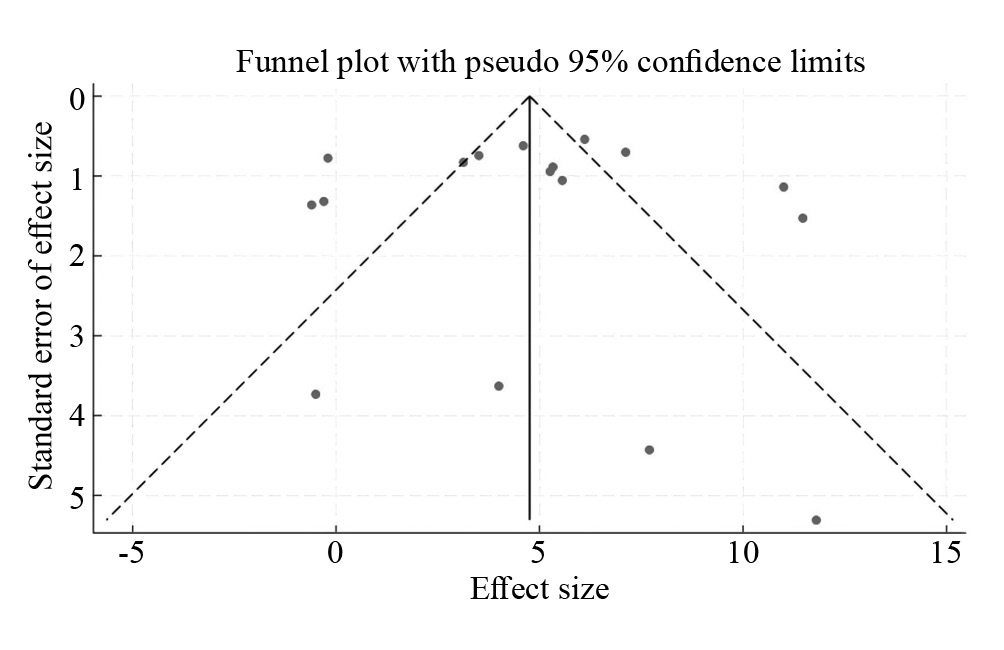
Figure 4
Funnel plot of publication bias for the effect of WBV on BBS scores"
| [1] |
GBD 2019 Stroke Collaborators. Global, regional, and national burden of stroke and its risk factors, 1990-2019: a systematic analysis for the Global Burden of Disease Study 2019[J]. Lancet Neurol, 2021, 20(10): 795-820.
doi: 10.1016/S1474-4422(21)00252-0 |
| [2] | 《中国脑卒中防治报告2021》编写组. 《中国脑卒中防治报告2021》概要[J]. 中国脑血管病杂志, 2023, 20(11): 783-793. |
| Report on Stroke Prevention and Treatment in China Writing Group. Brief report on stroke prevention and treatment in China, 2021[J]. Chin J Cerebrovascular Dis, 2023, 20(11): 783-793. | |
| [3] | Cho J E, Kim H. Ankle proprioception deficit is the strongest factor predicting balance impairment in patients with chronic stroke[J]. Arch Rehabil Res Clin Transl, 2021, 3(4): 100165. |
| [4] |
Zhang M, Wei J, Wu X. Effects of whole-body vibration training on lower limb motor function and neural plasticity in patients with stroke: protocol for a randomised controlled clinical trial[J]. BMJ Open, 2022, 12(6): e060796.
doi: 10.1136/bmjopen-2022-060796 |
| [5] |
Tian X, Fu S, He J, et al. Whole-body vibration training improves muscle mass and strength in older adults through intra- and extra-muscular pathways[J]. Front Cell Dev Biol, 2025, 13: 1643478.
doi: 10.3389/fcell.2025.1643478 |
| [6] | 马飞翔, 李万浪, 朱颖玲, 等. 低频共振训练对脑卒中后偏瘫患者平衡及步行功能的影响[J]. 中华物理医学与康复杂志, 2023, 45(9): 776-780. |
| Ma F X, Li W L, Zhu Y L, et al. Low-frequency whole-body resonance stimulation can improve the balance and walking of hemiplegic stroke survivors[J]. Chin J Phys Med Rehabil, 2023, 45(9): 776-780. | |
| [7] |
Seo J W, Kim J D, Seok J W. The effects of whole-body vibration on spasticity in stroke: a systematic review and meta-analysis[J]. J Clin Med, 2025, 14(17): 5966.
doi: 10.3390/jcm14175966 |
| [8] |
Xing K, Duan R, Fang Z, et al. Does frequency of the mechanical vibration matter? Evaluating the impact of whole-body vibration training on older adults strength, balance, and gait performance: a systematic review and network meta-analysis[J]. Arch Phys Med Rehabil, 2026, 107(3): 507-521.
doi: 10.1016/j.apmr.2025.07.015 |
| [9] |
Zhang Q, Zheng S, Li S, et al. Efficacy and safety of whole-body vibration therapy for post-stroke spasticity: a systematic review and meta-analysis[J]. Front Neurol, 2023, 14: 1074922.
doi: 10.3389/fneur.2023.1074922 |
| [10] | 涂美, 王剑雄, 张驰, 等. 不同下肢体位振动对脑卒中患者下肢肌力及运动功能的影响[J]. 中国康复医学杂志, 2021, 36(2): 166-171. |
| Tu M, Wang J X, Zhang C, et al. A study on different lower limb position vibrations on lower limb muscle strength and motor function in patients with stroke[J]. Chin J Rehabil Med, 2021, 36(2): 166-171. | |
| [11] | 王盛, 王翔, 王彤, 等. 渐进性全身垂直振动治疗方案对缺血性脑卒中偏瘫早期患者下肢功能与平衡功能的影响[J]. 中国康复医学杂志, 2017, 32(3): 297-300. |
| Wang S, Wang X, Wang T, et al. Effects of progressive whole body vertical vibration on lower limb function and balance in acute cerebral infarction patients with hemiplegia[J]. Chin J Rehabil Med, 2017, 32(3): 297-300. | |
| [12] | 宋云锋, 杜爱玲. 康复训练结合振动治疗对脑卒中后骨代谢及运动功能的影响分析[J]. 康复, 2024(23): 131-134. |
| [13] | 金振华, 陈玲, 叶祥明, 等. 全身低频渐进振动联合运动治疗对卒中患者下肢肌张力与步行能力的作用[J]. 中国康复, 2019, 34(6): 283-286. |
| Jin Z H, Chen L, Ye X M, et al. Effect of low frequency progressive whole-body vibration to spasticity of hemiplegic lower limb and walking ability in stroke patients[J]. Chin J Rehabil, 2019, 34(6): 283-286. | |
| [14] | 魏巍, 程凯, 杨云. 全身振动疗法对脑卒中后偏瘫患者双下肢本体感觉及平衡功能的影响[J]. 中国康复, 2021, 36(4): 200-203. |
| Wei W, Cheng K, Yang Y. Effect of whole body vibration therapy on proprioception and balance function of lower limbs in patients with hemiplegia after stroke[J]. Chin J Rehabilitation, 2021, 36(4): 200-203. | |
| [15] | 肖悦, 许光旭, 曹蓉, 等. 全身振动训练促进脑卒中偏瘫患者平衡功能和步行效率的研究[J]. 中华物理医学与康复杂志, 2020, 42(4): 312-316. |
| Xiao Y, Xu G X, Cao R, et al. Whole body vibration can improve balance and walking after a stroke[J]. Chin J Phys Med Rehabil, 2020, 42(4): 312-316. | |
| [16] | 胡川, 杨晓, 顾莹, 等. 全身振动训练对脑卒中后偏瘫病人步行功能的影响[J]. 中西医结合心脑血管病杂志, 2022, 20(2): 337-340. |
| [17] | 张国兴, 刘四文. 全身振动训练对脑卒中患者平衡及步行能力的影响[J]. 中国康复, 2011, 26(6): 418-420. |
| Zhang G X, Liu S W. Effect of whole body vibration training on balance and walking ability of post-acute stroke patients[J]. Chin J Rehabil, 2011, 26(6): 418-420. | |
| [18] |
金振华, 陈玲, 叶祥明. 全身振动训练对脑卒中患者下肢功能的效果[J]. 中国康复理论与实践, 2019, 25(3): 347-351.
doi: 10.3969/j.issn.1006-9771.2019.03.018 |
| Jin Z H, Chen L, Ye X M. Effect of whole body vibration on abilities of lower extremities for stroke patients[J]. Chin J Rehabil Theory Practice, 2019, 25(3): 347-351. | |
| [19] | 李岩, 何雯雯, 董燕飞, 等. 全身振动训练对脑卒中偏瘫患者本体感觉及平衡功能的影响[J]. 中国康复医学杂志, 2021, 36(6): 709-712. |
| [20] | 王伟国, 吴华. 全身振动训练对脑卒中偏瘫患者临床效果及平衡功能的影响[J]. 中国基层医药, 2020, 27(4): 394-397. |
| Wang W G, Wu H. Effect of whole body vibration training on balance function of stroke patients with hemiplegia[J]. Chin J Primary Med Pharm, 2020, 27(4): 394-397. | |
| [21] | 毛璐熙, 张安琪, 黄昆, 等. 全身振动训练对脑卒中偏瘫患者平衡功能及运动功能的影响[J]. 中国康复, 2023, 38(8): 480-482. |
| [22] | 冯兵, 史静琴, 杨斌, 等. 全身振动训练结合躯干控制训练在脑卒中患者康复治疗中的应用效果[J]. 广西医学, 2022, 44(20): 2438-2441. |
| [23] | Irshad A, Abbas T, Sumaira, et al. Comparative effects of whole-body vibration and squatting training on balance and mobility in chronic stroke patients, a randomized controlled trial[J]. Pak J Med Health Sci, 2022, 16(7): 685-688. |
| [24] |
Lee G C. Does whole-body vibration training in the horizontal direction have effects on motor function and balance of chronic stroke survivors? a preliminary study[J]. J Phys Ther Sci, 2015, 27: 1133-1136.
doi: 10.1589/jpts.27.1133 pmid: 25995573 |
| [25] |
Lee J H, Kim S B, Lee K W, et al. The effect of a whole-body vibration therapy on the sitting balance of subacute stroke patients: a randomized controlled trial[J]. Top Stroke Rehabil, 2017, 24(6): 457-462.
doi: 10.1080/10749357.2017.1305655 pmid: 28335701 |
| [26] |
Burq H S I A, Karimi H, Ahmad A, et al. The effects of whole body vibration on gait after chronic stroke: a randomized controlled clinical trial[J]. J Pak Med Assoc, 2021, 71(11): 2511-2514.
doi: 10.47391/JPMA.711 pmid: 34783727 |
| [27] |
Marín P J, Ferrero C M, Menéndez H, et al. Effects of whole-body vibration on muscle architecture, muscle strength, and balance in stroke patients: a randomized controlled trial[J]. Am J Phys Med Rehabil, 2013, 92(10): 881-888.
doi: 10.1097/PHM.0b013e318292336c |
| [28] |
Van Nes I J W, Latour H, Schils F, et al. Long-term effects of 6-week whole-body vibration on balance recovery and activities of daily living in the postacute phase of stroke: a randomized, controlled trial[J]. Stroke, 2006, 37(9): 2331-2335.
doi: 10.1161/01.STR.0000236494.62957.f3 pmid: 16902175 |
| [29] |
Brogårdh C, Flansbjer U B, Lexell J. No specific effect of whole-body vibration training in chronic stroke: a double-blind randomized controlled study[J]. Arch Phys Med Rehabil, 2012, 93(2): 253-258.
doi: 10.1016/j.apmr.2011.09.005 |
| [30] |
Lau R W K, Yip S P, Pang M Y C. Whole-body vibration has no effect on neuromotor function and falls in chronic stroke[J]. Med Sci Sports Exerc, 2012, 44(8): 1409-1418.
doi: 10.1249/MSS.0b013e31824e4f8c |
| [31] |
Eldeeb A M, Abdel-aziem A A. Effect of whole-body vibration exercise on power profile and bone mineral density in postmenopausal women with osteoporosis: a randomized controlled trial[J]. J Manipulative Physiol Ther, 2020, 43(4): 384-393.
doi: 10.1016/j.jmpt.2019.12.003 |
| [32] |
Dincher A, Becker P, Wydra G. Effect of whole-body vibration on freezing and flexibility in Parkinson's disease: a pilot study[J]. Neurol Sci, 2021, 42(7): 2795-2801.
doi: 10.1007/s10072-020-04884-7 pmid: 33159620 |
| [33] | 瓮长水, 王军, 王刚, 等. Berg平衡量表在脑卒中患者中的内在信度和同时效度[J]. 中国康复医学杂志, 2007, 22(8): 688-690. |
| Weng C S, Wang J, Wang G, et al. Assessments of internal reliability and concurrent validity of Berg Balance Scale in stroke patients[J]. Chin J Rehabil Med, 2007, 22(8): 688-690. | |
| [34] |
Mehrholz J, Wagner K, Rutte K, et al. Predictive validity and responsiveness of the Functional Ambulation Category in hemiparetic patients after stroke[J]. Arch Phys Med Rehabil, 2007, 88(10): 1314-1319.
doi: 10.1016/j.apmr.2007.06.764 |
| [35] | 瓮长水, 田哲, 李敏, 等. "起立-行走"计时测试在评定脑卒中患者功能性移动能力中的价值[J]. 中国康复理论与实践, 2004, 10(12): 17-19. |
| Weng C S, Tian Z, Li M, et al. The value of the timed "up and go" test at the evaluation of functional mobility in stroke patients[J]. Chin J Rehabil Theory Pract, 2004, 10(12): 17-19. | |
| [36] |
Qu X, Hu X, Zhao J, et al. The roles of lower-limb joint proprioception in postural control during gait[J]. Appl Ergon, 2022, 99: 103635.
doi: 10.1016/j.apergo.2021.103635 |
| [37] |
Chen X, Qu X. Age-related differences in the relationships between lower-limb joint proprioception and postural balance[J]. Hum Factors, 2019, 61(5): 702-711.
doi: 10.1177/0018720818795064 pmid: 30130130 |
| [38] | Garay-Sánchez A, Marcén-Román Y, Ferrando-Margelí M, et al. Effect of physiotherapy treatment with immersive virtual reality in subjects with stroke: a protocol for a randomized controlled trial[J]. Healthcare (Basel), 2023, 11(9): 1335. |
| [39] |
Tazawa T, Yasui M, Otsuka S, et al. Development of a musculoskeletal shoulder model considering anatomic joint structures and soft-tissue deformation for dynamic simulation[J]. Anat Sci Int, 2024, 99(3): 278-289.
doi: 10.1007/s12565-024-00773-7 pmid: 38698275 |
| [40] |
Wakeling J M, Nigg B M, Rozitis A I. Muscle activity damps the soft tissue resonance that occurs in response to pulsed and continuous vibrations[J]. J Appl Physiol, 2002, 93(3): 1093-1103.
doi: 10.1152/japplphysiol.00142.2002 pmid: 12183507 |
| [41] |
Rittweger J. Vibration as an exercise modality: how it may work, and what its potential might be[J]. Eur J Appl Physiol, 2010, 108(5): 877-904.
doi: 10.1007/s00421-009-1303-3 pmid: 20012646 |
| [42] |
Viganò A, Celletti C, Giuliani G, et al. Focal muscle vibration (FMV) for post-stroke motor recovery: multisite neuroplasticity induction, timing of intervention, clinical approaches, and prospects from a narrative review[J]. Vibration, 2023, 6(3): 645-658.
doi: 10.3390/vibration6030040 |
| [43] |
Williams L E, Küffer L, Bawa T, et al. Repetitive sensory stimulation potentiates and recruits sensory-evoked cortical population activity[J]. J Neurosci, 2025, 45(4): e2189232024.
doi: 10.1523/JNEUROSCI.2189-23.2024 |
| [44] |
Yang C X, Xu Y, Zhao Z, et al. Optimal exercise prescription for balance after stroke: a Bayesian dose-response network meta-analysis[J]. Front Neurol, 2026, 17: 1804224.
doi: 10.3389/fneur.2026.1804224 |
| [45] |
Morone G, Capone F, Iosa M, et al. May dual transcranial direct current stimulation enhance the efficacy of robot-assisted therapy for promoting upper limb recovery in chronic stroke?[J]. Neurorehabil Neural Repair, 2022, 36(12): 800-809.
doi: 10.1177/15459683221138743 pmid: 36458455 |
| [46] |
Raghavan P. Top-down and bottom-up mechanisms of motor recovery poststroke[J]. Phys Med Rehabil Clin N Am, 2024, 35(2): 235-257.
doi: 10.1016/j.pmr.2023.07.006 pmid: 38514216 |
| [1] | Jiang Yang, Peng Hao, Yin Xingxiao, Li Yanqi, Song Yanping, Yao Na, Shen Zhen, Chen Qigang. Effect of virtual reality-based exergaming on multidimensional outcomes in individuals with cognitive impairment: a three-level meta-analysis based on the ICF framework [J]. Chinese Journal of Rehabilitation Theory and Practice, 2026, 32(9): 1003-1015. |
| [2] | Huang Xuli, Wang Pingzhi, Luo Tian'e. Comparison of cortical hemodynamic responses between real-time and video-based action observation therapy in patients with stroke: a functional near-infrared spectroscopy study [J]. Chinese Journal of Rehabilitation Theory and Practice, 2026, 32(9): 1041-1051. |
| [3] | Su Panpan, He Chuan, Qiongji , Meng Dianhuai. Comparison of static balance characteristics under different standing postures in older patients with post-stroke hemiplegia [J]. Chinese Journal of Rehabilitation Theory and Practice, 2026, 32(9): 1052-1060. |
| [4] | Shen Xiaohua, Chen Fangyuan, Rong Jifeng, Rao Biaoqin, Kong Lingxuan, Tian Wei, Chen Zhiqun, Li Li. Effect of anterior seat inclination on sit-to-stand ability in patients with stroke and related brain network [J]. Chinese Journal of Rehabilitation Theory and Practice, 2026, 32(9): 1061-1067. |
| [5] | Feng Xiaojuan, Huang Fubiao, Li Dongyue, Zhou Mingyi, Niu Yuxuan, Ismaili McGee Pireti, Wang Xixian, Wang Zile. Development and feasibility study of a self-stabilizing home-based functional interactive training device [J]. Chinese Journal of Rehabilitation Theory and Practice, 2026, 32(9): 1068-1077. |
| [6] | Guo Xuxia, Yu Hengrui, Lu Yucheng, Yang Sichuang, Long Yu, Li Jiawei, Chen Lin, Nong Feiyu, Long Yaobin. An explainable artificial intelligence-driven motor rehabilitation assessment system based on perception-cognition decoupling: design and validation [J]. Chinese Journal of Rehabilitation Theory and Practice, 2026, 32(9): 1108-1116. |
| [7] | Yan Jiazheng, Luo Xiaoqin, Liu Rihua, Yu Ying, Qi Fengxue. Non-invasive brain stimulation techniques for balance function after stroke: a network meta-analysis [J]. Chinese Journal of Rehabilitation Theory and Practice, 2026, 32(8): 903-915. |
| [8] | Liu Shan, Xu Kunyao, Zhou Zhimeng, Zhou Lingyun, Zeng Mao, He Sha, Dai Luoyang, Qin Ting, Hu Qinglin, Yang Jiahai, Li Rui. Effects of different electromagnetic stimulation protocols on hand function and activities of daily living for stroke patients: a network meta-analysis [J]. Chinese Journal of Rehabilitation Theory and Practice, 2026, 32(8): 916-926. |
| [9] | Zhou Jie, He Zhicheng, Zhang Xiaoyu, Wang Xue, Liu Damei, Song Ning, Wu Jun. Effect of visuomotor integration training on unilateral spatial neglect after stroke [J]. Chinese Journal of Rehabilitation Theory and Practice, 2026, 32(7): 745-751. |
| [10] | Huang Yaohui, Ye Xiangming, Liu Yong, Tang Pei, Lu Yishu. Effect of repetitive transcranial magnetic stimulation on prolonged disorders of consciousness after stroke [J]. Chinese Journal of Rehabilitation Theory and Practice, 2026, 32(7): 752-759. |
| [11] | Shan Guixiang, Du Jubao, Cao Lei, Ye Linlin, Jiang Chunjing, Zhang Ye, Ma Huijuan, Song Weiqun. Characteristics of diaphragmatic function in stroke patients based on ultrasound [J]. Chinese Journal of Rehabilitation Theory and Practice, 2026, 32(7): 760-767. |
| [12] | Zhang Fei, Fu Boxun, Shen Hui, Chen Jin. Effect of action observation therapy based on mirror neuron system combined with low-frequency repetitive transcranial magnetic stimulation on post-stroke unilateral spatial neglect [J]. Chinese Journal of Rehabilitation Theory and Practice, 2026, 32(7): 768-775. |
| [13] | Fan Liubo, Shan Tingting, Liu Baohua, Luo Mimi, Zhang Luding, Wang Minghui. Effect of different doses of Botulinum toxin type A injected under ultrasound guidance combined with modified catheter-balloon localization for post-stroke cricopharyngeal dysfunction: a randomized controlled trial [J]. Chinese Journal of Rehabilitation Theory and Practice, 2026, 32(7): 776-787. |
| [14] | Zhou Guangxue, Xu Ning, Shi Bin. Effect of virtual reality combined with occupational therapy on upper limb motor function in patients with stroke: a meta-analysis [J]. Chinese Journal of Rehabilitation Theory and Practice, 2026, 32(7): 788-796. |
| [15] | Dun Shibo, Li Yuzhou. Effect of blood flow restriction training on lower-limb motor function after stroke: a meta-analysis [J]. Chinese Journal of Rehabilitation Theory and Practice, 2026, 32(7): 797-806. |
| Viewed | ||||||
|
Full text |
|
|||||
|
Abstract |
|
|||||
|
||
