



Chinese Journal of Rehabilitation Theory and Practice ›› 2026, Vol. 32 ›› Issue (10): 1165-1176.doi: 10.3969/j.issn.1006-9771.2026.10.005
Previous Articles Next Articles
Wu Xiaoli1a,2, Xia Xiaoqian2, Ye Changqing1a,2, Wang Yunlei1a,2, Li Xingzhu1a,2, Liu LiXu1a,2, Huang Fubiao1b, Liu Jingsong1c, Song Yichuan1d, Zhang Yue1e, Du Xiaoxia1a,2( )
Received:2025-09-26
Revised:2026-01-26
Accepted:2026-01-28
Published:2026-10-25
Online:2026-10-23
Contact:
Du Xiaoxia
E-mail:duxiaoxia2005@gmail.com
Supported by:CLC Number:
Wu Xiaoli, Xia Xiaoqian, Ye Changqing, Wang Yunlei, Li Xingzhu, Liu LiXu, Huang Fubiao, Liu Jingsong, Song Yichuan, Zhang Yue, Du Xiaoxia. Application of multimodal neuromodulation guided by multidisciplinary team-based management in dynamic assessment and precision rehabilitation for a case of large-area cerebral infarction[J]. Chinese Journal of Rehabilitation Theory and Practice, 2026, 32(10): 1165-1176.
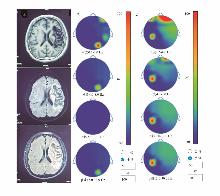
Figure 1
Brain imaging data on admission and changes in brain electroencephalogram topographic maps before and after a single rTMS intervention"
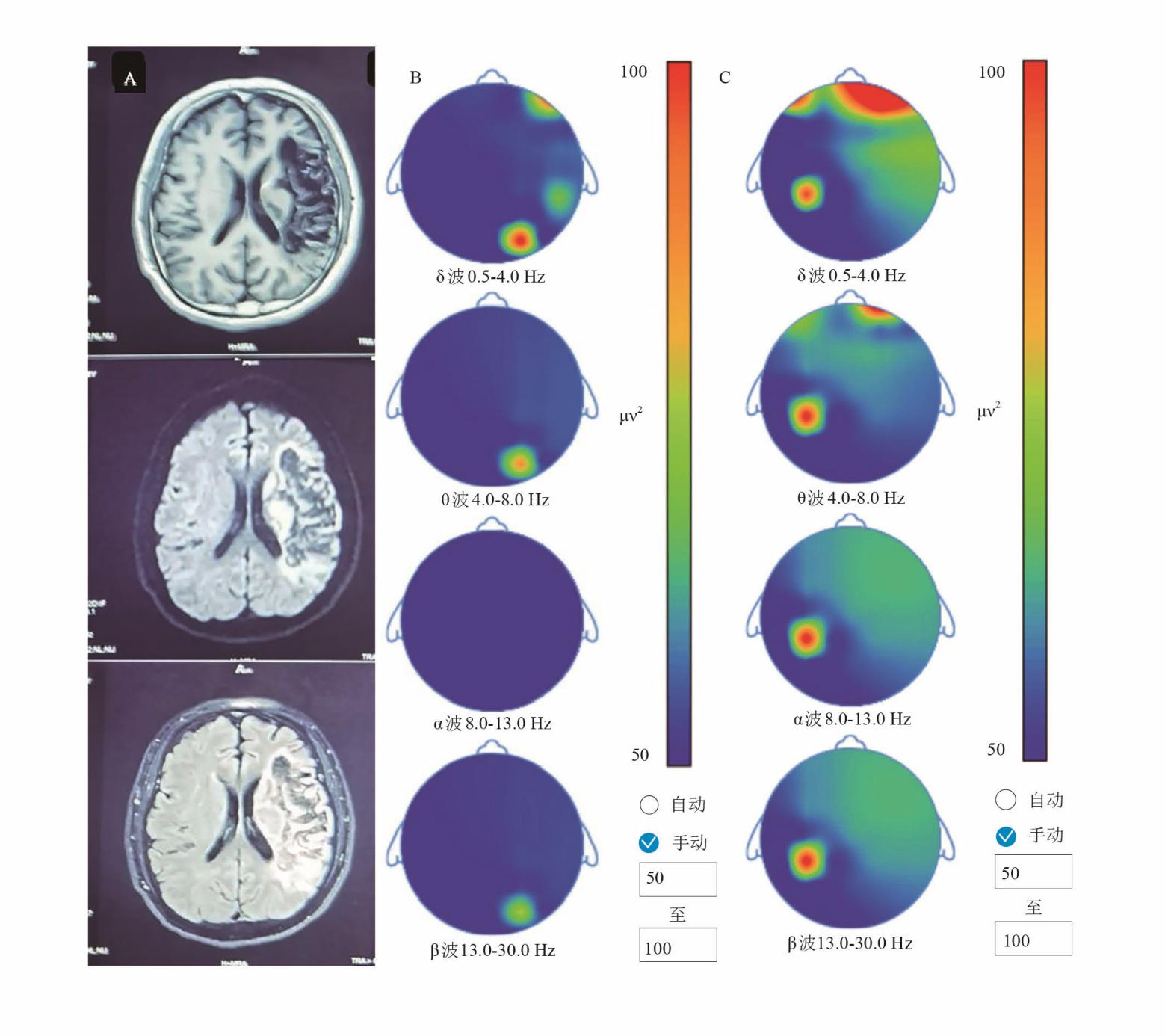

Table 1
Alterations in comprehensive functional assessments during the rehabilitation therapy period"
| 评定量表 | 入院时 | 治疗4周 | 治疗12周 | 治疗16周 | 治疗20周 | 治疗24周 | 治疗28周 |
|---|---|---|---|---|---|---|---|
| MMSE | NCC | NCC | 7 | 13 | 16 | 20 | 20 |
| NIHSS | 11 | 9 | 8 | 5 | 4 | 4 | 4 |
| LOTCA | 46 | NC | 53 | NC | NC | NC | 62 |
| FMA | 20 | 34 | 39 | 40 | 42 | 53 | 54 |
| FMA-B | 7 | 10 | 11 | 11 | 11 | 11 | 12 |
| 上肢Brunnstrom分期 | Ⅲ | Ⅲ | Ⅲ | Ⅲ | Ⅳ | Ⅳ | Ⅳ |
| 手Brunnstrom分期 | Ⅱ | Ⅲ | Ⅲ | Ⅲ | Ⅲ | Ⅲ | Ⅲ |
| 下肢Brunnstrom分期 | Ⅲ | Ⅲ | Ⅲ | Ⅳ | Ⅳ | Ⅳ | Ⅳ |
| HAMA | NC | NC | 10 | 7 | 6 | 4 | 2 |
| HAMD | NC | NC | 8 | 6 | 6 | 1 | 1 |
| HFAC | 0 | 1 | 1 | 2 | 3 | 3 | 4 |
| MBI | 40 | 50 | 58 | 86 | 86 | 91 | 91 |
| 上肢MAS | Ⅰ+ | Ⅱ | Ⅱ | Ⅰ+ | Ⅰ+ | Ⅰ+ | Ⅰ+ |
| 手MAS | Ⅰ+ | Ⅱ | Ⅱ | Ⅰ+ | Ⅰ+ | Ⅰ+ | Ⅰ+ |
| 下肢MAS | Ⅰ | Ⅰ+ | Ⅰ+ | Ⅰ | Ⅰ | Ⅰ | Ⅰ |
Table 2
Variations in key indicators of CRRCAE pre- and post-treatment"
| 评定项目 | 名词 | 动词 | 句子 | ||||||
|---|---|---|---|---|---|---|---|---|---|
| 入院时 | 治疗4周 | 治疗20周 | 入院时 | 治疗4周 | 治疗20周 | 入院时 | 治疗4周 | 治疗20周 | |
| 听理解(10个) | 0 | 0 | 9 | 0 | 3 | 8 | 0 | 0 | 6 |
| 复述(10个) | 0 | 3 | 10 | 0 | 3 | 9 | 0 | 0 | 6 |
| 说(10个) | 0 | 0 | 4 | 0 | 0 | 4 | 0 | 0 | 2 |
| 出声读(10个) | 0 | 0 | 3 | 0 | 0 | 5 | 0 | 0 | 2 |
| 阅读(10个) | 0 | 6 | 8 | 0 | 1 | 5 | 0 | 0 | 2 |
| 抄写(5个) | 0 | 0 | 3 | 0 | 0 | 3 | 0 | 0 | 1 |
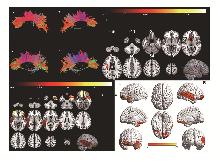
Figure 2
Changes in DTI and resting-state fMRI before and after multimodal neuromodulation intervention"
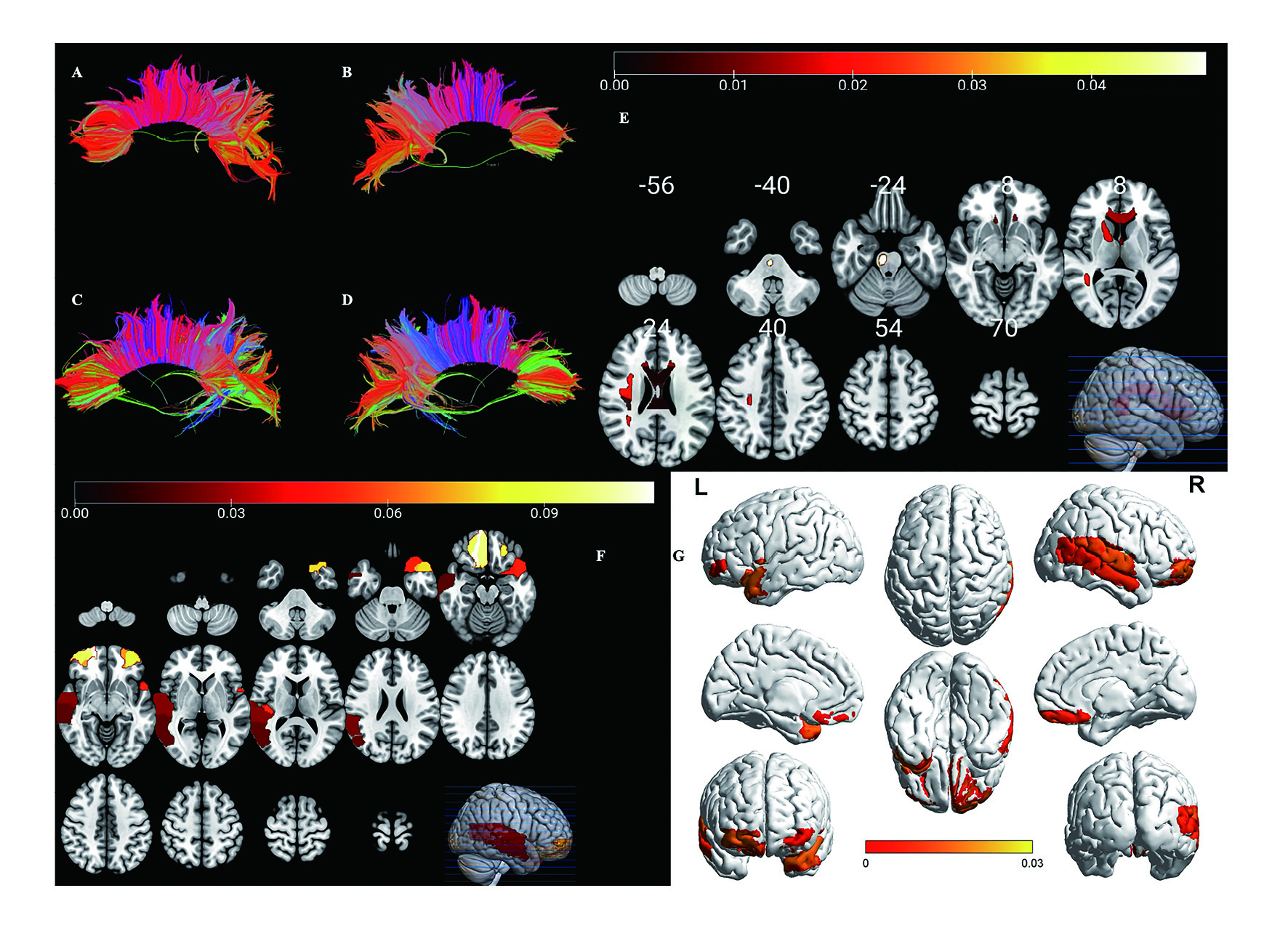
Figure 3
Changes in ERD before and after hand function rehabilitation training using a closed-loop BCI"
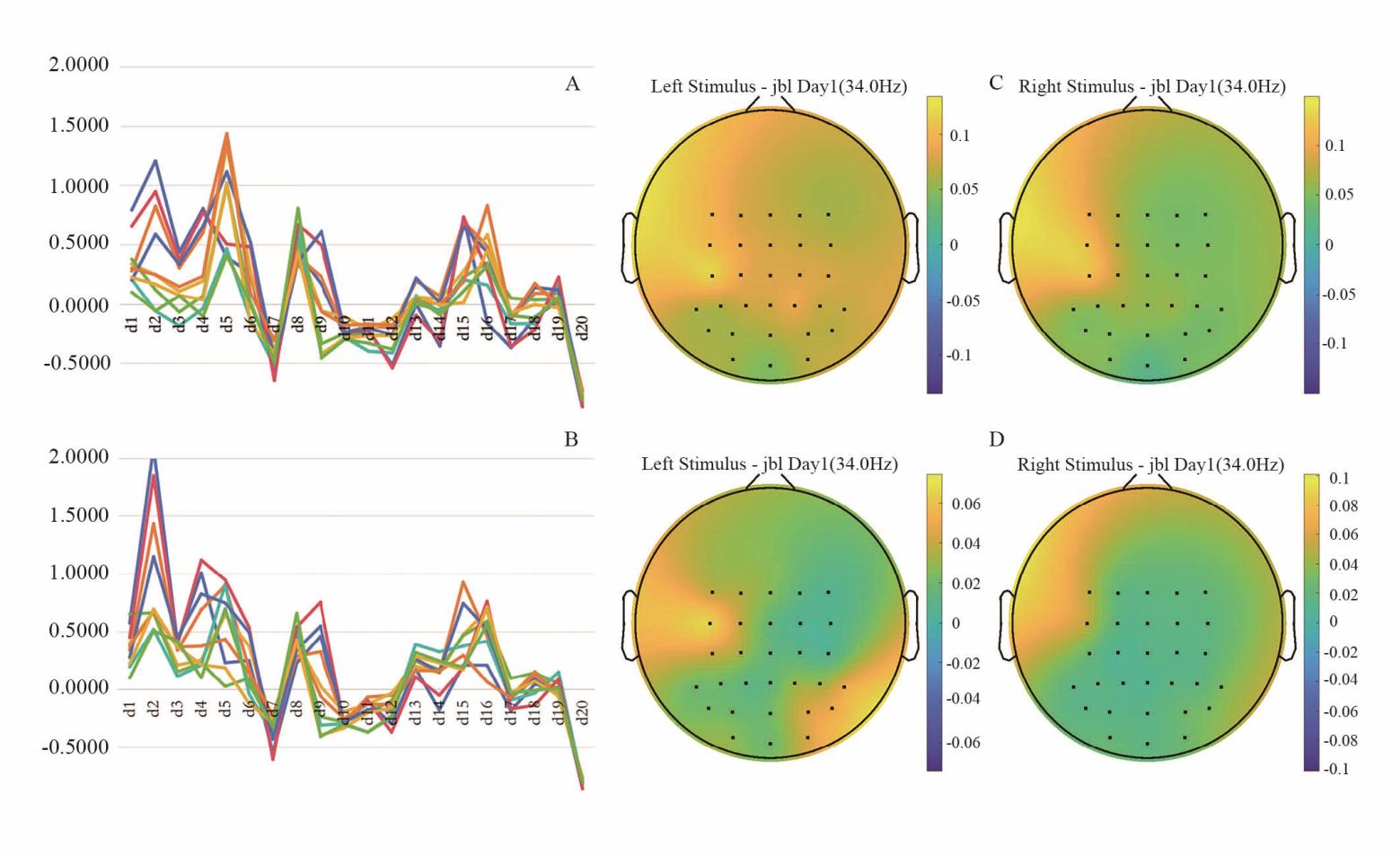
Table 3
Changes in gait analysis parameters during rehabilitation therapy"
| 指标 | 治疗12周 | 治疗16周 | 治疗20周 | 治疗24周 |
|---|---|---|---|---|
| 站立相百分比(左/右)/% | 92.4/85.5 | 91.7/76.4 | 91.9/84.6 | 88.1/78.4 |
| 步幅长/cm | 44±3 | 55±3 | 54±4 | 49±3 |
| 步行长度(左)/cm | 13±3 | 23±3 | 25±1 | 24±1 |
| 步行长度(右)/cm | 30±0 | 32±4 | 30±4 | 25±2 |
| 步行宽度/cm | 21±0 | 17±1 | 18±1 | 15±1 |
| 双支撑相百分比/% | 74.0±0.8 | 64.4±5.6 | 73.8±4.5 | 68.3±5.5 |
| 摆动期百分比(左/右)/% | 7.6/14.5 | 8.3/23.6 | 8.1/15.4 | 11.9/21.6 |
| 步速/km·h-1 | 0.4±0.0 | 0.5±0.0 | 0.4±0.0 | 0.5±0.0 |
| 站立时力的数据(左/右)/N | 57.8/1.5 | 22.4/3.76 | 85.6/4.08 | 19.7/2.34 |
| 髋关节屈曲活动度(左)/° | -5.490 | -6.000 | -4.680 | -6.250 |
| 髋关节屈曲活动度(右)/° | -8.040 | -3.570 | 0.850 | -7.540 |
| 膝关节屈曲活动度(左)/° | -0.508 | 3.580 | 4.830 | 3.470 |
| 膝关节屈曲活动度(右)/° | -6.810 | -2.520 | 24.100 | -5.680 |
| 踝关节背屈活动度(左)/° | -20.200 | -10.800 | -14.100 | -10.400 |
| 踝关节背屈活动度(右)/° | -14.100 | -9.940 | -6.060 | -2.500 |
| 踝关节反转(左)/° | -5.480 | -9.750 | -8.270 | 0.043 |
| 踝关节反转(右)/° | 1.600 | 5.760 | 12.100 | -2.190 |
| 足跟压力(左/右)/N | 436.8/519.8 | 343.6/484.1 | 376.2/468.4 | 370.9/516.4 |
| 足底中部压力(左/右)/N | 153.2/208.1 | 319.1/301.9 | 225.2/284.6 | 176.8/159.0 |
| 足底前部压力(左/右)/N | 449.6/159.9 | 579.4/132.2 | 502.2/153.7 | 460.2/255.9 |
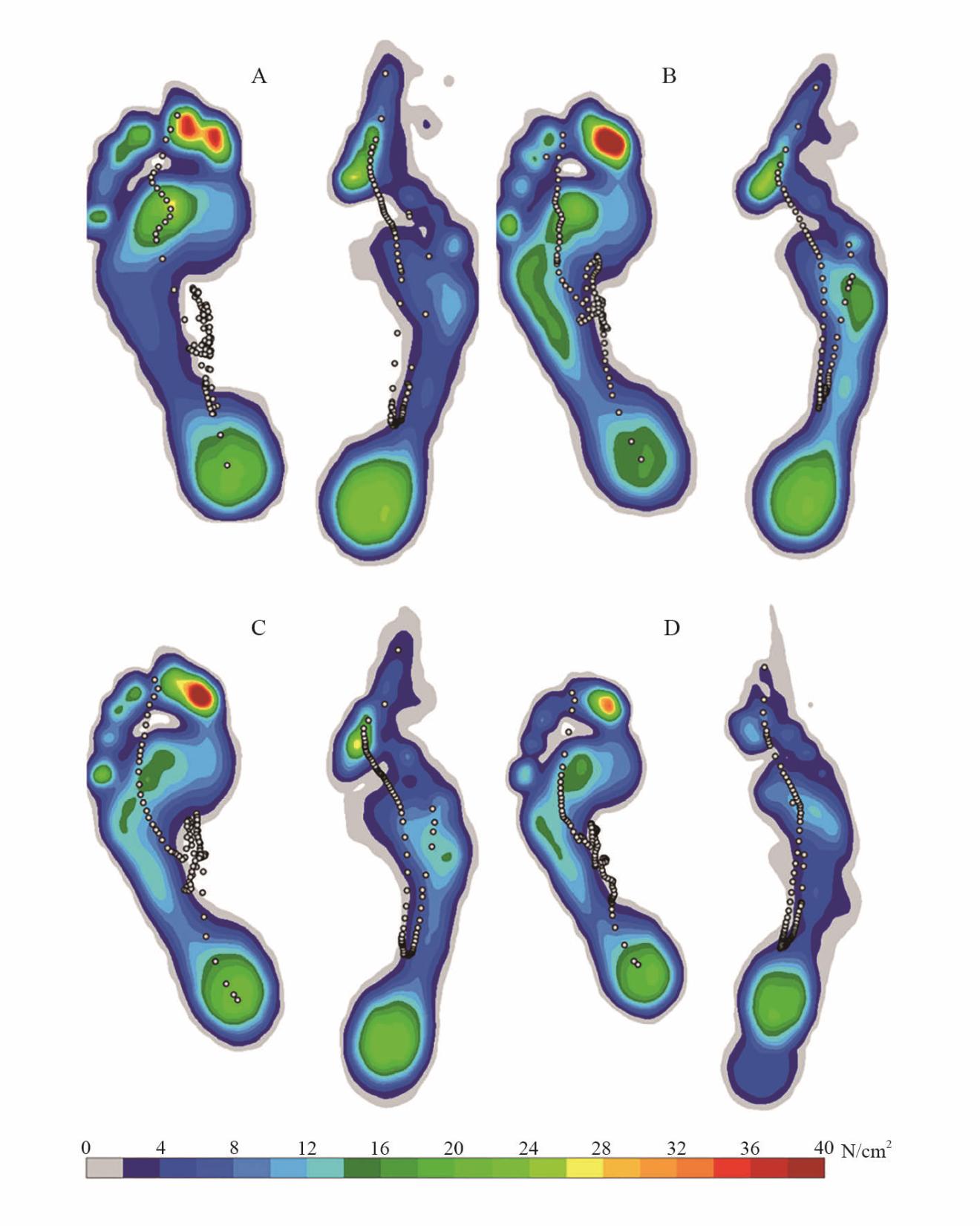
Figure 4
Diagram of plantar pressure changes derived from 3D gait analysis during the patient's transition from independent standing to independent walking"
| [1] |
Del Felice A, Bisogno A L, Bertuccelli M, et al. Neurorehabilitation as a forerunner in the paradigm shift towards systems medicine[J]. Lancet Neurol, 2025, 24(9): 723-724.
doi: 10.1016/S1474-4422(25)00281-9 pmid: 40818472 |
| [2] |
杨亚茹, 邱卓英, 陈迪, 等. 主要残疾类别的定义、分类、分级以及评估研究:基于ICF和ICD-11的方法[J]. 中国康复理论与实践, 2025, 31(4): 373-381.
doi: 10.3969/j.issn.1006-9771.2025.04.001 |
| Yang Y R, Qiu Z Y, Chen D, et al. Disability definition, classification, grading and assessment in disability eligibility: an ICF and ICD-11 framework perspective[J]. Chin J Rehabil Theory Pract, 2025, 31(4): 373-381. | |
| [3] |
贾杰. "上下肢一体化"整体康复:脑卒中后手功能康复新理念[J]. 中国康复理论与实践, 2017, 23(1): 1-3.
doi: 10.3969/j.issn.1006-9771.2017.01.001 |
| Jia J. Upper and Lower Extremities Integration: a novel concept for hands functional rehabilitation[J]. Chin J Rehabil Theory Pract, 2017, 23(1): 1-3. | |
| [4] | 贾杰. "手脑感知-手脑运动"理论在脑卒中后上肢康复中的应用[J]. 康复学报, 2024, 34(4): 311-315, 322. |
| Jia J. Application of "hand-brain perception and hand-brain movement" theory in upper limb rehabilitation after stroke[J]. Rehabil Med, 2024, 34(4): 311-315, 322. | |
| [5] | 贾杰. 脑卒中上肢康复:手脑感知与手脑运动[J]. 中国康复医学杂志, 2020, 35(4): 385-389. |
| Jia J. Upper limb rehabilitation after stroke: hand-brain perception and hand-brain movement[J]. Chin J Rehabil Med, 2020, 35(4): 385-389. | |
| [6] | 徐硕, 贾杰. "中枢-外周-中枢"闭环康复:脑卒中后手功能康复新理念的临床应用进展[J]. 中国康复医学杂志, 2024, 39(10): 1537-1541. |
| Xu S, Jia J. Clinical application progress of the "central-peripheral-central" closed-loop rehabilitation: a new concept for hand function rehabilitation after stroke[J]. Chin J Rehabil Med, 2024, 39(10): 1537-1541. | |
| [7] |
Jenkinson M, Beckmann C F, Behrens T E, et al. FSL[J]. Neuroimage, 2012, 62(2): 782-790.
doi: 10.1016/j.neuroimage.2011.09.015 pmid: 21979382 |
| [8] | Jia X Z, Wang J, Sun H Y, et al. RESTplus: an improved toolkit for resting-state functional magnetic resonance imaging data processing[J]. Sci Bull (Beijing), 2019, 64(14): 953-954. |
| [9] |
庞冬清, 刘介生, 刘劲松, 等. 感觉运动性鞋垫对脑性瘫痪儿童步态及能量消耗的影响[J]. 中国康复理论与实践, 2019, 25(8): 971-975.
doi: 10.3969/j.issn.1006-9771.2019.08.015 |
| Pang D Q, Liu J S, Liu J S, et al. Effect of sensomotor insole on gait and energy expenditure for children with cerebral palsy[J]. Chin J Rehabil Theory Pract, 2019, 25(8): 971-975. | |
| [10] | 闫华, 廖春华, 李亚琴, 等. 基于重复经颅磁刺激的脑卒中后失语症康复策略进展[J]. 神经损伤与功能重建, 2025, 20(4): 237-241. |
| Yan H, Liao C H, Li Y Q, et al. Advances in rehabilitation strategies for post-stroke aphasia based on repetitive transcranial magnetic stimulation[J]. Neural Inj Funct Reconstr, 2025, 20(4): 237-241. | |
| [11] |
Gholami M, Pourbaghi N, Taghvatalab S. Evaluation of rTMS in patients with poststroke aphasia: a systematic review and focused meta-analysis[J]. Neurol Sci, 2022, 43(8): 4685-4694.
doi: 10.1007/s10072-022-06092-x pmid: 35499630 |
| [12] |
Zhang J, Zhong D, Xiao X, et al. Effects of repetitive transcranial magnetic stimulation (rTMS) on aphasia in stroke patients: a systematic review and meta-analysis[J]. Clin Rehabil, 2021, 35(8): 1103-1116.
doi: 10.1177/0269215521999554 |
| [13] |
Gan L, Huang L, Zhang Y, et al. Effects of low frequency rTMS combined with speech and language therapy on Broca's aphasia in subacute stroke patients[J]. Front Neurol, 2024, 15: 1473254.
doi: 10.3389/fneur.2024.1473254 |
| [14] |
Barbieri E, Thompson C K, Higgins J, et al. Treatment-induced neural reorganization in aphasia is language-domain specific: evidence from a large-scale fMRI study[J]. Cortex, 2023, 159:75-100.
doi: 10.1016/j.cortex.2022.11.008 |
| [15] |
Ma Z Z, Wu J J, Cao Z, et al. Motor imagery-based brain-computer interface rehabilitation programs enhance upper extremity performance and cortical activation in stroke patients[J]. J Neuroeng Rehabil, 2024, 21(1): 91.
doi: 10.1186/s12984-024-01387-w |
| [16] |
Lau C C Y, Yuan K, Wong P C M, et al. Modulation of functional connectivity and low-frequency fluctuations after brain-computer interface-guided robot hand training in chronic stroke: a 6-month follow-up study[J]. Front Hum Neurosci, 2021, 14: 611064.
doi: 10.3389/fnhum.2020.611064 |
| [17] |
Chen J, Or C K, Chen T. Effectiveness of using virtual reality-supported exercise therapy for upper extremity motor rehabilitation in patients with stroke: systematic review and meta-analysis of randomized controlled trials[J]. J Med Internet Res, 2022, 24(6): e24111.
doi: 10.2196/24111 |
| [18] |
Wang L, Chen J L, Wong A M K, et al. Game-based virtual reality system for upper limb rehabilitation after stroke in a clinical environment: systematic review and meta-analysis[J]. Games Health J, 2022, 11(5): 277-297.
doi: 10.1089/g4h.2022.0086 pmid: 36252097 |
| [19] |
Amin F, Waris A, Syed S, et al. Effectiveness of immersive virtual reality-based hand rehabilitation games for improving hand motor functions in subacute stroke patients[J]. IEEE Trans Neural Syst Rehabil Eng, 2024, 32: 2060-2069.
doi: 10.1109/TNSRE.2024.3405852 |
| [20] |
Bernhardt J, Hayward K S, Kwakkel G, et al. Agreed definitions and a shared vision for new standards in stroke recovery research: the stroke recovery and rehabilitation roundtable taskforce[J]. Int J Stroke, 2017, 12(5): 444-450.
doi: 10.1177/1747493017711816 pmid: 28697708 |
| [21] |
Xu X Y, Pang Z J, Li M H, et al. Impact of extended nursing model after multi-disciplinary treatment on young patient with post-stroke[J]. World J Clin Cases, 2023, 11(14): 3148-3157.
doi: 10.12998/wjcc.v11.i14.3148 |
| [22] |
Goodhew E, Mayr R, Earing K, et al. The role of an inpatient aphasia-friendly choir for people with post-stroke communication impairment from the perspective of the multidisciplinary team: an exploratory study[J]. Int J Lang Commun Disord, 2025, 60(1): e13143.
doi: 10.1111/jlcd.v60.1 |
| [23] |
Oike K, Ishibashi O, Nosaka N, et al. The impact of multidisciplinary team intervention for early mobilization of patients with aneurysmal subarachnoid hemorrhage in stroke care unit: a retrospective cohort study[J]. Phys Ther Res, 2024, 27(3): 166-172.
doi: 10.1298/ptr.E10297 pmid: 39866391 |
| [24] |
Caldeira Quaresma D, Mcmonagle C. The efficacy of lower limb orthoses on quality of life, well-being, and participation following stroke: a systematic review[J]. Prosthet Orthot Int, 2024, 49(4): 388-399.
doi: 10.1097/PXR.0000000000000389 pmid: 39660844 |
| [25] | An B, Woo Y, Park K, et al. Effects of insole on the less affected side during execution of treadmill walking training on gait ability in chronic stroke patients: a preliminary study[J]. Restor Neurol Neurosci, 2020, 38(5): 375-384. |
| [26] | Park C, Woo Y, Won J, et al. Immediate effects of insoles applied to the sound side lower extremity of patients with chronic hemiplegia during walking[J]. Restor Neurol Neurosci, 2024, 42(2): 167-177. |
| [27] |
Liu Y T, Tsai H T, Hsu C Y, et al. Effects of orthopedic insoles on postural balance in patients with chronic stroke: a randomized crossover study[J]. Gait Posture, 2021, 87: 75-80.
doi: 10.1016/j.gaitpost.2021.04.014 |
| [28] | Wang J, Qiao L, Yu L, et al. Effect of customized insoles on gait in post-stroke hemiparetic individuals: a randomized controlled trial[J]. Biology (Basel), 2021, 10(11): 1187. |
| [29] |
Hozein M, Mortada H, Hamed M, et al. Effect of insole on postural control and gait of stroke patients: a systematic review and meta-analysis[J]. Int J Rehabil Res, 2024, 47(3): 137-146.
doi: 10.1097/MRR.0000000000000632 pmid: 38881488 |
| [30] | 刘丽旭. 融合·闭环·精准:神经调控技术重塑卒中康复[J]. 中国卒中杂志, 2025, 20(9): 1073-1077. |
|
Liu L X. Integration, closed-loop, precision: neuromodulation technology reshaping stroke rehabilitation[J]. Chin J Stroke, 2025, 20(9): 1073-1077.
doi: 10.3969/j.issn.1673-5765.2025.09.001 |
|
| [31] | 潘钰, 张皓, 谢青, 等. 脑卒中智能康复技术应用专家共识[J]. 中国康复医学杂志, 2025, 40(9): 1289-1297. |
| Pan Y, Zhang H, Xie Q, et al. Expert consensus on the application of intelligent rehabilitation technologies for stroke[J]. Chin J Rehabil Med, 2025, 40(9): 1289-1297. |
| [1] | Wei Tongtong, Tian Yifan, Chen Ting, Yao Qi, Hu Jianmin. Application of ICF in visual impairment rehabilitation: a scoping review [J]. Chinese Journal of Rehabilitation Theory and Practice, 2026, 32(9): 1025-1032. |
| [2] | Chi Qianqian, Zhang Xiaonian, Zhu Xiaomin, Sun Wanyue, Zhang Xin, Zhou Jin, Bu Hongwei, Zhai Lei, Zhang Xin, Ling Zirui, Chen Hongyu. Effect of standardized rehabilitation unit on traumatic brain injury [J]. Chinese Journal of Rehabilitation Theory and Practice, 2026, 32(9): 1033-1040. |
| [3] | Huang Xuli, Wang Pingzhi, Luo Tian'e. Comparison of cortical hemodynamic responses between real-time and video-based action observation therapy in patients with stroke: a functional near-infrared spectroscopy study [J]. Chinese Journal of Rehabilitation Theory and Practice, 2026, 32(9): 1041-1051. |
| [4] | Su Panpan, He Chuan, Qiongji , Meng Dianhuai. Comparison of static balance characteristics under different standing postures in older patients with post-stroke hemiplegia [J]. Chinese Journal of Rehabilitation Theory and Practice, 2026, 32(9): 1052-1060. |
| [5] | Shen Xiaohua, Chen Fangyuan, Rong Jifeng, Rao Biaoqin, Kong Lingxuan, Tian Wei, Chen Zhiqun, Li Li. Effect of anterior seat inclination on sit-to-stand ability in patients with stroke and related brain network [J]. Chinese Journal of Rehabilitation Theory and Practice, 2026, 32(9): 1061-1067. |
| [6] | Feng Xiaojuan, Huang Fubiao, Li Dongyue, Zhou Mingyi, Niu Yuxuan, Ismaili McGee Pireti, Wang Xixian, Wang Zile. Development and feasibility study of a self-stabilizing home-based functional interactive training device [J]. Chinese Journal of Rehabilitation Theory and Practice, 2026, 32(9): 1068-1077. |
| [7] | Zhou Huiling, Zeng Jiayan, Chen Bing. Quality of life among vocational rehabilitation patients with mild work-related disability and its association with return-to-work outcomes [J]. Chinese Journal of Rehabilitation Theory and Practice, 2026, 32(9): 1078-1086. |
| [8] | Guo Xuxia, Yu Hengrui, Lu Yucheng, Yang Sichuang, Long Yu, Li Jiawei, Chen Lin, Nong Feiyu, Long Yaobin. An explainable artificial intelligence-driven motor rehabilitation assessment system based on perception-cognition decoupling: design and validation [J]. Chinese Journal of Rehabilitation Theory and Practice, 2026, 32(9): 1108-1116. |
| [9] | Youth Working Committee of Chinese Association of Rehabilitation Medicine, Lymphedema Expert Committee of Peripheral Vascular Committee of Chinese Society of Microcirculation, Integrated Nursing Professional Committee for Tumor Rehabilitation of Chinese Anti-Cancer Association, Community Rehabilitation Working Committee of Chinese Association of Rehabilitation Medicine. Chinese expert consensus on rehabilitation and management of axillary web syndrome following breast cancer surgery (2025) [J]. Chinese Journal of Rehabilitation Theory and Practice, 2026, 32(8): 869-881. |
| [10] | Youth Working Committee of Chinese Association of Rehabilitation Medicine, Lymphedema Expert Committee of Peripheral Vascular Committee of Chinese Society of Microcirculation, Integrated Nursing Professional Committee for Tumor Rehabilitation of Chinese Anti-Cancer Association. Chinese expert consensus on identification and diagnostic criteria for axillary web syndrome after breast cancer surgery [J]. Chinese Journal of Rehabilitation Theory and Practice, 2026, 32(8): 882-891. |
| [11] | Yan Jiazheng, Luo Xiaoqin, Liu Rihua, Yu Ying, Qi Fengxue. Non-invasive brain stimulation techniques for balance function after stroke: a network meta-analysis [J]. Chinese Journal of Rehabilitation Theory and Practice, 2026, 32(8): 903-915. |
| [12] | Liu Shan, Xu Kunyao, Zhou Zhimeng, Zhou Lingyun, Zeng Mao, He Sha, Dai Luoyang, Qin Ting, Hu Qinglin, Yang Jiahai, Li Rui. Effects of different electromagnetic stimulation protocols on hand function and activities of daily living for stroke patients: a network meta-analysis [J]. Chinese Journal of Rehabilitation Theory and Practice, 2026, 32(8): 916-926. |
| [13] | Liang Yanhua, Zhang Tong, Zhang Qi, Zhou Tiantian, Zhang Yanqing, Yue Qing, Li Sijia. Effect of rehabilitation robot training on abdominal muscle thickness and balance ability in children with hemiplegia [J]. Chinese Journal of Rehabilitation Theory and Practice, 2026, 32(8): 927-937. |
| [14] | Tian Jingxiao, Ai Jiaming, Min Hongwei, Zhao Kecong, Zhang Baocui, Jiang Hong, Yang Wei, Liu Jun'e. Formulation and initial validation of a daily goal-management-based exercise intervention for total knee arthroplasty patients [J]. Chinese Journal of Rehabilitation Theory and Practice, 2026, 32(8): 959-967. |
| [15] | Liu Hua, Ma Xin, Li Jing, Wang Liyuan, Wang Li. Comparison master's training programs in sports rehabilitation based on rehabilitation competency framework [J]. Chinese Journal of Rehabilitation Theory and Practice, 2026, 32(8): 984-992. |
| Viewed | ||||||
|
Full text |
|
|||||
|
Abstract |
|
|||||
|
||
