



Chinese Journal of Rehabilitation Theory and Practice ›› 2026, Vol. 32 ›› Issue (5): 534-549.doi: 10.3969/j.issn.1006-9771.2026.05.004
Previous Articles Next Articles
LIU Rui1, GAO Zhenmei2,3( ), ZHOU Xingyu1, ZHANG Qi1, WU Jianlin2
Received:2026-01-16
Published:2026-05-25
Online:2026-05-26
Contact:
GAO Zhenmei
E-mail:gzmzjy@126.com
Supported by:CLC Number:
LIU Rui, GAO Zhenmei, ZHOU Xingyu, ZHANG Qi, WU Jianlin. Application of digital health technologies in upper limb motor function rehabilitation after stroke from 2015 to 2025: a bibliometric analysis[J]. Chinese Journal of Rehabilitation Theory and Practice, 2026, 32(5): 534-549.
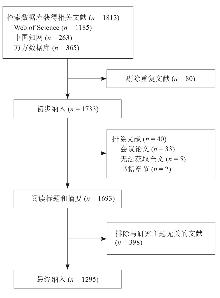
Figure 1
Flowchart of literature screening"

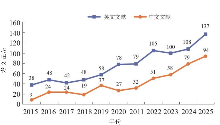
Figure 2
Annual publication volume"

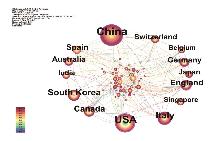
Figure 3
Co-occurrence map of countries of English literatures"
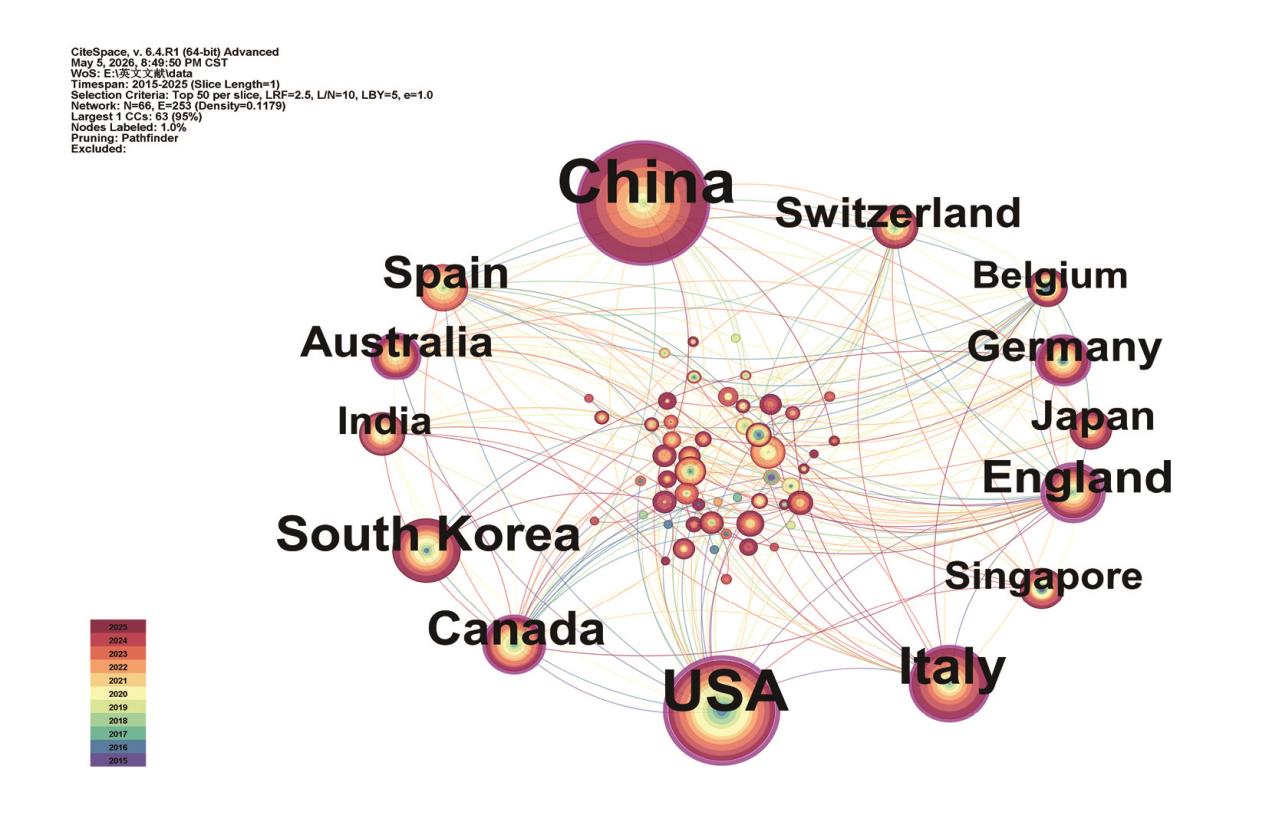

Table 1
Top five countries with the largest number of English literatures"
| 国家 | 发文量/n | 中心性 |
|---|---|---|
| 中国 | 220 | 0.12 |
| 美国 | 158 | 0.43 |
| 意大利 | 85 | 0.13 |
| 韩国 | 67 | 0.00 |
| 加拿大 | 55 | 0.20 |
Figure 4
Co-occurrence map of institutions of Chinese literatures"
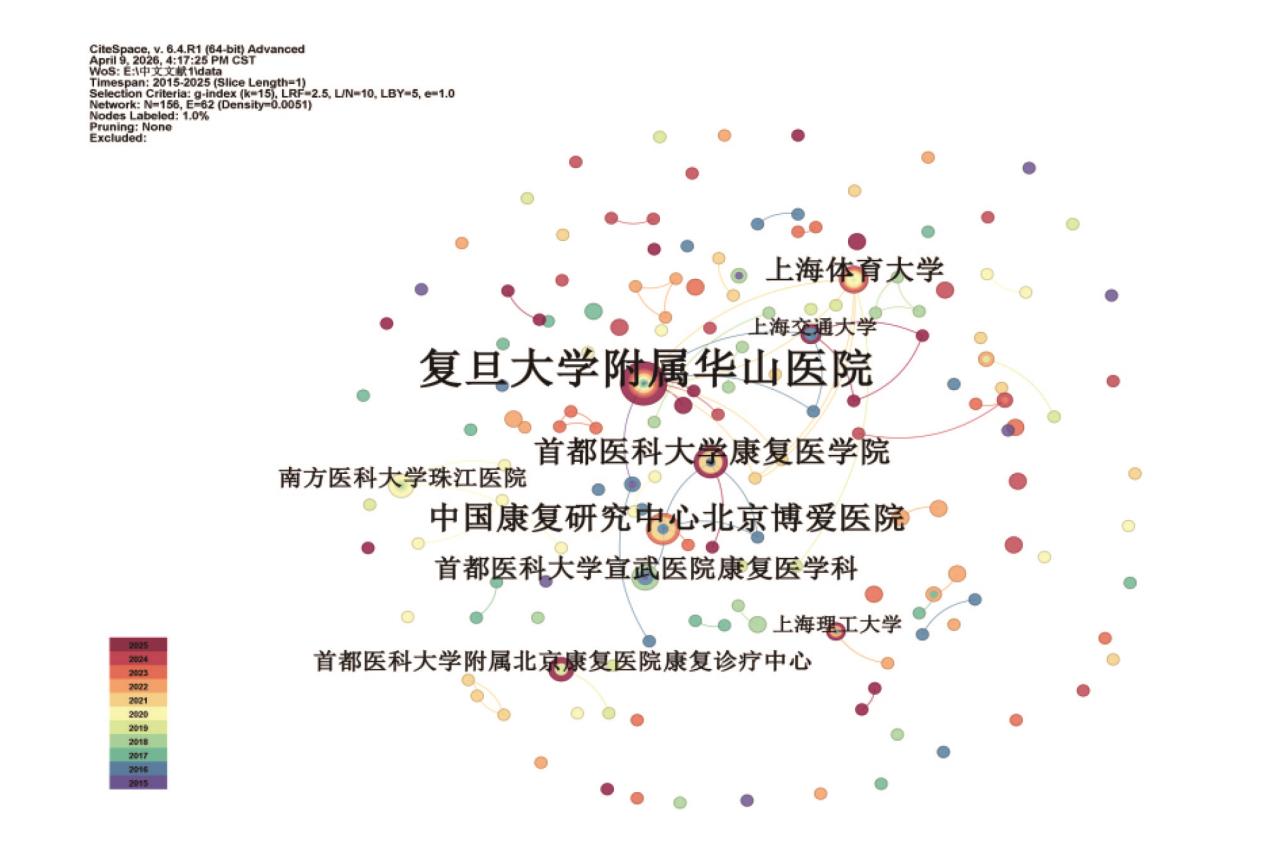
Figure 5
Co-occurrence map of institutions of English literatures"

Table 2
Top five institutions with the largest number of publications in Chinese and English literatures"
| 排名 | 中文文献 | 英文文献 | ||
|---|---|---|---|---|
| 机构 | 发文量/n | 机构 | 发文量/n | |
| 1 | 复旦大学附属华山医院 | 19 | ETH Zurich | |
| 2 | 中国康复研究中心北京博爱医院 | 8 | Hong Kong Polytechnic University | |
| 3 | 上海体育大学 | 7 | University of Wisconsin System | |
| 4 | 首都医科大学康复医学院 | 6 | McGill University | |
| 5 | 首都医科大学宣武医院康复医学科 | 5 | IRCCS Santa Lucia | |
Figure 6
Co-occurrence map of authors of Chinese literatures"
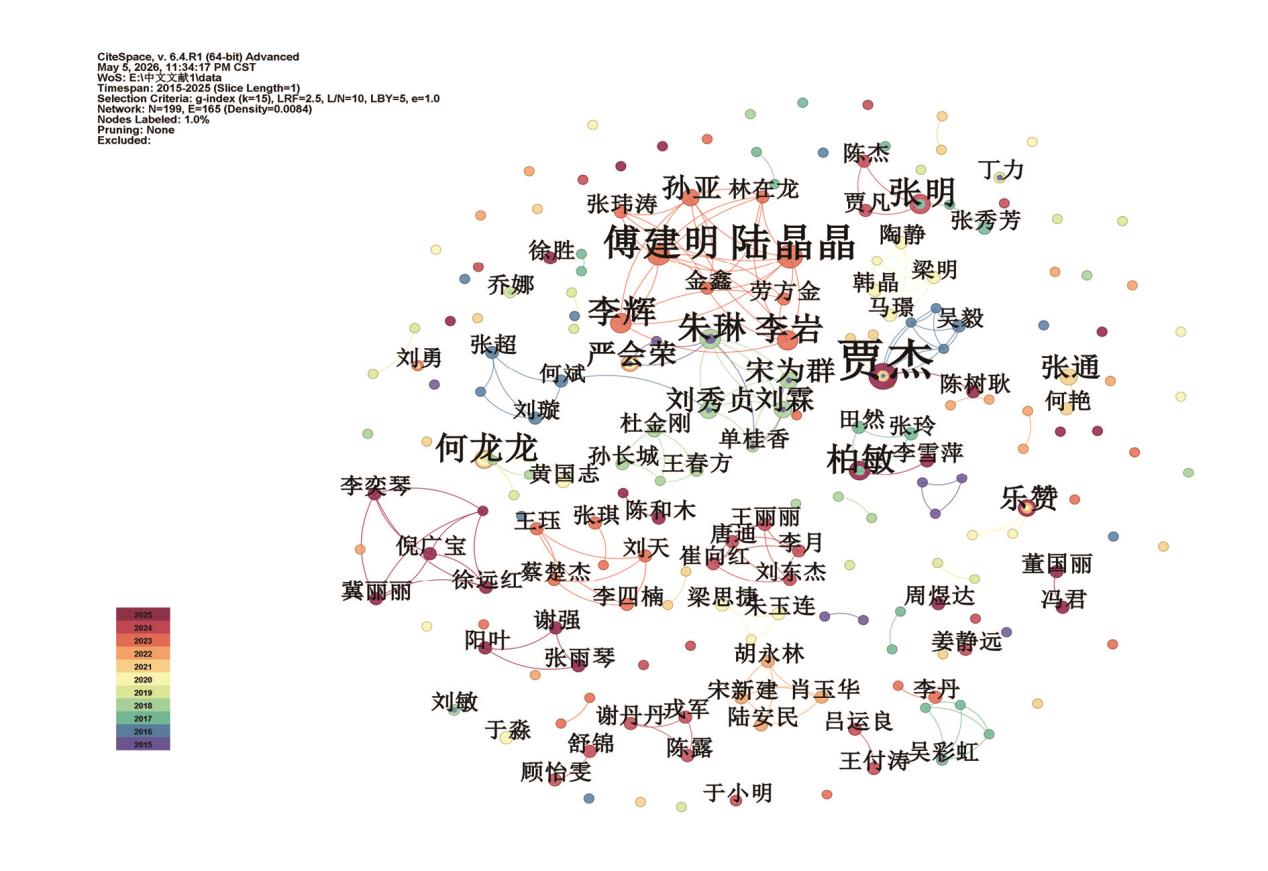
Figure 7
Co-occurrence map of authors of English literatures"

Figure 8
Co-occurrence map of keywords of Chinese literatures"

Figure 9
Co-occurrence map of keywords of English literatures"

Table 3
Top ten keywords with the most frequency of Chinese and English literatures"
| 排名 | 中文文献 | 英文文献 | ||
|---|---|---|---|---|
| 关键词 | 频次 | 关键词 | 频次 | |
| 1 | 脑卒中 | 365 | upper limb | |
| 2 | 上肢运动功能 | 156 | virtual reality | |
| 3 | 偏瘫 | 78 | brain-computer interface | |
| 4 | 康复训练 | 74 | stroke rehabilitation | |
| 5 | 脑机接口 | 60 | machine learning | |
| 6 | 虚拟现实 | 58 | motor function | |
| 7 | 手功能 | 30 | motor imagery | |
| 8 | 运动想象 | 26 | motor recovery | |
| 9 | 上肢康复机器人 | 23 | stroke | |
| 10 | 镜像疗法 | 19 | deep learning | |
Figure 10
Clustering map of Chinese keywords"
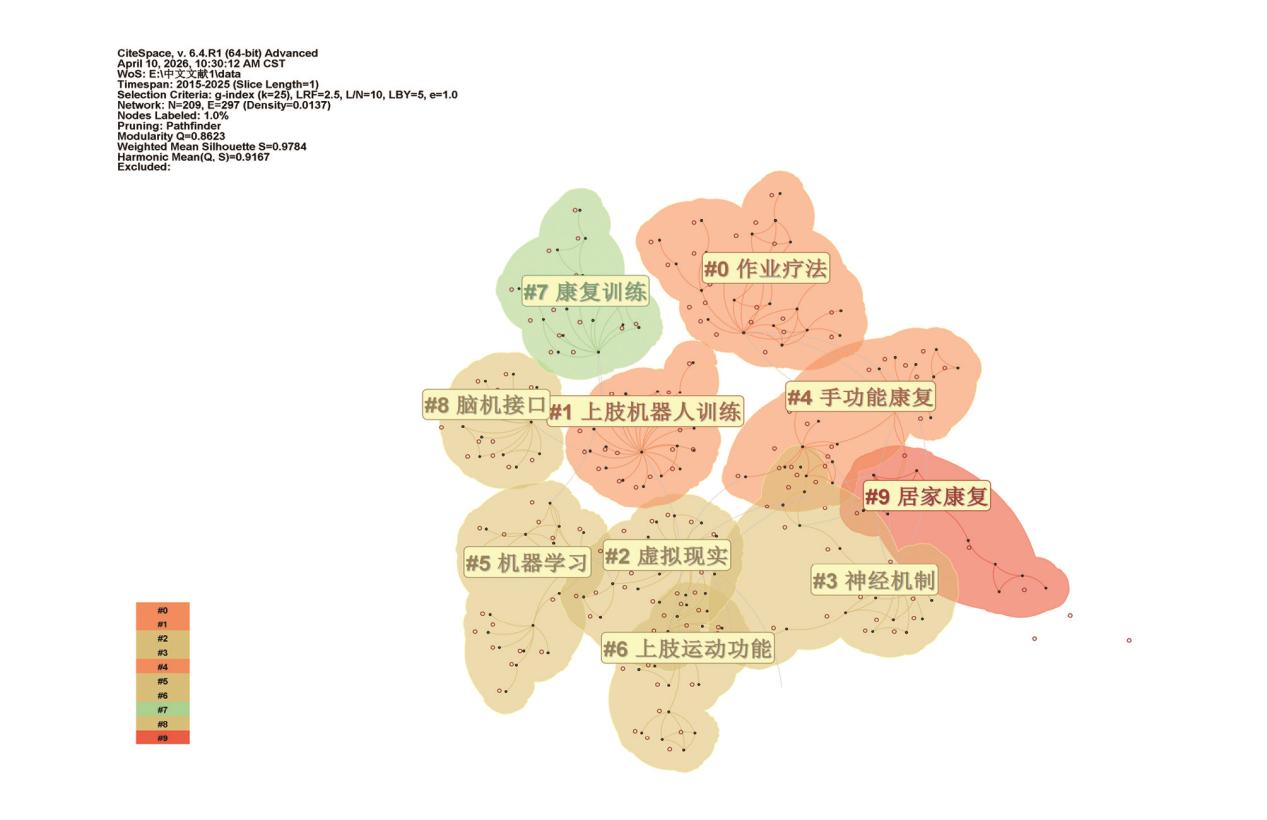
Figure 11
Clustering map of English keywords"
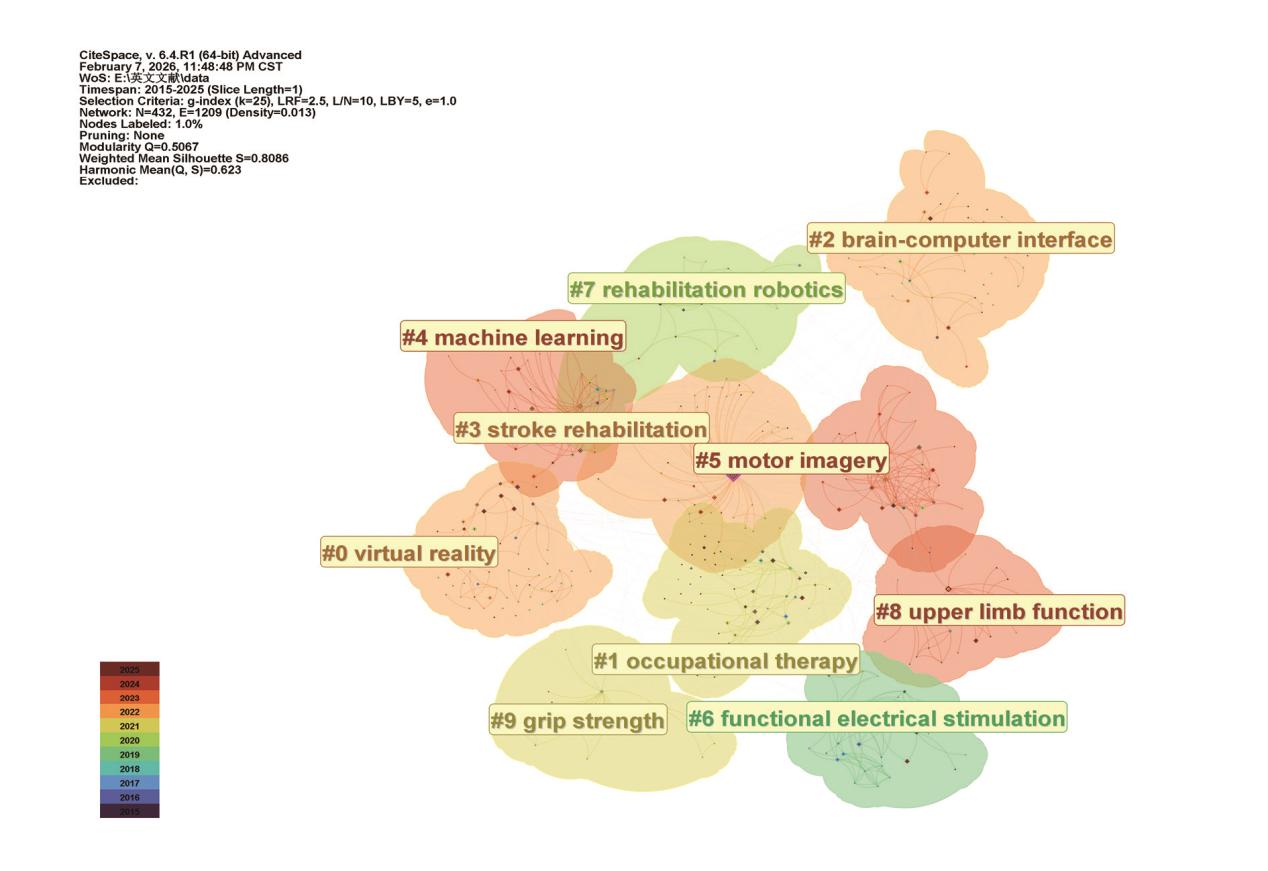
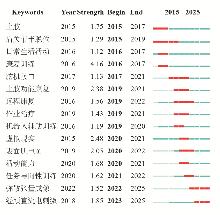
Figure 12
Bursting keywords of Chinese literatures"

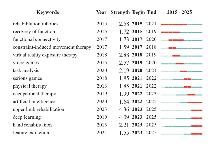
Figure 13
Bursting keywords of English literatures"

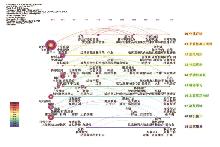
Figure 14
Keyword timeline map of Chinese literatures"
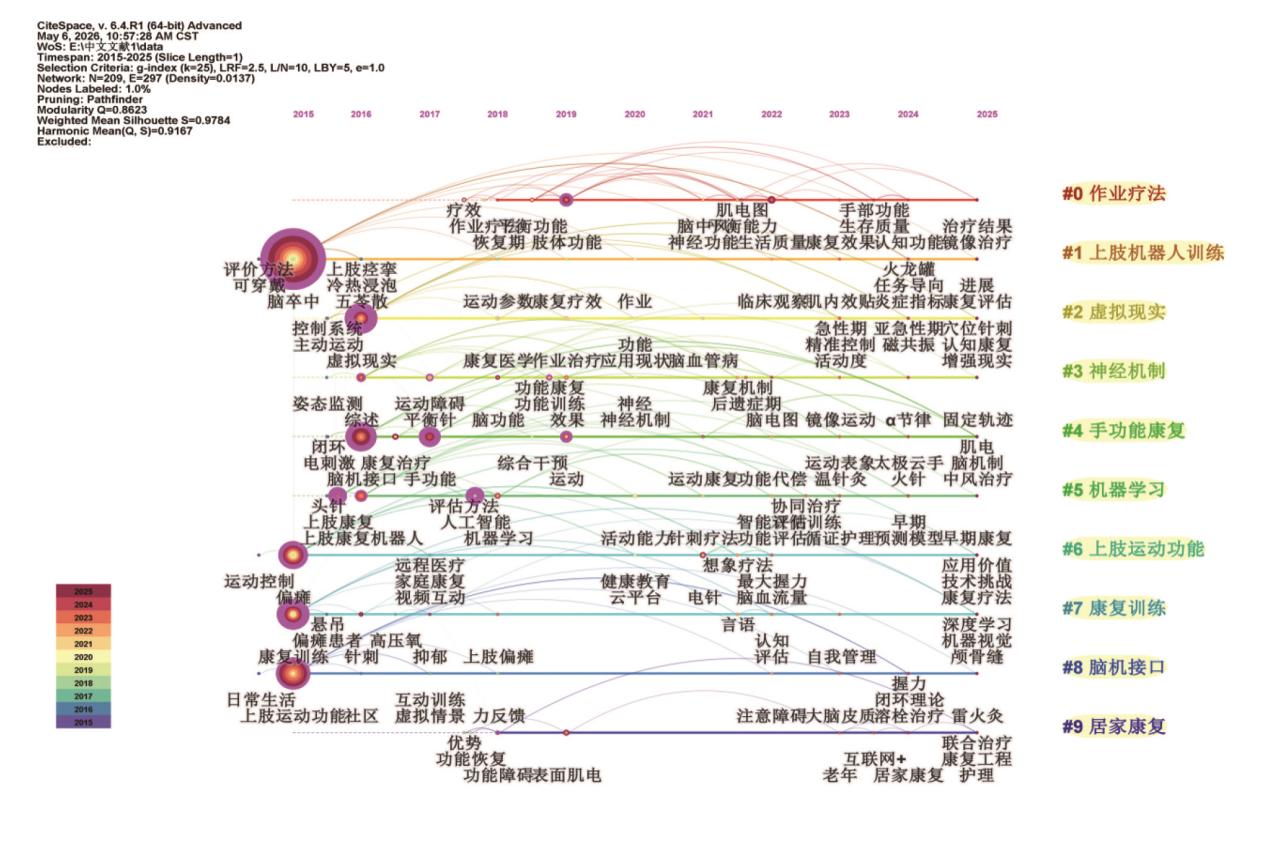
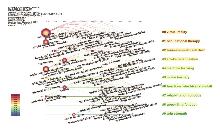
Figure 15
Keyword timeline map of English literatures"

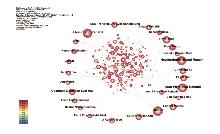
Figure 16
Co-occurrence map of journal co-citation"
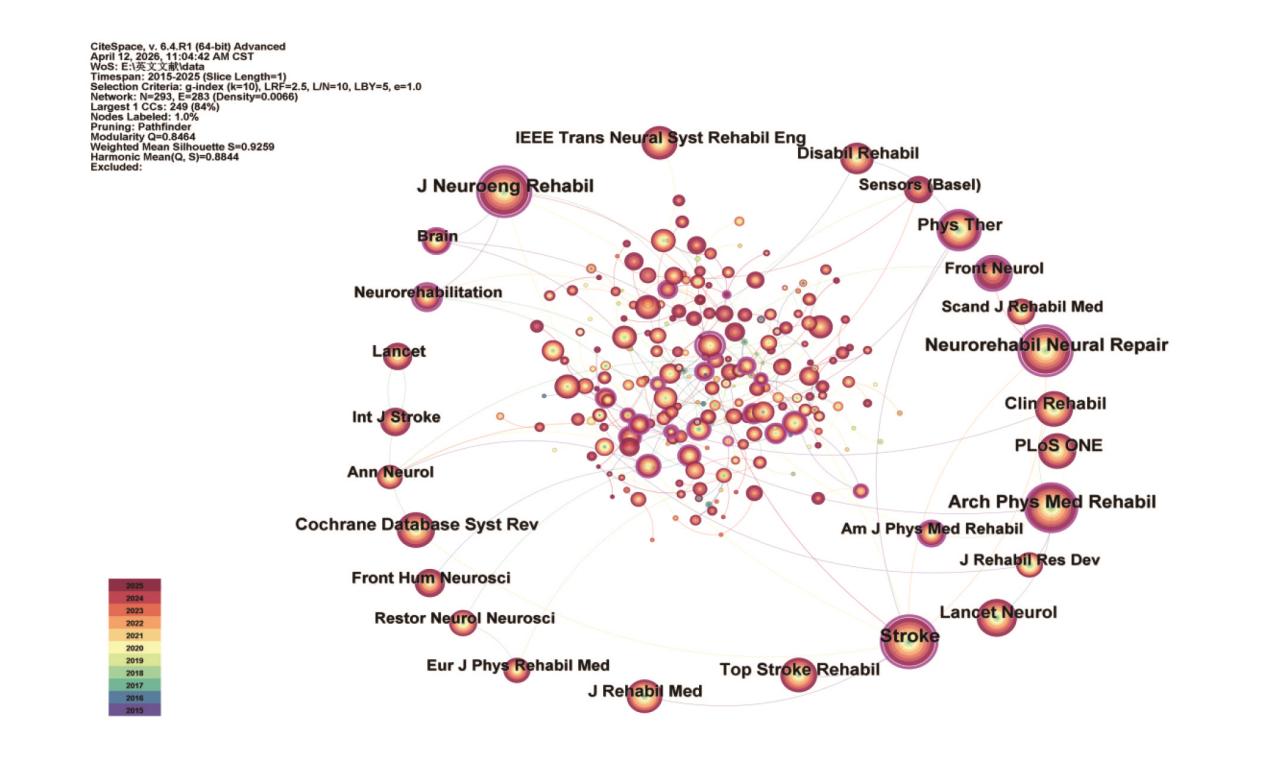
Table 4
Top five cited journals"
| 排名 | 期刊 | 被引频次 | 中心性 |
|---|---|---|---|
| 1 | Stroke | 676 | 0.70 |
| 2 | Neurorehabilitation and Neural Repair | 659 | 0.71 |
| 3 | Journal of NeuroEngineering and Rehabilitation | 639 | 0.62 |
| 4 | Archives of Physical Medicine and Rehabilitation | 630 | 0.28 |
| 5 | Physical Therapy | 413 | 0.34 |
| [1] | «中国卒中中心报告2022»编写组. «中国卒中中心报告2022»概要[J]. 中国脑血管病杂志, 2024, 21(8): 565-576. |
| Report on Stroke Center in China Writing Group. Brief report on stroke center in China, 2022[J]. Chin J Cerebrovasc Dis, 2024, 21(8): 565-576. | |
| [2] | 翟屹, 杨帆, 李天琪, 等. 中国卒中疾病负担与经济负担的整合分析[J]. 中国卒中杂志, 2025, 20(5): 566-580. |
|
ZHAI Y, YANG F, LI T Q, et al. An integrated analysis of disease burden and economic burden of stroke in China[J]. Chin J Stroke, 2025, 20(5): 566-580.
doi: 10.3969/j.issn.1673-5765.2025.05.005 |
|
| [3] |
FEIGIN V L, STARK B A, JOHNSON C O. Global, regional, and national burden of stroke and its risk factors, 1990-2019: a systematic analysis for the Global Burden of Disease Study 2019[J]. Lancet Neurol, 2021, 20(10): 795-820.
doi: 10.1016/S1474-4422(21)00252-0 pmid: 34487721 |
| [4] |
RODRÍGUEZ-GARCÍA M E, CARINO-ESCOBAR R, CARRILLO-MORA P, et al. Neuroplasticity changes in cortical activity, grey matter, and white matter of stroke patients after upper extremity motor rehabilitation via a brain-computer interface therapy program[J]. J Neural Eng, 2025, 22(2): 026025.
doi: 10.1088/1741-2552/adbebf |
| [5] |
SCHWARZ A, KANZLER C M, LAMBERCY O, et al. Systematic review on kinematic assessments of upper limb movements after stroke[J]. Stroke, 2019, 50(3): 718-727.
doi: 10.1161/STROKEAHA.118.023531 pmid: 30776997 |
| [6] |
STINEAR C M, LANG C E, ZEILER S, et al. Advances and challenges in stroke rehabilitation[J]. Lancet Neurol, 2020, 19(4): 348-360.
doi: S1474-4422(19)30415-6 pmid: 32004440 |
| [7] | 吴玉龙, 孙慧, 安军明, 等. 近5年脑卒中后上肢功能障碍中西医康复研究进展[J]. 辽宁中医药大学学报, 2021, 23(7): 148-151. |
| WU Y L, SUN H, AN J M, et al. Research progress of rehabilitation of Chinese and western medicine on upper limb dysfunction after stroke in recent 5 years[J]. Liaoning J Tradit Chin Med, 2021, 23(7): 148-151. | |
| [8] |
MARIANO B. Towards a global strategy on digital health[J]. Bull World Health Organ, 2020, 98(4): 231.
doi: 10.2471/BLT.20.253955 |
| [9] |
KHEIROLLAHZADEH M, SARVGHADI P, HANI J B, et al. Digital health technologies to support at-home recovery of people with stroke: a scoping review[J]. Appl Sci, 2025, 15(10): 5335.
doi: 10.3390/app15105335 |
| [10] |
GEBREHEAT G, GOMAN A, PORTER-ARMSTRONG A. The use of home-based digital technology to support post-stroke upper limb rehabilitation: a scoping review[J]. Clin Rehabil, 2024, 38(1): 60-71.
doi: 10.1177/02692155231189257 |
| [11] |
CHEN C, SONG M. Visualizing a field of research: a methodology of systematic scientometric reviews[J]. PLoS One, 2019, 14(10): e0223994.
doi: 10.1371/journal.pone.0223994 |
| [12] | 陈悦, 陈超美, 刘则渊, 等. CiteSpace知识图谱的方法论功能[J]. 科学学研究, 2015, 33(2): 242-253. |
| CHEN Y, CHEN C M, LIU Z Y, et al. The methodology function of CiteSpace mapping knowledge domains[J]. Stud Sci Sci, 2015, 33(2): 242-253. | |
| [13] |
蒋逸, 梁康, 楚家豪, 等. 2021年至2025年脑机接口技术在脑卒中康复领域应用的文献计量分析[J]. 中国康复理论与实践, 2025, 31(11): 1279-1289.
doi: 10.3969/j.issn.1006-9771.2025.11.005 |
| JIANG Y, LIANG K, CHU J H, et al. Application of brain-computer interface technology in stroke rehabilitation from 2021 to 2025: a bibliometric analysis[J]. Chin J Rehabil Theory Pract, 2025, 31(11): 1279-1289. | |
| [14] | 薛鹏, 白安颖, 江宇, 等. WHO数字健康全球战略及对中国的启示[J]. 中华预防医学杂志, 2022, 56(2): 218-221. |
| XUE P, BAI A Y, JIANG Y, et al. WHO global strategy on digital health and its implications to China[J]. Chin J Prev Med, 2022, 56(2): 218-221. | |
| [15] |
TENFORDE A S, BORGSTROM H, POLICH G, et al. Outpatient physical, occupational, and speech therapy synchronous telemedicine: a survey study of patient satisfaction with virtual visits during the COVID-19 pandemic[J]. Am J Phys Med Rehabil, 2020, 99(11): 977-981.
doi: 10.1097/PHM.0000000000001571 |
| [16] |
YUN S J, KIM J H, LEE J H, et al. Reliability and validity of virtual reality box & block test in healthy adults and patients with stroke: a prospective, multi-center, exploratory, cross-sectional study[J]. J Neuroeng Rehabil, 2025, 22(1): 241.
doi: 10.1186/s12984-025-01779-6 |
| [17] |
PAWASSAR C M, TIBERIUS V. Virtual reality in health care: bibliometric analysis[J]. JMIR Serious Games, 2021, 9(4): e32721.
doi: 10.2196/32721 |
| [18] |
SHIN S, HWANG G, KIM Y, et al. Role of fully-immersive virtual reality for paretic arm recovery in stroke rehabilitation[J]. Front Neurol, 2025, 16: 1653749.
doi: 10.3389/fneur.2025.1653749 |
| [19] |
GAO C, CHEN Y, WEI Y, et al. Combined immersive and nonimmersive virtual reality with mirror therapy for patients with stroke: systematic review and meta-analysis of randomized controlled trials[J]. J Med Internet Res, 2025, 27: e73142.
doi: 10.2196/73142 |
| [20] |
MUNOZ-NOVOA M, KRISTOFFERSEN M B, SUNNERHAGEN K S, et al. Myoelectric pattern recognition with virtual reality and serious gaming improves upper limb function in chronic stroke: a single case experimental design study[J]. J Neuroeng Rehabil, 2025, 22(1): 6.
doi: 10.1186/s12984-025-01541-y |
| [21] | 王颖俏, 张亚敏, 李维苹, 等. 机器人联合虚拟现实对脑卒中病人运动功能和日常生活活动能力影响的Meta分析[J]. 循证护理, 2024, 10(2): 239-245. |
| WANG Y Q, ZHANG Y M, LI W P, et al. Effect of robot combined virtual reality on motor function and daily living ability of stroke patients: a meta-analysis[J]. Chin Evid Based Nurs, 2024, 10(2): 239-245. | |
| [22] | ABDULLAHI A, WONG T W L, NG S S M. Effects of combining transcranial direct current stimulation with virtual reality on upper limb function in patients with stroke: a systematic review and meta-analysis[J]. Bioengineering (Basel), 2025, 12(11): 1205. |
| [23] | TONIN A, SEMPRINI M, KIPER P, et al. Brain-computer interfaces for stroke motor rehabilitation[J]. Bioengineering (Basel), 2025, 12(8): 820. |
| [24] |
CERVERA M A, SOEKADAR S R, USHIBA J, et al. Brain-computer interfaces for post-stroke motor rehabilitation: a meta-analysis[J]. Ann Clin Transl Neurol, 2018, 5(5): 651-663.
doi: 10.1002/acn3.2018.5.issue-5 |
| [25] | 韩诗雨, 解益, 董安琴. 基于脑机接口的功能性电刺激改善卒中后患者上肢功能的Meta分析[J]. 中国康复医学杂志, 2024, 39(12): 1862-1869. |
| HAN S Y, XIE Y, DONG A Q. Meta-analysis of functional electrical stimulation via brain-computer interface for improving upper limb function in post-stroke patients[J]. Chin J Rehabil Med, 2024, 39(12): 1862-1869. | |
| [26] |
唐千乇, 张通. 脑机接口控制的功能性电刺激对脑卒中患者上肢功能障碍的康复效果[J]. 中国康复理论与实践, 2021, 27(7): 802-806.
doi: 10.3969/j.issn.1006-9771.2021.07.011 |
| TANG Q T, ZHANG T. Effects of functional electrical stimulation controlled by brain-computer interface on upper limb dysfunction in stroke patients[J]. Chin J Rehabil Theory Pract, 2021, 27(7): 802-806. | |
| [27] |
JI X, LU X, XU Y, et al. Effects and neural mechanisms of a brain-computer interface-controlled soft robotic glove on upper limb function in patients with subacute stroke: a randomized controlled fNIRS study[J]. J Neuroeng Rehabil, 2025, 22(1): 171.
doi: 10.1186/s12984-025-01704-x pmid: 40707971 |
| [28] |
KEELING A B, PIITZ M, SEMRAU J A, et al. Robot enhanced stroke therapy optimizes rehabilitation (RESTORE): a pilot study[J]. J Neuroeng Rehabil, 2021, 18(1): 10.
doi: 10.1186/s12984-021-00804-8 pmid: 33478563 |
| [29] |
VEERBEEK J M, LANGBROEK-AMERSFOORT A C, VAN WEGEN E E, et al. Effects of robot-assisted therapy for the upper limb after stroke[J]. Neurorehabil Neural Repair, 2017, 31(2): 107-121.
doi: 10.1177/1545968316666957 pmid: 27597165 |
| [30] |
CASTELLI L, GIANNUZZI D, LORETI C, et al. The impact of robotic hand rehabilitation on hand function and fatigue in patients with stroke (RoHa-S)[J]. J Clin Neurosci, 2025, 139: 111445.
doi: 10.1016/j.jocn.2025.111445 |
| [31] |
BOARDSWORTH K, RASHID U, OLSEN S, et al. Upper limb robotic rehabilitation following stroke: a systematic review and meta-analysis investigating efficacy and the influence of device features and program parameters[J]. J Neuroeng Rehabil, 2025, 22(1): 164.
doi: 10.1186/s12984-025-01662-4 pmid: 40671078 |
| [32] |
RODGERS H, BOSOMWORTH H, KREBS H I, et al. Robot assisted training for the upper limb after stroke (RATULS): a multicentre randomised controlled trial[J]. Lancet, 2019, 394(10192): 51-62.
doi: S0140-6736(19)31055-4 pmid: 31128926 |
| [33] |
YANG Y M, PARK J H. Effects of upper limb robot therapy with action observation training on subacute stroke patients: a randomised controlled trial[J]. J Mot Behav, 2025, 57(4): 358-376.
doi: 10.1080/00222895.2025.2497376 |
| [34] |
BIASIUCCI A, LEEB R, ITURRATE I, et al. Brain-actuated functional electrical stimulation elicits lasting arm motor recovery after stroke[J]. Nat Commun, 2018, 9(1): 2421.
doi: 10.1038/s41467-018-04673-z pmid: 29925890 |
| [35] |
SEHLE A, STUERNER J, HASSA T, et al. Behavioral and neurophysiological effects of an intensified robot-assisted therapy in subacute stroke: a case control study[J]. J Neuroeng Rehabil, 2021, 18(1): 6.
doi: 10.1186/s12984-020-00792-1 pmid: 33430912 |
| [36] |
MAURO M C, FASANO A, GERMANOTTA M, et al. Aperiodic brain activity changes in patients with stroke following virtual reality-based upper limb robotic rehabilitation: a pilot randomized controlled trial[J]. Front Hum Neurosci, 2025, 19: 1671804.
doi: 10.3389/fnhum.2025.1671804 |
| [37] |
ANASTASIEV A, KADONE H, MARUSHIMA A, et al. A novel bilateral data fusion approach for EMG-driven deep learning in post-stroke paretic gesture recognition[J]. Sensors (Basel), 2025, 25(12): 3664.
doi: 10.3390/s25123664 |
| [38] | 李贤, 马秀芝. 机器学习预测脑卒中病人日常生活活动能力的研究进展[J]. 护理研究, 2024, 38(8): 1407-1412. |
| LI X, MA X Z. Research progress of machine learning in predicting activities of daily living in stroke patients[J]. Chin Nurs Res, 2024, 38(8): 1407-1412. | |
| [39] |
VAN DER GUN G J, MESKERS C G M, ANDRINOPOULOU E R, et al. Can machine learning improve on the early prediction of upper limb recovery after stroke?[J]. J Neuroeng Rehabil, 2025, 22(1): 223.
doi: 10.1186/s12984-025-01743-4 pmid: 41146217 |
| [40] |
GAO Y, XU G, PENG J, et al. Assessment of functional decline in stroke patients using 3D deep learning and dynamic functional connectivity based on resting-state fMRI[J]. Front Neurol, 2025, 16: 1666991.
doi: 10.3389/fneur.2025.1666991 |
| [41] |
张琦, 孙文玉, 高振梅, 等. 非侵入性脑刺激在阿尔茨海默病中应用的文献计量分析[J]. 中国康复理论与实践, 2025, 31(2): 194-208.
doi: 10.3969/j.issn.1006-9771.2025.02.009 |
| ZHANG Q, SUN W Y, GAO Z M, et al. Application of non-invasive brain stimulation in Alzheimer's disease: a bibliometric analysis[J]. Chin J Rehabil Theory Pract, 2025, 31(2): 194-208. |
| [1] | NI Tianhao, BI Siyu, DAI Yuan, QIAN Hong, WANG Yongli, WAN Qin, HUANG Zhaoming. Development and validation of assessment and diagnostic tools for apraxia of speech of Chinese Putonghua [J]. Chinese Journal of Rehabilitation Theory and Practice, 2026, 32(5): 550-560. |
| [2] | AN Yongyi, LI Xuemei, CHANG Xueyou, ZHAO Yaning, HUANG Hailing, YANG Yadong. Effect of blood flow restriction training under different intensities combined with low-intensity resistance training on motor function in elderly stroke patients with frailty [J]. Chinese Journal of Rehabilitation Theory and Practice, 2026, 32(5): 561-570. |
| [3] | CHEN Zhu, ZHAI Liru, CAO Cunxia, PENG Xiaohua, HUANG Tao. Effect of phrenic nerve-abdominal muscle electrical stimulation on pulmonary ventilation distribution in stroke patients: a study with electrical impedance tomography [J]. Chinese Journal of Rehabilitation Theory and Practice, 2026, 32(5): 571-576. |
| [4] | LI Xinyuan, ZHENG Jiejiao, WU Xuejiao, DUAN Linru, GAO Yufei. Effect of cerebellar intermittent theta-burst stimulation on postural control and fall risk in patients with stroke [J]. Chinese Journal of Rehabilitation Theory and Practice, 2026, 32(5): 577-587. |
| [5] | GU Yuhong, DUAN Jinxiu, XUE Mingyang, YANG Jie, WU Xia, LIU Hua, GAO Yufang, ZHANG Menghui, YE Caide. Effect of medical-community linkage model on psychological status and motor function in community-dwelling patients with stroke [J]. Chinese Journal of Rehabilitation Theory and Practice, 2026, 32(5): 597-603. |
| [6] | QI Yuanyuan, GAO Haifeng, LIU Lina, XIE Yujie, XU Jing, GAO Feng, CHEN Liang, YANG Degang, LI Jun. Spinal cord stimulation for spinal cord injury from 1999 to 2025: a bibliometric analysis [J]. Chinese Journal of Rehabilitation Theory and Practice, 2026, 32(4): 373-386. |
| [7] | HUANG Cheng, SHEN Yangyi, LU Biying, LIU Tong, LIU Yue. Application of action observation therapy in stroke rehabilitation from 2016 to 2025: a bibliometric analysis [J]. Chinese Journal of Rehabilitation Theory and Practice, 2026, 32(4): 399-410. |
| [8] | GUI Shun, ZHANG Jianfei, HUANG Huizhi. Prediction of neurological function rehabilitation outcome for stroke patients using interpretable machine learning models [J]. Chinese Journal of Rehabilitation Theory and Practice, 2026, 32(4): 463-472. |
| [9] | ZHU Lili, ZHAO Jiaxin, CHENG Xue, WANG Huijuan, CHEN Xiaoxia. Experiences and needs of stroke patients during rehabilitation: a qualitative meta-synthesis [J]. Chinese Journal of Rehabilitation Theory and Practice, 2026, 32(3): 286-293. |
| [10] | LIU Ping, ZHOU Nan, XUE Xiaojie, SHAO Weibo. Application of rehabilitation therapy techniques for post-stroke dysphagia: a bibliometric analysis [J]. Chinese Journal of Rehabilitation Theory and Practice, 2026, 32(3): 294-303. |
| [11] | PU Xinyu, WANG Jingxuan, WANG Hujun, XIU Anda, WANG Yingpeng. Application of repetitive peripheral magnetic stimulation in rehabilitation therapy: a bibliometric analysis [J]. Chinese Journal of Rehabilitation Theory and Practice, 2026, 32(3): 304-316. |
| [12] | SUN Kui, HUANG Hailun, LIU Yongai, GAO Heng. Brain-computer interface technology in treatment for spinal cord injury: a bibliometric analysis [J]. Chinese Journal of Rehabilitation Theory and Practice, 2026, 32(3): 317-328. |
| [13] | YANG Ling, WANG Qinglei, WANG Jie, XU Wenjie, WANG Tong, GUO Chuan, QIAN Xue. Activation patterns and mechanism in the prefrontal cortex of post-stroke anxiety patients: a study using functional near-infrared spectroscopy [J]. Chinese Journal of Rehabilitation Theory and Practice, 2026, 32(3): 329-336. |
| [14] | HE Zhaonan, ZHANG Tingting, HE Zhaoke, MENG Lijun. Topic mining and content analysis of rehabilitation ethics research in China based on BERTopic model [J]. Chinese Journal of Rehabilitation Theory and Practice, 2026, 32(2): 132-141. |
| [15] | GUO Yabin, ZENG Biyun, ZHOU Yang. Researches in sarcopenia-pain comorbidity from 2015 to 2025: a bibliometric analysis [J]. Chinese Journal of Rehabilitation Theory and Practice, 2026, 32(2): 151-161. |
| Viewed | ||||||
|
Full text |
|
|||||
|
Abstract |
|
|||||
|
||
