



Chinese Journal of Rehabilitation Theory and Practice ›› 2026, Vol. 32 ›› Issue (6): 653-664.doi: 10.3969/j.issn.1006-9771.2026.06.004
Previous Articles Next Articles
LI Wen1,2, YAN Xinyue3, HUANG Qiuchen1,2, ZHANG Rui1,2, SUN Yuemei1,2, ZHOU Yue1,2( )
Received:2025-11-20
Revised:2026-03-19
Published:2026-06-25
Online:2026-06-24
Supported by:CLC Number:
LI Wen, YAN Xinyue, HUANG Qiuchen, ZHANG Rui, SUN Yuemei, ZHOU Yue. Effect of neuromuscular electrical stimulation on patients after total knee arthroplasty: a meta-analysis[J]. Chinese Journal of Rehabilitation Theory and Practice, 2026, 32(6): 653-664.

Table 1
PICO framework"
| 人群(Population) | 干预(Intervention) | 比较(Comparison) | 结局(Outcome) |
|---|---|---|---|
| 接受过TKA的患者 年龄≥18岁 | 干预场所 医院 家庭 干预人员 康复治疗师 干预措施 NMES 运动康复 物理康复 干预剂量 单次干预时间 干预频率 干预周期 | 康复过程中额外增加NMES干预和只进行常规康复的比较 | 疼痛(VAS) b280痛觉 肌力(股四头肌肌力) b730肌力功能 关节活动度(膝关节屈曲活动度、膝关节伸展活动度) b710关节活动功能 平衡和行走、转移能力(TUG、SCT、2MWT、3MWT、6MWT) d410 改变身体姿势 d420转移 d450步行 d455移动 自理能力(WOMAC) d540穿衣 d530如厕 生活质量(SF-36) b130能量和驱力功能 d570照顾个人的健康 |
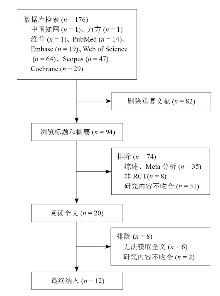
Figure 1
Flowchart of literature screening"
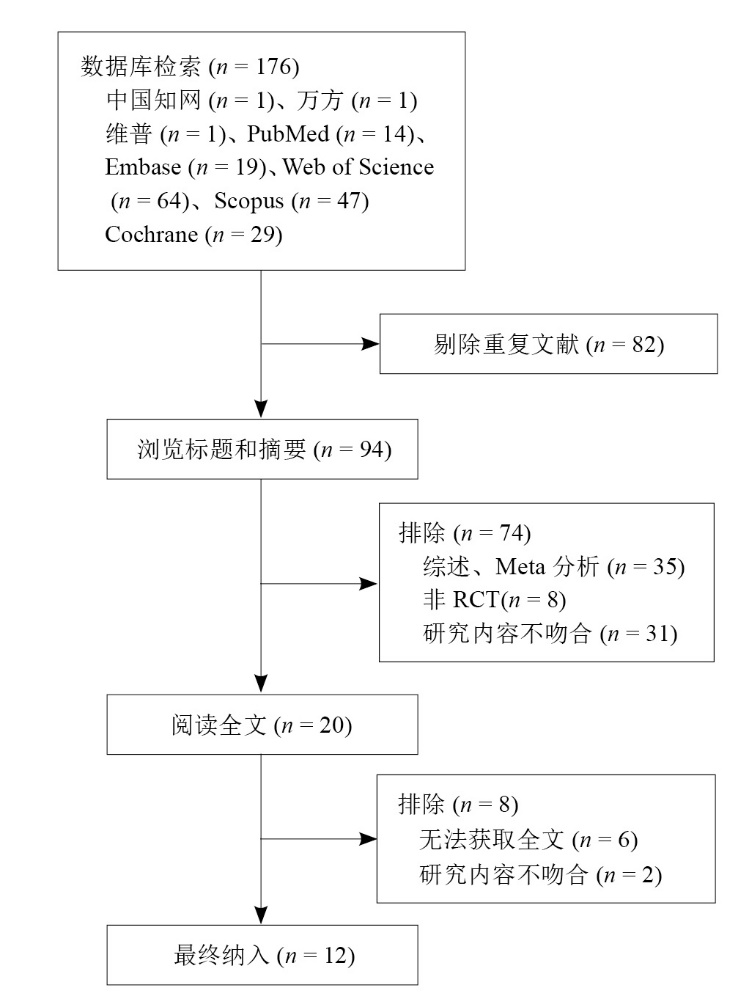
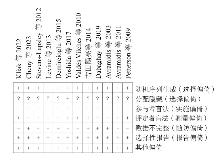
Figure 2
Bias assessment of included literatures"
Figure 3
Risk ratio of bias"
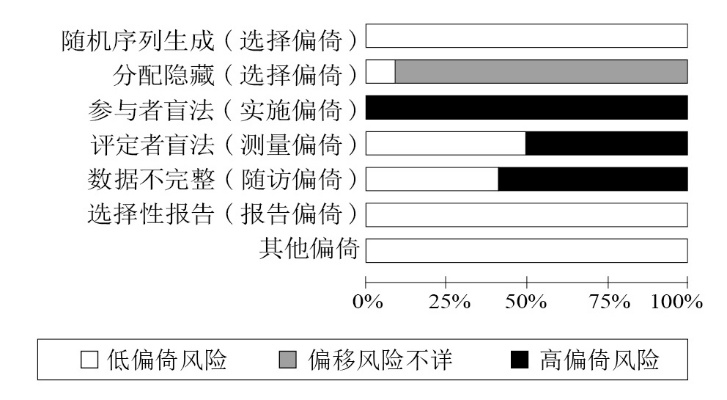
Table 2
Scores of PEDro scale of included literatures"
| 纳入文献 | 受试者纳入条件 | 随机分配 | 分配隐藏 | 基线相似 | 研究对象施盲 | 治疗师施盲 | 结果评估施盲 | 参与率>85% | 意向治疗分析 | 组间统计结果分析 | 点测量和差异值 | 总分 |
|---|---|---|---|---|---|---|---|---|---|---|---|---|
| Klika等[ | √ | √ | √ | √ | √ | √ | 5 | |||||
| Cheuy等[ | √ | √ | √ | √ | √ | √ | 5 | |||||
| Stevens-Lapsley等[ | √ | √ | √ | √ | √ | √ | √ | 6 | ||||
| Levine等[ | √ | √ | √ | √ | √ | 4 | ||||||
| Demircioglu等[ | √ | √ | √ | √ | √ | √ | 5 | |||||
| Yoshida等[ | √ | √ | √ | √ | √ | √ | √ | √ | 7 | |||
| Valdés Vilches等[ | √ | √ | √ | √ | √ | √ | 5 | |||||
| 吉田陽亮等[ | √ | √ | √ | √ | √ | √ | √ | 6 | ||||
| Dabadghav等[ | √ | √ | √ | √ | √ | 4 | ||||||
| Avramidis等[ | √ | √ | √ | √ | √ | √ | 5 | |||||
| Avramidis等[ | √ | √ | √ | √ | √ | √ | √ | 6 | ||||
| Petterson等[ | √ | √ | √ | √ | √ | √ | √ | 6 |
Table 3
Basic characteristics of included literatures"
| 纳入文献 | 国家 | 试验设计 | n(C/T) | 性别(男/女)/n | 年龄/岁 | 试验组处理(干预方法、频率、周期) | 对照组处理 | 随访时间 | 结局指标 | 研究结果 |
|---|---|---|---|---|---|---|---|---|---|---|
| Klika等[ | 德国 | RCT | 44/22 | C:27/17 T:17/5 | C:65±7.6 T:64±6.2 | 标准康复+NMES,每天1次,共12周 | 标准康复 | 12周 | ②④ | 显著改善股四头肌肌力和步行速度,促进患者功能恢复 |
| Cheuy等[ | 美国 | RCT | 9/10 | C:3/6 T:6/4 | C:65±6 T:68±4 | 标准康复+NMES,每次45 min,每天2次,共2周 | 标准康复 | 2周 | ① | 通过改善II型肌纤维尺寸,减轻术后早期肌肉无力 |
| Stevens-Lapsley等[ | 美国 | RCT | 31/35 | C:15/16 T:15/20 | C:64.8±7.7 T:66.2±9.1 | 标准康复+NMES,每次刺激收缩15次,每天2次 | 标准康复 | 52周 | ①②③④⑤⑥⑦⑧⑪ | 通过优化Ⅱ型肌纤维募集和提高运动皮质兴奋性改善功能 |
| Levine等[ | 美国 | RCT | 34/34 | C:13/21 T:7/25 | C:平均65.1 T:平均68.1 | 有监督的标准康复+无监督的NMES,每天1次,共60 d | 标准康复 | 6个月 | ③⑤⑥⑧ | NMES方案可降低TKA术后康复成本 |
| Demircioglu等[ | 日本 | RCT | 30/30 | C:1/29 T:2/28 | C:64.6±6.6 T:66.2±7.2 | 标准康复+NMES,每次30 min,每周5次,共4~6周 | 标准康复 | 3个月 | ②③⑤⑥⑦⑧ | 标准康复方案增加NMES能快速改善患者功能,提高生活质量 |
| Yoshida等[ | 美国 | RCT | C:22T1:22 T2:22 | C:2/20 T1:4/18(sNMES) T2:4/18(mNMES) | 73.5±6.3 | 感觉水平NMES、运动水平NMES,每次45 min,每周5次,共2周 | 标准康复 | 4周 | ①②③⑤⑥⑨ | 感觉水平NMES可能通过中枢神经系统激活机制发挥作用,适合对运动水平NMES不耐受的患者 |
| Valdés Vilches等[ | 西班牙 | RCT | 44/39 | C:19/25 T:14/25 | C:70±7 T:72±6 | 标准康复+NMES,共3个月 | 标准康复 | 3个月 | ③⑤⑥ | 可显著改善短期至中期的步行能力 |
| 吉田陽亮等[ | 日本 | RCT | 8/8 | 全为女性 | C:70.6±5.9 T:70.8±4.1 | 运动康复+NMES,每次45 min,每周5次,共2周 | 运动康复 | 8周 | ①②③④⑨ | 感觉水平的NMES可促进患者早期肌力和步行能力恢复,且患者耐受性良好 |
| Dabadghav等[ | 印度 | RCT | 14/14 | 12/16 | 60.82±5.69 | 运动康复+NMES,共7 d | 运动训康复 | 未提及 | ②⑤⑥ | NMES对伸膝迟滞、膝关节活动度和疼痛没有额外影响 |
| Avramidis等[ | 美国 | RCT | 15/15 | C:3/12 T:5/10 | C:71.20±7.83 T:68.20±10.59 | 标准康复+NMES,每次4 h,每天1次,共6周 | 标准康复 | 12周 | ⑩ | 可显著提高患者的步行速度,停止治疗后效应会持续 |
| Avramidis等[ | 美国 | RCT | 35/35 | C:6/29 T:7/28 | C:70.66±3.73 T:70.54±4.68 | 标准康复+NMES,每次45 min,每天2次,共6周 | 标准康复 | 52周 | ⑦⑩ | 刺激股内侧肌可促进功能恢复和早期康复 |
| Petterson等[ | 美国 | RCT | 100/100 | C:55/45 T:53/47 | C:65.2±8.5 T:65.3±8.3 | 主动运动训练+NMES,每周2~3次,共6周 | 主动运动训练 | 12个月 | ③④⑤⑥⑦⑪ | 可改善术后功能,实现短期和长期功能恢复,并接近健康老年人功能水平 |
Table 4
Results of meta-analyses"
| 结局指标 | 纳入研究数/n | 异质性检验结果 | 效应模型 | Meta分析结果 | ||
|---|---|---|---|---|---|---|
| P值 | I2 | SMD(95%CI) | P值 | |||
| VAS | 6[ | 0.010 | 65% | 随机 | -0.25(-0.51~0.00) | 0.051 |
| 股四头肌肌力 | 4[ | 0.030 | 49% | 随机 | 0.61(0.34~0.88) | <0.001 |
| 膝关节屈曲活动度 | 6[ | 0.660 | 0% | 固定 | 1.35(0.30~2.41) | 0.010 |
| 膝关节伸展活动度 | 6[ | 0.009 | 54% | 随机 | -0.33(-0.95~0.29) | 0.300 |
| TUGT | 7[ | 0.001 | 61% | 随机 | -0.86(-1.45~-0.26) | 0.005 |
| SCT | 3[ | 0.007 | 60% | 随机 | -1.66(-3.44~0.12) | 0.070 |
| 2MWT | 2[ | 0.710 | 0% | 固定 | 19.44(10.43~28.45) | <0.001 |
| 3MWT | 2[ | 0.360 | 9% | 随机 | 23.57(14.77~32.36) | <0.001 |
| 6MWT | 2[ | 0.001 | 79% | 随机 | 42.29(9.71~74.86) | 0.010 |
| WOMAC | 3[ | 0.001 | 88% | 随机 | -0.52(-1.00~-0.04) | 0.040 |
| SF-36(PCS) | 4[ | 0.001 | 75% | 随机 | 2.90(0.73~5.06) | 0.009 |
| SF-36(MCS) | 4[ | 0.070 | 40% | 随机 | 2.84(1.40~4.28) | 0.040 |
Table 5
Analysis results of quadriceps muscle strength at different time periods"
| 时间段 | 纳入研究数/n | 异质性检验结果 | 效应模型 | Meta分析结果 | ||
|---|---|---|---|---|---|---|
| P值 | I2 | SMD(95%CI) | P值 | |||
| ≤ 2周 | 2[ | 0.001 | 90% | 随机 | 0.97(-1.51~3.46) | 0.440 |
| 2~4周 | 4[ | 0.600 | 0 | 随机 | 0.90(0.58~1.21) | <0.001 |
| 1~2个月 | 2[ | 0.870 | 0 | 随机 | 0.40(-0.04~0.83) | 0.080 |
Table 6
Subgroup analysis of data results two to four weeks after surgery"
| 结局指标 | 纳入研究数/n | 异质性检验结果 | 效应模型 | Meta分析结果 | ||
|---|---|---|---|---|---|---|
| P值 | I2 | SMD(95%CI) | P值 | |||
| 股四头肌肌力 | 4[ | 0.600 | 0 | 随机 | 0.90(0.58~1.21) | <0.001 |
| TUGT | 5[ | 0.040 | 61% | 随机 | -1.28(-2.57~-0.02) | 0.049 |
| 2MWT | 2[ | 0.550 | 0 | 随机 | 20.43(10.44~30.43) | <0.001 |
Table 7
Subgroup analysis of data results two to three months after surgery"
| 结局指标 | 纳入研究数/n | 异质性检验结果 | 效应模型 | Meta分析结果 | ||
|---|---|---|---|---|---|---|
| P值 | I2 | SMD(95%CI) | P值 | |||
| 3MWT | 2[ | 0.920 | 0 | 固定 | 31.38(17.58~45.18) | <0.001 |
| WOMAC | 2[ | 0.760 | 0 | 固定 | -0.44(-0.79~-0.09) | 0.010 |
| SF-36(MCS) | 4[ | 0.970 | 0 | 固定 | 4.17(2.43~5.91) | <0.001 |
| [1] | 伍小兰, 罗晓晖, 钟卫, 等. 我国积极健康老龄化的现状评估与政策意涵[J]. 卫生经济研究, 2024, 41(5): 1-4. |
| WU X L, LUO X H, ZHONG W, et al. Current situation assessment and policy implications of active and healthy aging in China[J]. Health Economics Res, 2024, 41(5): 1-4. | |
| [2] | 国家统计局. 中国统计年鉴2024 [EB/OL].(2024-10-01)[2025-03-03]. https://www.stats.gov.cn/sj/ndsj/2024/indexch.htm. |
| National Bureau of Statistics of China. China Statistical Yearbook 2024 [EB/OL].(2024-10-01)[2025-03-03]. https://www.stats.gov.cn/sj/ndsj/2024/indexch.htm. | |
| [3] | SU W, ZHOU Y, QIU H, et al. The effects of preoperative rehabilitation on pain and functional outcome after total knee arthroplasty: a meta-analysis of randomized controlled trials[J]. Orthop Surg Res, 2022, 17(1): 175. |
| [4] |
FORTIER L M, ROCKOV Z A, CHEN A F, et al. Activity recommendations after total hip and total knee arthroplasty[J]. Bone Joint Surg Am, 2021, 103(5): 446-455.
doi: 10.2106/JBJS.20.00983 |
| [5] |
CONCOFF A, NIAZI F, FARROKHYAR F, et al. Delay to TKA and costs associated with knee osteoarthritis care using intra-articular hyaluronic acid: analysis of an administrative database[J]. Clin Med Insights Arthritis Musculoskelet Disord, 2021, 14: 1179544121994092.
doi: 10.1177/1179544121994092 |
| [6] | 刘朝晖, 马剑雄, 张顺, 等. 膝骨关节炎的现状及治疗方法的研究进展[J]. 中华骨与关节外科杂志, 2020, 13(8): 688-693. |
| LIU Z H, MA J X, ZHANG S, et al. Status and treatment progress of knee osteoarthritis[J]. Chin J Bone Joint Surg, 2020, 13(8): 688-693. | |
| [7] | VARACALLO M A, LUO T D, MABROUK A, et al. Total knee arthroplasty techniques[M]. Treasure Island(FL): StatPearls Publishing, 2025. |
| [8] | 谢慧勇, 孙贵兰, 梁青青, 等. 手术室亚专科体温保护标准化护理在老年膝关节置换术中的应用观察[J]. 黑龙江医学, 2025, 49(3): 363-366. |
| XIE H Y, SUN G L, LIANG Q Q, et al. Application of standardized subspecialty temperature-protection nursing in elderly patients undergoing total knee arthroplasty[J]. Heilongjiang Med J, 2025, 49(3): 363-366. | |
| [9] | 张琨, 陈洁, 卢梦, 等. ACTED康复护理模式在膝关节置换术病人术后快速康复中的应用效果[J]. 循证护理, 2025, 11(2): 315-320. |
| ZHANG K, CHEN J, LU M, et al. Effect of ACTED rehabilitation nursing model on enhanced recovery after total knee arthroplasty[J]. Evid Based Nurs, 2025, 11(2): 315-320. | |
| [10] | 章安琪, 化昊天, 蔡恬媛, 等. 全膝关节置换后疼痛: 研究现状及趋势分析[J]. 中国组织工程研究, 2026, 30(3): 795-804. |
| ZHANG A Q, HUA H T, CAI T Y, et al. Pain after total knee arthroplasty: current research status and trend analysis[J]. Chin J Tissue Eng Res, 2026, 30(3): 795-804. | |
| [11] | 王宇宁, 朱浩天, 刘康, 等. 数字化精准全膝关节置换与传统置换方法的短期效果对比[J]. 中国组织工程研究, 2025, 29(21): 4521-4528. |
| WANG Y N, ZHU H T, LIU K, et al. Comparison of short-term therapeutic effects between digital precision total knee arthroplasty and traditional methods[J]. J Clin Rehabil Tis Eng Res, 2025, 29(21): 4521-4528. | |
| [12] |
CONNOLLY P, COOMBS S, SCHWARZKOPF R. Mechanical complications after total knee arthroplasty[J]. Expert Rev Med Dev, 2023, 20(12): 1105-1117.
doi: 10.1080/17434440.2023.2282744 |
| [13] |
SILVA M, SHEPHERD E F, JACKSON W O, et al. Knee strength after total knee arthroplasty[J]. J Arthroplasty, 2003, 18(5): 605-611.
doi: 10.1016/s0883-5403(03)00191-8 pmid: 12934213 |
| [14] |
ZHOU F, HUANG Y, SHA R, et al. Effect of the health action process approach theory in patients undergoing total knee arthroplasty[J]. Sci Rep, 2026, 16(1): 4469.
doi: 10.1038/s41598-025-34635-7 |
| [15] |
WEI G, SHANG Z, LI Y, et al. Effects of lower-limb active resistance exercise on mobility, physical function, knee strength and pain intensity in patients with total knee arthroplasty: a systematic review and meta-analysis[J]. BMC Musculoskelet Disord, 2024, 25(1): 730.
doi: 10.1186/s12891-024-07845-9 |
| [16] | AN J, CHEON S J, LEE B H. The effect of combined balance exercise on knee range of motion, balance, gait, and functional outcomes in acute phase following total knee arthroplasty: a single-blind randomized controlled trial[J]. Medicina(Kaunas), 2024, 60(9): 1389. |
| [17] |
AN J, SON Y W, LEE B H. Effect of combined kinematic chain exercise on physical function, balance ability, and gait in patients with total knee arthroplasty: a single-blind randomized controlled trial[J]. Int J Environ Res Public Health, 2023, 20(4): 3524.
doi: 10.3390/ijerph20043524 |
| [18] | YUE C, ZHANG X, ZHU Y, et al. Systematic review of three electrical stimulation techniques for rehabilitation after total knee arthroplasty[J]. Arthroplasty, 2018, 33(7): 2330-2337. |
| [19] |
WILLINGER M L, HEIMROTH J, SODHI N, et al. Management of refractory pain after total joint replacement[J]. Curr Pain Headache Rep, 2021, 25(6): 42.
doi: 10.1007/s11916-021-00956-1 |
| [20] | KIM K M, CROY T, HERTEL J, et al. Effects of neuromuscular electrical stimulation after anterior cruciate ligament reconstruction on quadriceps strength, function, and patient-oriented outcomes: a systematic review[J]. J Orthop Sports Phys Ther, 2010, 47(7): 383-391. |
| [21] | 华裔骨科学会骨科康复专业委员会. 全膝关节置换术后膝关节功能加速康复专家共识[J]. 山东大学学报(医学版), 2024, 62(10): 48-61. |
| Orthopaedic Rehabilitation Special Committee of Chinese Speaking Orthopaedic Society. Expert consensus on accelerated recovery of knee function after total knee arthroplasty[J]. J Shandong Univ(Health Sci), 2024, 62(10): 48-61. | |
| [22] | 中国老年医学学会康复分会, 全膝关节置换围手术期康复干预中国专家共识组. 全膝关节置换围手术期康复干预中国专家共识[J]. 中华物理医学与康复杂志, 2024, 46(2): 97-104. |
| Rehabilitation Branch of the Chinese Geriatrics Society, Chinese Expert Consensus Group on Perioperative Rehabilitation Intervention for Total Knee Arthroplasty. Chinese expert consensus on perioperative rehabilitation intervention for total knee arthroplasty[J]. Chin J Phys Med Rehabil, 2024, 46(2): 97-104 | |
| [23] |
MOHER D, LIBERATI A, TETZLAFF J, et al.; PRISMA Group. Preferred reporting items for systematic reviews and meta-analyses: the PRISMA statement[J]. Phys Ther, 2009, 89(9): 873-880.
doi: 10.1093/ptj/89.9.873 |
| [24] |
邱卓英, 李伦, 陈迪, 等. 基于世界卫生组织国际健康分类家族康复指南研究: 理论架构和方法体系[J]. 中国康复理论与实践, 2020, 26(2): 125-135.
doi: 10.3969/j.issn.1006-9771.2020.02.001 |
| QIU Z Y, LI L, CHEN D, et al. Research on rehabilitation guidelines using World Health Organization Family International Classifications: framework and approaches[J]. Chin J Rehabil Theory Pract, 2020, 26(2): 125-135. | |
| [25] | The Cochrane Collaboration. Review Manager(RevMan)[CP]. Version 5.3. Copenhagen: The Nordic Cochrane Centre, 2014. |
| [26] |
MAHER C G, SHERRINGTON C, HERBERT R D, et al. Reliability of the PEDro scale for rating quality of randomized controlled trials[J]. Phys Ther, 2003, 83(8): 713-721.
pmid: 12882612 |
| [27] |
KLIKA A K, YAKUBEK G, PIUZZI N, et al. Neuromuscular electrical stimulation use after total knee arthroplasty improves early return to function: a randomized trial[J]. J Knee Surg, 2022, 35(1): 104-111.
doi: 10.1055/s-0040-1713420 |
| [28] |
CHEUY V A, DAYTON M R, HOGAN C A, et al. Neuromuscular electrical stimulation preserves muscle strength early after total knee arthroplasty: effects on muscle fiber size[J]. J Orthop Res, 2023, 41(4): 787-792.
doi: 10.1002/jor.v41.4 |
| [29] |
STEVENS-LAPSLEY J E, BALTER J E, WOLFE P, et al. Early neuromuscular electrical stimulation to improve quadriceps muscle strength after total knee arthroplasty: a randomized controlled trial[J]. Phys Ther, 2012, 92(2): 210-226.
doi: 10.2522/ptj.20110124 |
| [30] | LEVINE M, MCELROY K, STAKICH V, et al. Comparing conventional physical therapy rehabilitation with neuromuscular electrical stimulation after total knee arthroplasty[J]. Orthopedics, 2013, 36(3): e319-e324. |
| [31] |
DEMIRCIOGLU D T, PAKER N, ERBIL E, et al. The effect of neuromuscular electrical stimulation on functional status and quality of life after knee arthroplasty: a randomized controlled study[J]. J Phys Ther Sci, 2015, 27(8): 2501-2506.
doi: 10.1589/jpts.27.2501 pmid: 26355656 |
| [32] |
YOSHIDA Y, IKUNO K, SHOMOTO K. Comparison of the effect of sensory-level and conventional motor-level neuromuscular electrical stimulation on quadriceps strength after total knee arthroplasty: a prospective randomized single-blind trial[J]. Arch Phys Med Rehabil, 2017, 98(12): 2364-2370.
doi: 10.1016/j.apmr.2017.05.005 |
| [33] | VALDÉS VILCHES M, FERNÁNDEZ FERRERAS T, SERRA TARRAGÓN N, et al. Feedback and neuromuscular electrical stimulation during an early phase of a rehabilitation programme after total knee arthroplasty[J]. Trauma(Spain), 2010, 21(3): 163-168. |
| [34] | 吉田陽亮, 生野公貴, 庄本康治. 人工膝関節全置換術後症例に対する感覚強度の神経筋電気刺激の効果 ─予備的準ランダム化比較対照試験[J]. 物理療法科学, 2014, 21: 45-52. |
| YOSHIDA Y, IKUNO K, SHOMOTO K. Effects of sensory level neuromuscular electrical stimulation in patients after total knee arthroplasty: a pilot quasi randomized trial[J]. Jpn J Electrophys Agents, 2014, 21(1): 45-52. | |
| [35] | DABADGHAV R, POTDAR A, PATIL V, et al. Additional effect of neuromuscular electrical stimulation on knee extension lag, pain and knee range of motion in immediate postsurgical phase(0-2 weeks)in primary total knee arthroplasty patient[J]. Ann Transl Med, 2019, 7(Suppl 7): S253. |
| [36] |
AVRAMIDIS K, STRIKE P W, TAYLOR P N, et al. Effectiveness of electrical stimulation of the vastus medialis muscle in the rehabilitation of patients after total knee arthroplasty[J]. Arch Phys Med Rehabil, 2003, 84(12): 1850-1853.
doi: 10.1016/S0003-9993(03)00429-5 |
| [37] | AVRAMIDIS K, KARACHALIOS T, POPOTONASIOS K, et al. Does electrical stimulation of the vastus medialis muscle influence rehabilitation after total knee replacement[J]. Orthopedics, 2011, 34(3): 175. |
| [38] | PETTERSON S C, MIZNER R L, STEVENS J E, et al. Improved function from progressive strengthening interventions after total knee arthroplasty: a randomized clinical trial with an embedded prospective cohort[J]. Arthritis Rheum, 2009, 61(2): 174-183. |
| [39] | PENG L, WANG K, ZENG Y, et al. Effect of neuromuscular electrical stimulation after total knee arthroplasty: a systematic review and meta-analysis of randomized controlled trials[J]. Front Med(Lausanne), 2021, 8: 779019. |
| [40] |
MAFFIULETTI N A. Physiological and methodological considerations for the use of neuromuscular electrical stimulation[J] Eur J Appl Physiol, 2010, 110(2): 223-234.
doi: 10.1007/s00421-010-1502-y pmid: 20473619 |
| [41] | 杨海, 蔡菊红, 周驰, 等. 超声波结合经皮神经电刺激对膝骨关节炎患者膝关节疼痛和功能的影响[J]. 中国康复医学杂志, 2024, 39(8): 1174-1179. |
| YANG H, CAI J H, ZHOU C, et al. Effects of ultrasound combined with transcutaneous electrical nerve stimulation on knee joint pain and function in patients with knee osteoarthritis[J]. Chin J Rehabil Med, 2024, 39(8): 1174-1179. | |
| [42] |
RAMANATHAN D, SALEH A, KLIKA A K, et al. The use of transcutaneous electrical nerve stimulation after total knee arthroplasty: a prospective randomized controlled trial[J]. Surg Technol Int, 2017, 30: 425-434.
pmid: 28537354 |
| [43] |
RAKEL B A, ZIMMERMAN B M, GEASLAND K, et al. Transcutaneous electrical nerve stimulation for the control of pain during rehabilitation after total knee arthroplasty: a randomized, blinded, placebo-controlled trial[J]. Pain, 2014, 155(12): 2599-2611.
doi: 10.1016/j.pain.2014.09.025 pmid: 25270585 |
| [44] |
CHURCHILL L, BADE M J, KOONCE R C, et al. The past and future of peri-operative interventions to reduce arthrogenic quadriceps muscle inhibition after total knee arthroplasty: a narrative review[J]. Osteoarthr Cartil Open, 2023, 6(1): 100429.
doi: 10.1016/j.ocarto.2023.100429 |
| [45] |
DURIGAN J L, DELFINO G B, PEVIANI S M, et al. Neuromuscular electrical stimulation alters gene expression and delays quadriceps muscle atrophy of rats after anterior cruciate ligament transection[J]. Muscle Nerve, 2014, 49(1): 120-128.
doi: 10.1002/mus.23883 pmid: 23625381 |
| [46] |
DOS ANJOS T, GABRIEL F, VIEIRA T D, et al. Neuromotor treatment of arthrogenic muscle inhibition after knee injury or surgery[J]. Sports Health, 2024, 16(3): 383-389.
doi: 10.1177/19417381231169285 |
| [47] |
MIZNER R L, PETTERSON S C, STEVENS J E, et al. Early quadriceps strength loss after total knee arthroplasty: contributions of muscle atrophy and failure of voluntary muscle activation[J]. J Bone Joint Surg Am, 2005, 87(5): 1047-1053.
doi: 10.2106/00004623-200505000-00016 |
| [48] |
SPECTOR P, LAUFER Y, ELBOIM-GABYZON M, et al. Neuromuscular electrical stimulation therapy to restore quadriceps muscle function in patients after orthopaedic surgery: a novel structured approach[J]. J Bone Joint Surg Am, 2016, 98(23): 2017-2024.
pmid: 27926683 |
| [49] |
LABANCA L, BONSANTO F, RAFFA D, et al. Does adding neuromuscular electrical stimulation to rehabilitation following total knee arthroplasty lead to a better quadriceps muscle strength recovery? A systematic review[J]. Int J Rehabil Res, 2022, 45(2): 118-125.
doi: 10.1097/MRR.0000000000000525 pmid: 35256573 |
| [50] |
MIZNER R L, PETTERSON S C, STEVENS J E, et al. Preoperative quadriceps strength predicts functional ability one year after total knee arthroplasty[J]. J Rheumatol, 2005, 32(8): 1533-1539.
pmid: 16078331 |
| [51] | HAMILTON D F, BEARD D J, BARKER K L, et al. Targeting rehabilitation to improve outcomes after total knee arthroplasty in patients at risk of poor outcomes: randomised controlled trial[J]. BMJ, 2020, 371: m3576. |
| [52] |
MATSUMOTO H, OKUNO M, NAKAMURA T, et al. Fall incidence and risk factors in patients after total knee arthroplasty[J]. Arch Orthop Trauma Surg, 2012, 132(4): 555-563.
doi: 10.1007/s00402-011-1418-y |
| [53] | SADIQ S, NOOR R, AKRAM R. Risk factors of post discharge falls in patients undergoing total knee arthroplasty: an integrative review[J]. Back Musculoskelet Rehabil, 2024, 37(6): 1427-1439. |
| [54] | MATSUMOTO H, OKUNO M, NAKAMURA T, et al. Incidence and risk factors for falling in patients after total knee arthroplasty compared to healthy elderly individuals[J]. Acta Med, 2014, 57: 137-145. |
| [55] |
AKKAN H, KAYA MUTLU E, KUYUBASI S N. Reliability and validity of the two-minute step test in patients with total knee arthroplasty[J]. Disabil Rehabil, 2024, 46(14): 3128-3132.
doi: 10.1080/09638288.2023.2239141 |
| [56] | BOKAEIAN H R, BAKHTIARY A H, MIRMOHAMMADKHANI M, et al. The effect of adding whole body vibration training to strengthening training in the treatment of knee osteoarthritis: a randomized clinical trial[J]. Bodyw Mov Ther, 2016, 20(2): 334-340. |
| [57] |
FRANZ A, JI S, BITTERSOHL B, et al. Impact of a six-week prehabilitation with blood-flow restriction training on pre- and postoperative skeletal muscle mass and strength in patients receiving primary total knee arthroplasty[J]. Front Physiol, 2022, 13: 881484.
doi: 10.3389/fphys.2022.881484 |
| [58] |
BOURNE R B, CHESWORTH B M, DAVIS A M, et al. Patient satisfaction after total knee arthroplasty: who is satisfied and who is not[J]. Clin Orthop Relat Res, 2010, 468(1): 57-63.
doi: 10.1007/s11999-009-1119-9 |
| [59] |
HUANG C H, CHANG C K, LEE Y T, et al. Muscle strength after successful total knee replacement: a 6-12-year follow-up period[J]. Clin Orthop Relat Res, 1996, 328: 147-154.
doi: 10.1097/00003086-199607000-00023 |
| [60] |
CHAN A C, PANG M Y. Assessing balance function in patients with total knee arthroplasty[J]. Phys Ther, 2015, 95(10): 1397-1407.
doi: 10.2522/ptj.20140486 pmid: 25882482 |
| [61] | LIU Y, YANG Y, LIU H, et al. A systematic review and meta-analysis of fall incidence and risk factors in elderly patients after total joint arthroplasty[J]. Medicine(Baltimore), 2020, 99(50): e23664. |
| [62] | DI LAURA FRATTURA G, FILARDO G, GIUNCHI D, et al. Risk of falls in patients with knee osteoarthritis undergoing total knee arthroplasty: a systematic review and best evidence synthesis[J]. J Orthop, 2018, 15(3): 903-908. |
| [63] | TURAN H, YASACI Z, ELKAN H. Less time, same insight? Evaluating short functional tests as substitutes for the six-minute walk test and the reliability and validity of the 2MWT, 3MWT, and 1MSTS in bariatric surgery candidates with obesity[J]. Healthcare(Basel), 2025, 13(15): 1883. |
| [64] |
LEE H G, AN J, LEE B H. The effect of progressive dynamic balance training on physical function, the ability to balance and quality of life among elderly women who underwent a total knee arthroplasty: a double-blind randomized control trial[J]. Int J Environ Res Public Health, 2021, 18(5): 2513.
doi: 10.3390/ijerph18052513 |
| [65] |
RODRIGUEZ K, GARCIA S A, SPINO C, et al. Michigan initiative for anterior cruciate ligament rehabilitation(MiACLR): a protocol for a randomized clinical trial[J]. Phys Ther, 2020, 100(12): 2154-2164.
doi: 10.1093/ptj/pzaa169 |
| [66] | LABANCA L, ROCCHI J E, GIANNINI S, et al. Early superimposed NMES training is effective to improve strength and function following ACL reconstruction with hamstring graft regardless of tendon regeneration[J]. Sports Sci Med, 2022, 21(1): 91-103. |
| [67] |
BERGQUIST A J, WIEST M J, COLLINS D F. Motor unit recruitment when neuromuscular electrical stimulation is applied over a nerve trunk compared with a muscle belly: quadriceps femoris[J]. J Appl Physiol, 2012, 113(1): 78-89.
doi: 10.1152/japplphysiol.00074.2011 pmid: 22556395 |
| [68] |
BENEDETTI M G, CATANI F, DONATI D, et al. Muscle performance about the knee joint in patients who had distal femoral replacement after resection of a bone tumor[J]. J Bone Joint Surg Am, 2000, 82(12): 1619-1625.
doi: 10.2106/00004623-200011000-00016 |
| [69] |
HOSSEINI S H, FARAHMAND F. Is it truly impossible to strengthen the vastus medialis in isolation from the entire quadriceps muscle group?[J]. Heliyon, 2024, 10(24): e41012.
doi: 10.1016/j.heliyon.2024.e41012 |
| [70] |
PANAGIOTOPOULOS E, STRZELCZYK P, HERRMANN M, et al. Cadaveric study on static medial patellar stabilizers: the dynamizing role of the vastus medialis obliquus on medial patellofemoral ligament[J]. Knee Surg Sports Traumatol Arthrosc, 2006, 14(1): 7-12.
doi: 10.1007/s00167-005-0631-z |
| [71] |
TANG Y, WANG Z, CAO J, et al. Bone-brain crosstalk in osteoarthritis: pathophysiology and interventions[J]. Trends Mol Med, 2025, 31(3): 281-295.
doi: 10.1016/j.molmed.2024.09.006 |
| [72] | SHERMAN D A, RUSH J, GLAVIANO N R, et al. Knee joint pathology and efferent pathway dysfunction: mapping muscle inhibition from motor cortex to muscle force[J]. Musculoskelet Sci Pract, 2024, 74: 103204. |
| [73] | 李永杰, 刘梦玲, 张达宽, 等. 单侧膝骨关节炎对老年女性步态动力学和肌肉激活不对称性的影响[J]. 中国组织工程研究, 2025, 29(27): 5750-5756. |
| LI Y J, LIU M L, ZHANG D K, et al. Effect of unilateral knee osteoarthritis on gait dynamics and muscle activation asymmetry in elderly women[J]. Chin J Tissue Eng Res, 2025, 29(27): 5750-5756. | |
| [74] | 李捷婷, 陈耿钊, 方倩颖, 等. 基于多通道表面肌电探讨不同角速度下膝骨关节炎患者生物力学基础的研究[J]. 中国康复医学杂志, 2024, 39(2): 218-225. |
| LI J T, CHEN G Z, FANG Q Y, et al. The biomechanical research of knee osteoarthritis patients under different angular velocities based on the characteristic multichannel surface electromyography[J]. Chin J Rehabil Med, 2024, 39(2): 218-225. |
| [1] | LI Xinyuan, ZHENG Jiejiao, ZHANG Tingyu, WU Xuejiao, LIANG Xiaoxiao. Effect of intermittent theta burst stimulation on lower extremity motor function and balance function in stroke patients: a meta-analysis [J]. Chinese Journal of Rehabilitation Theory and Practice, 2026, 32(6): 631-644. |
| [2] | SHEN Tingting, LIU Dongfei. Effect of exercise on multidimensional health outcomes in adults with Down syndrome: a meta-analysis [J]. Chinese Journal of Rehabilitation Theory and Practice, 2026, 32(6): 677-689. |
| [3] | HAN Tianxing, LIU Haotian, XU Ziqi, PENG Xiaohan, WANG Yang, CAO Danna. Functional connectivity in default mode network and medial temporal lobe in mild cognitive impairment stage of Alzheimer's disease based on resting-state functional magnetic resonance imaging: a meta-analysis [J]. Chinese Journal of Rehabilitation Theory and Practice, 2026, 32(5): 522-533. |
| [4] | CHE Ruixin, TANG Yongtian, PAN Shiqin, TONG Yaqian. Effect of transcutaneous electrical acupoint stimulation on chronic obstructive pulmonary disease: a meta-analysis [J]. Chinese Journal of Rehabilitation Theory and Practice, 2026, 32(4): 426-436. |
| [5] | WANG Zhiwei, MENG Lijun, WU Yu, LIU Jian, DA Zhaojin, YAN Zeping, WU Shicai. Network analysis of pain, kinesiophobia, social participation and knee function in patients after total knee arthroplasty from an ethical equity perspective [J]. Chinese Journal of Rehabilitation Theory and Practice, 2026, 32(3): 364-372. |
| [6] | DU Wenqian, ZHANG Xu, CHEN Jiwei, WANG Xing, ZHU Kun. Effect of exercise on freezing of gait in Parkinson's disease: a meta-analysis [J]. Chinese Journal of Rehabilitation Theory and Practice, 2025, 31(7): 781-789. |
| [7] | FU Guojun, YU Xiufang, LÜ Xin, JI Lu, LIU Huaqing. Effect of composite electromagnetic stimulation combined with chin tuck against resistance on post-stroke patients with dysphagia [J]. Chinese Journal of Rehabilitation Theory and Practice, 2025, 31(6): 721-728. |
| [8] | ZHONG Jing, YU Boyang, YANG Yanyan, ZHOU Mouwang. Joint surgeons' perceptions and management strategies of knee extension lag in the perioperative period of total knee arthroplasty: a qualitative study [J]. Chinese Journal of Rehabilitation Theory and Practice, 2025, 31(4): 490-496. |
| [9] | YANG Yicheng, WANG Dandan, SHEN Qunce, ZHANG Lei, WU Xueping. Effect of exercise on cancer patients with anxiety and depression during chemotherapy: a meta-analysis [J]. Chinese Journal of Rehabilitation Theory and Practice, 2025, 31(2): 184-193. |
| [10] | FAN Zhijiao, JIN Lanqi, HUANG Zhibin, LI Yige, YAO Sihan, MA Yubao. Effect of neuromuscular electrical stimulation on quadriceps muscle strength and walking for patients after anterior cruciate ligament reconstruction [J]. Chinese Journal of Rehabilitation Theory and Practice, 2025, 31(2): 242-248. |
| [11] | ZHU Airong, LIU Peihao, GUO Jing, GUAN Tingyu, CHEN Xizhu, CAI Shining, HU Yan, ZHANG Yuxia. Motor-cognitive dual-task training for cognitive function in patients with Parkinson's disease: a meta-analysis [J]. Chinese Journal of Rehabilitation Theory and Practice, 2025, 31(12): 1376-1384. |
| [12] | LIU Dongfei, YAN Huiyi, YANG Fan, ZHANG Shuai. Effect of exercise interventions on multidimensional health outcomes in children and adolescents with Down syndrome: a meta-analysis [J]. Chinese Journal of Rehabilitation Theory and Practice, 2025, 31(12): 1398-1413. |
| [13] | ZHANG Hao, XU Chuanlei, WEI Zhenxing, MA Lihong. Comparison of different virtual reality technologies on motor function in Parkinson's disease: a network meta-analysis [J]. Chinese Journal of Rehabilitation Theory and Practice, 2025, 31(11): 1290-1302. |
| [14] | MAO Tao, YOU Maolin. Effect of exercise on respiratory function in Parkinson's disease: a meta-analysis [J]. Chinese Journal of Rehabilitation Theory and Practice, 2025, 31(11): 1303-1313. |
| [15] | CHEN Yuhang, YANG Yu'ai, LU Xuanyu, WANG Yuhang, ZHANG Mengyuan, ZHANG Zihan, WANG Huiying, CHANG Jingling. Spontaneous brain activity changes in post-stroke aphasia and post-stroke depression: a meta-analysis of resting state functional magnetic resonance imaging [J]. Chinese Journal of Rehabilitation Theory and Practice, 2025, 31(10): 1143-1155. |
| Viewed | ||||||
|
Full text |
|
|||||
|
Abstract |
|
|||||
|
||
