



Chinese Journal of Rehabilitation Theory and Practice ›› 2026, Vol. 32 ›› Issue (6): 677-689.doi: 10.3969/j.issn.1006-9771.2026.06.006
Previous Articles Next Articles
SHEN Tingting1, LIU Dongfei2( )
Received:2026-04-07
Published:2026-06-25
Online:2026-06-24
Supported by:CLC Number:
SHEN Tingting, LIU Dongfei. Effect of exercise on multidimensional health outcomes in adults with Down syndrome: a meta-analysis[J]. Chinese Journal of Rehabilitation Theory and Practice, 2026, 32(6): 677-689.

Table 1
PICO framework"
| 人群(Population) | 干预(Intervention) | 比较(Comparison) | 结局(Outcome) |
|---|---|---|---|
| 唐氏综合征成人 核心特征:经核型分析(如21-三体、易位型、嵌合型)或依据公认的临床诊断标准明确诊断为唐氏综合征的个体 年龄≥18岁 | 任何形式的规律身体活动 干预形式 有氧运动 抗阻运动 联合运动 干预方案 干预周期 干预频率 单次干预时长 | 与对照组比较 不同干预周期、频率、时长比较 不同运动方式比较 | 身体成分 腰围、臀围、腰臀比、体质量、BMI、体脂率、脂肪量 心肺功能 相对峰值摄氧量、绝对峰值摄氧量、呼吸交换率、每分通气量、最大心率、静息心率 运动能力 握力、立定跳远、坐位体前屈、仰卧起坐、8英尺起立-行走-返回测试、30 s坐立测试、6 min步行距离、静态平衡、动态平衡 炎症水平 TNF-α、IL-6 |
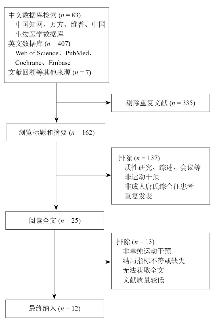
Figure 1
Flowchart of literature screening"
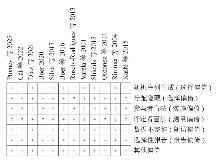
Figure 2
Bias assessment of included literatures"
Figure 3
Risk ratio of bias"
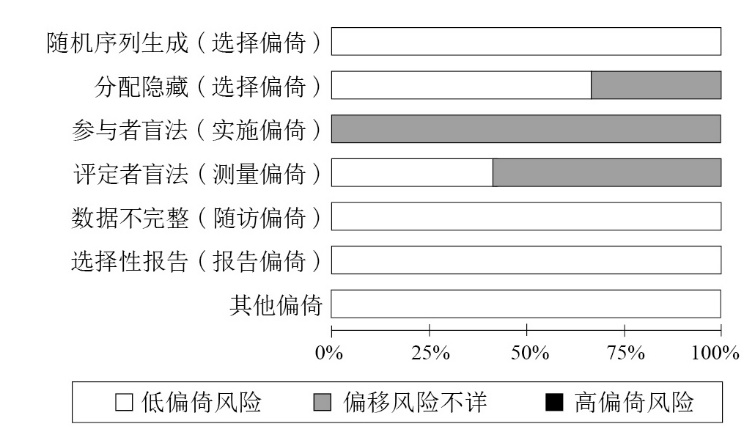
Table 2
Basic characteristics of the included literatures"
| 纳入文献 | 国家 | 年龄/岁 | n | 对照措施 | 干预措施 | 运动类型 | 周期/周 | 频率/周-1 | 时间/min | 结局 指标 | 文献质量评分 | |
|---|---|---|---|---|---|---|---|---|---|---|---|---|
| C | T | |||||||||||
| Ptomey等[ | 美国 | 18~27 | 12 | 34 | 教育课程 | 抗阻和有氧 | ③ | 48 | 3 | 40 | B | |
| Ptomey等[ | 美国 | 18~27 | 12 | 32 | 教育课程 | 抗阻和有氧 | ③ | 48 | 1 | 40 | B | |
| Cai等[ | 中国 | 18~40 | 11 | 11 | 日常生活 | 篮球 | ① | 24 | 3 | 60 | A、C | |
| Diaz等[ | 西班牙 | 28.1±3.3 | 18 | 18 | 日常生活 | 抗阻训练 | ② | 12 | 3 | - | A | |
| Boer[ | 新西兰 | 18~45 | 13 | 13 | 日常生活 | 游泳 | ① | 8 | 3 | 30~40 | A、C | |
| Silva等[ | 葡萄牙 | 18~60 | 13 | 12 | 日常生活 | 有氧和力量训练 | ③ | 8 | 3 | 60 | A、C | |
| Boer等[ | 南非 | 18~50 | 16 | 13 | 日常生活 | 跑步机或自行车 | ① | 12 | 3 | 30~35 | A、B、C | |
| Boer等[ | 南非 | 18~50 | 16 | 13 | 日常生活 | 跑步机和自行车 | ① | 12 | 3 | 30~35 | A、B、C | |
| Rosety-Rodriguez等[ | 西班牙 | 23.7±3.1 | 16 | 24 | 日常生活 | 抗阻循环训练 | ② | 12 | 3 | - | D | |
| Varela等[ | 葡萄牙 | 21.3 | 8 | 8 | 日常生活 | 有氧划船 | ① | 16 | 3 | 15~25 | B | |
| Shields等[ | 澳大利亚 | 18~35 | 8 | 8 | 社交活动 | 步行 | ① | 8 | 3 | 45~60 | A、C | |
| Ordonez等[ | 西班牙 | 18~30 | 9 | 11 | 日常生活 | 跑步机 | ① | 10 | 3 | 45~65 | A、D | |
| Rimmer等[ | 美国 | 30~70 | 22 | 30 | 日常生活 | 抗阻和有氧 | ③ | 12 | 3 | 45 | A、B、C | |
| Kashi等[ | 伊朗 | 25.917±3.889 | 11 | 13 | 日常生活 | 抗阻和平衡、有氧 | ③ | 12 | 3 | - | C | |
Table 3
Meta-analysis of effects of exercise intervention on body composition in adults with Down syndrome"
| 身体成分 | 研究数/n | 样本量/n | Meta结果 | 异质性检验结果 | ||||
|---|---|---|---|---|---|---|---|---|
| SMD | 95%CI | P值 | I2值/% | 效应模型 | P值 | |||
| 腰围 | 7 | 177 | -0.387 | -0.686~-0.087 | 0.011 | 0.0 | 固定 | 0.874 |
| 臀围 | 3 | 80 | -0.431 | -0.878~0.015 | 0.058 | 0.0 | 固定 | 0.728 |
| 腰臀比 | 2 | 58 | -0.385 | -1.262~0.492 | 0.390 | 61.5 | 随机 | 0.107 |
| 体质量 | 8 | 242 | -0.197 | -0.451~0.057 | 0.128 | 0.0 | 固定 | 0.809 |
| BMI | 8 | 247 | -0.248 | -0.501~0.005 | 0.055 | 19.5 | 固定 | 0.276 |
| 体脂率 | 4 | 100 | -0.325 | -0.722~0.072 | 0.108 | 0.0 | 固定 | 0.761 |
| 脂肪量 | 3 | 94 | -0.259 | -0.667~0.150 | 0.215 | 0.0 | 固定 | 0.572 |
Table 4
Meta-analysis of effects of exercise intervention on cardiorespiratory function in adults with Down syndrome"
| 心肺功能 | 研究数/n | 样本量/n | Meta结果 | 异质性检验结果 | ||||
|---|---|---|---|---|---|---|---|---|
| SMD | 95%CI | P值 | I2值/% | 效应模型 | P值 | |||
| 相对峰值摄氧量 | 6 | 216 | 0.241 | -0.240~0.722 | 0.326 | 63.2 | 随机 | 0.019 |
| 绝对峰值摄氧量 | 4 | 126 | 0.748 | 0.383~1.114 | <0.001 | 0.0 | 随机 | 0.744 |
| 呼吸交换率 | 4 | 158 | 0.070 | -0.750~0.890 | 0.866 | 81.4 | 随机 | 0.001 |
| 每分通气量 | 2 | 58 | 0.701 | 0.165~1.237 | 0.010 | 0.0 | 固定 | 0.430 |
| 最大心率 | 6 | 216 | 0.489 | 0.201~0.777 | 0.001 | 25.4 | 固定 | 0.244 |
| 静息心率 | 2 | 90 | 0.247 | -0.417~0.911 | 0.466 | 49.5 | 固定 | 0.159 |
Table 5
Meta-analysis of effects of exercise intervention on motor ability in adults with Down syndrome"
| 运动能力 | 研究数/n | 样本量/n | Meta结果 | 异质性检验结果 | ||||
|---|---|---|---|---|---|---|---|---|
| SMD | 95%CI | P值 | I2值/% | 效应模型 | P值 | |||
| 握力 | 6 | 221 | 0.378 | 0.103~0.653 | 0.007 | 0.0 | 固定 | 0.948 |
| 立定跳远 | 3 | 71 | 0.692 | 0.210~1.173 | 0.005 | 0.0 | 固定 | 0.804 |
| 坐位体前屈 | 2 | 47 | 0.937 | 0.331~1.543 | 0.002 | 0.0 | 固定 | 0.679 |
| 仰卧起坐 | 3 | 73 | 0.560 | 0.088~1.032 | 0.020 | 0.0 | 固定 | 0.375 |
| 8英尺起立-行走-返回测试 | 4 | 109 | -0.876 | -1.274~-0.479 | <0.001 | 0.0 | 固定 | 0.597 |
| 30 s坐立测试 | 2 | 58 | 0.978 | 0.429~1.528 | <0.001 | 0.0 | 固定 | 0.798 |
| 6 min步行距离 | 5 | 125 | 0.656 | 0.294~1.018 | <0.001 | 0.0 | 固定 | 0.941 |
| 静态平衡 | 2 | 48 | 0.598 | 0.014~1.182 | 0.045 | 31.9 | 固定 | 0.226 |
| 动态平衡 | 2 | 48 | 1.616 | 0.093~3.138 | 0.038 | 79.3 | 随机 | 0.028 |
Table 6
Meta-analysis of effects of exercise intervention on inflammatory levels in adults with Down syndrome"
| 炎症水平 | 研究数/n | 样本量/n | Meta结果 | 异质性检验结果 | ||||
|---|---|---|---|---|---|---|---|---|
| SMD | 95%CI | P值 | I2值/% | 效应模型 | P值 | |||
| TNF-α | 2 | 60 | -1.165 | -1.726~-0.603 | <0.001 | 17.5 | 固定 | 0.271 |
| IL-6 | 2 | 60 | -1.392 | -1.972~-0.811 | <0.001 | 40.3 | 固定 | 0.196 |
Table 7
Subgroup analysis of effects of exercise intervention on waist circumference in adults with Down syndrome"
| 分组 | SMD | 95%CI | P组内值 | P交互值 | I2值/% | P值异质性 |
|---|---|---|---|---|---|---|
| 干预周期亚组A | ||||||
| 5~8周 | -0.306 | -0.923~0.310 | 0.330 | 0.485 | 0.0 | 0.872 |
| 9~12周 | -0.341 | -0.714~0.031 | 0.073 | 0.0 | 0.691 | |
| 干预周期亚组B | ||||||
| <10周 | -0.306 | -0.923~0.310 | 0.330 | 0.782 | 0.0 | 0.872 |
| ≥10周 | -0.411 | -0.754~-0.069 | 0.019 | 0.0 | 0.673 | |
| 单次干预时长A | ||||||
| <40 min | -0.412 | -0.936~0.111 | 0.123 | 0.838 | 0.0 | 0.916 |
| ≥60 min | -0.504 | -1.089~0.081 | 0.464 | 0.0 | 0.378 | |
| 单次干预时长B | ||||||
| <60 min | -0.284 | -0.661~0.094 | 0.141 | 0.421 | 0.0 | 0.854 |
| ≥60 min | -0.561 | -1.053~-0.069 | 0.025 | 0.0 | 0.637 |
Table 8
Subgroup analysis of effects of exercise intervention on maximum heart rate in adults with Down Syndrome"
| 分组 | SMD | 95%CI | P值 | P交互值 | I2值/% | P值异质性 |
|---|---|---|---|---|---|---|
| 干预类型 | ||||||
| 有氧运动 | 0.650 | 0.174~1.126 | 0.007 | 0.501 | 36.6 | 0.207 |
| 联合运动 | 0.396 | 0.034~0.758 | 0.032 | 29.9 | 0.240 | |
| 干预周期 | ||||||
| 9~12周 | 0.729 | 0.336~1.122 | <0.001 | 0.501 | 36.1 | 0.209 |
| 13周及以上 | 0.210 | -0.214~0.633 | 0.332 | 0.0 | 0.791 | |
| 单次干预时长 | ||||||
| <40 min | 0.650 | 0.174~1.126 | 0.007 | 0.153 | 36.6 | 0.207 |
| 40~<60min | 0.396 | 0.034~0.758 | 0.032 | 29.9 | 0.240 |
Table 9
Subgroup analysis of effects of exercise intervention on grip strength in adults with Down syndrome"
| 分组 | SMD | 95%CI | P值 | P交互值 | I2值/% | P值异质性 |
|---|---|---|---|---|---|---|
| 干预类型 | ||||||
| 有氧运动 | 0.276 | -0.246~0.797 | 0.300 | 0.662 | 0.0 | 0.432 |
| 联合运动 | 0.417 | 0.093~0.740 | 0.012 | 0.0 | 0.950 | |
| 单次干预时长 | ||||||
| <40 min | 0.276 | -0.246~0.797 | 0.300 | 0.923 | 0.0 | 0.432 |
| 40 ~<60 min | 0.425 | 0.032~0.819 | 0.034 | 0.0 | 0.813 |
Table 10
Subgroup analysis of effects of exercise intervention on 6-minute walking distance in adults with Down syndrome"
| 分组 | SMD | 95%CI | P值 | P交互值 | I2值/% | P值异质性 |
|---|---|---|---|---|---|---|
| 干预周期 | ||||||
| 5~8周 | 0.526 | 0.037~1.014 | 0.035 | 0.493 | 0.0 | 0.920 |
| 9~12周 | 0.815 | 0.275~1.355 | 0.003 | 0.0 | 0.948 |
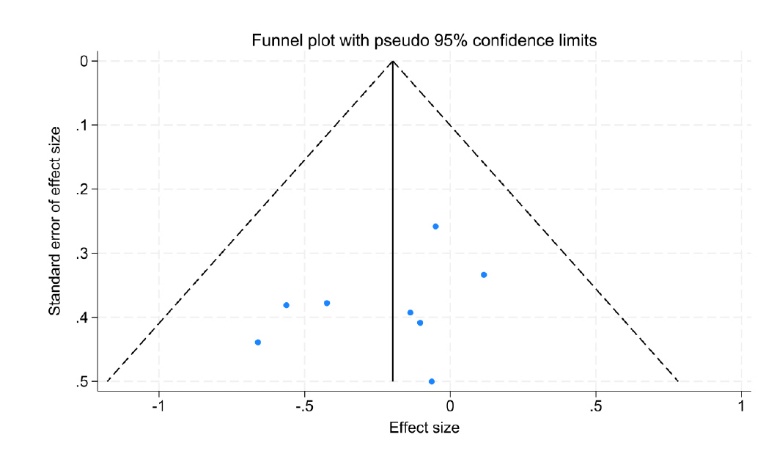
Figure 4
Evaluation of publication bias in included literatures"
| [1] |
MEKONNEN T, KRISTJANSSON D, BRATSBERG B, et al. Changes in survival probabilities and mortality risks among population living with Down syndrome born 1967-2018: a Norwegian registry-based study[J]. BMC Public Health, 2025, 25(1): 4272.
doi: 10.1186/s12889-025-25326-z |
| [2] |
BENEJAM B, MCCARRON M, CARMONA‐IRAGUI M, et al. Factors impacting survival in individuals with Down syndrome‐associated Alzheimer's disease[J]. Alzheimers Dement, 2026, 22(2): e71156.
doi: 10.1002/alz.v22.2 |
| [3] |
JENKINS M R, FLEMING V L, SCHWORER E K, et al. Role of leisure and sleep in promoting daily physical activity in adults with down syndrome[J]. Health Psychol Behav Med, 2025, 13(1): 2521418.
doi: 10.1080/21642850.2025.2521418 |
| [4] |
HICKEY E J, GREENLEE J L, JENKINS M R, et al. Stressful life experiences and mental health symptoms in adults with down syndrome[J]. Res Dev Disabil, 2025, 167: 105152.
doi: 10.1016/j.ridd.2025.105152 |
| [5] |
WEDEN M M, FRANK L, DICK A W, et al. Investment in Alzheimer's disease research for the next generation of adults with Down syndrome will yield health benefits for future generations[J]. Alzheimers Dement, 2025, 21(9): e70348.
doi: 10.1002/alz.v21.9 |
| [6] |
BRUGNARO B H, CAMPOS R, DE CAMARGO O K, et al. Association between parent-reported level of physical activity and mobility performance in children with Down syndrome: a cross-sectional study[J]. Res Dev Disabil, 2025, 167: 105164.
doi: 10.1016/j.ridd.2025.105164 |
| [7] |
MERZBACH V, JEWISS M, SCRUTON A, et al. The effects of prescribed physical and cognitive exercise on life satisfaction, self-efficacy and mood states in adults with Down syndrome: The MinDSets Study[J]. Int J Environ Res Public Health, 2024, 21(5): 610.
doi: 10.3390/ijerph21050610 |
| [8] | PTOMEY L T, HELSEL B C, WASHBURN R A, et al. The promotion of physical activity for use in Alzheimer's disease prevention trials in adults with Down syndrome: results from a 12-month randomized trial[J]. Alzheimers Dement Transl Res Clin Interv, 2025, 11(2): e70115. |
| [9] |
CAI W, BAEK S S. Effects of 24-week basketball programme on body composition and functional fitness on adults with Down syndrome[J]. J Intellect Disabil Res, 2022, 66(12): 939-951.
doi: 10.1111/jir.v66.12 |
| [10] |
DIAZ A J, ROSETY I, ORDONEZ F J, et al. Effects of resistance training in muscle mass and markers of muscle damage in adults with Down syndrome[J]. Int J Environ Res Public Health, 2021, 18(17): 8996.
doi: 10.3390/ijerph18178996 |
| [11] |
BOER P H. The effect of 8 weeks of freestyle swim training on the functional fitness of adults with Down syndrome[J]. J Intellect Disabil Res, 2020, 64(10): 770-781.
doi: 10.1111/jir.v64.10 |
| [12] |
SILVA V, CAMPOS C, SÁ A, et al. Wii-based exercise program to improve physical fitness, motor proficiency and functional mobility in adults with Down syndrome[J]. J Intellect Disabil Res, 2017, 61(8): 755-765.
doi: 10.1111/jir.v61.8 |
| [13] |
BOER P H, MOSS S J. Effect of continuous aerobic vs. interval training on selected anthropometrical, physiological and functional parameters of adults with Down syndrome[J]. J Intellect Disabil Res, 2016, 60(4): 322-334.
doi: 10.1111/jir.v60.4 |
| [14] |
ROSETY-RODRIGUEZ M, CAMACHO A, ROSETY I, et al. Resistance circuit training reduced inflammatory cytokines in a cohort of male adults with Down syndrome[J]. Med Sci Monit, 2013, 19: 949.
doi: 10.12659/MSM.889362 |
| [15] |
VARELA A M, BETTENCOUNT SARDINHA L, PITETTI K H. Effects of an aerobic rowing training regimen in young adults with Down syndrome[J]. Am J Ment Retard, 2001, 106(2): 135-144.
doi: 10.1352/0895-8017(2001)106<0135:EOAART>2.0.CO;2 |
| [16] |
SHIELDS N, TAYLOR N F. The feasibility of a physical activity program for young adults with Down syndrome: a phase II randomised controlled trial[J]. J Intellect Dev Disabil, 2015, 40(2): 115-125.
doi: 10.3109/13668250.2015.1014027 |
| [17] |
ORDONEZ F J, ROSETY M A, CAMACHO A, et al. Aerobic training improved low-grade inflammation in obese women with intellectual disability[J]. J Intellect Disabil Res, 2014, 58(6): 583-590.
doi: 10.1111/jir.2014.58.issue-6 |
| [18] |
RIMMER J H, HELLER T, WANG E, et al. Improvements in physical fitness in adults with Down syndrome[J]. Am J Ment Retard, 2004, 109(2): 165-174.
doi: 10.1352/0895-8017(2004)109<165:IIPFIA>2.0.CO;2 |
| [19] | KASHI A, SHEIKH M, DADKHAH A, et al. The effect of "Kashi practices" on the improvement of psycho-motor skills in people with Down syndrome[J]. Iran Rehabil J, 2015, 13(3): 13-21. |
| [20] | SUAREZ-VILLADAT B, VEIGA O L, VILLAGRA A, et al. Changes in body composition and physical fitness in adolescents with Down syndrome: the UP&DOWN longitudinal study[J]. Child Obes, 2019, 15(6): 397-405. |
| [21] | MEIRA L B, BARRETO L O, FERNANDES J V, et al. Impact of physical exercise on health outcomes in people with Down Syndrome: a systematic review and meta-analysis of randomized controlled trials[J]. J Sports Med Phys Fitness, 2026, 66(1): 130-142. |
| [22] |
BOER P H, DE BEER Z. The effect of aquatic exercises on the physical and functional fitness of adults with Down syndrome: a non-randomised controlled trial[J]. J Intellect Disabil Res, 2019, 63(12): 1453-1463.
doi: 10.1111/jir.v63.12 |
| [23] |
刘东斐, 颜会义, 杨帆, 等. 运动干预对唐氏综合征儿童青少年多维健康结局影响的Meta 分析[J]. 中国康复理论与实践, 2025, 31(12): 1398-1413.
doi: 10.3969/j.issn.1006-9771.2025.12.004 |
| LIU D F, YAN H Y, YANG F, et al. Effects of exercise interventions on multidimensional health outcomes in children and adolescents with Down syndrome: a meta-analysis[J]. Chin J Rehabil Theory Pract, 2025, 31(12): 1398-1413. | |
| [24] |
TRANAH G J, BARNES H N, CAWTHON P M, et al. Expression of mitochondrial oxidative stress response genes in muscle is associated with mitochondrial respiration, physical performance, and muscle mass in the Study of Muscle, Mobility, and Aging[J]. Aging Cell, 2024, 23(6): e14114.
doi: 10.1111/acel.v23.6 |
| [25] |
HUSSEIN Z A. Strength training versus chest physical therapy on pulmonary functions in children with Down syndrome[J]. Egypt J Med Hum Genet, 2017, 18(1): 35-39.
doi: 10.1016/j.ejmhg.2016.02.008 |
| [26] | BAHIRAEI S, GHADERI M, SHARIFIAN E, et al. Effects of exercise programs on cardiovascular responses in individuals with Down syndrome: a systematic review and meta-analysis[J]. Prev Med Rep, 2023, 36: 102521. |
| [27] |
GIAGKOUDAKI F, DIMITROS E, KOUIDI E, et al. Effects of exercise training on heart-rate-variability indices in individuals with Down syndrome[J]. J Sport Rehabil, 2010, 19(2): 173-183.
pmid: 20543218 |
| [28] |
BRICOUT V A, GUINOT M, FAURE P, et al. Are hormonal responses to exercise in young men with Down's syndrome related to reduced endurance performance?[J]. J Neuroendocrinol, 2008, 20(5): 558-565.
doi: 10.1111/j.1365-2826.2008.01695.x pmid: 18363810 |
| [29] |
KILANY A, ELHADIDY M E, GANEM M M F, et al. Diet and physical activity modification: impact on adaptive behavior and biochemical measures of children with Down syndrome[J]. Int J Dev Disabil, 2024, 70(6): 1082-1091.
doi: 10.1080/20473869.2024.2383807 pmid: 39564196 |
| [30] |
EID M A. Effect of whole-body vibration training on standing balance and muscle strength in children with Down syndrome[J]. Am J Phys Med Rehabil, 2015, 94(8): 633-643.
doi: 10.1097/PHM.0000000000000224 |
| [31] | CHERNI A, OUERGHI N, JEBABLI N, et al. A Tai Chi program improves physical performance measures in adolescents with down syndrome and enhances their parents' psychological well-being: a randomized controlled trial[J]. Adapt Phys Activ Q, 2025, 42(2): 228-246. |
| [32] |
EID M A, ALY S M, HUNEIF M A, et al. Effect of isokinetic training on muscle strength and postural balance in children with Down's syndrome[J]. Int J Rehabil Res, 2017, 40(2): 127-133.
doi: 10.1097/MRR.0000000000000218 pmid: 28146007 |
| [33] |
TERBLANCHE E, BOER P H. The functional fitness capacity of adults with Down syndrome in South Africa[J]. J Intellect Disabil Res, 2013, 57(9): 826-836.
doi: 10.1111/jir.2013.57.issue-9 |
| [34] |
EL-MENIAWY G H, KAMAL H M, ELSHEMY S A. Role of treadmill training versus suspension therapy on balance in children with Down syndrome[J]. Egypt J Med Hum Genet, 2012, 13(1): 37-43.
doi: 10.1016/j.ejmhg.2011.10.001 |
| [35] | RAHMAN S A A, SHAHEEN A. Efficacy of weight bearing exercises on balance in children with Down syndrome[J]. Egypt J Neurol Psychiatr Neurosurg, 2010, 47(1): 37-42. |
| [36] |
DE LUCA CORREA H, DOS SANTOS ROSA T, MARQUES R S, et al. Exercise therapy in Down syndrome: a systematic review and meta-analysis focused on muscle strength, redox balance, and inflammatory profile[J]. Med Sci Sports Exerc, 2025, 57(9): 2073-2082.
doi: 10.1249/MSS.0000000000003739 |
| [37] |
ROSETY-RODRIGUEZ M, BERNARDI M, ELOSEGUI S, et al. A short-term resistance training circuit improved antioxidants in sedentary adults with Down syndrome[J]. Oxid Med Cell Longev, 2021, 2021: 8811153.
doi: 10.1155/omcl.v2021.1 |
| [38] |
ALASMARI F, AHMAD A, ALSANEA S, et al. Current insights and prospects for the pathogenesis and treatment of clinical manifestations associated with Down syndrome through neurotransmitter, inflammatory, and oxidative stress pathways[J]. Front Pharmacol, 2025, 16: 1592277.
doi: 10.3389/fphar.2025.1592277 |
| [39] |
ORDONEZ F J, FORNIELES-GONZALEZ G, CAMACHO A, et al. Anti-inflammatory effect of exercise, via reduced leptin levels, in obese women with Down syndrome[J]. Int J Sport Nutr Exerc Metab, 2013, 23(3): 239-244.
doi: 10.1123/ijsnem.23.3.239 |
| [40] |
MARTÍNEZ-ESPINOSA R M, MOLINA VILA M D, REIG GARCIA-GALBIS M. Evidences from clinical trials in Down syndrome: diet, exercise and body composition[J]. Int J Environ Res Public Health, 2020, 17(12): 4294.
doi: 10.3390/ijerph17124294 |
| [41] |
MENDONCA G V, PEREIRA F D, FERNHALL B. Effects of combined aerobic and resistance exercise training in adults with and without Down syndrome[J]. Arch Phys Med Rehabil, 2011, 92(1): 37-45.
doi: 10.1016/j.apmr.2010.09.015 |
| [42] |
OVIEDO G R, CARBÓ-CARRETÉ M, GUERRA-BALIC M, et al. Hemodynamic and cardiorespiratory responses to submaximal and maximal exercise in adults with Down syndrome[J]. Front Physiol, 2022, 13: 905795.
doi: 10.3389/fphys.2022.905795 |
| [43] |
FERNHALL B O, MENDONCA G V, BAYNARD T. Reduced work capacity in individuals with Down syndrome: a consequence of autonomic dysfunction?[J]. Exerc Sport Sci Rev, 2013, 41(3): 138-147.
doi: 10.1097/JES.0b013e318292f408 pmid: 23558694 |
| [44] |
CHEN C C, RINGENBACH S D R. Dose-response association between exercise intensity and manual motor performance in individuals with Down syndrome: a preliminary study[J]. J Dev Phys Disabil, 2019, 31(3): 299-311.
doi: 10.1007/s10882-018-9640-y |
| [1] | LI Xinyuan, ZHENG Jiejiao, ZHANG Tingyu, WU Xuejiao, LIANG Xiaoxiao. Effect of intermittent theta burst stimulation on lower extremity motor function and balance function in stroke patients: a meta-analysis [J]. Chinese Journal of Rehabilitation Theory and Practice, 2026, 32(6): 631-644. |
| [2] | LI Wen, YAN Xinyue, HUANG Qiuchen, ZHANG Rui, SUN Yuemei, ZHOU Yue. Effect of neuromuscular electrical stimulation on patients after total knee arthroplasty: a meta-analysis [J]. Chinese Journal of Rehabilitation Theory and Practice, 2026, 32(6): 653-664. |
| [3] | HAN Tianxing, LIU Haotian, XU Ziqi, PENG Xiaohan, WANG Yang, CAO Danna. Functional connectivity in default mode network and medial temporal lobe in mild cognitive impairment stage of Alzheimer's disease based on resting-state functional magnetic resonance imaging: a meta-analysis [J]. Chinese Journal of Rehabilitation Theory and Practice, 2026, 32(5): 522-533. |
| [4] | AN Yongyi, LI Xuemei, CHANG Xueyou, ZHAO Yaning, HUANG Hailing, YANG Yadong. Effect of blood flow restriction training under different intensities combined with low-intensity resistance training on motor function in elderly stroke patients with frailty [J]. Chinese Journal of Rehabilitation Theory and Practice, 2026, 32(5): 561-570. |
| [5] | CHE Ruixin, TANG Yongtian, PAN Shiqin, TONG Yaqian. Effect of transcutaneous electrical acupoint stimulation on chronic obstructive pulmonary disease: a meta-analysis [J]. Chinese Journal of Rehabilitation Theory and Practice, 2026, 32(4): 426-436. |
| [6] | LIU Hua, WANG Liyuan, MA Xin, LI Jing, WANG Li. OBE-CDIO model of teaching for curriculum of exercise rehabilitation training [J]. Chinese Journal of Rehabilitation Theory and Practice, 2026, 32(3): 270-275. |
| [7] | CHEN Junli, ZHANG Han, ZHANG Yefan, ZHANG Yanqiu, GAO Runguo, GAO Qianqian, CAI Weiqin, LI Haiyan, JI Lihong, DONG Zhiwei, JING Qi. Construction of a community-family management model for older adults with mild cognitive impairment [J]. Chinese Journal of Rehabilitation Theory and Practice, 2026, 32(1): 90-100. |
| [8] | YE Lü, CHEN Yuelin, LIU Yufei. Cognitive neuroscience paradigms and advances in physical activity and brain health in children: a scoping review [J]. Chinese Journal of Rehabilitation Theory and Practice, 2025, 31(8): 889-895. |
| [9] | LÜ Xueqin, ZHANG Tong, LIU Huilin, LIU Jianhua, LI Da, WANG Huawei. Effect of preoperative exercise on patients undergoing ventriculoperitoneal shunt [J]. Chinese Journal of Rehabilitation Theory and Practice, 2025, 31(8): 958-964. |
| [10] | DU Lilu, YAO Renkui, ZHAO Yanyu, LI Mengxuan, ZOU Min, ZHANG Gongfa. Impact of meaning in life and living arrangements on association between activities of daily living and depression in older adults [J]. Chinese Journal of Rehabilitation Theory and Practice, 2025, 31(8): 987-992. |
| [11] | DU Wenqian, ZHANG Xu, CHEN Jiwei, WANG Xing, ZHU Kun. Effect of exercise on freezing of gait in Parkinson's disease: a meta-analysis [J]. Chinese Journal of Rehabilitation Theory and Practice, 2025, 31(7): 781-789. |
| [12] | SUN Jiayao, MA Chunhua, LÜ Jun, TANG Qi, SHAO Zhimin, HU Kangning, HUANG Haoying, HUANG Aihua. Development of a needs assessment tool for grading care services for adults with disabilities in welfare institutions [J]. Chinese Journal of Rehabilitation Theory and Practice, 2025, 31(7): 802-811. |
| [13] | TANG Li, GE Xiaozhen, LIU Jie, ZHANG Yan, WANG Jingrong, ZUO Xuebing, WANG Guodong. Correlation between cardiopulmonary capacity and heart rate recovery after exercise in patients with coronary borderline lesions [J]. Chinese Journal of Rehabilitation Theory and Practice, 2025, 31(7): 838-845. |
| [14] | WU Xiaohui, JIANG Lei, ZHU Jingru, XIE Lihui. Deep learning for diagnosis of mild cognitive impairment in older adults: a scoping review [J]. Chinese Journal of Rehabilitation Theory and Practice, 2025, 31(6): 674-681. |
| [15] | CHEN Junli, ZHANG Han, SHI Zhixue, LIU Ya, ZHAO Yingzhe, DONG Zhiwei, JI Lihong, LI Haiyan, CHEN Fangfang, WANG Chunping, MA Anning, JING Qi. Development of a community toolkit for identifying and managing mild cognitive impairment among older adults [J]. Chinese Journal of Rehabilitation Theory and Practice, 2025, 31(6): 692-702. |
| Viewed | ||||||
|
Full text |
|
|||||
|
Abstract |
|
|||||
|
||
