



Chinese Journal of Rehabilitation Theory and Practice ›› 2026, Vol. 32 ›› Issue (6): 699-707.doi: 10.3969/j.issn.1006-9771.2026.06.008
Previous Articles Next Articles
JIAO Yang1a, HU Xinru1a, HOU Weijia1a, WANG Yue1a, WANG Jin1b, YU Yang1a, ZHU Zhizhong1a( ), DONG Ying2,3()
Received:2026-01-28
Revised:2026-03-23
Published:2026-06-25
Online:2026-06-24
Supported by:CLC Number:
JIAO Yang, HU Xinru, HOU Weijia, WANG Yue, WANG Jin, YU Yang, ZHU Zhizhong, DONG Ying. Prediction factors of dual-task gait function improvement through short-term aerobic training in patients with Parkinson's disease[J]. Chinese Journal of Rehabilitation Theory and Practice, 2026, 32(6): 699-707.

Table 1
Comparison of baseline data between two groups"
| 组别 | n | 性别(男/女)/n | 年龄/岁 | BMI/(kg·m-2) | 病程/年 | H-Y分期 | MMSE评分 |
|---|---|---|---|---|---|---|---|
| 高应答组 | 12 | 4/8 | 61.0(60.0, 62.0) | 26.44(25.52, 27.48) | 2.0(1.6, 6.0) | 1(1, 2) | 27.0(26.0, 28.0) |
| 低应答组 | 30 | 20/10 | 68.0(66.0, 72.5) | 23.94(21.30, 25.45) | 5.0(2.5, 7.0) | 2(1, 3) | 29.0(26.0, 29.0) |
| χ2/W值 | 2.647 | 263.000 | 83.000 | 242.000 | 255.500 | 224.500 | |
| P值 | 0.104 | 0.021 | 0.007 | 0.084 | 0.026 | 0.209 |
Table 2
Comparison of cardiopulmonary exercise test parameters between two groups pre- and post-training"
| 指标 | 组别 | n | 评估 | M(QL, QU) | Z值 | P值 |
|---|---|---|---|---|---|---|
| 静息心率/(次·min-1) | 高应答组 | 12 | 前测 | 86.00(78.00, 90.00) | 1.030 | 0.303 |
| 12 | 后测 | 89.00(74.00, 97.00) | ||||
| 低应答组 | 30 | 前测 | 81.00(72.00, 105.50) | 0.620 | 0.535 | |
| 30 | 后测 | 87.00(74.00, 93.00) | ||||
| 治疗前两组差值 | 5.00(-15.00, 12.75) | 0.014 | 0.989 | |||
| 治疗后两组差值 | 2.00(-14.75, 19.25) | 0.182 | 0.856 | |||
| AT/(mL·kg-1·min-1) | 高应答组 | 12 | 前测 | 11.95(9.50, 13.03) | 2.165 | 0.030 |
| 12 | 后测 | 15.10(12.40, 15.67) | ||||
| 低应答组 | 30 | 前测 | 13.00(10.80, 13.50) | 1.420 | 0.156 | |
| 30 | 后测 | 12.55(11.50, 15.20) | ||||
| 治疗前两组差值 | -0.90(-3.38, 1.53) | 0.600 | 0.549 | |||
| 治疗后两组差值 | 1.40(-2.60, 3.38) | 1.145 | 0.252 | |||
| VO2max/(mL·kg-1·min-1) | 高应答组 | 12 | 前测 | 12.90(10.47, 14.05) | 2.637 | 0.008 |
| 12 | 后测 | 17.00(13.10, 18.50) | ||||
| 低应答组 | 30 | 前测 | 13.70(12.98, 15.90) | 3.932 | <0.001 | |
| 30 | 后测 | 15.85(13.90, 17.60) | ||||
| 治疗前两组差值 | -1.15(-3.47, -0.05) | 1.857 | 0.063 | |||
| 治疗后两组差值 | -1.30(-3.10, 4.05) | 0.209 | 0.834 | |||
| AT/VO2max | 高应答组 | 12 | 前测 | 0.94(0.89, 0.96) | 1.220 | 0.222 |
| 12 | 后测 | 0.87(0.84, 0.94) | ||||
| 低应答组 | 30 | 前测 | 0.90(0.80, 0.92) | 2.573 | 0.010 | |
| 30 | 后测 | 0.80(0.75, 0.85) | ||||
| 治疗前两组差值 | 0.05(-0.04, 0.13) | 1.688 | 0.091 | |||
| 治疗后两组差值 | 0.07(0.00, 0.14) | 2.525 | 0.012 |
Table 3
Comparison of gait spatiotemporal parameters between two groups pre- and post- training"
| 指标 | 组别 | n | 评估 | M(QL, QU) | Z值 | P值 |
|---|---|---|---|---|---|---|
| 步长/m | 高应答组 | 12 | 前测 | 1.02(0.96, 1.07) | 2.943 | 0.003 |
| 12 | 后测 | 1.08(1.05, 1.13) | ||||
| 低应答组 | 30 | 前测 | 0.95(0.82, 1.09) | 2.541 | 0.011 | |
| 30 | 后测 | 0.85(0.78, 1.05) | ||||
| 治疗前两组差值 | 0.04(-0.11, 0.22) | 0.738 | 0.460 | |||
| 治疗后两组差值 | 0.18(0.08, 0.29) | 2.730 | 0.006 | |||
| 步速/(m·s-1) | 高应答组 | 12 | 前测 | 0.93(0.86, 0.97) | 3.020 | 0.003 |
| 12 | 后测 | 1.05(1.02, 1.08) | ||||
| 低应答组 | 30 | 前测 | 0.88(0.77, 1.01) | 1.625 | 0.104 | |
| 30 | 后测 | 0.81(0.69, 0.99) | ||||
| 治疗前两组差值 | 0.03(-0.07, 0.20) | 0.724 | 0.469 | |||
| 治疗后两组差值 | 0.25(0.12, 0.36) | 3.901 | <0.001 | |||
| 步频/(步·min-1) | 高应答组 | 12 | 前测 | 110.08(108.58, 113.03) | 3.020 | 0.003 |
| 12 | 后测 | 117.31(115.30, 120.11) | ||||
| 低应答组 | 30 | 前测 | 110.40(107.16, 113.52) | 2.468 | 0.014 | |
| 30 | 后测 | 112.26(106.51, 114.06) | ||||
| 治疗前两组差值 | 1.33(-2.83, 7.40) | 0.320 | 0.749 | |||
| 治疗后两组差值 | 8.48(5.27, 11.26) | 3.968 | <0.001 | |||
| 步速不对称度/% | 高应答组 | 12 | 前测 | -1.00(-1.94, -0.51) | 0.902 | 0.367 |
| 12 | 后测 | -0.55(-1.01, -0.27) | ||||
| 低应答组 | 30 | 前测 | -0.95(-2.43, 1.14) | 1.028 | 0.304 | |
| 30 | 后测 | -0.57(-2.06, 0.41) | ||||
| 治疗前两组差值 | -0.11(-2.42, 1.41) | 0.501 | 0.616 | |||
| 治疗后两组差值 | -0.08(-1.46, 1.61) | 0.139 | 0.889 | |||
| 步长不对称度/% | 高应答组 | 12 | 前测 | -0.97(-2.32, -0.66) | 1.509 | 0.290 |
| 12 | 后测 | -0.56(-1.21, -0.34) | ||||
| 低应答组 | 30 | 前测 | -1.33(-2.40, 1.16) | 0.679 | 0.497 | |
| 30 | 后测 | -0.91(-2.91, 0.24) | ||||
| 治疗前两组差值 | -0.26(-2.64, 1.70) | 0.543 | 0.587 | |||
| 治疗后两组差值 | 0.01(-1.50, 1.05) | 0.042 | 0.967 | |||
| 步频不对称度/% | 高应答组 | 12 | 前测 | 0.16(0.02, 0.39) | 1.556 | 0.120 |
| 12 | 后测 | 0.01(-0.10, 0.23) | ||||
| 低应答组 | 30 | 前测 | 0.20(-0.05, 0.50) | 1.718 | 0.086 | |
| 30 | 后测 | 0.14(-0.21, 0.32) | ||||
| 治疗前两组差值 | -0.12(-0.38, 0.38) | 0.056 | 0.956 | |||
| 治疗后两组差值 | -0.17(-0.39, 0.33) | 0.237 | 0.813 |
Table 4
Comparison of gait kinematic parameters between two groups pre- and post-training"
| 指标 | 组别 | n | 评估 | M(QL, QU) | Z值 | P值 |
|---|---|---|---|---|---|---|
| 上肢运动范围/° | 高应答组 | 12 | 前测 | 24.14(21.27, 26.25) | 2.628 | 0.009 |
| 12 | 后测 | 31.29(29.02, 39.71) | ||||
| 低应答组 | 30 | 前测 | 28.26(25.83, 45.47) | 0.226 | 0.821 | |
| 30 | 后测 | 28.03(22.59, 46.10) | ||||
| 治疗前两组差值 | -5.20(-23.41, 3.89) | 2.353 | 0.019 | |||
| 治疗后两组差值 | 1.72(-13.96, 16.06) | 0.933 | 0.351 | |||
| 上肢摆动速度/(°·s-1) | 高应答组 | 12 | 前测 | 148.35(130.88, 155.42) | 2.706 | 0.007 |
| 12 | 后测 | 187.03(123.61, 207.81) | ||||
| 低应答组 | 30 | 前测 | 164.97(120.83, 191.84) | 0.226 | 0.821 | |
| 30 | 后测 | 148.53(111.35, 198.59) | ||||
| 治疗前两组差值 | -13.95(-67.69, 30.29) | 1.434 | 0.152 | |||
| 治疗后两组差值 | 20.34(-36.41, 87.35) | 1.211 | 0.226 | |||
| 上肢运动范围不对称度/% | 高应答组 | 12 | 前测 | 2.50(-25.26, 69.61) | 0.981 | 0.327 |
| 12 | 后测 | -32.20(-45.99, 36.12) | ||||
| 低应答组 | 30 | 前测 | -17.50(-35.13, 29.99) | 2.160 | 0.031 | |
| 30 | 后测 | -44.64(-81.76, 15.98) | ||||
| 治疗前两组差值 | 21.54(-21.80, 65.72) | 0.905 | 0.366 | |||
| 治疗后两组差值 | 40.27(10.76, 75.97) | 1.295 | 0.195 | |||
| 上肢摆动速度不对称度/% | 高应答组 | 12 | 前测 | 7.84(-48.24, 17.85) | 0.275 | 0.784 |
| 12 | 后测 | -22.06(-49.84, 11.47) | ||||
| 低应答组 | 30 | 前测 | -4.00(-38.82, 35.76) | 2.530 | 0.011 | |
| 30 | 后测 | -21.81(-50.80, 11.02) | ||||
| 治疗前两组差值 | 6.86(-46.94, 24.42) | 0.125 | 0.900 | |||
| 治疗后两组差值 | 10.76(-46.41, 62.10) | 0.292 | 0.770 | |||
| 转身速度/(°·s-1) | 高应答组 | 12 | 前测 | 108.97(106.37, 115.31) | 1.765 | 0.078 |
| 12 | 后测 | 114.58(109.91, 122.58) | ||||
| 低应答组 | 30 | 前测 | 110.27(94.53, 118.60) | 0.391 | 0.696 | |
| 30 | 后测 | 102.17(94.04, 123.65) | ||||
| 治疗前两组差值 | -1.03(-11.04, 18.18) | 0.376 | 0.707 | |||
| 治疗后两组差值 | 14.30(-0.57, 29.82) | 1.879 | 0.060 |
Table 5
Result of multivariate Firth regression analysis"
| 变量 | β | SE | OR(95%CI) | χ2值 | P值 |
|---|---|---|---|---|---|
| 截距 | -1.201 | 0.432 | 0.301(0.107~0.660) | 9.810 | 0.002 |
| AT/VO2max | 1.208 | 0.588 | 3.348(1.193~14.862) | 5.609 | 0.018 |
| BMI | 0.802 | 0.379 | 2.229(1.102~5.273) | 5.024 | 0.025 |
| 年龄 | -0.849 | 0.412 | 0.428(0.172~0.962) | 4.214 | 0.040 |
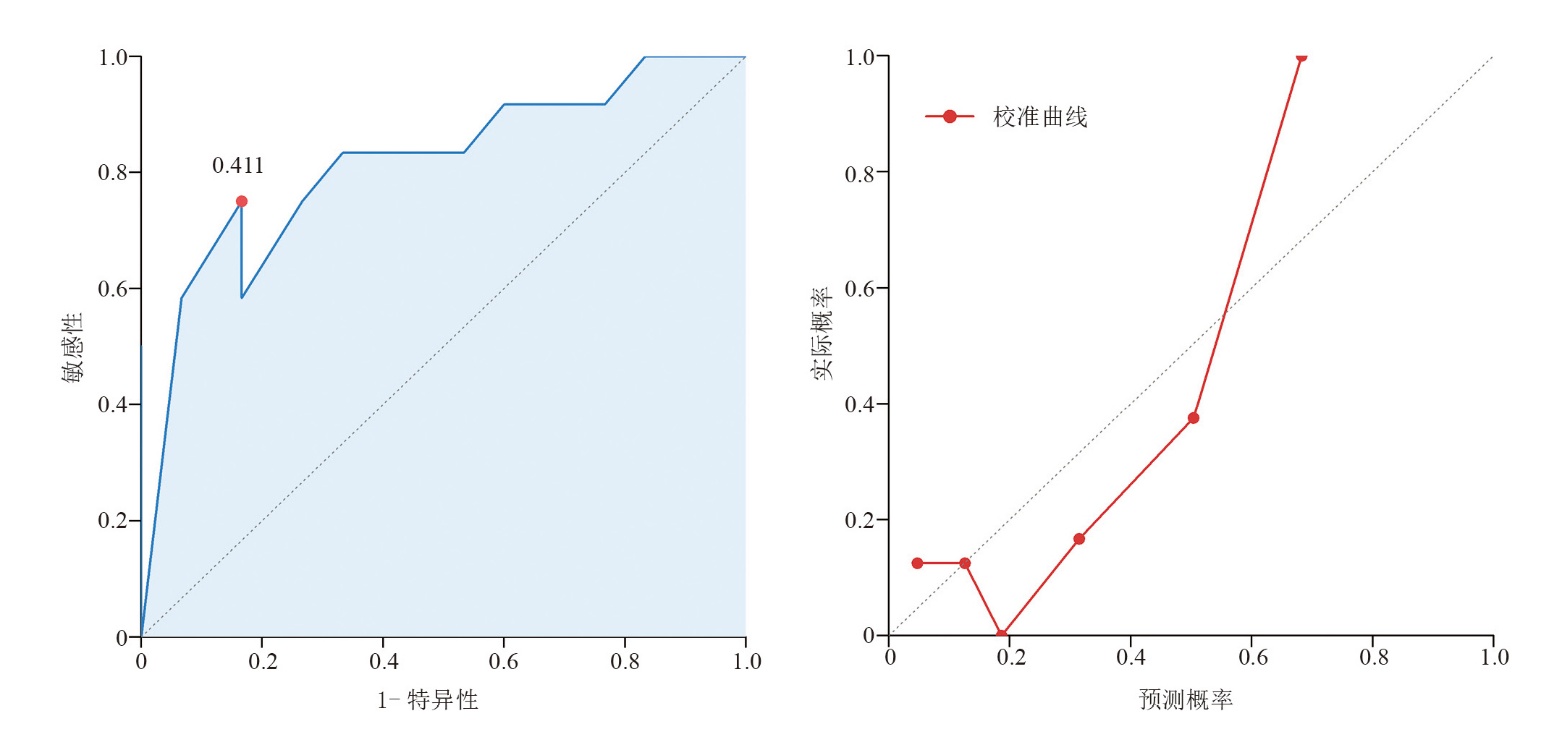
Figure 1
ROC(left)and calibration curves(right)for the Firth regression model"
| [1] |
FEIGIN V L, NICHOLS E, ALAM T, et al. Global, regional, and national burden of neurological disorders, 1990-2016: a systematic analysis for the Global Burden of Disease Study 2016[J]. Lancet Neurol, 2019, 18(5): 459-480.
doi: S1474-4422(18)30499-X pmid: 30879893 |
| [2] | SU D, CUI Y, HE C, et al. Projections for prevalence of Parkinson's disease and its driving factors in 195 countries and territories to 2050: modelling study of Global Burden of Disease Study 2021[J]. BMJ, 2025, 388: e080952. |
| [3] |
CHU Y, HIRST W D, FEDEROFF H J, et al. Nigrostriatal tau pathology in Parkinsonism and Parkinson's disease[J]. Brain, 2024, 147(2): 444-457.
doi: 10.1093/brain/awad388 |
| [4] |
DE PASQUALE P, BONANNO M, DE MARCHIS C, et al. Beyond clinical scales: an observational study on instrumental gait analysis and biomechanical patterns in patients with Parkinson's disease[J]. Front Bioeng Biotechnol, 2025, 13: 1541240.
doi: 10.3389/fbioe.2025.1541240 |
| [5] | DICKSON D W. Neuropathology of Parkinson's disease and Parkinsonism[J]. Cold Spring Harb Perspect Med, 2025, 15(5): a041610. |
| [6] |
KOLA S, SUBRAMANIAN I. Updates in Parkinson's disease integrative therapies: an evidence-based review[J]. Curr Neurol Neurosci Rep, 2023, 23(11): 717-726.
doi: 10.1007/s11910-023-01312-z |
| [7] |
WILSON A C, POUNTNEY D L, KHOO T K. Therapeutic mechanisms of exercise in Parkinson's disease[J]. Int J Mol Sci, 2025, 26(10): 4860.
doi: 10.3390/ijms26104860 |
| [8] |
BURTSCHER J, MORAUD E M, MALATESTA D, et al. Exercise and gait/movement analyses in treatment and diagnosis of Parkinson's disease[J]. Ageing Res Rev, 2024, 93: 102147.
doi: 10.1016/j.arr.2023.102147 |
| [9] |
BARBIERI R A, BARBIERI F A, ZELADA-ASTUDILLO N, et al. Influence of aerobic exercise on functional capacity and maximal oxygen uptake in patients with Parkinson disease: a systematic review and meta-analysis[J]. Arch Phys Med Rehabil, 2025, 106(1): 134-144.
doi: 10.1016/j.apmr.2024.09.013 |
| [10] | 中华医学会神经病学分会帕金森病及运动障碍学组, 中国医师协会神经内科医师分会帕金森病及运动障碍专业委员会. 中国帕金森病的诊断标准(2016版)[J]. 中华神经科杂志, 2016, 49(4): 268-271. |
| [11] |
LI J, JIN M, WANG L, et al. MDS clinical diagnostic criteria for Parkinson's disease in China[J]. J Neurol, 2017, 264(3): 476-481.
doi: 10.1007/s00415-016-8370-2 pmid: 28025665 |
| [12] |
张力引. 帕金森病抑郁及其对认知、平衡功能和生活质量的影响[J]. 中国康复理论与实践, 2026, 32(2): 174-180.
doi: 10.3969/j.issn.1006-9771.2026.02.006 |
| ZHANG L Y. Depression in Parkinson's disease and its association with cognition, balance and quality of life[J]. Chin J Rehabil Theory Pract, 2026, 32(2): 174-180. | |
| [13] |
LINDER S M, BARON E, LEARMAN K. An 8-week aerobic cycling intervention elicits improved gait velocity and biomechanics in persons with Parkinson's disease[J]. Gait Posture, 2022, 98: 313-315.
doi: 10.1016/j.gaitpost.2022.10.007 pmid: 36265219 |
| [14] |
KURL S, JAE S Y, VOUTILAINEN A, et al. Exercise heart rate reserve and recovery as risk factors for sudden cardiac death[J]. Prog Cardiovasc Dis, 2021, 68: 7-11.
doi: 10.1016/j.pcad.2021.09.002 pmid: 34536445 |
| [15] | CORCOS D M, LAMOTTE G, LUTHRA N S, et al. Advice to people with Parkinson's in my clinic: exercise[J]. J Parkinsons Dis, 2024, 14(3): 609-617. |
| [16] |
WANG J, LU J, WANG Y, et al. Decrease in walking ability with increased functional connectivity between multiple brain areas in Parkinson's disease: a functional near-infrared spectroscopy study[J]. Front Aging Neurosci, 2024, 16: 1454598.
doi: 10.3389/fnagi.2024.1454598 |
| [17] |
MØLMEN K S, ALMQUIST N W, SKATTEBO Ø. Effects of exercise training on mitochondrial and capillary growth in human skeletal muscle: a systematic review and meta-regression[J]. Sports Med, 2025, 55(1): 115-144.
doi: 10.1007/s40279-024-02120-2 |
| [18] |
THOMAS A G, DENNIS A, BANDETTINI P A, et al. The effects of aerobic activity on brain structure[J]. Front Psychol, 2012, 3: 86.
doi: 10.3389/fpsyg.2012.00086 pmid: 22470361 |
| [19] |
BURTSCHER J, SOLTANY A, VISAVADIYA N P, et al. Mitochondrial stress and mitokines in aging[J]. Aging Cell, 2023, 22(2): e13770.
doi: 10.1111/acel.v22.2 |
| [20] |
FOLEY T E, FLESHNER M. Neuroplasticity of dopamine circuits after exercise: implications for central fatigue[J]. Neuromolecular Med, 2008, 10: 67-80.
doi: 10.1007/s12017-008-8032-3 |
| [21] |
LI G, HUANG P, CUI S S, et al. Mechanisms of motor symptom improvement by long-term Tai Chi training in Parkinson's disease patients[J]. Transl Neurodegener, 2022, 11(1): 6.
doi: 10.1186/s40035-022-00280-7 pmid: 35125106 |
| [22] |
MITCHELL A K, BLISS R R, CHURCH F C. Exercise, neuroprotective exerkines, and Parkinson's disease: a narrative review[J]. Biomolecules, 2024, 14(10): 1241.
doi: 10.3390/biom14101241 |
| [23] |
DE SOUSA R A L. Exercise-produced irisin effects on brain-related pathological conditions[J]. Metab Brain Dis, 2024, 39(8): 1679-1687.
doi: 10.1007/s11011-024-01412-w |
| [24] |
NGUYEN T X D, MAI P T, CHANG Y J, et al. Effects of transcranial direct current stimulation alone and in combination with rehabilitation therapies on gait and balance among individuals with Parkinson's disease: a systematic review and meta-analysis[J]. J Neuroeng Rehabil, 2024, 21(1): 27.
doi: 10.1186/s12984-024-01311-2 pmid: 38373966 |
| [25] |
DEL DIN S, ELSHEHABI M, GALNA B, et al. Gait analysis with wearables predicts conversion to Parkinson disease[J]. Ann Neurol, 2019, 86(3): 357-367.
doi: 10.1002/ana.25548 pmid: 31294853 |
| [26] | 赵嘉豪, 万赢, 宋璐, 等. 早期帕金森病患者步态特征定量分析的初步探索[J]. 中华神经科杂志, 2020, 53(7): 485-492. |
| ZHAO J H, WAN Y, SONG L, et al. An exploratory study of quantitative analysis of gait characteristics in patients with early Parkinson′s disease[J]. Chin J Neurol, 2020, 53(07): 485-492. | |
| [27] |
LINDER S M, LEARMAN K, MILLER KOOP M, et al. Increased comfortable gait speed is associated with improved gait biomechanics in persons with chronic stroke completing an 8-week forced-rate aerobic cycling intervention: a preliminary study[J]. Am J Phys Med Rehabil, 2023, 102(7): 619-624.
doi: 10.1097/PHM.0000000000002248 |
| [28] |
IVANISKI-MELLO A, MÜLLER V T, DE LIZ ALVES L, et al. Determinants of dual-task gait speed in older adults with and without Parkinson's disease[J]. Int J Sports Med, 2023, 44(10): 744-750.
doi: 10.1055/a-2085-1429 |
| [29] |
SHEARIN S, MEDLEY A, TRUDELLE-JACKSON E, et al. Differences in predictors for gait speed and gait endurance in Parkinson's disease[J]. Gait Posture, 2021, 87: 49-53.
doi: 10.1016/j.gaitpost.2021.04.019 pmid: 33892391 |
| [30] |
BONDE-JENSEN F, DALGAS U, LANGESKOV-CHRISTENSEN M, et al. Are physical activity levels, cardiorespiratory fitness and peak power associated with Parkinson's disease severity[J]. J Neurol Sci, 2024, 460: 122996.
doi: 10.1016/j.jns.2024.122996 |
| [31] |
SCHOOTEMEIJER S, VAN DER KOLK N M, BLOEM B R, et al. Current perspectives on aerobic exercise in people with Parkinson's disease[J]. Neurotherapeutics, 2020, 17(4): 1418-1433.
doi: 10.1007/s13311-020-00904-8 |
| [32] |
WHIPP B J, WARD S A. The physiological basis of the 'anaerobic threshold' and implications for clinical cardiopulmonary exercise testing[J]. Anaesthesia, 2011, 66(11): 1048-1049.
doi: 10.1111/j.1365-2044.2011.06909_1.x pmid: 22004202 |
| [33] |
JARRAHI B, MCEWEN S C, HOLSCHNEIDER D P, et al. The effects of cardiorespiratory and motor skill fitness on intrinsic functional connectivity of neural networks in individuals with Parkinson's disease[J]. Brain Plast, 2021, 7(2): 77-95.
doi: 10.3233/BPL-200115 pmid: 34868875 |
| [34] |
SOUILLA L, AVESANI M, BOISSON A, et al. Cardiorespiratory fitness, muscle fitness, and physical activity in children with long QT syndrome: a prospective controlled study[J]. Front Cardiovasc Med, 2023, 9: 1081106.
doi: 10.3389/fcvm.2022.1081106 |
| [35] |
SHEN T, WANG Y, REN C, et al. The effects of CPET-guided cardiac rehabilitation on exercise tolerance in older persons with CHD after PCI[J]. Sci Rep, 2023, 13(1): 19994.
doi: 10.1038/s41598-023-47494-x |
| [36] |
HEALY R D, SMITH C, WOESSNER M N, et al. Relationship between VO2peak, VO2 recovery kinetics, and muscle function in older adults[J]. Gerontology, 2023, 69(11): 1278-1283.
doi: 10.1159/000533920 |
| [37] | YOON S Y, HEO S J, LEE H J, et al. Initial BMI and weight loss over time predict mortality in Parkinson disease[J]. J Am Med Dir Assoc, 2022, 23(10): 1719. e1-1719.e7. |
| [38] |
STEINHARDT J, LOKOWANDT L, RASCHE D, et al. Mechanisms and consequences of weight gain after deep brain stimulation of the subthalamic nucleus in patients with Parkinson's disease[J]. Sci Rep, 2023, 13(1): 14202.
doi: 10.1038/s41598-023-40316-0 pmid: 37648732 |
| [39] |
BASTIOLI G, MANCINI M, PATEL J C, et al. Voluntary exercise increases striatal dopamine release and improves motor performance in aging mice[J]. NPJ Parkinsons Dis, 2025, 11(1): 345.
doi: 10.1038/s41531-025-01213-7 |
| [1] | DUAN Guanting, XIAO Xue, HOU Huisheng, JIANG Yunqiao, LIU Yuge, SHI Wenxia. Relationship between physical activity and mental health in children with autism spectrum disorder: the mediating role of social response [J]. Chinese Journal of Rehabilitation Theory and Practice, 2025, 31(2): 150-157. |
| [2] | HAN Xuling, ZHAO Hang, SUN Mudi, ZHAO Meiping, WANG Yanxia, LIU Min, QU Lu, LIU Qiaoyun. Characteristics of response to joint attention under diverse guiding behaviors in preschoolers with moderate to severe autism spectrum disorder [J]. Chinese Journal of Rehabilitation Theory and Practice, 2024, 30(8): 882-887. |
| [3] | YANG Yuran, WANG Qian, CHEN Cuicui, DU Xiaoxin. Effect of different interventions on joint attention in children aged three to six years with mild to moderate autism spectrum disorder [J]. Chinese Journal of Rehabilitation Theory and Practice, 2024, 30(8): 888-893. |
| [4] | DU Huayong, LI Zehui, WANG Xiaoxin, JING Yingli, GAO Feng, YANG Degang, LI Jianjun. Immune responses in the microenvironment after spinal cord injury: a bibliometric analysis [J]. Chinese Journal of Rehabilitation Theory and Practice, 2024, 30(11): 1322-1333. |
| [5] | SHAO Weiting, LEI Jianghua. Effect of response interruption and redirection as a behavioral intervention on vocal stereotypy in children with autism spectrum disorder: a scoping review [J]. 《Chinese Journal of Rehabilitation Theory and Practice》, 2024, 30(1): 10-20. |
| [6] | LI Gao-feng,MEI Jian-feng,ZHANG Meng,CAI Hong-bo,CAO Ping,LI Chen-na,ZHANG Xiao-jun. Testing System for Analyzing Directionally-specific Postural Adjustments Indued by Plantar Vibratory Stimulation [J]. 《Chinese Journal of Rehabilitation Theory and Practice》, 2021, 27(9): 1110-1116. |
| [7] | TANG Rui-ling, LI Min, WANG Jun-yu, XIANG Wu, ZHANG An-ren. Advance in Role of IκB Kinase beta in Inflammatory Response Mechanism post Spinal Cord Injury (review) [J]. 《Chinese Journal of Rehabilitation Theory and Practice》, 2019, 25(6): 634-637. |
| [8] | DU Jun-long, CHEN Xian-bing, WANG Feng-jie, QIN Xiao-li, ZHAO Fang-yu, TANG Xian-e. Effect of Trillin on Oxidative Stress and Nuclear Factor E2-related Factor 2/Antioxidant Response Element Pathway in Rats after Spinal Cord Injury [J]. 《Chinese Journal of Rehabilitation Theory and Practice》, 2019, 25(10): 1140-1145. |
| [9] | WANG Dan, LIU Wei, LI Zhong-ming, ZHONG Lian-mei. Neuroelectrophysiological Characteristics of Peripheral Neuropathy after Chronic Obstructive Pulmonary Disease [J]. 《Chinese Journal of Rehabilitation Theory and Practice》, 2018, 24(7): 846-849. |
| [10] | HE Yu, ZHANG An-ren, SUN Nian-yi, WANG Wen-chun, WANG Zhi-qiang, TIAN Li-jun, ZOU Wen-chen, ZHANG Zhi-qiang. Protective Effect and Mechanism of Every-other-day Fasting on Rats with Spinal Cord Injury [J]. 《Chinese Journal of Rehabilitation Theory and Practice》, 2018, 24(2): 153-159. |
| [11] | WANG Xiao-wen, DENG Hai-yan, WANG Jian, XU Ying. Role of cAMP Response Element Binding Protein/Brain-derived Neurotrophic Factor Signaling Pathway in Tiaoxin Formula Improving Learning and Memory of APP/PS1 Mice [J]. 《Chinese Journal of Rehabilitation Theory and Practice》, 2018, 24(1): 11-16. |
| [12] | ZHU Lu-wen1, YE Tao2, JIANG Yun-fei2, WU Xiao-jun2, LI Hong-yu2, SONG Ming-yang2, TANG Qiang1. Effects of Electro-acupuncture Pretreatment on Interleukin-1β, Interleukin-6 and Apoptosis in Rats after Cerebral Ischemia-reperfusion Injury [J]. 《Chinese Journal of Rehabilitation Theory and Practice》, 2016, 22(7): 765-768. |
| [13] | WANG Xin, SUN Cai-hua, XU Yang, ZHU Xiao-yun, CHEN Xia, SHI Wei, YANG Min. Change of Histone Acetylation Homeostasis of Central Cholinergic Circuits in Mice with Post-stroke Cognitive Impairment [J]. 《Chinese Journal of Rehabilitation Theory and Practice》, 2016, 22(6): 621-628. |
| [14] | YUAN Ai-yun, LIU Qiu-yan, LI Xiao-ping, HOU Mei. Effect of Phosphorylation Cyclic Adenosine Monophosphate Response Element Binding Protein on Expression of Apoptotic Regulated Genes in Hippocampus after Status Convulsivus [J]. 《Chinese Journal of Rehabilitation Theory and Practice》, 2016, 22(2): 136-140. |
| [15] | Lü Pan-pan, DONG Rong-zhi, LIU Fang, WANG Na-na, XU Chong-feng, BING Wei-wei, GENG Li-meng. Hearing Screening and Follow-up of High Risk Infant [J]. 《Chinese Journal of Rehabilitation Theory and Practice》, 2016, 22(12): 1459-1458. |
| Viewed | ||||||
|
Full text |
|
|||||
|
Abstract |
|
|||||
|
||
