



Chinese Journal of Rehabilitation Theory and Practice ›› 2026, Vol. 32 ›› Issue (6): 731-738.doi: 10.3969/j.issn.1006-9771.2026.06.011
Previous Articles Next Articles
WEI Yongli1a, DING Junhang1a, ZHOU Ping1a( ), YANG Xiaoman1b, WANG Zhen1a, YU Fujie1a, DUAN Fangfang1a, GUAN Enjing1c()
Received:2026-04-03
Published:2026-06-25
Online:2026-06-24
Supported by:CLC Number:
WEI Yongli, DING Junhang, ZHOU Ping, YANG Xiaoman, WANG Zhen, YU Fujie, DUAN Fangfang, GUAN Enjing. Construction of undergraduate rehabilitation engineering curriculum system based on World Health Organization rehabilitation competency framework[J]. Chinese Journal of Rehabilitation Theory and Practice, 2026, 32(6): 731-738.
Figure 1
Schematic diagram illustrating the interdisciplinary nature of rehabilitation engineering"
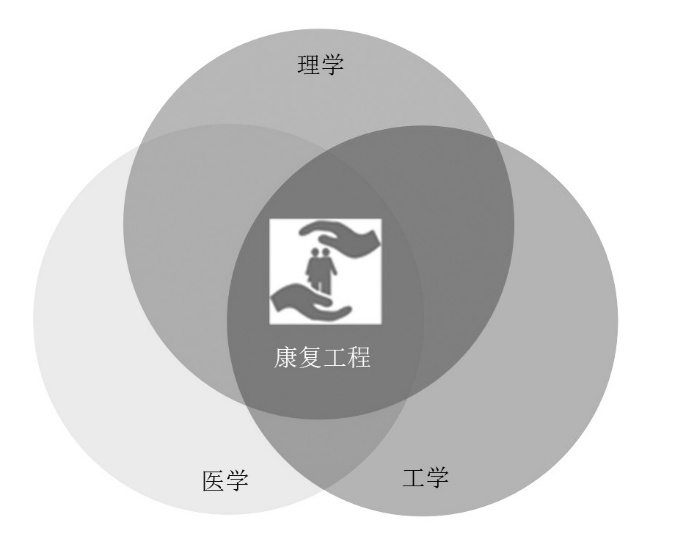
Figure 2
Closed-loop training model for "needs-R&D-supported adaptation""
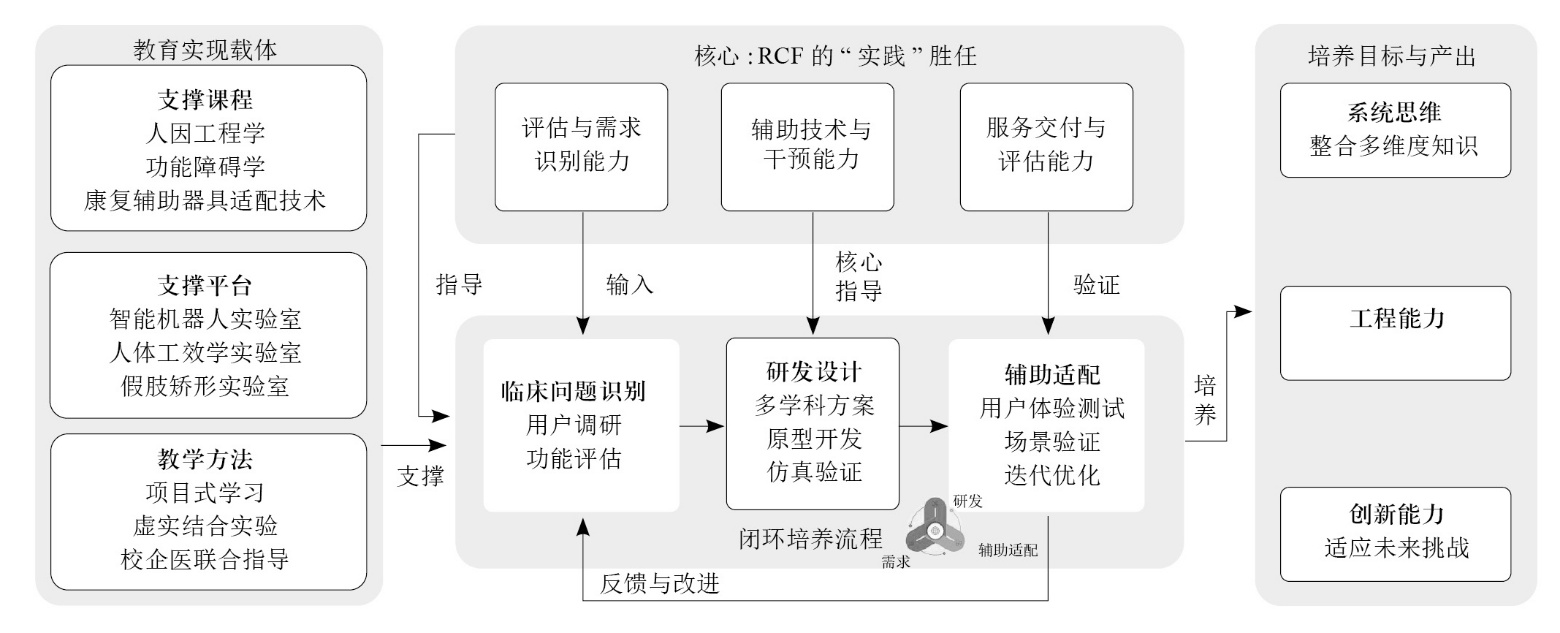

Table 1
Mapping of RCF competencies to the stages of the "needs-R&D-supported adaptation""
| 培养阶段 | 核心教学活动 | 对应RCF胜任力领域 | 具体能力映射 |
|---|---|---|---|
| 需求分析 | 临床/社区调研、用户访谈、功能评估 | 实践(评估与需求识别)、专业精神(以人为本、沟通共情) | 识别功能障碍者的真实需求;与用户及家属有效沟通;理解使用场景的环境与社会因素 |
| 研发设计 | 概念设计、技术选型、原型制作、仿真验证 | 实践(辅助技术与干预)、学习与发展(反思与创新)、管理与领导力(团队协调) | 综合运用工程知识提出技术方案;在团队中协作创新;通过迭代优化设计 |
| 辅助适配 | 人机交互测试、环境适配、用户训练、效果评估 | 实践(服务交付与评估)、专业精神(伦理与法规)、管理与领导力(质量管理) | 验证产品的用户接受度与环境适应性;遵守医疗器械法规;根据反馈完成改进 |
Table 2
Mapping of RCF competency domains to course modules"
| RCF胜任力领域 | 对应课程模块 | 代表性课程 | 学分 |
|---|---|---|---|
| 实践(辅助技术核心能力) | 专业核心模块 | 康复辅助器具适配技术、假肢矫形器学、智能康复机器人技术 | 24 |
| 实践(评估与干预能力) | 学科平台+专业核心 | 功能障碍学、人体运动学、康复评定学 | 10 |
| 专业精神 | 通识教育+专业核心 | 康复医学概论、康复工程伦理、医患沟通 | 8 |
| 学习与发展 | 通识教育+多元选修 | 科研方法与论文写作、持续专业发展导论 | 5 |
| 管理与领导力 | 多元选修 | 康复服务管理、医疗器械法规与标准 | 4 |
Table 3
Breakdown of specialized teaching laboratory construction"
| 序号 | 实验室名称 | 主要功能 | 支撑核心课程 | 支撑的RCF胜任力 |
|---|---|---|---|---|
| 1 | 工业设计实验室 | 三维建模、辅助器具设计、3D打印 | 工程图学、3D打印与矫形器设计、三维建模 | 实践(辅助技术) |
| 2 | 工程力学实验室 | 材料检测、力学性能测试 | 工程力学 | 实践(技术基础) |
| 3 | 电机与控制实验室 | 电机控制、实时仿真 | 机器人驱动技术、自动控制原理 | 实践(技术实现) |
| 4 | 智能机器人实验室 | 机器人应用、虚实结合实训 | 计算机视觉、机器人动力学与控制 | 实践(先进技术) |
| 5 | 人体工效学实验室 | 运动捕捉、肌电测试、生理监测 | 认知实习、生物力学 | 实践(评估能力) |
| 6 | 假肢矫形实验室 | 假肢矫形器设计制作全流程 | 假肢矫形器学、3D打印与矫形器设计 | 实践(辅助技术) |
| 7 | 辅助器具适配实验室 | 辅具评估、个性化设计、虚拟训练 | 康复辅助器具适配技术、科技创新实践 | 实践(适配能力) |
| 8 | 适老化改造实验室 | 适老化环境模拟、智能辅具研发 | 日常生活技能与环境改造、科技创新实践 | 实践(环境适配) |
| [1] | 中共中央, 国务院. «"健康中国2030"规划纲要»[A].(2016-10-25)[2026-02-25]. https://www.nhc.gov.cn/guihuaxxs/c100132/201610/cef9821abcfc4544bb27e2bc533bd7cf.shtml. |
| [2] | 国家统计局, 民政部. 2023年中国残疾人事业发展统计公报[R]. 北京: 中国统计出版社, 2024. |
| National Bureau of Statistics, Ministry of Civil Affairs. 2023 Statistical Bulletin on the Development of the Cause of Persons with Disabilities in China[R]. Beijing: China Statistics Press, 2024. | |
| [3] | 冯晶晶, 么莉, 安磊, 等. 国内外康复护理服务质量评价现状研究[J]. 中国卫生质量管理, 2022, 29(4): 4-8. |
| FENG J J, MO L, AN L, et al. Study on the current situation of rehabilitation nursing service quality evaluation at home and abroad[J]. Chin Health Qual Manag, 2022, 29(4): 4-8. | |
| [4] | 邵涵, 黄晓彤, 许心蕊, 等. 我国残疾人康复服务领域关键问题确认[J]. 护理学杂志, 2023, 38(10): 94-98. |
| SHAO H, HUANG X T, XU X R, et al. Identification of key issues in the field of rehabilitation services for people with disabilities in China[J]. J Nurs Sci, 2023, 38(10): 94-98. | |
| [5] | 孙熠, 于晓云, 薛阳阳, 等. 长期照护老年人不同维度健康状况及其对生活自理能力的影响[J]. 中国老年学杂志, 2016, 36(2): 442-444. |
| SUN Y, YU X Y, XUE Y Y, et al. The health status of older adults in long-term care across different dimensions and its impact on activities of daily living[J]. Chin J Gerontol, 2016, 36(2): 442-444. | |
| [6] | 吴瑞凯, 汪明伟, 韩正风, 等. 多病共存住院老年人常见慢性病对轻度认知功能障碍的影响[J]. 中华老年多器官疾病杂志, 2025, 24(1): 26-31. |
| WU R K, WANG M W, HAN Z F, et al. Influencing factors of common chronic diseases on mild cognitive impairment in elderly inpatients with multiple comorbidities[J]. Chin J Mult Organ Dis Elderly, 2025, 24(1): 26-31. | |
| [7] | MISHRA S, LAPLANTE-LÉVESQUE A, BARBARESCHI G, et al. Assistive technology needs, access and coverage, and related barriers and facilitators in the WHO European region: a scoping review[J]. Disabil Rehabil: Assistive Technol, 2024, 19(2): 474-485. |
| [8] |
闫媚, 江华, 董理权, 等. 中国辅助技术的需求,供给和满意度研究:基于快速辅助技术评估数据[J]. 中国康复理论与实践, 2023, 29(4): 373-380.
doi: 10.3969/j.issn.1006-9771.2023.04.001 |
| YAN M, JIANG H, DONG L Q, et al. Demand, supply and satisfaction of assistive technology in China based on rapid assistive technology assessment data[J]. Chin J Rehabil Theory Pract, 2023, 29(4): 373-380. | |
| [9] | 吕杰, 韩甲, 张夏静, 等. 新形势下康复工程专业人才培养路径探讨[J]. 中国继续医学教育, 2025, 17(10): 68-71. |
| LÜ J, HAN J, ZHANG X J, et al. Discussion on the cultivation path of rehabilitation engineering professionals under the new situation[J]. Chin Contin Med Educ, 2025, 17(10): 68-71. | |
| [10] | 朱明, 张琳琳, 陈莉, 等. "医工结合型"康复工程专业人才创新能力培养探索与实践[J]. 医学教育管理, 2022, 8(2): 133-138. |
|
ZHU M, ZHANG L L, CHEN L, et al. Exploration and practice of cultivating the innovative ability of rehabilitation engineering talents with the combination of medicine and engineering[J]. Med Educ Manag, 2022, 8(2): 133-138.
doi: 10.3969/j.issn.2096-045X.2022.02.001 |
|
| [11] | 魏永利, 刘晓凤, 周平. 智能康复工程中的生物力学问题[J]. 生物医学工程研究, 2024, 43(2): 87-91. |
| WEl Y L, LlU X F, ZHOU P. Biomechanics in Intelligent Rehabilitation Engineering[J]. J Biomed Engineer Res, 2024, 43(2): 87-91. | |
| [12] | 李梦, 张佳仪, 王友权. 新质生产力驱动下康复工程专业实验教学路径研究[J]. 教育进展, 2025, 15(12): 406-411. |
|
LI M, ZHANG J Y, WANG Y Q. Research on the experimental teaching path of rehabilitation engineering major driven by new quality productivity[J]. Adv Educ, 2025, 15(12): 406-411.
doi: 10.12677/ae.2025.15122294 |
|
| [13] | 石萍, 喻洪流. 康复工程专业实践教学模式探索与实践[J]. 医疗卫生装备, 2015, 36(3): 145-147. |
| SHI P, YU H L. Practice teaching mode in discipline of rehabilitation engineering[J]. Chin Med Equip J, 2015, 36(3): 145-147. | |
| [14] | 马锋, 李艳, 魏沙沙, 等. 医工交叉复合型医学研究生培养体系探索与实践[J]. 中国医学教育技术, 2022, 36(6): 717-722. |
| MA F, LI Y, WEI S S, et al. Exploration and practice on training system of medical postgraduates of medicine-engineering interdisciplinary compound talents[J]. Chin Med Educ Technol, 2022, 36(6): 717-722. | |
| [15] | World Health Organization. Rehabilitation competency framework[M]. Geneva: World Health Organization, 2020. |
| [16] |
肖晓飞, 刘妤姝, 杨亚茹, 等. 世界卫生组织康复胜任力架构在康复科学教育体系和课程开发中的应用[J]. 中国康复理论与实践, 2023, 29(11): 1261-1267.
doi: 10.3969/j.issn.1006-9771.2023.11.003 |
| XIAO X F, LIU Y S, YANG Y R, et al. Application of WHO rehabilitation competency framework in development of rehabilitation science education sys-tem and curriculu[J]. Chin J Rehabil Theory Pract, 2023, 29(11): 1261-1267. | |
| [17] | 仪维, 宋维业. 医工交叉实践教学平台的研究与探索[J]. 实验室科学, 2024, 27(3): 211-214. |
| YI W, SONG W Y. Research and exploration of medical-industrial cross-practice teaching platform[J]. Lab Sci, 2024, 27(3): 211-214. | |
| [18] | 段磊, 王伟, 朱松盛, 等. 医工结合建设生物医学工程实验教学示范中心[J]. 实验室研究与探索, 2012, 31(7): 116-118. |
| DUAN L, WANG W, ZHU S S, et al. Construction of a biomedical engineering experimental teaching demonstration center by integration of medicine with engineering[J]. Res Exp Lab, 2012, 31(7): 116-118. | |
| [19] | 高克强, 高凡. "生物医学信号处理"课程虚实结合实验教学改革[J]. 教育教学论坛, 2024(1): 62-66. |
| GAO K Q, GAO F. Reform of biomedical signal processing experimental teaching by combining virtuality and reality[J]. Education Forum, 2024(1): 62-66. | |
| [20] |
SINGH M, FUENMAYOR E, HINCHY E P, et al. Digital twin in engineering education: a systematic review[J]. IEEE Trans Educ, 2024, 67(3): 1-12.
doi: 10.1109/TE.2023.3296975 |
| [21] |
SOMAN R K, FARGHALY K, MILLS G, et al. Digital twin construction with a focus on human twin interfaces[J]. Autom Constr, 2025, 170: 105924.
doi: 10.1016/j.autcon.2024.105924 |
| [1] | LIU Hua, LI Jing, WANG Liyuan, MA Xin, WANG Li. Application of presentation-assimilation-discussion-based classroom-community collaborative teaching in sports rehabilitation therapy under sports-medicine integration [J]. Chinese Journal of Rehabilitation Theory and Practice, 2026, 32(4): 482-487. |
| [2] | AN Le, QIN Xiaoxia, GU Bin, HU Guobing, TIAN Weiyi. A competency model for "dual-qualified" teachers in vocational undergraduate rehabilitation therapy programs based on the integration of rehabilitation competency framework and multi-source standards [J]. Chinese Journal of Rehabilitation Theory and Practice, 2026, 32(3): 258-269. |
| [3] | CHEN Jian, LI Zheheng, WANG Dingxuan. Current status of talent cultivation in sports rehabilitation in China: based on World Health Organization rehabilitation competency framework [J]. Chinese Journal of Rehabilitation Theory and Practice, 2026, 32(1): 110-116. |
| [4] | HU Long, YU Hang. Effect of summer short-term clinical practice teaching on empathy ability in rehabilitation therapy students [J]. Chinese Journal of Rehabilitation Theory and Practice, 2026, 32(1): 117-124. |
| [5] | LIANG Fei, CHEN Ximei, QI Jing, WANG Shurong, LIANG Yongsheng. Functioning, vocational competency and career development of college students with disabilities based on ICF and RCF [J]. Chinese Journal of Rehabilitation Theory and Practice, 2025, 31(8): 922-929. |
| [6] | DONG Yuanjun, LOU Xin, SUN Rui, WANG Wenshuai, LIU Xiaoqin, XIA Xue, YANG Yaru, WANG Zhongyan, QIU Zhuoying. Cultivating key competencies of teamwork and interprofessional practice for rehabilitation psychology professionals based on RCF [J]. Chinese Journal of Rehabilitation Theory and Practice, 2025, 31(8): 939-946. |
| [7] | CAO Jing, LIU Jing, ZHANG Xiaoyan, GAO Shaoyu. Construction of competency evaluation indicator system for special education teachers based on World Health Organization rehabilitation competency framework [J]. Chinese Journal of Rehabilitation Theory and Practice, 2025, 31(6): 621-627. |
| [8] | WU Aihong, ZHANG Qing, WU Jiaming, XIE Junxia, WU Dang. Construction of a competency-based and functioning-oriented training curriculum system for inclusive education teachers in primary and secondary schools [J]. Chinese Journal of Rehabilitation Theory and Practice, 2025, 31(5): 539-547. |
| [9] | ZENG Bin, GUO Shuang, YE Haiyan, YE Jinqun, XU Zihan, XU Guangqing, ZHANG Lei. Investigation for research competency of undergraduate interns in rehabilitation therapy using WHO rehabilitation competency framework [J]. Chinese Journal of Rehabilitation Theory and Practice, 2025, 31(5): 548-552. |
| [10] | ZHANG Qing, WU Jiaming, JIA Wenrong, YU Fayou. Competency framework and contents for primary and secondary school teachers in inclusive education settings based on RCF and ICF [J]. Chinese Journal of Rehabilitation Theory and Practice, 2025, 31(4): 406-414. |
| [11] | GUAN Shan, SUN Meili, GUAN Yi, XUE Yifan, ZHONG Yuliang⁴, LI Xinqin. Developing a curriculum framework for vocational competency in college students with disabilities: based on RCF and ICF [J]. Chinese Journal of Rehabilitation Theory and Practice, 2025, 31(4): 415-422. |
| [12] | SUN Wen, LIANG Yongsheng, ZHANG Yu, ZHOU Jing, GAO Weiwei, WANG Yongli, CHEN Xuefen. Construction of curriculum system of higher vocational education in speech-language-hearing rehabilitation based on WHO rehabilitation competency framework [J]. Chinese Journal of Rehabilitation Theory and Practice, 2024, 30(9): 1003-1010. |
| [13] | XIAO Yue, WANG Xihui, GONG Xiang, SUN Wanting, XIAO Jianqiu, YI Wenchao, XU Guangxu. Effect of case-based learning combined with PICOS framework on occupational therapy teaching for undergraduate rehabilitation students [J]. Chinese Journal of Rehabilitation Theory and Practice, 2024, 30(9): 1011-1017. |
| [14] | TANG Qiang, ZHENG Shuang, LI Baolong, WANG Yan, WANG Lei, ZHU Luwen. Research on competency of traditional Chinese medicine rehabilitation based on WHO rehabilitation competency framework [J]. Chinese Journal of Rehabilitation Theory and Practice, 2024, 30(9): 1018-1025. |
| [15] | ZHOU Jing, DING Zhongbing, ZHONG Kaiying, WANG Dan, LI Qunqun, CAO Yanjing, CHEN Xuefen. Developing an education system for speech-language-hearing rehabilitation technology in higher vocational colleges based on WHO rehabilitation competency framework [J]. Chinese Journal of Rehabilitation Theory and Practice, 2024, 30(9): 993-1002. |
| Viewed | ||||||
|
Full text |
|
|||||
|
Abstract |
|
|||||
|
||
