



《Chinese Journal of Rehabilitation Theory and Practice》 ›› 2020, Vol. 26 ›› Issue (3): 278-284.doi: 10.3969/j.issn.1006-9771.2020.03.003
Previous Articles Next Articles
LIANG Ming1a,WEI Zhen1b,XIE Rong1a( ),XU Yi-peng1a,HOU Tian1a,TAO Jing1a,WANG Bao-xia1a,FANG Rui1a
Received:2019-02-11
Revised:2019-03-04
Published:2020-03-25
Online:2020-04-01
Contact:
XIE Rong
E-mail:wszsydxs@163.com
CLC Number:
LIANG Ming,WEI Zhen,XIE Rong,XU Yi-peng,HOU Tian,TAO Jing,WANG Bao-xia,FANG Rui. Virtual Reality Training for Balance Function for Old Adults: A Meta-analysis[J]. 《Chinese Journal of Rehabilitation Theory and Practice》, 2020, 26(3): 278-284.
"

"
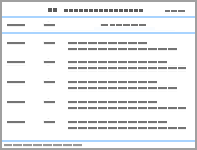
| 纳入研究 | 地区 | 样本量(n) | 平均年龄(岁) | 实验方案 | 结局指标 | 改良Jadad 质量评分 | |||
|---|---|---|---|---|---|---|---|---|---|
| 实验组 | 对照组 | 实验组 | 对照组 | 实验组 | 对照组 | ||||
| Daniel | 美国 | 8 | 7 | 80.0 | 72.6 | VR每次45 min,每周3次,共15周 | 常规康复每次45 min,每周3次,共15周 | TUGT | 4 |
| Yeşilyaprak等 | 土耳其 | 7 | 11 | 70.1 | 73.1 | VR每次40 min,每周3次,共6周 | 常规康复每次40 min,每周3次,共6周 | BBS、TUGT | 5 |
| Hagedorn等 | 美国 | 15 | 12 | 81.5 | 81.1 | VR每次90 min,每周2次,共12周 | 常规康复每次90 min,每周2次,共12周 | BBS、TUGT | 4 |
| Williams等 | 苏格兰 | 15 | 6 | 76.8 | 76.5 | VR每周2次,共12周 | 常规康复每周2次,共12周 | BBS | 3 |
| Laver等 | 澳大利亚 | 22 | 22 | 85.2 | 84.6 | VR每次25 min,每周5次 | 常规康复每次25 min,每周5次 | TUGT | 7 |
| Lai等 | 台湾 | 15 | 15 | 70.6 | 74.8 | VR每次30 min,每周3次,共6周 | 常规康复每次30 min,每周3次,共6周 | BBS、TUGT | 6 |
| Schwenk等 | 美国 | 17 | 16 | 84.3 | 84.9 | VR每次45 min,每周2次,共4周 | 常规康复每次45 min,每周2次,共4周 | TUGT | 5 |
| Ku等 | 韩国 | 18 | 16 | 64.7 | 65.0 | VR每次30 min,每周3次,共4周 | 常规康复每次30 min,每周3次,共4周 | BBS、TUGT | 5 |
| Lee等 | 韩国 | 21 | 19 | 76.15 | 75.71 | VR每次60 min,每周2次,共6周 | 常规康复每次60 min,每周2次,共6周 | BBS、TUGT | 5 |
| Singh等 | 新加坡 | 18 | 18 | 61.12 | 64.00 | VR每次40 min,每周2次,共6周 | 常规康复每次40 min,每周2次,共6周 | TUGT | 4 |
| Delbroek等 | 比利时 | 10 | 10 | 86.9 | 87.5 | VR每次18~30 min,每周2次,共6周 | 常规康复每次18~30 min,每周2次,共6周 | TUGT | 7 |
| Franco等 | 美国 | 11 | 10 | 79.8 | 76.9 | VR每次10~15 min,每周2次,共3周 | 常规康复每次10~15 min,每周2次,共3周 | BBS | 4 |
| Jung等 | 韩国 | 8 | 8 | 74.3 | 73.6 | VR每次30 min,每周2次,共8周 | 常规康复每次30 min,每周2次,共8周 | BBS、TUGT | 4 |
| Jorgensen等 | 丹麦 | 28 | 30 | 75.9 | 73.7 | VR每次35 min,每周2次,共10周 | 常规康复每次35 min,每周2次,共10周 | TUGT | 6 |
| Pluchino等 | 美国 | 12 | 14 | 70.72 | 76.00 | VR每次60 min,每周2次,共8周 | 常规康复每次60 min,每周2次,共8周 | TUGT | 4 |
| Tsang等 | 香港 | 39 | 40 | 82.3 | 82.0 | VR每次60 min,每周3次,共6周 | 常规康复每次60 min,每周3次,共6周 | BBS、TUGT | 6 |
| Park等 | 韩国 | 12 | 12 | 66.5 | 65.2 | VR每次30 min,每周3次,共8周 | 常规康复每次30 min,每周3次,共8周 | TUGT | 4 |
| Schoene等 | 澳大利亚 | 15 | 17 | 77.5 | 78.4 | VR每次90 min,每周2~3次,共8周 | 常规康复每次90 min,每周2~3次,共8周 | TUGT | 4 |
| Merriman等 | 爱尔兰 | 17 | 17 | 74.06 | 73.41 | VR每次30 min,每周2次,共5周 | 常规康复每次30 min,每周2次,共5周 | BBS | 4 |
| Hsieh等 | 台湾 | 31 | 29 | 76.4 | 80.0 | VR每次60 min,每周2次,共24周 | 常规康复每次60 min,每周2次,共24周 | TUGT | 3 |
"
"
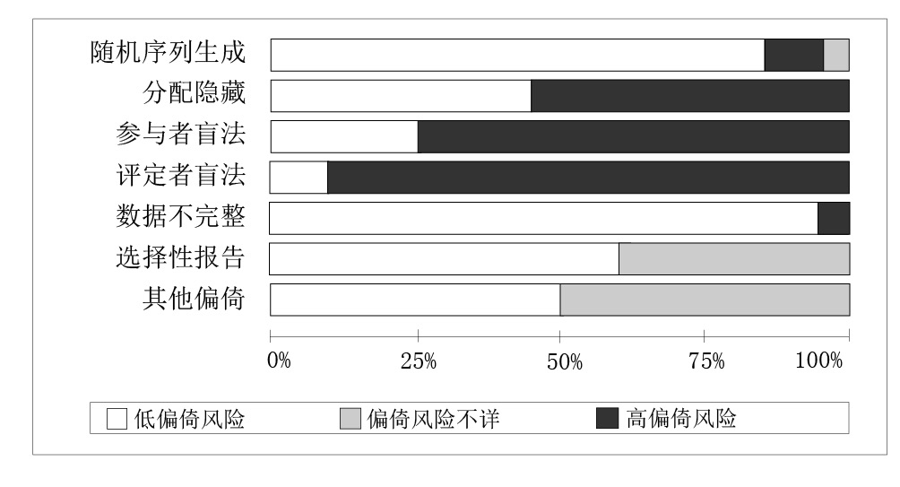
| 纳入研究 | 随机序列生成 | 分配隐藏 | 参与盲法 | 评定者盲法 | 数据完整性 | 选择性报告 | 其他偏倚 | 证据质量 |
|---|---|---|---|---|---|---|---|---|
| Daniel | 是 | 否 | 否 | 否 | 是 | 不清楚 | 是 | B |
| Yeşilyaprak等 | 是 | 是 | 否 | 否 | 是 | 是 | 是 | B |
| Hagedorn等 | 否 | 否 | 否 | 否 | 是 | 是 | 不清楚 | B |
| Williams等 | 否 | 否 | 否 | 否 | 否 | 是 | 不清楚 | B |
| Laver等 | 是 | 是 | 是 | 是 | 是 | 是 | 是 | A |
| Lai等 | 是 | 是 | 是 | 否 | 是 | 是 | 不清楚 | B |
| Schwenk等 | 是 | 是 | 否 | 否 | 是 | 不清楚 | 不清楚 | B |
| Ku等 | 是 | 是 | 否 | 否 | 是 | 是 | 不清楚 | B |
| Lee等 | 是 | 是 | 否 | 否 | 是 | 是 | 是 | B |
| Singh等 | 是 | 否 | 否 | 否 | 是 | 是 | 不清楚 | B |
| Delbroek等 | 是 | 是 | 是 | 是 | 是 | 是 | 是 | A |
| Franco等 | 是 | 否 | 否 | 否 | 是 | 不清楚 | 不清楚 | B |
| Jung等 | 是 | 否 | 否 | 否 | 是 | 不清楚 | 不清楚 | B |
| Jorgensen等 | 是 | 是 | 是 | 否 | 是 | 是 | 是 | B |
| Pluchino等 | 是 | 否 | 否 | 否 | 是 | 不清楚 | 不清楚 | B |
| Tsang等 | 是 | 是 | 是 | 否 | 是 | 是 | 是 | B |
| Park等 | 是 | 否 | 否 | 否 | 是 | 是 | 是 | B |
| Schoene等 | 是 | 否 | 否 | 否 | 是 | 不清楚 | 是 | B |
| Merriman等 | 是 | 否 | 否 | 否 | 是 | 不清楚 | 不清楚 | B |
| Hsieh等 | 不清楚 | 否 | 否 | 否 | 是 | 不清楚 | 是 | B |
"
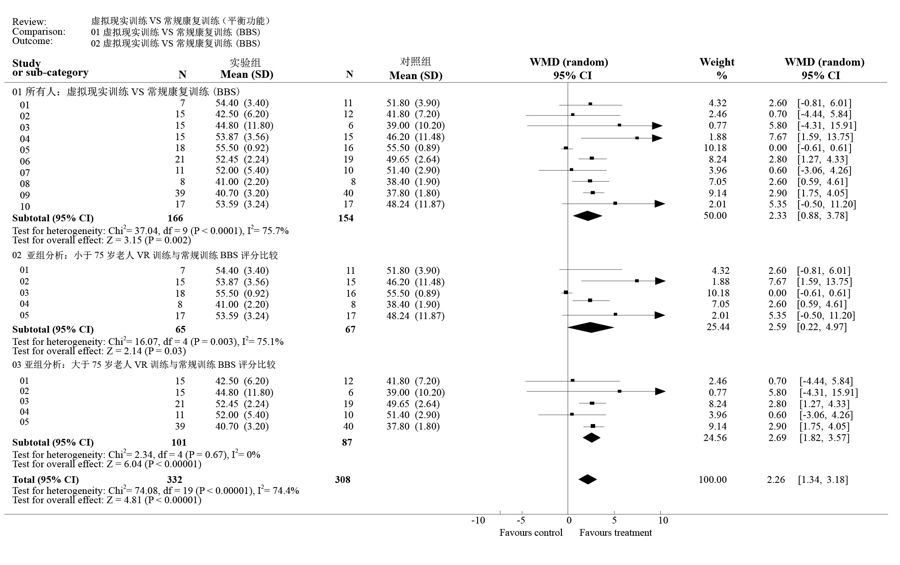
"
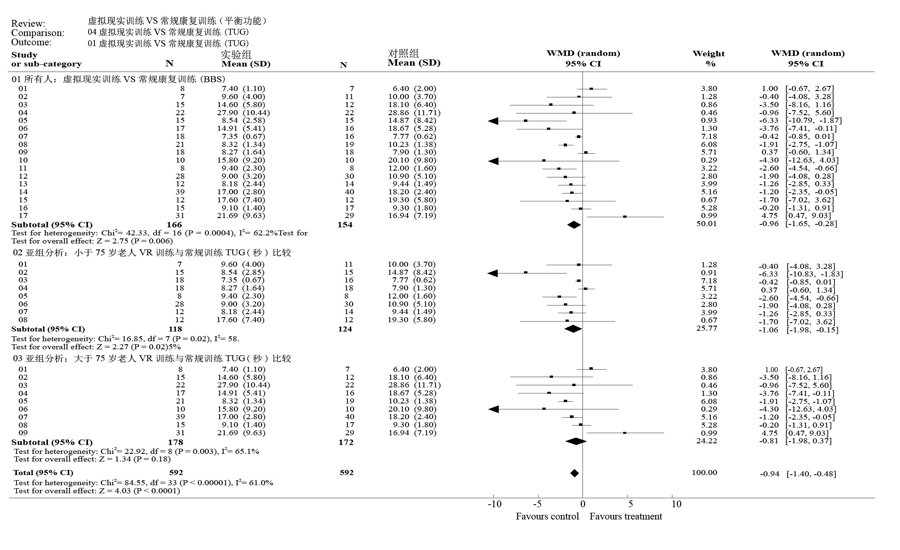
"
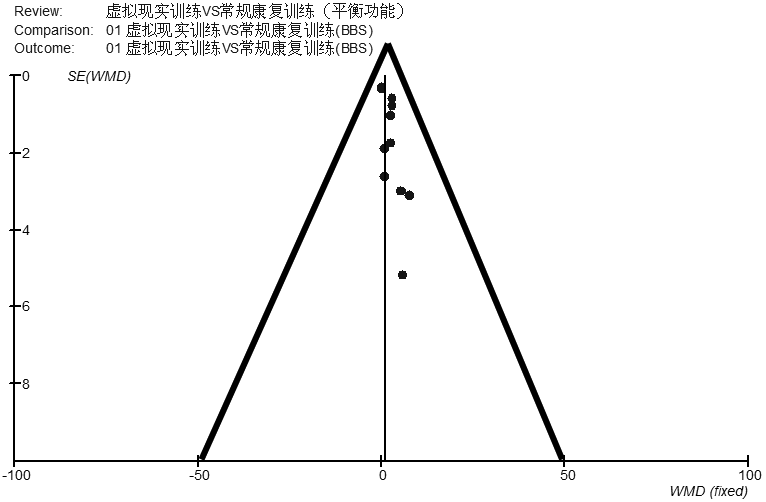
"

| [1] | 刘元标, 励建安. 老年人跌倒与平衡及步态异常[J]. 中国康复理论与实践, 2012, 18(1):5-8. |
| [2] | 王秀阳, 王伟, 许莉敏, 等. 老年人身体平衡能力的影响因素及改善方法[J]. 中国康复医学杂志, 2015, 30(6):631-634. |
| [3] |
Delbroek T, Vermeylen W, Spildooren J. The effect of cognitive-motor dual task training with the biorescue force platform on cognition, balance and dual task performance in institutionalized older adults: a randomized controlled trial[J]. J Phys Ther Sci, 2017, 29(7):1137-1143.
doi: 10.1589/jpts.29.1137 pmid: 28744033 |
| [4] | 梁明, 窦祖林, 王清辉, 等. 虚拟现实技术对不同类型脑卒中患者偏瘫上肢功能的影响[J]. 中华物理医学与康复杂志, 2014, 36(8):592-595. |
| [5] |
Daniel K. Wii-hab for pre-frail older adults[J]. Rehabil Nurs, 2012, 37(4):195-201.
doi: 10.1002/rnj.25 |
| [6] |
Yeşilyaprak S S, Yıldırım M Ş, Tomruk M, et al. Comparison of the effects of virtual reality-based balance exercises and conventional exercises on balance and fall risk in older adults living in nursing homes in Turkey[J]. Physiother Theory Pract, 2016, 32(3):191-201.
doi: 10.3109/09593985.2015.1138009 |
| [7] | Hagedorn D K, Holm E. Effects of traditional physical training and visual computer feedback training in frail elderly patients. A randomized intervention study[J]. Eur J Phys Rehabil Med, 2010, 46(2):159-168. |
| [8] |
Williams M A, Soiza R L, Jenkinson A M, et al. Exercising with Computers in Later Life (EXCELL) - pilot and feasibility study of the acceptability of the Nintendo® WiiFit in community-dwelling fallers[J]. BMC Res Notes, 2010, 13(3):238.
doi: 10.1186/s13104-020-05062-w |
| [9] |
Laver K, George S, Ratcliffe J, et al. Use of an interactive video gaming program compared with conventional physiotherapy for hospitalised older adults: a feasibility trial[J]. Disabil Rehabil, 2012, 34(21):1802-1808.
doi: 10.3109/09638288.2012.662570 pmid: 22409245 |
| [10] |
Lai C H, Peng C W, Chen Y L, et al. Effects of interactive video-game based system exercise on the balance of the elderly[J]. Gait Posture, 2013, 37(4):511-515.
doi: 10.1016/j.gaitpost.2012.09.003 |
| [11] | Schwenk M, Grewal G S, Honarvar B, et al. Interactive balance training integrating sensor-based visual feedback of movement performance: a pilot study in older adults[J]. J Neuroeng Rehabil, 2014, 13(11):164. |
| [12] |
Ku J, Kim Y J, Cho S, et al. Three-dimensional augmented reality system for balance and mobility rehabilitation in the elderly: a randomized controlled trial[J]. Cyberpsychol Behav Soc Netw, 2019, 22(2):132-141.
doi: 10.1089/cyber.2018.0261 |
| [13] | Lee Y, Choi W, Lee K, et al. Virtual reality training with three-dimensional video games improves postural balance and lower extremity strength in community-dwelling older adults[J]. J Aging Phys Act, 2017, 25(4):621-627. |
| [14] |
Singh D K, Rajaratnam B S, Palaniswamy V, et al. Effects of balance-focused interactive games compared to therapeutic balance classes for older women[J]. Climacteric, 2013, 16(1):141-146.
doi: 10.3109/13697137.2012.664832 pmid: 22640573 |
| [15] |
Franco J R, Jacobs K, Inzerillo C, et al. The effect of the Nintendo Wii Fit and exercise in improving balance and quality of life in community dwelling elders[J]. Technol Health Care, 2012, 20(2):95-115.
doi: 10.3233/THC-2011-0661 |
| [16] |
Jung D I, Ko D S, Jeong M A. Kinematic effect of Nintendo Wii (TM) sports program exercise on obstacle gait in elderly women with falling risk[J]. J Phys Ther Sci, 2015, 27(5):1397-1400.
doi: 10.1589/jpts.27.1397 |
| [17] |
Jorgensen M G, Laessoe U, Hendriksen C, et al. Efficacy of Nintendo Wii training on mechanical leg muscle function and postural balance in community-dwelling older adults: a randomized controlled trial[J]. J Gerontol A Biol Sci Med Sci, 2013, 68(7):845-852.
doi: 10.1093/gerona/gls222 pmid: 23114461 |
| [18] |
Pluchino A, Lee S Y, Asfour S, et al. Pilot study comparing changes in postural control after training using a video game balance board program and 2 standard activity-based balance intervention programs[J]. Arch Phys Med Rehabil, 2012, 93(7):1138-1146.
doi: 10.1016/j.apmr.2012.01.023 |
| [19] | Tsang W W, Fu A S. Virtual reality exercise to improve balance control in older adults at risk of falling[J]. Hong Kong Med J, 2016, 22(2):19-22. |
| [20] |
Park E C, Kim S G, Lee C W. The effects of virtual reality game exercise on balance and gait of the elderly[J]. J Phys Ther Sci, 2015, 27(4):1157-1159.
doi: 10.1589/jpts.27.1157 |
| [21] |
Schoene D, Lord S R, Delbaere K, et al. A randomized controlled pilot study of home-based step training in older people using videogame technology[J]. PLoS One, 2013, 8(3):e57734.
doi: 10.1371/journal.pone.0057734 |
| [22] |
Merriman N A, Whyatt C, Setti A, et al. Successful balance training is associated with improved multisensory function in fall-prone older adults[J]. Computers Human Behav, 2015, 45:192-203.
doi: 10.1016/j.chb.2014.12.017 |
| [23] |
Hsieh C C, Lin P S, Hsu W C, et al. The effectiveness of a virtual reality-based Tai Chi exercise on cognitive and physical function in older adults with cognitive impairment[J]. Dement Geriatr Cogn Disord, 2018; 46(5-6):358-370.
doi: 10.1159/000494659 |
| [24] | Higgins J P T, Green S. Cochrane Handbook for Systematic Reviews of Interventions Version5.1 [EB/OL]. ( 2011- 04- 10) [2015- 07- 05]. http://www.cochrane handbook.org. |
| [25] |
Jadad A R, Moore R A, Carroll D, et al. Assessing the quality of reports of randomized clinical trials: is blinding necessary?[J]. Control Clin Trials, 1996, 17(1):1-12.
pmid: 8721797 |
| [26] | 梁明, 窦祖林, 邱雅贤. 虚拟现实技术在脑损伤后运动障碍康复中的应用[J]. 中华脑科疾病与康复杂志(电子版), 2012, 2(4):33-38. |
| [27] | 梁明, 窦祖林, 王清辉, 等. 虚拟现实技术对脑卒中偏瘫患者上肢功能康复疗效的Meta分析[J]. 中国康复医学杂志, 2013, 28(12):1146-1150. |
| [1] | QIAN Liguo, WU Tongxuan, ZHANG Qiaoyun, XING Jian, YANG Yanyan. Design and application effect of continuing education case library combined with case-based learning for rehabilitation therapists [J]. Chinese Journal of Rehabilitation Theory and Practice, 2026, 32(3): 249-257. |
| [2] | AN Le, QIN Xiaoxia, GU Bin, HU Guobing, TIAN Weiyi. A competency model for "dual-qualified" teachers in vocational undergraduate rehabilitation therapy programs based on the integration of rehabilitation competency framework and multi-source standards [J]. Chinese Journal of Rehabilitation Theory and Practice, 2026, 32(3): 258-269. |
| [3] | LIU Hua, WANG Liyuan, MA Xin, LI Jing, WANG Li. OBE-CDIO model of teaching for curriculum of exercise rehabilitation training [J]. Chinese Journal of Rehabilitation Theory and Practice, 2026, 32(3): 270-275. |
| [4] | LIU Xia, ZHANG Yuanmin, GE Shuhui, LIU Jinmei, SUN Chenming, WANG Yuanhui, LIU Jing, LI Wenfu. Cultivation mode of rehabilitation therapy talents in local colleges and universities under the background of New Medicine [J]. Chinese Journal of Rehabilitation Theory and Practice, 2026, 32(3): 276-285. |
| [5] | ZHU Lili, ZHAO Jiaxin, CHENG Xue, WANG Huijuan, CHEN Xiaoxia. Experiences and needs of stroke patients during rehabilitation: a qualitative meta-synthesis [J]. Chinese Journal of Rehabilitation Theory and Practice, 2026, 32(3): 286-293. |
| [6] | LIU Ping, ZHOU Nan, XUE Xiaojie, SHAO Weibo. Application of rehabilitation therapy techniques for post-stroke dysphagia: a bibliometric analysis [J]. Chinese Journal of Rehabilitation Theory and Practice, 2026, 32(3): 294-303. |
| [7] | PU Xinyu, WANG Jingxuan, WANG Hujun, XIU Anda, WANG Yingpeng. Application of repetitive peripheral magnetic stimulation in rehabilitation therapy: a bibliometric analysis [J]. Chinese Journal of Rehabilitation Theory and Practice, 2026, 32(3): 304-316. |
| [8] | ZHANG Wenjing, LI Hao, YUAN Jiajia, HU Huaining. Effect of tele-supervised home-based pulmonary music therapy on chronic obstructive pulmonary disease [J]. Chinese Journal of Rehabilitation Theory and Practice, 2026, 32(3): 337-344. |
| [9] | LIANG Guanjun, XU Huanlan, ZHANG Hewei, ZHANG Dali, GU Qin, LI Mingdi. Changes in balance and lower limb biomechanics of spastic hemiplegia under different visual deprivation and task conditions [J]. Chinese Journal of Rehabilitation Theory and Practice, 2026, 32(3): 345-355. |
| [10] | WU Shicai. Theoretical construction and practical exploration of rehabilitation ethics management [J]. Chinese Journal of Rehabilitation Theory and Practice, 2026, 32(2): 125-131. |
| [11] | HE Zhaonan, ZHANG Tingting, HE Zhaoke, MENG Lijun. Topic mining and content analysis of rehabilitation ethics research in China based on BERTopic model [J]. Chinese Journal of Rehabilitation Theory and Practice, 2026, 32(2): 132-141. |
| [12] | MENG Lijun. Challenges and reflections on ethical review of rehabilitation research for children with disabilities [J]. Chinese Journal of Rehabilitation Theory and Practice, 2026, 32(2): 142-150. |
| [13] | LI Shuiyan, LI Xiang, LI Yanhui, LU Yimeng, LI Dujuan, YANG Xiaoliang, XIE Qiuyou. Application of airway clearance techniques in critical care rehabilitation: a bibliometric analysis [J]. Chinese Journal of Rehabilitation Theory and Practice, 2026, 32(2): 162-173. |
| [14] | ZHANG Liyin. Depression in Parkinson's disease and its association with cognition, balance and quality of life [J]. Chinese Journal of Rehabilitation Theory and Practice, 2026, 32(2): 174-180. |
| [15] | XIA Yan, XU Siwei, ZHU Yanyan, WANG Fengli, LIANG Sijie, LI Jingye, MEI Guangyan, XIANG Jie. Effect of personalized home-based rehabilitation under digital health model on Parkinson's disease [J]. Chinese Journal of Rehabilitation Theory and Practice, 2026, 32(2): 181-190. |
| Viewed | ||||||
|
Full text |
|
|||||
|
Abstract |
|
|||||
|
||
