



《Chinese Journal of Rehabilitation Theory and Practice》 ›› 2023, Vol. 29 ›› Issue (8): 903-909.doi: 10.3969/j.issn.1006-9771.2023.08.006
Previous Articles Next Articles
JIANG Changhao1, HUANG Chen2, GAO Xiaoyan2, DAI Yuanfu2, ZHAO Guoming3( )
)
Received:2023-08-15
Published:2023-08-25
Online:2023-10-09
Contact:
ZHAO Guoming
E-mail:zhgm32@163.com
Supported by:CLC Number:
JIANG Changhao, HUANG Chen, GAO Xiaoyan, DAI Yuanfu, ZHAO Guoming. Effect of neurofeedback training on cognitive function in the elderly: a systematic review[J]. 《Chinese Journal of Rehabilitation Theory and Practice》, 2023, 29(8): 903-909.
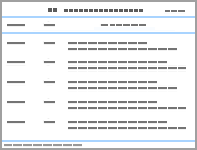
"
| 人群(Population) | 干预 (Intervention) | 比较 (Comparison) | 结局 (Outcome) | ||
|---|---|---|---|---|---|
| 健康状况 | ICD-11编码 | ICF编码 | |||
| 健康人 MCI患者 年龄≥ 60岁 | 6E0Z神经认知障碍 | 主要功能障碍 b身体功能 b1精神功能 b117智力功能 b140注意力功能 b144记忆功能 b152情感功能 b160思维功能 b164高水平认知功能 b172计算功能 | 干预所选取的脑电波 β波 θ波 α波 β/α波 SMR波 干预方案 神经反馈训练单次持续时间 神经反馈训练频率 | 1.神经反馈干预前后比较 2.神经反馈干预组与对照组比较 3.神经反馈干预方式比较 | b140注意功能 b144记忆功能 b164执行功能 |

"

"
| 纳入文献 | 国家 | 样本特征 | 神经反馈波形 | 持续时间 | 干预频率 | 对照组 | 比较 | 测试任务 | 结局指标 |
|---|---|---|---|---|---|---|---|---|---|
| Alatorre-Cruz等[ | 墨西哥 | MCI,n = 18,平均(68.60±5.95)岁 | 下调θ波 | 30 min | 12周,共30次干预 | 虚假神经反馈干预 | 1.干预前后比较:干预后随访阶段执行功能得分显著高于干预前 2.干预组与对照组比较:干预组智力得分增长显著高于对照组 | WAIS-Ⅲ NEUROPSI test | 1.WAIS-Ⅲ中IQ得分显著提高; 2.执行功能显著改善 |
| Becerra等[ | 墨西哥 | MCI,n = 14,平均(65.8±2.4)岁 | 下调θ波 | 30 min | 12周,共31次干预 | 虚假神经反馈干预 | 1.干预前后比较:干预后WAIS-Ⅲ中言语理解指数、言语智商得分显著提高,NEUROPSI test中记忆功能得分、总分显著提高 2.干预组与对照组比较:干预组全量表智商、言语理解指数得分增加显著高于对照组 | WAIS-Ⅲ NEUROPSI test | 1.WAIS-Ⅲ中言语理解指数、言语智商显著改善; 2.记忆功能显著改善 |
| Bielas等[ | 波兰 | 健康人,n = 15,平均(72±7.02)岁 | 上调β波 | 20 min | 2周,共20次干预 | 未接受干预 | 1.Stroop任务干预前后比较:干预后不一致条件下反应时显著降低,对照组前后测无显著差异 2.Simon任务干预前后比较:干预组不一致条件下反应时显著降低 | Stroop任务 Simon任务 | 注意、抑制控制、执行功能显著改善 |
| Campos da Paz等[ | 巴西 | 健康人,n = 17,平均(69.05±2.1)岁 | 控制SMR波 | 20 min | 5周,共10次干预 | 虚假神经反馈干预/未接受干预 | 1.干预前后比较:干预后任务平均正确率显著提高,对照组前后测无显著性差异 2.干预组与对照组比较:干预组后测平均正确率显著高于对照组 | DMTS | 工作记忆显著改善 |
| Gomez-Pilar等[ | 西班牙 | 健康人,n = 63,平均(68.0±5.6)岁 | 控制SMR波 | 30 min | 5周,共5次干预 | 未接受干预 | 1.干预前后比较:干预后视觉感知、空间定向、接受性言语、表达性言语、即时记忆、逻辑记忆、主题绘画、概念活动得分显著提高 2.干预组与对照组比较:干预组视觉感知、即时记忆、概念活动得分增加显著高于对照组 | Luria-AND test | 视觉空间、口头语言、记忆、智力显著改善 |
| Jirayucharoensak等[ | 泰国 | MCI,n = 119,平均(71.7±6.5)岁 | 上调β/α波 | 20 min | 12周,共20次干预 | 维持原治疗 | 1.干预前后比较:干预后延迟匹配任务、快速视觉信息处理得分显著提高 2.干预组与对照组比较:干预组快速视觉信息处理能力、空间工作记忆策略得分显著高于对照组 | CANTAB | 工作记忆显著改善、注意力显著改善 |
| Lavy等[ | 以色列 | MCI,n = 30,平均(70.23±6.65)岁 | 上调α波 | 30 min | 8周,共10次干预 | 虚假神经反馈干预 | 1.干预前后比较:干预后综合记忆得分显著提高,对照组无显著变化 | NeuroTraxTM计算机认知评估测验 | 记忆功能改善 |
| Marcos-Martínez等[ | 西班牙 | 健康人,n = 11,平均69.36岁 | 上调SMR波 | 90 min | 5周,共5次干预 | 未接受干预 | 1.干预前后比较:干预后主题绘画、概念活动、接受性言语得分显著提高 | Luria-AND test | 口头言语、智力显著改善 |
| Israsena等[ | 泰国 | MCI,n = 65,平均(69.48±6.15)岁 | 上调α波 | 30 min | 10周,共20次干预 | 虚假神经反馈干预 | 1.干预前后比较:干预后视觉记忆、注意力、空间工作记忆得分显著提高 | CANTAB | 记忆、注意功能显著改善 |
| Reis等[ | 美国 | 健康人,n = 30,平均(65.97±6.63)岁 | 上调α波 | 30 min | 1周,共8次干预 | 虚假神经反馈干预/认知训练干预 | 1.干预前后比较:神经反馈训练组矩阵旋转结果精度显著提高 | DST MRT Stroop test TMT | 空间记忆、注意力显著改善 |
| Staufenbiel等[ | 荷兰 | 健康人,n = 20,平均(69.2±1.87)岁 | 上调β波 | 30 min | 3周,共8次干预 | 上调γ波 | 1.干预前后比较:上调β组被试记忆测验得分显著提高,上调γ组被试无显著变化 2.不同干预方式比较:上调β波组被试训练后Raven's SPM得分显著高于上调γ组 | Raven's SPM Memory任务 | 非言语智力、记忆显著改善 |
| Lee等[ | 新加坡 | 健康人,n = 31,平均(65.1±2.9)岁 | 个性化调控 | 30 min | 8周,共24次干预 | 虚假神经反馈干预 | 1.干预前后比较:干预后空间构造、注意、延迟记忆、总分显著提高 | RBANS | 注意、记忆显著改善 |
| Lee等[ | 新加坡 | 健康人,n = 39,平均(65.2±2.8)岁 | 个性化调控 | 30 min | 8周,共24次干预 | 未接受干预 | 1.干预前后比较:干预后延迟记忆得分显著增加、延迟记忆和注意得分中位数显著提高 | RBANS | 记忆、注意功能显著改善 |
| Eijk等[ | 荷兰 | 健康人,n = 16,平均(77.9±7.8)岁 | 下调β波 | 21 min | 9周,共10次干预 | 未接受干预 | 1.干预前后比较:干预后听觉语言学习测试即时回忆得分显著提高,对照组无显著变化 | RAVLT | 工作记忆能力显著改善 |
| Wang等[ | 中国 | 健康人,n = 32,平均(65±3.3)岁 | 上调θ波 | 30 min | 4周,共12次干预 | 虚假神经反馈干预 | 1.干预前后比较:干预后ANT得分显著提高;斯滕伯格识别任务得分显著提高 | ANT 斯滕伯格识别任务 | 注意、抑制控制能力显著改善 |
"
| 纳入文献 | 资格标准 | 随机分配 | 分配隐藏 | 基线均衡 | 被试施盲 | 治疗师施盲 | 评估者施盲 | 被试退出率≤ 15% | 意向性分析 | 组间进行统计分析 | 点估计和变异性测量 | 总分 |
|---|---|---|---|---|---|---|---|---|---|---|---|---|
| Alatorre-Cruz等[ | √ | √ | √ | √ | √ | √ | √ | √ | √ | √ | 9 | |
| Becerra等[ | √ | √ | √ | √ | √ | √ | √ | √ | 7 | |||
| Bielas等[ | √ | √ | √ | √ | √ | √ | √ | √ | 7 | |||
| Campos da Paz等[ | √ | √ | √ | √ | √ | √ | √ | 6 | ||||
| Gomez-Pilar 等[ | √ | √ | √ | √ | √ | √ | √ | √ | √ | 8 | ||
| Jirayucharoensak等[ | √ | √ | √ | √ | √ | √ | √ | 6 | ||||
| Lavy等[ | √ | √ | √ | √ | √ | √ | √ | 6 | ||||
| Marcos-Martínez等[ | √ | √ | √ | √ | √ | √ | √ | √ | 7 | |||
| Israsena等[ | √ | √ | √ | √ | √ | √ | √ | √ | √ | 8 | ||
| Reis等[ | √ | √ | √ | √ | √ | √ | √ | √ | 7 | |||
| Staufenbiel等[ | √ | √ | √ | √ | √ | √ | √ | √ | √ | √ | √ | 10 |
| Lee等[ | √ | √ | √ | √ | √ | √ | √ | √ | √ | 8 | ||
| Lee等[ | √ | √ | √ | √ | √ | √ | √ | √ | √ | 8 | ||
| Eijk等[ | √ | √ | √ | √ | √ | √ | √ | 6 | ||||
| Wang等[ | √ | √ | √ | √ | √ | √ | √ | 6 |
| [1] |
FABIANI M. It was the best of times, it was the worst of times: a psychophysiologist's view of cognitive aging[J]. Psychophysiology, 2012, 49(3): 283-304.
doi: 10.1111/j.1469-8986.2011.01331.x pmid: 22220910 |
| [2] |
SITARAM R, ROS T, STOECKEL L, et al. Closed-loop brain training: the science of neurofeedback[J]. Nat Rev Neurosci, 2017, 18(2): 86-100.
doi: 10.1038/nrn.2016.164 pmid: 28003656 |
| [3] |
ANGELAKIS E, STATHOPOULOU S, FRYMIARE J L, et al. EEG neurofeedback: a brief overview and an example of peak alpha frequency training for cognitive enhancement in the elderly[J]. Clin Neuropsychol, 2007, 21(1): 110-129.
doi: 10.1080/13854040600744839 pmid: 17366280 |
| [4] | World Heath Oranization. International Classification of Diseases 11th Revision [EB/OL]. (2019-10-17)[2021-6-16]. https://int/browse11/1-m/en. |
| [5] | 世界卫生组织. 国际功能、 残疾和健康分类(国际中文增补版)[M]. 邱卓英,译. 日内瓦: 世界卫生组织, 2015. |
| World Health Orgnization.International Classification of Functioning, Disability and Health (Chinese Version)[M]. QIU Z Y, trans trans. Geneva: World Health Orgnization, 2015. | |
| [6] |
CASHIN A G, MCAULEY J H. Clinimetrics: Physiotherapy Evidence Database (PEDro) Scale[J]. J Physiother, 2020, 66 (1): 59.
doi: S1836-9553(19)30092-X pmid: 31521549 |
| [7] | ALATORRE-CRUZ G C, FERNÁNDEZ T, CASTRO-CHAVIRA S A, et al. One-year follow-up of healthy older adults with electroencephalographic risk for neurocognitive disorder after neurofeedback training[J]. J Alzheimer Dis, 2022, 85(4): 1767-1781. |
| [8] | BECERRA J, FERNÁNDEZ T, ROCA-STAPPUNG M, et al. Neurofeedback in healthy elderly human subjects with electroencephalographic risk for cognitive disorder[J]. J Alzheimer Dis, 2012, 28(2): 357-367. |
| [9] |
BIELAS J, MICHALCZYK Ł. Beta neurofeedback training improves attentional control in the elderly[J]. Psychol Report, 2021, 124(1): 54-69.
doi: 10.1177/0033294119900348 |
| [10] |
CAMPOS DA PAZ V K, GARCIA A, CAMPOS DA PAZ NETO A, et al. SMR neurofeedback training facilitates working memory performance in healthy older adults: a behavioral and EEG study[J]. Front Behav Neurosci, 2018, 12: 321.
doi: 10.3389/fnbeh.2018.00321 pmid: 30618671 |
| [11] | GOMEZ-PILAR J, CORRALEJO R, NICOLAS-ALONSO L F, et al. Neurofeedback training with a motor imagery-based BCI: neurocognitive improvements and EEG changes in the elderly[J]. Med Biol Engineer Comput, 2016, 54(11): 1655-1666. |
| [12] |
JIRAYUCHAROENSAK S, ISRASENA P, PAN-NGUM S, et al. A game-based neurofeedback training system to enhance cognitive performance in healthy elderly subjects and in patients with amnestic mild cognitive impairment[J]. Clin Interv Aging, 2019, 14: 347-360.
doi: 10.2147/CIA.S189047 pmid: 30863028 |
| [13] |
LAVY Y, DWOLATZKY T, KAPLAN Z, et al. Mild cognitive impairment and neurofeedback: a randomized controlled trial[J]. Front Aging Neurosci, 2021, 13: 657646.
doi: 10.3389/fnagi.2021.657646 |
| [14] |
MARCOS-MARTÍNEZ D, MARTÍNEZ-CAGIGAL V, SANTAMARÍA-VÁZQUEZ E, et al. Neurofeedback training based on motor imagery strategies increases EEG complexity in elderly population[J]. Entropy, 2021, 23(12): 1574.
doi: 10.3390/e23121574 |
| [15] |
ISRASENA P, JIRAYUCHAROENSAK S, HEMRUNGROJN S, et al. Brain exercising games with consumer-grade single-channel electroencephalogram neurofeedback: pre-post intervention study[J]. JMIR Serious Games, 2021, 9(2): e26872.
doi: 10.2196/26872 |
| [16] |
REIS J, PORTUGAL A M, FERNANDES L, et al. An alpha and theta intensive and short neurofeedback protocol for healthy aging working-memory training[J]. Front Aging Neurosci, 2016, 8: 157.
doi: 10.3389/fnagi.2016.00157 pmid: 27458369 |
| [17] |
STAUFENBIEL S M, BROUWER A M, KEIZER A W, et al. Effect of beta and gamma neurofeedback on memory and intelligence in the elderly[J]. Biol Psychol, 2014, 95: 74-85.
doi: 10.1016/j.biopsycho.2013.05.020 pmid: 23751914 |
| [18] | LEE T S, QUEK S Y, GOH S J A, et al. A pilot randomized controlled trial using EEG-based brain-computer interface training for a Chinese-speaking group of healthy elderly[J]. Clin Interv Aging, 2015, 10: 217-227. |
| [19] |
LEE T S, GOH S J A, QUEK S Y, et al. A brain-computer interface based cognitive training system for healthy elderly: a randomized control pilot study for usability and preliminary efficacy[J]. PLoS One, 2013, 8(11): e79419.
doi: 10.1371/journal.pone.0079419 |
| [20] | EIJK L, ZWIJSEN S A, KEESER D, et al. EEG-neurofeedback training and quality of life of institutionalized elderly women: a pilot study[J]. Adv Gerontol, 2017, 30(2): 248-254. |
| [21] |
WANG J R, HSIEH S. Neurofeedback training improves attention and working memory performance[J]. Clin Neurophysiol, 2013, 124(12): 2406-2420.
doi: 10.1016/j.clinph.2013.05.020 |
| [22] |
LAVY Y, DWOLATZKY T, KAPLAN Z, et al. Neurofeedback improves memory and peak alpha frequency in individuals with mild cognitive impairment[J]. Appl Psychophysiol Biofeedback, 2019, 44(1): 41-49.
doi: 10.1007/s10484-018-9418-0 |
| [23] |
MARLATS F, BAO G, CHEVALLIER S, et al. SMR/theta neurofeedback training improves cognitive performance and EEG activity in elderly with mild cognitive impairment: a pilot study[J]. Front Aging Neurosci, 2020, 12: 147.
doi: 10.3389/fnagi.2020.00147 pmid: 32612522 |
| [24] | LI X, ZHANG J, LI X D, et al. Neurofeedback training for brain functional connectivity improvement in mild cognitive impairment[J]. J Med Biol Engineer, 2020, 40: 484-495. |
| [25] |
FOTUHI M, LUBINSKI B, TRULLINGER M, et al. A personalized 12-week "brain fitness program" for improving cognitive function and increasing the volume of hippocampus in elderly with mild cognitive impairment[J]. J Prev Alzheimers Dis, 2016, 3(3): 133-137.
doi: 10.14283/jpad.2016.92 pmid: 29205251 |
| [1] | ZHANG Liyin. Depression in Parkinson's disease and its association with cognition, balance and quality of life [J]. Chinese Journal of Rehabilitation Theory and Practice, 2026, 32(2): 174-180. |
| [2] | WANG Xiaohe, ZHANG Lu, XIAO Shuqin. Development of an intervention program to enhance communication and collaboration in multidisciplinary teams of nurses in stroke rehabilitation wards based on a shared mental model [J]. Chinese Journal of Rehabilitation Theory and Practice, 2026, 32(1): 101-109. |
| [3] | ZHANG Jihui, YI Longyue, YANG Yuanbin. Associated factors of balance dysfunction and its correlation with functional lower limb muscle strength in middle-aged and older adults: an analysis based on CHARLS database [J]. Chinese Journal of Rehabilitation Theory and Practice, 2026, 32(1): 13-22. |
| [4] | SU Benyue, LIU Wenyao, ZONG Wenjie, WANG Baoqian, SHENG Min. Adaptive temporal alignment-based motion intention recognition for intelligent lower-limb prostheses [J]. Chinese Journal of Rehabilitation Theory and Practice, 2025, 31(9): 1101-1115. |
| [5] | YANG Tongnian, REN Jie, XIAO Hui. Effect of physical activity on anxiety for children and adolescents: a systematic review of systematic reviews [J]. Chinese Journal of Rehabilitation Theory and Practice, 2025, 31(8): 883-888. |
| [6] | WANG Xiaofeng, HU Mengqiao, WANG Yan, WEI Kun, XU Wenzhu, REN Dan, MA Ye. Effect of exoskeleton robot-assisted gait training on lower limb function after stroke and spinal cord injury: a systematic review [J]. Chinese Journal of Rehabilitation Theory and Practice, 2025, 31(8): 914-921. |
| [7] | DUAN Linru, ZHENG Jiejiao, ZHENG Yongjun, DING Jianwei. Difference in posture control ability between elderly and young people [J]. Chinese Journal of Rehabilitation Theory and Practice, 2025, 31(7): 846-852. |
| [8] | SHAO Xueyun. Physical activity, functioning and psycho-behavioral health in obese children: policy framework and health behavior intervention model [J]. Chinese Journal of Rehabilitation Theory and Practice, 2025, 31(6): 642-649. |
| [9] | GU Yiqing, CHENG Shupeng, LI Yongqiang, MAO Erli, LI Jian'an. Capping versus non-capping decannulation strategy in adult tracheostomized patients: a systematic review [J]. Chinese Journal of Rehabilitation Theory and Practice, 2025, 31(6): 666-673. |
| [10] | CHEN Junli, ZHANG Han, SHI Zhixue, LIU Ya, ZHAO Yingzhe, DONG Zhiwei, JI Lihong, LI Haiyan, CHEN Fangfang, WANG Chunping, MA Anning, JING Qi. Development of a community toolkit for identifying and managing mild cognitive impairment among older adults [J]. Chinese Journal of Rehabilitation Theory and Practice, 2025, 31(6): 692-702. |
| [11] | WANG Mei, ZHU Wenping. Health benefits of physical activity in patients with type 2 diabetes: a systematic review of systematic reviews [J]. Chinese Journal of Rehabilitation Theory and Practice, 2025, 31(5): 553-560. |
| [12] | YE Lü, CHANG Jing, LING Hairun. Effect of exercise intervention on internet behavioral addictions: a systematic review of systematic reviews [J]. Chinese Journal of Rehabilitation Theory and Practice, 2025, 31(4): 431-440. |
| [13] | ZHU Zhiqiang, XU Qiaoling, SHAO Xueyun. Health benefits of physical activity for obese and overweight children: a systematic review of systematic reviews [J]. Chinese Journal of Rehabilitation Theory and Practice, 2025, 31(3): 296-305. |
| [14] | CAI Qian, ZHANG Xi, SU Hairong, LIU Na, HUANG Ying, LI Jiqiang, XIA Jin'gen, ZHENG Decai. Inspiratory muscle training for weaning outcomes in patients with weaning failure: a systematic review [J]. Chinese Journal of Rehabilitation Theory and Practice, 2025, 31(3): 306-313. |
| [15] | CHEN Yuanyue, ZHU Jun, HU Jingjun, GUO Chuan, ZHU Lan. Intervention and duration of work-related injury rehabilitation, and related factors [J]. Chinese Journal of Rehabilitation Theory and Practice, 2025, 31(3): 348-355. |
| Viewed | ||||||
|
Full text |
|
|||||
|
Abstract |
|
|||||
|
||
