



《Chinese Journal of Rehabilitation Theory and Practice》 ›› 2023, Vol. 29 ›› Issue (12): 1377-1385.doi: 10.3969/j.issn.1006-9771.2023.12.002
Previous Articles Next Articles
ZHANG Yuan, YANG Jian( )
)
Received:2023-11-26
Published:2023-12-25
Online:2023-12-28
Contact:
YANG Jian, E-mail: Supported by:CLC Number:
ZHANG Yuan, YANG Jian. Exercise rehabilitation interventions for people with spinal cord injury and their health benefits: a systematic review of systematic reviews based on ICD-11 and ICF[J]. 《Chinese Journal of Rehabilitation Theory and Practice》, 2023, 29(12): 1377-1385.
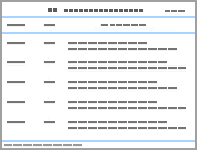
"
| 人群(Population) | 干预 (Intervention) | 比较 (Comparison) | 结局(Outcome) | ||
|---|---|---|---|---|---|
| 健康状况 | ICD-11编码 | 结局指标 | ICF编码 | ||
| 脊髓损伤(完全性、不完全性) 四肢瘫 截瘫(胸部、腰椎和骶骨损伤) 运动神经元损伤(上、下) 年龄> 18岁 | ND51.2 脊髓损伤,水平未特指 MB50 四肢瘫 MB56 截瘫 | 干预类型 被动干预 运动辅助设备,如动力外骨骼辅助机器人、电自行车等 功能性电刺激 主动干预 步进运动 平地训练、户外行走、穿越障碍、爬楼梯和进行日常生活活动 混合干预(主动+被动) 运动与功能性电刺激相结合 运动与运动辅助设备相结合 干预方案 干预频率 干预强度 干预持续时间 干预场所 家庭 社区卫生服务中心 运动场馆 | 干预前后比较 不同干预方式比较 不同干预时间段比较 不同损伤类型比较 不同干预频率比较 | 身体结构与功能 心血管 腿部血流速度 肌肉骨骼 肌肉横截面积 肌纤维平均直径 肌力 肌耐力 柔韧性 肌肉质量 神经系统 痉挛和反射兴奋性 肩部执行功能 运动能力 活动和参与 步态速度 步行距离 活动性和独立性 生活质量 痉挛程度 排便规律 心理状况 药物使用(如巴氯芬) 功能独立性水平 抗感染免疫反应水平 患病风险(血管性痴呆和呼吸系统疾病) | 身体结构 s7702 肌肉 身体功能 b415 血管功能 b730 肌肉力量功能 b740 肌肉耐力功能 b798 其他特指的神经肌肉骨骼和运动有关的功能 b770 步态功能 活动和参与 d450 步行 |

"

"
| 作者 | 国家 | 样本特征 | 损伤类别 | 干预场所 | 干预类型 | 干预方式 | 干预频率 | 干预强度 | 比较 | 健康结局 |
|---|---|---|---|---|---|---|---|---|---|---|
| Louie等[ | 加拿大 | 文献数15 样本量92 (男74,女18) 平均年龄37.5岁 | 完全性脊髓损伤(胸部) 四肢瘫 平均损伤平面T7 | 未提及 | 被动干预 | 外骨骼机器辅助下的步进运动 | 每次60~120 min,每周5次,持续1~72周 | 未提及 | 未提及 | 身体结构与功能 未提及 活动和参与 步速提高 生活质量 未提及 |
| Miller等[ | 美国 | 文献数14 样本量111 (男92,女19) 平均年龄37岁 | 完全性脊髓损伤 损伤平面T1-12 | 家庭 社区卫生服务中心 | 被动干预 | 基于动力外骨骼辅助下的干预,主要包括室内平地训练、户外行走、穿越障碍、爬楼梯和进行日常生活活动 | 每次60~120 min,每周3次,持续1~24周 | 未提及 | 干预前后比较 | 身体结构与功能 未提及 活动和参与 6分钟步行速度和距离改善 生活质量 痉挛程度降低 排便规律改善 |
| Nam等[ | 韩国 | 文献数10 样本量502 平均年龄48岁 | 不完全性脊髓损伤 上运动神经元损伤 下运动神经元损伤 损伤平面T2-8 | 未提及 | 混合干预 | 常规地上步态训练、机器人辅助步态训练 | 每次30~60 min,每周3~5次,持续4~12周 | 未提及 | 不同干预方式比较 干预前后比较 | 身体结构与功能 腿部力量增强 活动和参与 步速改善 步行距离增加 生活质量 活动性和独立性功能水平提高 |
| Oliveira等[ | 巴西 | 文献数10 样本量153 (男128,女25) 平均年龄30.3岁 | 截瘫 脊髓损伤 四肢瘫 损伤平面不详 | 家庭 | 混合干预 | 运动与功能性电刺激相结合(4项研究) 在没有功能性电刺激的情况下使用运动辅助设备进行锻炼(5项研究) 不带电的拉伸/强化运动(1项研究) | 每次30~240 min,每周2~3次,持续4~96周 | 未提及 | 未提及 | 身体结构与功能 肌肉横截面积增加 肌纤维平均直径增加 力输出增加 肩部执行功能改善 活动和参与 未提及 生活质量 心理状况与整体疲劳显著改善 |
| Figoni等[ | 美国 | 文献数75 样本量742(男426,女316) 年龄18~65岁 | 截瘫 四肢瘫 损伤平面不详 | 家庭 社区卫生服务中心 运动场馆 | 混合干预 | 自主手臂运动 瘫痪肌肉FES-LCE 混合运动(与FES-LCE相结合的自主手臂运动) | 每次45~60 min,每周3~6次,持续2~116周 | 未提及 | 未提及 | 身体结构与功能 肌力、耐力、柔韧性改善 肌肉质量增加 脂肪质量减少 活动和参与 运动能力显著提高 生活质量 股四头肌痉挛和巴氯芬使用减少 功能独立性水平提高 |
| Quel de Oliveira等[ | 澳大利亚 | 文献数19 样本量639 平均年龄48.3岁 | 上部运动神经元损伤 不完全性脊髓损伤 四肢瘫 截瘫 损伤程度:C~D级 | 家庭 社区卫生服务中心 运动场馆 | 混合干预 | 基于人工智能的活动训练 基于功能性电刺激的步态训练 主动辅助下肢锻炼、全身阻力训练、负重活动等 | 每次30~180 min,每周3~5次,持续4.5~456周 | 未提及 | 不同干预方式的比较 | 身体结构与功能 上肢功能改善 活动和参与 未提及 生活质量 独立性和功能能力提高 |
| Neefkes-Zonneveld等[ | 荷兰 | 文献数11 样本量328 (男313,女15) 平均年龄27岁 | 截瘫 四肢瘫 损伤平面不详 | 家庭 社区卫生服务中心 | 混合干预 | 有氧运动、强化运动、功能性电刺激 | 每次10~60 min,每周2~7次,持续6~10周 | 低~剧烈 | 干预前后比较; 不同干预时间段比较; 不同损伤类型比较 | 身体结构与功能 未提及 活动和参与 未提及 生活质量 白细胞介素-6水平提高,抗感染免疫反应水平提高 降低血管性痴呆和呼吸系统疾病的患病风险 |
| Phadke等[ | 加拿大 | 文献数11 样本量179 平均年龄未提及 | 完全性脊髓损伤 损伤平面不详 | 未提及 | 被动干预 | 被动腿部自行车运动 | 每次20~90 min,每周2~18次,持续6~12周 | 低~中等 | 干预前后比较 不同干预频率比较 | 身体结构与功能 腿部血流速度改善 关节活动范围和肌肉肥大标志物改善 痉挛和反射兴奋性改善 活动和参与 未提及 生活质量 未提及 |
| [1] | World Health Organization. International perspectives on spinal cord injury[EB/OL]. (2023-11-11) [2023-11-16]. https://www.who.int/publications/i/item/international-perspectives-on-spinal-cord-injury. |
| [2] |
DUAN R, QU M, YUAN Y, et al. Clinical benefit of rehabilitation training in spinal cord injury: a systematic review and meta-analysis[J]. Spine (Phila Pa 1976), 2021, 46(6): E398-E410.
doi: 10.1097/BRS.0000000000003789 |
| [3] |
PATATHONG T, KLAEWKASIKUM K, WORATANARAT P, et al. The efficacy of gait rehabilitations for the treatment of incomplete spinal cord injury: a systematic review and network meta-analysis[J]. J Orthop Surg Res, 2023, 18(1): 60.
doi: 10.1186/s13018-022-03459-w pmid: 36683024 |
| [4] |
NOOIJEN C F, VAN DEN BRAND I L, TER HORST P, et al. Feasibility of handcycle training during inpatient rehabilitation in persons with spinal cord injury[J]. Arch Phys Med Rehabil, 2015, 96(9): 1654-1657.
doi: 10.1016/j.apmr.2015.05.014 |
| [5] |
YANG A, ASSELIN P, KNEZEVIC S, et al. Assessment of in-hospital walking velocity and level of assistance in a powered exoskeleton in persons with spinal cord injury[J]. Top Spinal Cord Inj Rehabil, 2015, 21(2): 100-109.
doi: 10.1310/sci2102-100 pmid: 26364279 |
| [6] |
LAJEUNESSE V, VINCENT C, ROUTHIER F, et al. Exoskeletons' design and usefulness evidence according to a systematic review of lower limb exoskeletons used for functional mobility by people with spinal cord injury[J]. Disabil Rehabil Assist Technol, 2016, 11(7): 535-547.
doi: 10.3109/17483107.2015.1080766 pmid: 26340538 |
| [7] |
BAKKUM A J, DE GROOT S, STOLWIJK-SWÜSTE J M, et al. Effects of hybrid cycling versus handcycling on wheelchair-specific fitness and physical activity in people with long-term spinal cord injury: a 16-week randomized controlled trial[J]. Spinal Cord, 2015, 53(5): 395-401.
doi: 10.1038/sc.2014.237 pmid: 25622729 |
| [8] |
邹敏, 孙宏伟, 邱卓英, 等. 基于ICD-11和ICF的智力残疾术语、诊断和分类研究[J]. 中国康复理论与实践, 2019, 25(1): 1-5.
doi: 10.3969/j.issn.1006-9771.2019.01.001 |
| ZOU M, SUN H W, QIU Z Y, et al. Terminology, diagnosis and classification of intellectual disability using WHO ICD-11 and ICF[J]. Chin J Rehabil Theory Pract, 2019, 25(1): 1-5 | |
| [9] |
郭彤彤, 杨剑, 吴铭, 等. 成年运动功能障碍者电子游戏干预的Scoping综述[J]. 中国康复理论与实践, 2022, 28(9): 1012-1021.
doi: 10.3969/j.issn.1006-9771.2022.09.003 |
| GUO T T, YANG J, WU M, et al. Effect of video games intervention on adults motor functioning: a scoping review[J]. Chin J Rehabil Theory Pract, 2022, 28(9): 1012-1021. | |
| [10] | 世界卫生组织. 国际功能、残疾和健康分类(国际中文增补版)[M]. 邱卓英,译. 日内瓦: 世界卫生组织, 2015. |
| World Health Organization. International Classification of Functioning, Disability and Health-International Chinese Supplement[M]. QIU Z Y, trans trans. Geneva: World Health Organization, 2015. | |
| [11] |
杨同念, 肖辉. 残疾儿童青少年身体活动及其健康效果:系统综述的系统综述[J]. 中国康复理论与实践, 2022, 28(11): 1299-1308.
doi: 10.3969/j.issn.1006-9771.2022.11.009 |
| YANG T N, XIAO H. Physical activity and its health benefits for children and adolescents with disabilities: a systematic review of systematic reviews[J]. Chin J Rehabil Theory Pract, 2022, 28(11): 1299-1308. | |
| [12] |
LOUIE D R, ENG J J, LAM T. Gait speed using powered robotic exoskeletons after spinal cord injury: a systematic review and correlational study[J]. J Neuroeng Rehabil, 2015, 12(3): 82.
doi: 10.1186/s12984-015-0074-9 |
| [13] | MILLER L E, ZIMMERMANN A K, HERBERT W G. Clinical effectiveness and safety of powered exoskeleton-assisted walking in patients with spinal cord injury: systematic review with meta-analysis[J]. Med Devices (Auckl), 2016, 9(2): 455-466. |
| [14] |
NAM K Y, KIM H J, KWON B S, et al. Robot-assisted gait training (Lokomat) improves walking function and activity in people with spinal cord injury: a systematic review[J]. J Neuroeng Rehabil, 2017, 14(1): 24.
doi: 10.1186/s12984-017-0232-3 pmid: 28330471 |
| [15] | OLIVEIRA J I, OLIVEIRA L, COSTA M, et al. Impacts of home-based physical exercises on the health of people with spinal cord injury: a systematic review[J]. Revista Brasileira de Atividade Física & Saúde, 2021, 26(5): 505-516. |
| [16] |
FIGONI S F, DOLBOW D R, CRAWFORD E C, et al. Does aerobic exercise benefit persons with tetraplegia from spinal cord injury? A systematic review[J]. J Spinal Cord Med, 2021, 44(5): 690-703.
doi: 10.1080/10790268.2020.1722935 |
| [17] | QUEL DE OLIVEIRA C, REFSHAUGE K, MIDDLETON J, et al. Effects of activity-based therapy interventions on mobility, independence, and quality of life for people with spinal cord injuries: a systematic review and meta-analysis[J]. J Neurotrauma, 2017, 34(9): 172617-172643. |
| [18] |
NEEFKES-ZONNEVELD C R, BAKKUM A J, BISHOP N C, et al. Effect of long-term physical activity and acute exercise on markers of systemic inflammation in persons with chronic spinal cord injury: a systematic review[J]. Arch Phys Med Rehabil, 2015, 96(1): 30-42.
doi: 10.1016/j.apmr.2014.07.006 |
| [19] |
PHADKE C P, VIERIRA L, MATHUR S, et al. Impact of passive leg cycling in persons with spinal cord injury: a systematic review[J]. Top Spinal Cord Inj Rehabil, 2019, 25(1): 83-96.
doi: 10.1310/sci18-00020 pmid: 30774292 |
| [20] |
BARBOSA P, GLINSKY J V, FACHIN-MARTINS E, et al. Physiotherapy interventions for the treatment of spasticity in people with spinal cord injury: a systematic review[J]. Spinal Cord, 2021, 59(3): 236-247.
doi: 10.1038/s41393-020-00610-4 pmid: 33564117 |
| [21] |
AGUIRRE-GÜEMEZ A V, PÉREZ-SANPABLO A I, QUINZAÑOS-FRESNEDO J, et al. Walking speed is not the best outcome to evaluate the effect of robotic assisted gait training in people with motor incomplete spinal cord injury: a systematic review with meta-analysis[J]. J Spinal Cord Med, 2019, 42(2): 142-154.
doi: 10.1080/10790268.2017.1390644 |
| [22] |
VAN DER SCHEER J W, DE GROOT S, TEPPER M, et al. Low-intensity wheelchair training in inactive people with long-term spinal cord injury: a randomized controlled trial on fitness, wheelchair skill performance and physical activity levels[J]. J Rehabil Med, 2016, 48(1): 33-42.
doi: 10.2340/16501977-2037 pmid: 26660337 |
| [23] |
ARAZPOUR M, HUTCHINS S W, AHMADI BANI M. The efficacy of powered orthoses on walking in persons with paraplegia[J]. Prosthet Orthot Int, 2015, 39(2): 90-99.
doi: 10.1177/0309364613520031 pmid: 24549210 |
| [24] |
ARAZPOUR M, SAMADIAN M, BAHRAMIZADEH M, et al. The efficiency of orthotic interventions on energy consumption in paraplegic patients: a literature review[J]. Spinal Cord, 2015, 53(3): 168-175.
doi: 10.1038/sc.2014.227 pmid: 25600308 |
| [25] |
KOZLOWSKI A J, BRYCE T N, DIJKERS M P. Time and effort required by persons with spinal cord injury to learn to use a powered exoskeleton for assisted walking[J]. Top Spinal Cord Inj Rehabil, 2015, 21(2): 110-121.
doi: 10.1310/sci2102-110 pmid: 26364280 |
| [26] |
GORGEY A S, LESTER R M, WADE R C, et al. A feasibility pilot using telehealth videoconference monitoring of home-based NMES resistance training in persons with spinal cord injury[J]. Spinal Cord Ser Cases, 2017, 3(1): 17039.
doi: 10.1038/scsandc.2017.39 |
| [27] |
RUPP R, SCHLIESSMAN D, PLEWA H, et al. Safety and efficacy of at-home robotic locomotion therapy in individuals with chronic incomplete spinal cord injury: a prospective, pre-post intervention, proof-of-concept study[J]. PLoS One, 2015, 10(3): e0119167.
doi: 10.1371/journal.pone.0119167 |
| [28] |
TEFERTILLER C, BARTELT P, STOBELAAR M, et al. Improving upper extremity strength, function, and trunk stability using wide-pulse functional electrical stimulation in combination with functional task-specific practice[J]. Top Spinal Cord Inj Rehabil, 2022, 28(2): 139-152.
doi: 10.46292/sci21-00004 pmid: 35521056 |
| [29] |
WIESENER C, SPIEKER L, AXELGAARD J, et al. Supporting front crawl swimming in paraplegics using electrical stimulation: a feasibility study[J]. J Neuroeng Rehabil, 2020, 17(1): 51.
doi: 10.1186/s12984-020-00682-6 pmid: 32299483 |
| [1] | LIU Hua, WANG Liyuan, MA Xin, LI Jing, WANG Li. OBE-CDIO model of teaching for curriculum of exercise rehabilitation training [J]. Chinese Journal of Rehabilitation Theory and Practice, 2026, 32(3): 270-275. |
| [2] | SUN Kui, HUANG Hailun, LIU Yongai, GAO Heng. Brain-computer interface technology in treatment for spinal cord injury: a bibliometric analysis [J]. Chinese Journal of Rehabilitation Theory and Practice, 2026, 32(3): 317-328. |
| [3] | GAO Kaixiang, LU Haitao. Research in neurorehabilitation from 2015 to 2024: a bibliometric analysis [J]. Chinese Journal of Rehabilitation Theory and Practice, 2026, 32(1): 59-68. |
| [4] | YANG Tongnian, REN Jie, XIAO Hui. Effect of physical activity on anxiety for children and adolescents: a systematic review of systematic reviews [J]. Chinese Journal of Rehabilitation Theory and Practice, 2025, 31(8): 883-888. |
| [5] | WANG Xiaofeng, HU Mengqiao, WANG Yan, WEI Kun, XU Wenzhu, REN Dan, MA Ye. Effect of exoskeleton robot-assisted gait training on lower limb function after stroke and spinal cord injury: a systematic review [J]. Chinese Journal of Rehabilitation Theory and Practice, 2025, 31(8): 914-921. |
| [6] | REN Liangxiang, MEI Peipei, MAO Erli, TANG Yifan, WANG Xue, YE Yiqing. Needs of full participation in intestinal management for primary caregivers of patients with neurogenic bowel dysfunction after spinal cord injury: a qualitative study [J]. Chinese Journal of Rehabilitation Theory and Practice, 2025, 31(8): 965-971. |
| [7] | LI Qiaozhen, FENG Feng, DU Xia, SHAO Wen, GAO Mi, HUI Linna, YUAN Hua, SUN Xiaolong. Characteristics of electroencephalography in neuropathic pain after spinal cord injury [J]. Chinese Journal of Rehabilitation Theory and Practice, 2025, 31(7): 830-837. |
| [8] | GU Yiqing, CHENG Shupeng, LI Yongqiang, MAO Erli, LI Jian'an. Capping versus non-capping decannulation strategy in adult tracheostomized patients: a systematic review [J]. Chinese Journal of Rehabilitation Theory and Practice, 2025, 31(6): 666-673. |
| [9] | WANG Mei, ZHU Wenping. Health benefits of physical activity in patients with type 2 diabetes: a systematic review of systematic reviews [J]. Chinese Journal of Rehabilitation Theory and Practice, 2025, 31(5): 553-560. |
| [10] | YE Lü, CHANG Jing, LING Hairun. Effect of exercise intervention on internet behavioral addictions: a systematic review of systematic reviews [J]. Chinese Journal of Rehabilitation Theory and Practice, 2025, 31(4): 431-440. |
| [11] | ZHU Zhiqiang, XU Qiaoling, SHAO Xueyun. Health benefits of physical activity for obese and overweight children: a systematic review of systematic reviews [J]. Chinese Journal of Rehabilitation Theory and Practice, 2025, 31(3): 296-305. |
| [12] | CAI Qian, ZHANG Xi, SU Hairong, LIU Na, HUANG Ying, LI Jiqiang, XIA Jin'gen, ZHENG Decai. Inspiratory muscle training for weaning outcomes in patients with weaning failure: a systematic review [J]. Chinese Journal of Rehabilitation Theory and Practice, 2025, 31(3): 306-313. |
| [13] | XU Xiaohong, ZHONG Xiaoke, SUN Siyi, ZHANG Qi, CHENG Huaichun. Psychological benefits of art therapy for older adults with mild cognitive impairment: a systematic review [J]. Chinese Journal of Rehabilitation Theory and Practice, 2025, 31(2): 165-171. |
| [14] | WANG Weiping, MA Yingchun. Factors affecting home-based exercise rehabilitation for chronic kidney disease patients: a qualitative analysis [J]. Chinese Journal of Rehabilitation Theory and Practice, 2025, 31(2): 235-241. |
| [15] | DUAN Fuwen, ZHANG Beiqi, LI Li. Preventive effect of exercise interventions on sport-related concussion: a systematic review [J]. Chinese Journal of Rehabilitation Theory and Practice, 2025, 31(12): 1385-1397. |
| Viewed | ||||||
|
Full text |
|
|||||
|
Abstract |
|
|||||
|
||
