



Chinese Journal of Rehabilitation Theory and Practice ›› 2026, Vol. 32 ›› Issue (9): 1003-1015.doi: 10.3969/j.issn.1006-9771.2026.09.002
Previous Articles Next Articles
Jiang Yang1, Peng Hao1, Yin Xingxiao1, Li Yanqi1, Song Yanping2, Yao Na2, Shen Zhen2, Chen Qigang2( )
)
Received:2026-02-12
Revised:2026-04-02
Accepted:2026-04-08
Published:2026-09-25
Online:2026-09-20
Contact:
Chen Qigang
E-mail:cqg_cq@163.com
Supported by:CLC Number:
Jiang Yang, Peng Hao, Yin Xingxiao, Li Yanqi, Song Yanping, Yao Na, Shen Zhen, Chen Qigang. Effect of virtual reality-based exergaming on multidimensional outcomes in individuals with cognitive impairment: a three-level meta-analysis based on the ICF framework[J]. Chinese Journal of Rehabilitation Theory and Practice, 2026, 32(9): 1003-1015.
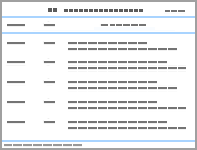
Table 1
PICO framework"
| 人群(Population) | 干预(Intervention) | 比较(Comparison) | 结局(Outcome) |
|---|---|---|---|
| 认知功能障碍人群 (MCI、痴呆或AD) | 对照措施 被动控制:无干预、健康教育、常规护理 主动控制:单一的运动或认知训练、运动-认知训练干预措施 VREG 干预要素 时间、频率、周期 | VREG与被动控制和主动控制比较 受试者个体因素差异与干预要素的调节作用比较 | b身体功能 b110~b139整体认知功能 b140注意力功能 b144记忆功能 b164高水平认知功能(执行功能) b152情感功能(抑郁) b455运动耐受功能(综合体适能) b730肌肉力量功能 b755不随意运动反应功能(平衡功能) s身体结构 d活动和参与 d450~d469步行和移动(跌倒风险) d450步行 d9社区、社会和公民(生活质量) |
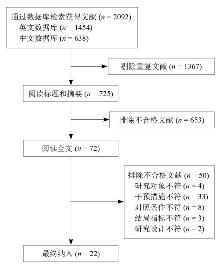
Figure 1
Flowchart of literature screening"
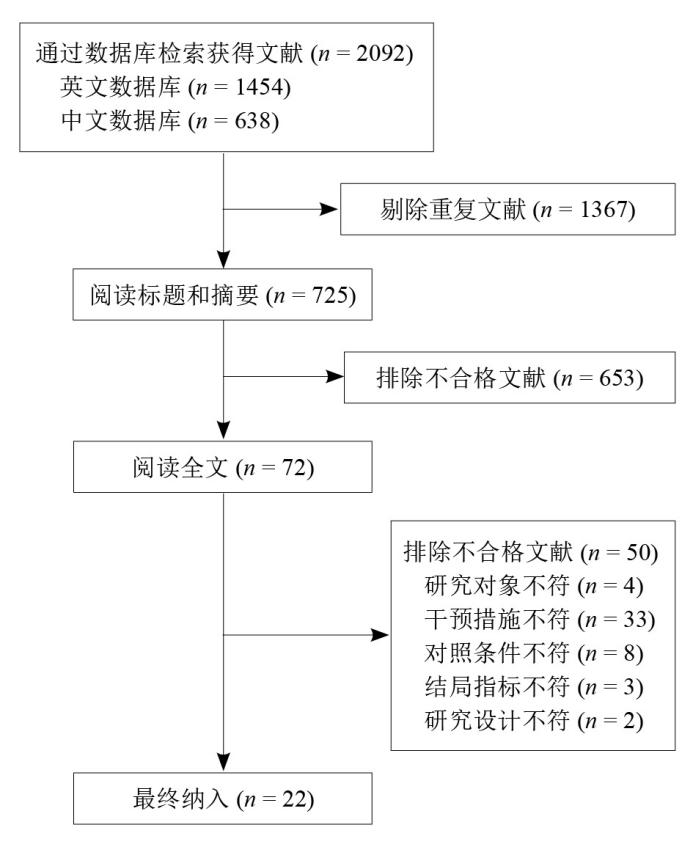
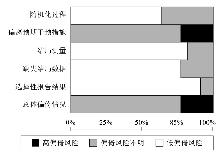
Figure 2
Risk ratio of bias"
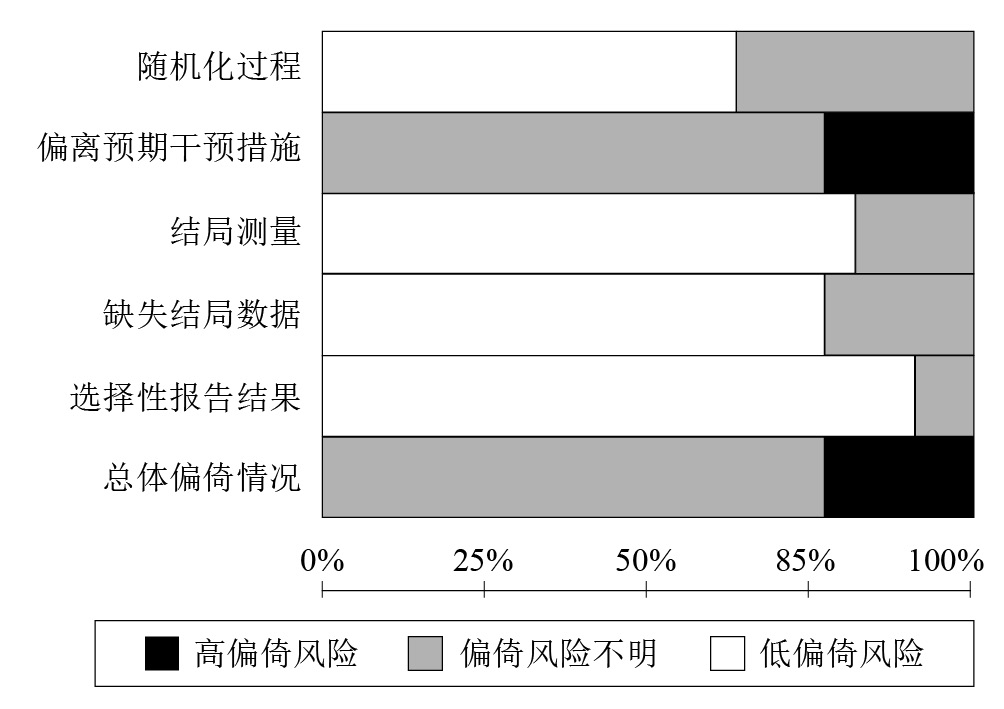
Figure 3
Bias assessment of included literatures"
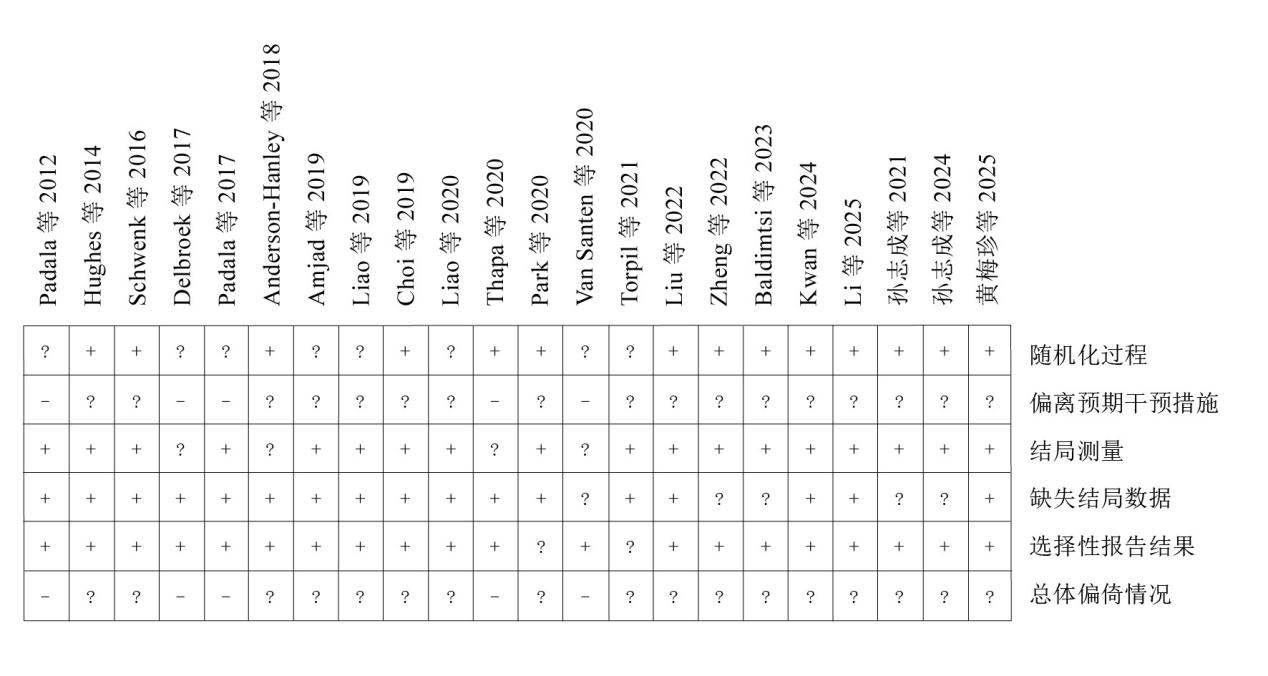
Table 2
Basic characteristics of included literatures"
| 纳入文献 | 国家 | 人群 | n(男/女) | 年龄/岁 | 干预措施 | 干预处方 | 结局指标(评估工具) | |||||
|---|---|---|---|---|---|---|---|---|---|---|---|---|
| C | T | C | T | C | T | |||||||
| 黄梅珍等[ | 中国 | MCI | 16/32 | 12/37 | 71.12±5.28 | 69.54±5.17 | 健康教育 | 沉浸式 | 每次30~45 min,每周3次,共12周 | 整体认知功能(a, b)、记忆功能(c)、注意力功能(d)、执行功能(d)、抑郁(v) | ||
| 孙志成等[ | 中国 | MCI | 13/18 | 11/21 | 78.03±5.95 | 77.18±6.41 | 认知训练 | 非沉浸式 | 每次45 min,每周3次,共24周 | 整体认知功能(a)、记忆功能(e)、注意力功能(f, d)、执行功能(x, d)、步行(g, y)、肌肉力量功能(r)、生活质量(h) | ||
| 孙志成等[ | 中国 | MCI | 10/19 | 11/17 | 77.14±4.01 | 77.33±4.06 | 健康教育 | 非沉浸式 | 每次50 min,每周3次,共24周 | 整体认知功能(a)、记忆功能(e)、注意力功能(f, d)、执行功能(d) 综合体适能(i)、步行(i)、平衡功能(i)、肌肉力量功能(i)、生活质量(h) | ||
| Li等[ | 中国 | MCI | 53/60 | 46/67 | 72.29±4.85 | 73.12±4.31 | 常规护理 | 非沉浸式 | 每次60 min,每周2次,共12周 | 整体认知功能(a, ac)、步行(ad) | ||
| Kwan等[ | 中国 | MCI | 28/119 | 36/110 | 73.9±6.6 | 75.2±7.1 | 常规护理 | 沉浸式 | 每次60 min,每周2次,共8周 | 整体认知功能(a)、记忆功能(ae)、执行功能(d, j)、步行(g)、综合体适能(af) | ||
| Baldimtsi等[ | 希腊 | MCI | 4/24 | 2/29 | 74.36±7.04 | 70.39±7.36 | 无干预 | 沉浸式 | 每次45 min,每周2~3次,共12周 | 整体认知功能(b)、记忆功能(c)、执行功能(d) | ||
| 70.96±7.95 | 运动训练 | |||||||||||
| 66.07±10.04 | 认知训练 | |||||||||||
| 73.00±8.54 | 运动-认知训练 | |||||||||||
| Zheng等[ | 中国 | 痴呆 | 6/14 | 3/15 | 84.26±5.48 | 81.74±5.79 | 常规护理 | 非沉浸式 | 每次60 min,每周5次,共8周 | 整体认知功能(b)、生活质量(h)、抑郁(ag) | ||
| Liu等[ | 中国 | MCI | 6/11 | 4/12 | 73.4±6.5 | 74.6±6.1 | 无干预 | 非沉浸式 | 每次50 min,每周3次,共12周 | 整体认知功能(a) 记忆功能(c) 注意力功能(d) 执行功能(d, j) 步行(o) | ||
| 73.2±6.3 | 运动训练 | |||||||||||
| Torpil等[ | 土耳其 | MCI | 14/17 | 11/19 | 70.30±2.73 | 70.12±2.57 | 认知训练 | 非沉浸式 | 每次45 min,每周2次,共12周 | 整体认知功能(k)、记忆功能(k)、注意力功能(k)、执行功能(k)、综合体适能(k) | ||
| Van Santen等[ | 荷兰 | 痴呆 | 23/16 | 37/36 | 79.0±7.0 | 79.0±6.0 | 健康教育 | 非沉浸式 | 每次60 min,每周5次,共24周 | 整体认知功能(b)、注意力功能(d)、执行功能(d)、综合体适能(i) 跌倒风险(t)、生活质量(ah) | ||
| Park等[ | 韩国 | MCI | 7/10 | 10/8 | 77.2±7.2 | 75.8±8.5 | 认知训练 | 非沉浸式 | 每次30 min,每周5次,共6周 | 整体认知功能(a)、记忆功能(ai)、注意力功能(d)、执行功能(d) | ||
| Thapa等[ | 韩国 | MCI | 10/24 | 6/28 | 72.7±5.6 | 72.6±5.4 | 健康教育 | 沉浸式 | 每次60 min,每周3次,共8周 | 整体认知功能(b)、注意力功能(d)、执行功能(d, aj)、步行(g, o)、肌肉力量功能(p) | ||
| Liao等[ | 中国 | MCI | 4/12 | 7/11 | 73.1±6.8 | 75.5±5.2 | 运动-认知训练 | 沉浸式 | 每次60 min,每周3次,共12周 | 整体认知功能(a)、记忆功能(c)、执行功能(w)、生活质量(n) | ||
| Choi等[ | 韩国 | MCI | 4/26 | 5/25 | 75.37±3.97 | 77.27±4.37 | 运动训练 | 非沉浸式 | 每次60 min,每周2次,共6周 | 整体认知功能(a, u)、步行(g)、肌肉力量功能(p, n)、平衡功能(q, z, aa, l) | ||
| Liao等[ | 中国 | MCI | 4/12 | 7/11 | 73.1±6.8 | 75.5±5.2 | 运动-认知训练 | 沉浸式 | 每次60 min,每周3次,共12周 | 注意力功能(d)、执行功能(d, j)、步行(o) | ||
| Amjad等[ | 巴基斯坦 | MCI | 18 | 20 | 运动训练 | 非沉浸式 | 每次25~30 min,每周5次,共6周 | 整体认知功能(a, b)、注意力功能(d)、执行功能(d) | ||||
| Anderson-Hanley等[ | 希腊 | MCI | 3/4 | 4/3 | 80.9±12.3 | 75.4±9.8 | 运动-认知训练 | 非沉浸式 | 每次20~45 min,每周3~5次,共24周 | 记忆功能(ak)、执行功能(j)、步行(g) | ||
| Padala等[ | 美国 | AD | 9/6 | 10/5 | 73.9±7.1 | 72.1±5.3 | 运动训练 | 非沉浸式 | 每次30 min,每周5次,共8周 | 整体认知功能(b)、平衡功能(l)、跌倒风险(ab)、生活质量(s, n, h) | ||
| Delbroek等[ | 比利时 | MCI | 5/5 | 2/8 | 87.5±6.6 | 86.9±5.6 | 无干预 | 非沉浸式 | 每次18~30 min,每周2次,共6周 | 整体认知功能(a)、平衡功能(m)、步行(g) | ||
| Schwenk等[ | 美国 | MCI | 5/5 | 5/7 | 79.0±10.4 | 77.8±6.9 | 无干预 | 非沉浸式 | 每次45 min,每周2次,共4周 | 整体认知功能(a)、注意力功能(d)、执行功能(d)、平衡功能(q)、 步行(o)、跌倒风险(ab) | ||
| Hughes等[ | 美国 | MCI | 4/6 | 2/8 | 76.2±4.3 | 78.5±7.1 | 健康教育 | 非沉浸式 | 每次90 min,每周1次,共24周 | 整体认知功能(al)、注意力功能(d)、执行功能(d)、步行(o)、生活质量(n) | ||
| Padala等[ | 美国 | AD | 3/8 | 3/8 | 81.6±5.2 | 79.3±9.8 | 运动训练 | 非沉浸式 | 每次30 min,每周5次,共8周 | 整体认知功能(b)、平衡功能(l, m)、步行(g)、生活质量(s, n, h) | ||
Table 3
Results of meta-analysis"
| 结局指标 | k(n) | Meta分析 | 效应模型 | 异质性检验 | 证据等级 | ||
|---|---|---|---|---|---|---|---|
| SMD(95%CI) | P值 | 研究内I2 (研究间I2)/% | P值 | ||||
| 整体认知功能 | 30(20) | 0.69(0.11~1.28) | 0.022 | REML | 2.48(93.17) | < 0.001 | 极低 |
| 记忆功能 | 22(10) | 0.47(0.07~0.87) | 0.023 | REML | 29.51(53.64) | < 0.001 | 低 |
| 注意力功能 | 16(12) | 0.62(0.23~1.01) | 0.004 | REML | 0(78.07) | < 0.001 | 低 |
| 执行功能 | 35(16) | 0.42(0.09~0.75) | 0.013 | REML | 17.25(63.24) | < 0.001 | 低 |
| 抑郁 | 2(2) | -0.81(-5.38~3.77) | 0.267 | REML | (34.19) | 0.075 | 中等 |
| 综合体适能 | 5(4) | 0.40(-0.12~0.93) | 0.098 | REML | 0(72.71) | 0.058 | 中等 |
| 平衡功能 | 22(6) | 0.54(0.07~1.00) | 0.027 | REML | 0(67.79) | 0.163 | 中等 |
| 肌肉力量功能 | 7(4) | 0.63(0.37~0.88) | 0.001 | REML | 0(10.52) | 0.359 | 中等 |
| 步行 | 25(13) | 0.29(0.04~0.54) | 0.024 | REML | 22.34(40.22) | < 0.001 | 中等 |
| 跌倒风险 | 4(3) | -0.77(-1.89~0.34) | 0.115 | REML | 5.76(71.88) | 0.037 | 低 |
| 生活质量 | 18(8) | 0.29(0.03~0.56) | 0.029 | REML | 0(37.25) | 0.271 | 中等 |
Table 4
Results of subgroup and meta-regression analysis"
| 调节变量 | 整体认知功能 | 记忆功能 | 注意力功能 | 执行功能 | 平衡功能 | 步行 | 生活质量 |
|---|---|---|---|---|---|---|---|
| 对照形式 | |||||||
| 被动 | 0.54(-0.10~1.18) | 0.53(-0.01~1.07) | 0.42(0.05~0.78) | 0.42(0.02~0.81) | 0.39(-0.40~1.17) | 0.20(-0.10~0.50) | 0.32(-0.06~0.70) |
| 主动 | 0.85(0.20~1.50) | 0.43(-0.05~0.90) | 0.87(0.47~1.27) | 0.44(0.03~0.84) | 0.70(-0.07~1.46) | 0.41(0.08~0.75) | 0.28(-0.08~0.64) |
| P交互值 | 0.286 | 0.719 | 0.034 | 0.928 | 0.563 | 0.272 | 0.877 |
| 沉浸度 | |||||||
| 沉浸式 | 0.36(-0.82~1.54) | 0.35(-0.25~0.96) | 0.26(-0.45~0.97) | 0.36(-0.21~0.94) | 0.51(-0.40~1.42) | ||
| 非沉浸式 | 0.81(0.11~1.50) | 0.58(-0.00~1.15) | 0.76(0.31~1.21) | 0.48(0.02~0.94) | 0.28(-0.01~0.56) | ||
| P交互值 | 0.512 | 0.585 | 0.222 | 0.762 | 0.608 | ||
| 干预时间 | |||||||
| < 45 min | 1.01(0.29~1.73) | 0.52(-0.01~1.05) | 0.95(0.55~1.34) | 0.61(0.14~1.07) | 0.54(-0.17~1.24) | 0.59(0.19~0.98) | 0.25(-0.15~0.65) |
| 45~60 min | 0.34(-0.42~1.09) | 0.39(-0.22~1.01) | 0.35(-0.04~0.75) | 0.28(-0.21~0.78) | 0.57(-0.35~1.49) | 0.19(-0.10~0.49) | 0.39(0.02~0.76) |
| > 60 min | 0.57(-2.22~3.37) | 0.00(-1.28~1.28) | 0.00(-1.59~1.59) | -0.50(-1.68~0.68) | -0.09(-1.19~1.00) | ||
| P交互值 | 0.235 | 0.733 | 0.030 | 0.463 | 0.948 | 0.096 | 0.626 |
| 干预频率 | |||||||
| 每周1~2次 | 0.37(-0.56~1.30) | 0.17(-0.51~0.86) | 0.92(0.11~1.73) | 0.21(-0.40~0.82) | 0.42(-0.35~1.19) | 0.20(-0.18~0.58) | -0.09(-1.17~0.99) |
| 每周3~5次 | 0.91(0.14~1.67) | 0.62(0.13~1.10) | 0.53(0.09~0.97) | 0.54(0.11~0.96) | 0.69(-0.11~1.49) | 0.36(0.01~0.70) | 0.32(0.04~0.60) |
| P交互值 | 0.371 | 0.286 | 0.373 | 0.379 | 0.619 | 0.539 | 0.443 |
| 干预周期 | |||||||
| 4~< 8周 | 0.71(-0.12~1.53) | 0.24(-0.53~1.01) | 0.70(-0.03~1.43) | 0.66(0.18~1.14) | 0.55(-0.06~1.16) | 0.21(-0.06~0.48) | 0.23(-0.20~0.67) |
| 8~< 12周 | 0.60(-0.32~1.52) | 0.38(-0.11~0.87) | 0.55(-0.01~1.10) | 0.26(-0.18~0.71) | 0.21(-0.06~0.47) | 0.35(-0.11~0.80) | |
| 12~24周 | 0.88(-0.18~1.95) | 1.04(0.20~1.89) | 0.63(0.00~1.25) | 0.32(-0.21~0.85) | 0.54(-0.81~1.90) | 0.85(0.44~1.25) | 0.35(-0.06~0.76) |
| P交互值 | 0.771 | 0.300 | 0.912 | 0.416 | 0.992 | 0.024 | 0.912 |
| 人群 | |||||||
| MCI | 0.89(0.19~1.58) | 0.67(0.25~1.10) | 0.48(0.14~0.82) | 0.45(-0.22~1.12) | 0.32(0.07~0.58) | 0.50(0.06~0.93) | |
| 痴呆 | 0.28(-1.59~2.15) | 0.19(-1.02~1.40) | -0.18(-1.32~0.96) | 0.33(-0.08~0.74) | |||
| AD | -0.03(-1.62~1.55) | 0.77(-0.23~1.76) | -0.16(-1.08~0.76) | 0.05(-0.36~0.47) | |||
| P交互值 | 0.499 | 0.436 | 0.268 | 0.586 | 0.305 | 0.311 | |
| 年龄 | -0.03(-0.09~0.03) t = -1.02, P = 0.327 | 0.06(-0.06~0.18) t = 1.04, P = 0.292 | -0.08(-0.21~0.06) t = -1.27, P = 0.236 | -0.04(-0.10~0.02) t = -1.36, P = 0.191 | -0.11(-0.20~-0.02) t = -2.55, P = 0.020 | -0.02(-0.09~0.05) t = -0.59, P = 0.550 | 0.01(-0.09~0.12) t = 0.20, P = 0.764 |
| [1] |
Nichols E, Steinmetz J D, Vollset S E, et al. Estimation of the global prevalence of dementia in 2019 and forecasted prevalence in 2050: an analysis for the Global Burden of Disease Study 2019[J]. Lancet Public Health, 2022, 7(2): e105-e125.
doi: 10.1016/S2468-2667(21)00249-8 pmid: 34998485 |
| [2] |
Chen L, Sun Y, Han Q, et al. The effects of virtual reality-based interventions on cognitive function, depressive symptoms, and daily functioning in older adults with mild cognitive impairment: a systematic review and meta-analysis of randomized controlled trials[J]. Front Public Health, 2025, 13: 1682781.
doi: 10.3389/fpubh.2025.1682781 |
| [3] | 公维军, 王伟, 赵宏波, 等. 认知功能障碍疾病非药物干预中国专家共识(2025版)[J]. 康复学报, 2026, 36(2): 87-97. |
|
Gong W J, Wang W, Zhao H B, et al. Chinese expert consensus on non-pharmacological interventions for cognitive impairment (2025 edition)[J]. Rehabil Med, 2026, 36(2): 87-97.
doi: 10.1080/16501960410015470 |
|
| [4] |
朱艾荣, 刘培豪, 郭晶, 等. 运动-认知双任务训练对帕金森病患者认知功能的Meta分析[J]. 中国康复理论与实践, 2025, 31(12): 1376-1384.
doi: 10.3969/j.issn.1006-9771.2025.12.002 |
| Zhu A R, Liu P H, Guo J, et al. Motor-cognitive dual-task training for cognitive function in patients with Parkinson's disease: a meta-analysis[J]. Chin J Rehabil Theory Pract, 2025, 31(12): 1376-1384. | |
| [5] |
Grospretre S, Marcel-Millet P, Eon P, et al. How exergaming with virtual reality enhances specific cognitive and visuo-motor abilities: an explorative study[J]. Cogn Sci, 2023, 47(4): e13278.
doi: 10.1111/cogs.v47.4 |
| [6] |
Yuan P, Chen J, Peng D, et al. Effectiveness of VR-based cognitive training and games on cognitive rehabilitation in patients with MCI: a systematic review and meta-analysis[J]. Front Neurol, 2025, 16: 1691344.
doi: 10.3389/fneur.2025.1691344 |
| [7] | Yang Q, Zhang L, Chang F, et al. Virtual reality interventions for older adults with mild cognitive impairment: systematic review and meta-analysis of randomized controlled trials[J]. J Med Internet Res, 2025, 27: e59195. |
| [8] |
Cheung M W. Modeling dependent effect sizes with three-level meta-analyses: a structural equation modeling approach[J]. Psychol Methods, 2014, 19(2): 211-229.
doi: 10.1037/a0032968 pmid: 23834422 |
| [9] |
邱卓英, 李伦, 陈迪, 等. 基于世界卫生组织国际健康分类家族康复指南研究:理论架构和方法体系[J]. 中国康复理论与实践, 2020, 26(2): 125-135.
doi: 10.3969/j.issn.1006-9771.2020.02.001 |
| Qiu Z Y, Li L, Chen D, et al. Research on rehabilitation guidelines using world health organization family international classifications: framework and approaches[J]. Chin J Rehabil Theory Pract, 2020, 26(2): 125-135. | |
| [10] |
Winblad B, Palmer K, Kivipelto M, et al. Mild cognitive impairment: beyond controversies, towards a consensus: report of the international working group on mild cognitive impairment[J]. J Intern Med, 2004, 256(3): 240-246.
doi: 10.1111/j.1365-2796.2004.01380.x pmid: 15324367 |
| [11] |
Jack C R, Bennett D A, Blennow K, et al. NIA-AA research framework: toward a biological definition of Alzheimer's disease[J]. Alzheimers Dement, 2018, 14(4): 535-562.
doi: S1552-5260(18)30072-4 pmid: 29653606 |
| [12] | Sterne J A C, Savovic J, Page M J, et al. RoB 2: a revised tool for assessing risk of bias in randomised trials[J]. BMJ, 2019, 366: l4898. |
| [13] |
Guyatt G H, Oxman A D, Vist G E, et al. GRADE: an emerging consensus on rating quality of evidence and strength of recommendations[J]. BMJ, 2008, 336(7650): 924-926.
doi: 10.1136/bmj.39489.470347.AD |
| [14] | Harrer M, Cuijpers P, Furukawa T, et al. Doing meta-analysis with R: a hands-on guide[M]. Boca Raton: Chapman and Hall/CRC, 2021. |
| [15] | Higgins J P, Thompson S G, Deeks J J, et al. Measuring inconsistency in meta-analyses[J]. BMJ, 2003, 327(7414): 557-560. |
| [16] | 黄梅珍, 朱开彦, 何炳蔚, 等. 基于沉浸式虚拟现实认知训练对社区轻度认知障碍患者的干预效果[J]. 军事护理, 2025, 42(8): 85-89. |
| Huang M Z, Zhu K Y, He B W, et al. Intervention effects of immersive virtual reality cognitive training for community-dwelling patients with mild cognitive impairment[J]. Mil Nurs, 2025, 42(8): 85-89. | |
| [17] | 孙志成, 王鸣, 李咏阳, 等. 虚拟现实训练对养老机构轻度认知障碍病人的康复治疗效果[J]. 实用老年医学, 2024, 38(1): 34-39. |
| Sun Z C, Wang M, Li Y Y, et al. Effect of virtual reality training on rehabilitation therapy in patients with mild cognitive impairment in nursing home[J]. Pract Geriatr, 2024, 38(1): 34-39. | |
| [18] | 孙志成, 马金霖, 顾晓美, 等. 基于虚拟现实的八段锦锻炼对养老院轻度认知障碍老年患者的影响[J]. 中华物理医学与康复杂志, 2021, 43(4): 322-326. |
| Sun Z C, Ma J L, Gu X M, et al. Baduanjin training based on virtual reality can relieve mild cognitive impairment in the elderly[J]. Chin J Phys Med Rehabil, 2021, 43(4): 322-326. | |
| [19] |
Li A, Qiang W, Li J, et al. Effectiveness of an exergame-based training program on physical and cognitive function in older adults with cognitive impairment: a randomized controlled trial in rural China[J]. BMC Geriatr, 2025, 25(1): 892.
doi: 10.1186/s12877-025-06341-6 |
| [20] | Kwan R Y C, Liu J, Sin O S K, et al. Effects of virtual reality motor-cognitive training for older people with cognitive frailty: multicentered randomized controlled trial[J]. J Med Internet Res, 2024, 26: e57809. |
| [21] |
Baldimtsi E, Mouzakidis C, Karathanasi E M, et al. Effects of virtual reality physical and cognitive training intervention on cognitive abilities of elders with mild cognitive impairment[J]. J Alzheimers Dis Rep, 2023, 7(1): 1475-1490.
doi: 10.3233/ADR-230099 pmid: 38225966 |
| [22] |
Zheng J, Yu P, Chen X. An evaluation of the effects of active game play on cognition, quality of life and depression for older people with dementia[J]. Clin Gerontol, 2022, 45(4): 1034-1043.
doi: 10.1080/07317115.2021.1980170 |
| [23] |
Liu C L, Cheng F Y, Wei M J, et al. Effects of exergaming-based Tai Chi on cognitive function and dual-task gait performance in older adults with mild cognitive impairment: a randomized control trial[J]. Front Aging Neurosci, 2022, 14: 761053.
doi: 10.3389/fnagi.2022.761053 |
| [24] |
Torpil B, Sahin S, Pekcetin S, et al. The effectiveness of a virtual reality-based intervention on cognitive functions in older adults with mild cognitive impairment: a single-blind, randomized controlled trial[J]. Games Health J, 2021, 10(2): 109-114.
doi: 10.1089/g4h.2020.0086 pmid: 33058735 |
| [25] |
Van Santen J, Droes R M, Twisk J W R, et al. Effects of exergaming on cognitive and social functioning of people with dementia: a randomized controlled trial[J]. J Am Med Dir Assoc, 2020, 21(12): 1958-1967.e5.
doi: 10.1016/j.jamda.2020.04.018 pmid: 32651132 |
| [26] | Park J S, Jung Y J, Lee G. Virtual reality-based cognitive-motor rehabilitation in older adults with mild cognitive impairment: a randomized controlled study on motivation and cognitive function[J]. Healthcare (Basel), 2020, 8(3): 335. |
| [27] |
Thapa N, Park H J, Yang J G, et al. The effect of a virtual reality-based intervention program on cognition in older adults with mild cognitive impairment: a randomized control trial[J]. J Clin Med, 2020, 9(5): 1283.
doi: 10.3390/jcm9051283 |
| [28] | Liao Y Y, Tseng H Y, Lin Y J, et al. Using virtual reality-based training to improve cognitive function, instrumental activities of daily living and neural efficiency in older adults with mild cognitive impairment[J]. Eur J Phys Rehabil Med, 2020, 56(1): 47-57. |
| [29] | Choi W, Lee S. The effects of virtual kayak paddling exercise on postural balance, muscle performance, and cognitive function in older adults with mild cognitive impairment: a randomized controlled trial[J]. J Aging Phys Act, 2019, 27(4): 861-870. |
| [30] |
Liao Y Y, Chen I H, Lin Y J, et al. Effects of virtual reality-based physical and cognitive training on executive function and dual-task gait performance in older adults with mild cognitive impairment: a randomized control trial[J]. Front Aging Neurosci, 2019, 11: 162.
doi: 10.3389/fnagi.2019.00162 |
| [31] |
Amjad I, Toor H, Niazi I K, et al. Xbox 360 kinect cognitive games improve slowness, complexity of EEG, and cognitive functions in subjects with mild cognitive impairment: a randomized control trial[J]. Games Health J, 2019, 8(2): 144-152.
doi: 10.1089/g4h.2018.0029 pmid: 30239213 |
| [32] |
Anderson-Hanley C, Barcelos N M, Zimmerman E A, et al. The aerobic and cognitive exercise study (ACES) for community-dwelling older adults with or at-risk for mild cognitive impairment (MCI): neuropsychological, neurobiological and neuroimaging outcomes of a randomized clinical trial[J]. Front Aging Neurosci, 2018, 10: 76.
doi: 10.3389/fnagi.2018.00076 pmid: 29780318 |
| [33] |
Padala K P, Padala P R, Lensing S Y, et al. Home-based exercise program improves balance and fear of falling in community-dwelling older adults with mild Alzheimer's disease: a pilot study[J]. J Alzheimers Dis, 2017, 59(2): 565-574.
doi: 10.3233/JAD-170120 pmid: 28655135 |
| [34] |
Delbroek T, Vermeylen W, Spildooren J. The effect of cognitive-motor dual task training with the biorescue force platform on cognition, balance and dual task performance in institutionalized older adults: a randomized controlled trial[J]. J Phys Ther Sci, 2017, 29(7): 1137-1143.
doi: 10.1589/jpts.29.1137 pmid: 28744033 |
| [35] |
Schwenk M, Sabbagh M, Lin I, et al. Sensor-based balance training with motion feedback in people with mild cognitive impairment[J]. J Rehabil Res Dev, 2016, 53(6): 945-958.
doi: 10.1682/JRRD.2015.05.0089 pmid: 28475201 |
| [36] |
Hughes T F, Flatt J D, Fu B, et al. Interactive video gaming compared with health education in older adults with mild cognitive impairment: a feasibility study[J]. Int J Geriatr Psychiatry, 2014, 29(9): 890-898.
doi: 10.1002/gps.v29.9 |
| [37] | Padala K P, Padala P R, Malloy T R, et al. Wii-fit for improving gait and balance in an assisted living facility: a pilot study[J]. J Aging Res, 2012, 2012: 597573. |
| [38] |
Chan J Y C, Liu J, Chan A T C, et al. Exergaming and cognitive functions in people with mild cognitive impairment and dementia: a meta-analysis[J]. NPJ Digit Med, 2024, 7(1): 154.
doi: 10.1038/s41746-024-01142-4 pmid: 38879695 |
| [39] | Ackerman P L. Cognitive fatigue: multidisciplinary perspectives on current research and future applications[M]. Washington D. C.: American Psychological Association, 2011. |
| [40] |
Zhao Y, Feng H, Wu X, et al. Effectiveness of exergaming in improving cognitive and physical function in people with mild cognitive impairment or dementia: systematic review[J]. JMIR Serious Games, 2020, 8(2): e16841.
doi: 10.2196/16841 |
| [41] |
Cai Z, Ma Y, Li L, et al. Effects of exergaming in older individuals with mild cognitive impairment and dementia: a systematic review and meta-analysis[J]. Geriatr Nurs, 2023, 51: 351-359.
doi: 10.1016/j.gerinurse.2023.03.028 pmid: 37099867 |
| [42] |
Sturnieks D L, St George R, Lord S R. Balance disorders in the elderly[J]. Neurophysiol Clin, 2008, 38(6): 467-478.
doi: 10.1016/j.neucli.2008.09.001 pmid: 19026966 |
| [43] |
Klotzbier T J, Schott N. Cognitive-motor interference during walking in older adults with probable mild cognitive impairment[J]. Front Aging Neurosci, 2017, 9: 350.
doi: 10.3389/fnagi.2017.00350 pmid: 29321738 |
| [44] |
Schaumburg M, Imtiaz A, Zhou R, et al. Immersive virtual reality for older adults: challenges and solutions in basic research and clinical applications[J]. Ageing Res Rev, 2025, 109: 102771.
doi: 10.1016/j.arr.2025.102771 |
| [45] |
Toien T, Berg O K, Modena R, et al. Heavy strength training in older adults: implications for health, disease and physical performance[J]. J Cachexia Sarcopenia Muscle, 2025, 16(2): e13804.
doi: 10.1002/jcsm.v16.2 |
| [1] | Sun Fengyi, Yin Haiyan, Yin Tingting, Yang Bingqing, Gu Jianpeng, Wang Yan, Bai Yamei, Xu Guihua, Song Yulei. Application of central auditory testing combined with electroencephalogram characteristics in the early screening of mild cognitive impairment due to Alzheimer's disease [J]. Chinese Journal of Rehabilitation Theory and Practice, 2026, 32(9): 1016-1024. |
| [2] | Wang Xiaolei, Zhao Xiaoqing, Chen Shuying, Zhang Minghao, Zhou Xiaoyu, Li Haiyan, Zhang Jianhua, Jing Qi, Dong Zhiwei. Development of a nomogram for predicting cognitive impairment risk among older adults with heart disease [J]. Chinese Journal of Rehabilitation Theory and Practice, 2026, 32(9): 993-1002. |
| [3] | Yan Jiazheng, Luo Xiaoqin, Liu Rihua, Yu Ying, Qi Fengxue. Non-invasive brain stimulation techniques for balance function after stroke: a network meta-analysis [J]. Chinese Journal of Rehabilitation Theory and Practice, 2026, 32(8): 903-915. |
| [4] | Liu Shan, Xu Kunyao, Zhou Zhimeng, Zhou Lingyun, Zeng Mao, He Sha, Dai Luoyang, Qin Ting, Hu Qinglin, Yang Jiahai, Li Rui. Effects of different electromagnetic stimulation protocols on hand function and activities of daily living for stroke patients: a network meta-analysis [J]. Chinese Journal of Rehabilitation Theory and Practice, 2026, 32(8): 916-926. |
| [5] | Zhou Guangxue, Xu Ning, Shi Bin. Effect of virtual reality combined with occupational therapy on upper limb motor function in patients with stroke: a meta-analysis [J]. Chinese Journal of Rehabilitation Theory and Practice, 2026, 32(7): 788-796. |
| [6] | Dun Shibo, Li Yuzhou. Effect of blood flow restriction training on lower-limb motor function after stroke: a meta-analysis [J]. Chinese Journal of Rehabilitation Theory and Practice, 2026, 32(7): 797-806. |
| [7] | Yuan Yiyi, Tian Wuchao, Zhang Xianbin, Chao Qiang, Li Yongsheng, Liu Guixin, Wu Wanqing, Wang Pu. Effect of dual task training on mobility and balance in stroke patients: a meta-analysis [J]. Chinese Journal of Rehabilitation Theory and Practice, 2026, 32(7): 807-816. |
| [8] | LI Xinyuan, ZHENG Jiejiao, ZHANG Tingyu, WU Xuejiao, LIANG Xiaoxiao. Effect of intermittent theta burst stimulation on lower extremity motor function and balance function in stroke patients: a meta-analysis [J]. Chinese Journal of Rehabilitation Theory and Practice, 2026, 32(6): 631-644. |
| [9] | LI Wen, YAN Xinyue, HUANG Qiuchen, ZHANG Rui, SUN Yuemei, ZHOU Yue. Effect of neuromuscular electrical stimulation on patients after total knee arthroplasty: a meta-analysis [J]. Chinese Journal of Rehabilitation Theory and Practice, 2026, 32(6): 653-664. |
| [10] | SHEN Tingting, LIU Dongfei. Effect of exercise on multidimensional health outcomes in adults with Down syndrome: a meta-analysis [J]. Chinese Journal of Rehabilitation Theory and Practice, 2026, 32(6): 677-689. |
| [11] | HAN Tianxing, LIU Haotian, XU Ziqi, PENG Xiaohan, WANG Yang, CAO Danna. Functional connectivity in default mode network and medial temporal lobe in mild cognitive impairment stage of Alzheimer's disease based on resting-state functional magnetic resonance imaging: a meta-analysis [J]. Chinese Journal of Rehabilitation Theory and Practice, 2026, 32(5): 522-533. |
| [12] | CHE Ruixin, TANG Yongtian, PAN Shiqin, TONG Yaqian. Effect of transcutaneous electrical acupoint stimulation on chronic obstructive pulmonary disease: a meta-analysis [J]. Chinese Journal of Rehabilitation Theory and Practice, 2026, 32(4): 426-436. |
| [13] | XU Mingxia, ZHU Hui, CHEN Piaopiao, MENG Kexin, CHEN Jie, CHEN Jing, SUN Huifang, SUN Yanyan. Effect of virtual reality biofeedback training combined with oral positioning therapy on dysphagia after oral cancer surgery [J]. Chinese Journal of Rehabilitation Theory and Practice, 2026, 32(4): 445-452. |
| [14] | DONG Lijun, XU Shihao, CHEN Qiuhua, ZHANG Lu, YIN Xiaobing. Application of virtual reality technology in managing negative emotions and postoperative rehabilitation in perioperative patients from 2015 to 2025: a bibliometric analysis [J]. Chinese Journal of Rehabilitation Theory and Practice, 2026, 32(1): 69-82. |
| [15] | CHEN Junli, ZHANG Han, ZHANG Yefan, ZHANG Yanqiu, GAO Runguo, GAO Qianqian, CAI Weiqin, LI Haiyan, JI Lihong, DONG Zhiwei, JING Qi. Construction of a community-family management model for older adults with mild cognitive impairment [J]. Chinese Journal of Rehabilitation Theory and Practice, 2026, 32(1): 90-100. |
| Viewed | ||||||
|
Full text |
|
|||||
|
Abstract |
|
|||||
|
||
