



Chinese Journal of Rehabilitation Theory and Practice ›› 2026, Vol. 32 ›› Issue (9): 1052-1060.doi: 10.3969/j.issn.1006-9771.2026.09.007
Previous Articles Next Articles
Su Panpan1, He Chuan1, Qiongji 2, Meng Dianhuai3( )
)
Received:2026-04-21
Revised:2026-06-24
Accepted:2026-07-01
Published:2026-09-25
Online:2026-09-20
Contact:
Meng Dianhuai
E-mail:dhdream@126.com
Supported by:CLC Number:
Su Panpan, He Chuan, Qiongji , Meng Dianhuai. Comparison of static balance characteristics under different standing postures in older patients with post-stroke hemiplegia[J]. Chinese Journal of Rehabilitation Theory and Practice, 2026, 32(9): 1052-1060.
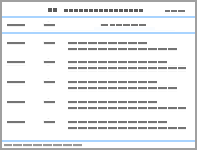
Table 1
Baseline data of the patients"
| 特征 | 数值 |
|---|---|
| 性别(男/女)/n | 32/6 |
| 年龄/岁 | 65.85±5.41 |
| 身高/m | 1.68±0.09 |
| 体质量/kg | 69.93±11.08 |
| 体质量指数/(kg·m-2) | 24.83±3.16 |
| 脑卒中类型(缺血/出血)/n | 31/7 |
| 脑卒中病程/月 | 4.96±2.32 |
| 下肢Brunnstrom分期/n | |
| III期 | 19 |
| IV期 | 11 |
| V期 | 8 |
| 计时起立-行走测试/s | 26.25±15.03 |
| 30 s坐站测试/个 | 8.71±2.46 |
| 偏瘫侧(左/右)/n | 21/17 |
| 过去12个月内有跌倒史/n | 6 |
Table 2
Description of the standing task in the static balance test"
| 任务编号 | 任务名称 | 操作定义 |
|---|---|---|
| 任务1 | BS | 双足内侧缘并拢相触,双足跟并拢,双足呈平行位,脚尖向前 |
| 任务2 | ASTS | 患侧足在前,患足跟接触健足足弓中部 |
| 任务3 | USTS | 健侧足在前,健足跟接触患足足弓中部 |
| 任务4 | ATS | 患侧足在前,患足的足跟紧贴健足的脚尖,双足呈直线前后排列 |
| 任务5 | UTS | 健侧足在前,健足的足跟紧贴患足的脚尖,双足呈直线前后排列 |
| 任务6 | UMS | 健侧下肢单腿支撑,患侧腿抬离地面,尽量保持躯干直立,骨盆维持中立位 |
| 任务7 | SS | 患者选择自我感觉最稳定、最舒适的站立姿势 |
Table 3
Comparison of VAP and VML of different standing postures"
| 站姿 | n | VAP | VML |
|---|---|---|---|
| BS | 38 | 12.46±3.93 | 10.12±3.35 |
| ASTS | 38 | 14.48±4.46 | 12.27±3.44 |
| USTS | 38 | 17.46±6.49 | 12.44±3.83 |
| ATS | 38 | 20.99±7.29 | 17.82±4.65 |
| UTS | 38 | 28.11±10.04 | 16.91±3.96 |
| UMS | 38 | 38.62±13.01 | 30.02±7.17 |
| SS | 38 | 10.35±3.33 | 6.51±2.36 |
| F值 | 80.848 | 139.772 | |
| P值 | < 0.001 | < 0.001 |
Table 4
Bonferroni pairwise comparisons for VAP under different standing postures (mean difference)"
| 任务 | ASTS | USTS | ATS | UTS | UMS | SS |
|---|---|---|---|---|---|---|
| BS | 2.026 | 5.009a | 8.535b | 15.649b | 26.167b | -2.105a |
| ASTS | 2.982 | 6.609b | 13.623b | 24.140b | -4.132a | |
| USTS | 3.526 | 10.640b | 21.158b | -7.114b | ||
| ATS | 7.114a | 17.632b | -10.640b | |||
| UTS | 10.518a | -17.754b | ||||
| UMS | -28.272b |
Table 5
Bonferroni pairwise comparisons for VML under different standing postures (mean difference)"
| 任务 | BS | ASTS | USTS | ATS | UTS | UMS |
|---|---|---|---|---|---|---|
| ASTS | 2.149 | |||||
| USTS | 2.232 | 0.175 | ||||
| ATS | 7.702a | 5.553a | 5.377a | |||
| UTS | 6.781a | 4.632a | 4.456a | -0.921 | ||
| UMS | 19.895a | 17.749a | 17.570a | 12.193a | 13.114a | |
| SS | -3.614a | -5.763a | -5.939a | -11.316a | -10.395a | -23.509a |
Table 6
SA and SL of different standing postures"
| 站姿 | n | SA/mm2 | SL/mm |
|---|---|---|---|
| BS | 38 | 471.12±219.11 | 317.11±95.83 |
| ASTS | 38 | 548.47±222.99 | 353.20±91.79 |
| USTS | 38 | 658.14±301.08 | 390.34±116.76 |
| ATS | 38 | 842.61±403.75 | 518.88±131.17 |
| UTS | 38 | 1074.15±522.28 | 631.62±207.19 |
| UMS | 38 | 2283.53±1405.85 | 914.55±253.19 |
| SS | 38 | 270.87±140.66 | 236.97±76.21 |
| F值 | 53.796 | 112.232 | |
| P值 | < 0.001 | < 0.001 |
Table 7
Bonferroni pairwise comparisons for SA under different standing postures"
| 站姿 | ASTS | USTS | ATS | UTS | UMS | SS |
|---|---|---|---|---|---|---|
| BS | 77.342 | 187.018 | 371.272a | 603.026a | 1812.412a | -200.254a |
| ASTS | 109.675 | 294.149a | 525.684a | 1735.070a | -277.596a | |
| USTS | 184.474b | 416.008a | 1625.395a | -387.272a | ||
| ATS | 231.535b | 1440.921a | -571.746a | |||
| UTS | 1209.386a | -803.281a | ||||
| UMS | -2012.667a |
Table 8
Bonferroni pairwise comparisons for SL under different standing postures"
| 站姿 | BS | ASTS | USTS | ATS | UTS | UMS |
|---|---|---|---|---|---|---|
| ASTS | 36.088 | |||||
| USTS | 73.228 | 37.140 | ||||
| ATS | 201.772a | 165.684a | 128.544a | |||
| UTS | 314.509a | 278.421a | 241.281a | 112.737a | ||
| UMS | 597.439a | 561.351a | 524.211a | 395.667a | 282.930a | |
| SS | -80.140a | -116.228a | -153.368a | -281.912a | -394.649a | -677.579a |
Table 9
SDML and SDAP of different standing postures"
| 站姿 | n | SDAP/mm | SDML/mm |
|---|---|---|---|
| BS | 38 | 5.36±1.63 | 4.67(3.67,6.00) |
| ASTS | 38 | 5.67±2.02 | 4.67(3.67,5.75) |
| USTS | 38 | 6.23±2.42 | 4.83(4.00,6.33) |
| ATS | 38 | 7.55±3.57 | 5.00(4.33,6.41) |
| UTS | 38 | 10.11±3.41 | 5.67(4.58,6.83) |
| UMS | 38 | 11.59±3.94 | 9.67(6.92,17.75) |
| SS | 38 | 4.81±1.46 | 2.83(2.00,3.67) |
| F/χ2值 | 39.793 | 109.632 | |
| P值 | < 0.001 | < 0.001 |
Table 10
Bonferroni pairwise comparisons for SDAP under different standing postures (mean difference)"
| 站姿 | ASTS | USTS | ATS | UTS | UMS | SS |
|---|---|---|---|---|---|---|
| BS | 0.316 | 0.868 | 2.193a | 4.746b | 6.237b | -0.553 |
| ASTS | 0.553 | 1.877a | 4.430b | 5.921b | -0.868 | |
| USTS | 1.325 | 3.877b | 5.368b | -1.421 | ||
| ATS | 2.553b | 4.044b | -2.746a | |||
| UTS | 1.491 | -5.298b | ||||
| UMS | -6.789b |
Table 11
Bonferroni pairwise comparisons for SDML among standing postures (Z value)"
| 站姿 | BS | ASTS | USTS | ATS | UTS | UMS |
|---|---|---|---|---|---|---|
| ASTS | 0.133 | |||||
| USTS | -1.142 | -1.274 | ||||
| ATS | -1.699 | -1.832 | -0.558 | |||
| UTS | -3.159a | -3.292a | -2.018 | -1.460 | ||
| UMS | -6.160b | -6.292b | -5.018b | -4.460b | -3.000 | |
| SS | 3.478a | 3.345a | 4.620b | 5.177b | 6.637b | 9.638b |
| [1] | 李亚芳, 梁珊珊, 王子怡, 等. 中国脑卒中流行病学和疾病负担的Meta分析[J]. 中国循证医学杂志, 2025, 25(6): 664-669. |
| Li Y F, Liang S S, Wang Z Y, et al. Epidemiology and disease burden of stroke in China: a meta-analysis[J]. Chin J Evid-Based Med, 2025, 25(6): 664-669. | |
| [2] |
Feigin V L, Brainin M, Norrving B, et al. World stroke organization: global stroke fact sheet 2025[J]. Int J Stroke, 2025, 20(2): 132-144.
doi: 10.1177/17474930241308142 pmid: 39635884 |
| [3] |
Ghrouz A, Guillen-Sola A, Morgado-Perez A, et al. The effect of a motor relearning on balance and postural control in patients after stroke: an open-label randomized controlled trial[J]. Eur Stroke J, 2024, 9(2): 303-311.
doi: 10.1177/23969873231220218 |
| [4] |
Kwon I H, Shin W S, Choi K S, et al. Effects of real-time feedback methods on static balance training in stroke patients: a randomized controlled trial[J]. Healthcare, 2024, 12(7): 767.
doi: 10.3390/healthcare12070767 |
| [5] |
阚超杰, 郭川, 朱仕哲, 等. 老年人在认知-平衡双任务下的皮质激活特征[J]. 中国康复理论与实践, 2023, 29(10): 1189-1194.
doi: 10.3969/j.issn.1006-9771.2023.10.010 |
| Kan C J, Guo C, Zhu S Z, et al. Characteristics of cortical activation in older adults under cognition-balance dual tasks[J]. Chin J Rehabil Theory Pract, 2023, 29(10): 1189-1194. | |
| [6] |
Wang Z, Molenaar P M C, Newell K M. The effects of foot position and orientation on inter-and intra-foot coordination in standing postures: a frequency domain PCA analysis[J]. Exp Brain Res, 2013, 230(1): 15-27.
doi: 10.1007/s00221-013-3627-9 |
| [7] |
Luo W, Huang Z, Li H, et al. Regulation of static and dynamic balance in healthy young adults: interactions between stance width and visual conditions[J]. Front Bioeng Biotechnol, 2025, 13: 1538286.
doi: 10.3389/fbioe.2025.1538286 |
| [8] |
Lo P Y, Su B L, You Y L, et al. Measuring the reliability of postural sway measurements for a static standing task: the effect of age[J]. Front Physiol, 2022, 13: 850707.
doi: 10.3389/fphys.2022.850707 |
| [9] |
Schedler S, Tenelsen F, Wich L, et al. Effects of balance training on balance performance in youth: role of training difficulty[J]. BMC Sports Sci Med Rehabil, 2020, 12(1): 71.
doi: 10.1186/s13102-020-00218-4 pmid: 33292455 |
| [10] |
Murillo D B, Solana R S, Vera-Garcia F J, et al. Effect of increasing difficulty in standing balance tasks with visual feedback on postural sway and EMG: complexity and performance[J]. Hum Mov Sci, 2012, 31(5): 1224-1237.
doi: 10.1016/j.humov.2012.01.002 |
| [11] |
Almohiza M A, Reddy R S. Relationship between postural and kinesthetic awareness, static balance, and weight-bearing asymmetry in individuals with chronic stroke: a cross-sectional study[J]. PLoS One, 2026, 21(1): e0341001.
doi: 10.1371/journal.pone.0341001 |
| [12] |
De Abreu D C C, Bandeira A C L, Magnani P E, et al. Standing balance test for fall prediction in older adults: a 6-month longitudinal study[J]. BMC Geriatr, 2024, 24(1): 947.
doi: 10.1186/s12877-024-05380-9 pmid: 39548372 |
| [13] |
张季辉, 伊龙悦, 杨远滨. 中老年人平衡功能障碍的相关因素及其与功能性下肢肌力的关联: 基于CHARLS数据库的分析[J]. 中国康复理论与实践, 2026, 32(1): 13-22.
doi: 10.3969/j.issn.1006-9771.2026.01.002 |
| Zhang J H, Yi L Y, Yang Y B. Associated factors of balance dysfunction and its correlation with functional lower limb muscle strength in middle-aged and older adults: an analysis based on CHARLS database[J]. Chin J Rehabi Theory Pract, 2026, 32(1): 13-22. | |
| [14] | 中华医学会神经病学分会, 中华医学会神经病学分会脑血管病学组. 中国各类主要脑血管病诊断要点2019[J]. 中华神经科杂志, 2019, 52(9): 710-715. |
| Chinese Society of Neurology, Chinese Stroke Society. Diagnostic criteria of cerebrovascular diseases in China (version 2019) [J]. Chin J Neurol, 2019, 52(9): 710-715. | |
| [15] |
Zheng S, Xue X, Yu L, et al. Balance Error Scoring System in the assessment of chronic ankle stability: a systematic review and meta-analysis[J]. PM R, 2025, 17(1): 76-87.
doi: 10.1002/pmrj.v17.1 |
| [16] | Osada Y, Kobayashi Y, Osuka T. Differences in pre-swing posture between successful and tripping steps in individuals with stroke[J]. Gait Posture, 2026, 110: 110173. |
| [17] |
Warmerdam E, Schumacher M, Beyer T, et al. Postural sway in Parkinson's disease and multiple sclerosis patients during tasks with different complexity[J]. Front Neurol, 2022, 13: 857406.
doi: 10.3389/fneur.2022.857406 |
| [18] |
Muehlbauer T, Roth R, Bopp M, et al. An exercise sequence for progression in balance training[J]. J Strength Cond Res, 2012, 26(2): 568-574.
doi: 10.1519/JSC.0b013e318225f3c4 pmid: 22067238 |
| [19] |
Wang T, Yang L, Li X, et al. Characteristics of static balance performance in 4-Stage Balance Test in the healthy older adults[J]. Int J Neurosci, 2025, 135(5): 563-569.
doi: 10.1080/00207454.2024.2312992 |
| [20] |
Kohli S, Fitzgibbon-Collins L K, Luan S, et al. Exploring the relationship between prefrontal cortex activation, standing balance, and fatigue in people post-stroke: a fNIRS study[J]. NeuroRehabilitation, 2025, 57(3): 352-362.
doi: 10.1177/10538135251341124 |
| [21] |
Richer N, Saunders D, Polskaia N, et al. The effects of attentional focus and cognitive tasks on postural sway may be the result of automaticity[J]. Gait Posture, 2017, 54: 45-49.
doi: S0966-6362(17)30056-5 pmid: 28259038 |
| [22] |
Goh H T, Stewart J C. Poststroke fatigue is related to motor and cognitive performance: a secondary analysis[J]. J Neurol Phys Ther, 2019, 43(4): 233-239.
doi: 10.1097/NPT.0000000000000290 |
| [23] |
Penedo T, Polastri P F, Rodrigues S T, et al. Motor strategy during postural control is not muscle fatigue joint-dependent, but muscle fatigue increases postural asymmetry[J]. PLoS One, 2021, 16(2): e0247395.
doi: 10.1371/journal.pone.0247395 |
| [24] | Joo B, Marquez J L, Osmotherly P G. Ten-second tandem stance test: a potential tool to assist walking aid prescription and falls risk in balance impaired individuals[J]. Arch Rehabil Res Clin Transl, 2022, 4(1): 100173. |
| [25] |
Sozzi S, Honeine J L, Do M C, et al. Leg muscle activity during tandem stance and the control of body balance in the frontal plane[J]. Clin Neurophysiol, 2013, 124(6): 1175-1186.
doi: 10.1016/j.clinph.2012.12.001 pmid: 23294550 |
| [26] |
Jonsson E, Seiger Å, Hirschfeld H. Postural steadiness and weight distribution during tandem stance in healthy young and elderly adults[J]. Clin Biomech, 2005, 20(2): 202-208.
pmid: 15621326 |
| [27] |
Inoue M, Amimoto K, Chiba Y, et al. Analyses of weight-bearing asymmetry pattern for standing in the early phase after stroke: a cross-sectional study[J]. Physiother Theory Pract, 2024, 40(6): 1241-1248.
doi: 10.1080/09593985.2022.2163860 |
| [28] |
Hsiao H Y, Gray V L, Borrelli J, et al. Biomechanical control of paretic lower limb during imposed weight transfer in individuals post-stroke[J]. J Neuroeng Rehabil, 2020, 17(1): 140.
doi: 10.1186/s12984-020-00768-1 |
| [29] |
苏盼盼, 叶朋, 卢倩, 等. 视觉剥夺训练联合本体感觉训练对脑卒中偏瘫患者平衡功能的效果[J]. 中国康复理论与实践, 2025, 31(3): 254-263.
doi: 10.3969/j.issn.1006-9771.2025.03.002 |
| Su P P, Ye P, Lu Q, et al. Effect of visual deprivation training combined with proprioceptive training on balance in hemiplegic patients after stroke[J]. Chin J Rehabil Theory Pract, 2025, 31(3): 254-263. | |
| [30] |
Alderink G, Mccrumb D, Zeitler D, et al. Analysis of connectivity in electromyography signals to examine neural correlations in the activation of lower leg muscles for postural stability: a pilot study[J]. Bioengineering, 2025, 12(1): 84.
doi: 10.3390/bioengineering12010084 |
| [31] | 祝珺文, 张汇, 诸斌, 等. 四肢联动训练对脑卒中偏瘫患者运动功能和下肢表面肌电的影响[J]. 中国康复医学杂志, 2025, 40(11): 1645-1649. |
| Zhu J W, Zhang H, Zhu B, et al. The effect of limb linkage training on motor function and lower limb surface electromyography in stroke patients with hemiplegia[J]. Chin J Rehabil Med, 2025, 40(11): 1645-1649. | |
| [32] | 肖仔仙, 陈谦, 孟殿怀. 脑卒中偏瘫恢复期患者双足间距离对静态站立平衡功能的影响[J]. 康复学报, 2021, 31(3): 241-245, 251. |
| Xiao Z X, Chen Q, Meng D H. Effects of the distance between two feet on static standing balance function in convalescent hemiplegia patients with stroke[J]. Rehabil Med, 2021, 31(3): 241-245, 251. | |
| [33] |
Amiridis I G, Hatzitaki V, Arabatzi F. Age-induced modifications of static postural control in humans[J]. Neurosci Lett, 2003, 350(3): 137-140.
doi: 10.1016/s0304-3940(03)00878-4 pmid: 14550913 |
| [34] |
Yu J W, Wang C, Yang F M. Observations on the kinematic characteristics of the healthy side of the knee in stroke patients: a cross-sectional study[J]. Medicine, 2022, 101(46): e31853.
doi: 10.1097/MD.0000000000031853 |
| [35] |
Hansen C, Beckbauer M, Romijnders R, et al. Reliability of IMU-derived static balance parameters in neurological diseases[J]. Int J Environ Res Public Health, 2021, 18(7): 3644.
doi: 10.3390/ijerph18073644 |
| [36] |
Hong S, Park S. Biomechanical optimization and reinforcement learning provide insight into transition from ankle to hip strategy in human postural control[J]. Sci Rep, 2025, 15(1): 13640.
doi: 10.1038/s41598-025-97637-5 |
| [37] | Frankowski G, Zyznawska J, Boczoń K. EMG and postural stability: parallel vs. semi-tandem foot position 4-Stage Balance Test[J]. Folia Med Cracov, 2025, 65(2): 142-152. |
| [1] | Sun Fengyi, Yin Haiyan, Yin Tingting, Yang Bingqing, Gu Jianpeng, Wang Yan, Bai Yamei, Xu Guihua, Song Yulei. Application of central auditory testing combined with electroencephalogram characteristics in the early screening of mild cognitive impairment due to Alzheimer's disease [J]. Chinese Journal of Rehabilitation Theory and Practice, 2026, 32(9): 1016-1024. |
| [2] | Huang Xuli, Wang Pingzhi, Luo Tian'e. Comparison of cortical hemodynamic responses between real-time and video-based action observation therapy in patients with stroke: a functional near-infrared spectroscopy study [J]. Chinese Journal of Rehabilitation Theory and Practice, 2026, 32(9): 1041-1051. |
| [3] | Shen Xiaohua, Chen Fangyuan, Rong Jifeng, Rao Biaoqin, Kong Lingxuan, Tian Wei, Chen Zhiqun, Li Li. Effect of anterior seat inclination on sit-to-stand ability in patients with stroke and related brain network [J]. Chinese Journal of Rehabilitation Theory and Practice, 2026, 32(9): 1061-1067. |
| [4] | Feng Xiaojuan, Huang Fubiao, Li Dongyue, Zhou Mingyi, Niu Yuxuan, Ismaili McGee Pireti, Wang Xixian, Wang Zile. Development and feasibility study of a self-stabilizing home-based functional interactive training device [J]. Chinese Journal of Rehabilitation Theory and Practice, 2026, 32(9): 1068-1077. |
| [5] | Wang Xiaolei, Zhao Xiaoqing, Chen Shuying, Zhang Minghao, Zhou Xiaoyu, Li Haiyan, Zhang Jianhua, Jing Qi, Dong Zhiwei. Development of a nomogram for predicting cognitive impairment risk among older adults with heart disease [J]. Chinese Journal of Rehabilitation Theory and Practice, 2026, 32(9): 993-1002. |
| [6] | Yan Jiazheng, Luo Xiaoqin, Liu Rihua, Yu Ying, Qi Fengxue. Non-invasive brain stimulation techniques for balance function after stroke: a network meta-analysis [J]. Chinese Journal of Rehabilitation Theory and Practice, 2026, 32(8): 903-915. |
| [7] | Liu Shan, Xu Kunyao, Zhou Zhimeng, Zhou Lingyun, Zeng Mao, He Sha, Dai Luoyang, Qin Ting, Hu Qinglin, Yang Jiahai, Li Rui. Effects of different electromagnetic stimulation protocols on hand function and activities of daily living for stroke patients: a network meta-analysis [J]. Chinese Journal of Rehabilitation Theory and Practice, 2026, 32(8): 916-926. |
| [8] | Liang Yanhua, Zhang Tong, Zhang Qi, Zhou Tiantian, Zhang Yanqing, Yue Qing, Li Sijia. Effect of rehabilitation robot training on abdominal muscle thickness and balance ability in children with hemiplegia [J]. Chinese Journal of Rehabilitation Theory and Practice, 2026, 32(8): 927-937. |
| [9] | Zhou Jie, He Zhicheng, Zhang Xiaoyu, Wang Xue, Liu Damei, Song Ning, Wu Jun. Effect of visuomotor integration training on unilateral spatial neglect after stroke [J]. Chinese Journal of Rehabilitation Theory and Practice, 2026, 32(7): 745-751. |
| [10] | Huang Yaohui, Ye Xiangming, Liu Yong, Tang Pei, Lu Yishu. Effect of repetitive transcranial magnetic stimulation on prolonged disorders of consciousness after stroke [J]. Chinese Journal of Rehabilitation Theory and Practice, 2026, 32(7): 752-759. |
| [11] | Shan Guixiang, Du Jubao, Cao Lei, Ye Linlin, Jiang Chunjing, Zhang Ye, Ma Huijuan, Song Weiqun. Characteristics of diaphragmatic function in stroke patients based on ultrasound [J]. Chinese Journal of Rehabilitation Theory and Practice, 2026, 32(7): 760-767. |
| [12] | Zhang Fei, Fu Boxun, Shen Hui, Chen Jin. Effect of action observation therapy based on mirror neuron system combined with low-frequency repetitive transcranial magnetic stimulation on post-stroke unilateral spatial neglect [J]. Chinese Journal of Rehabilitation Theory and Practice, 2026, 32(7): 768-775. |
| [13] | Fan Liubo, Shan Tingting, Liu Baohua, Luo Mimi, Zhang Luding, Wang Minghui. Effect of different doses of Botulinum toxin type A injected under ultrasound guidance combined with modified catheter-balloon localization for post-stroke cricopharyngeal dysfunction: a randomized controlled trial [J]. Chinese Journal of Rehabilitation Theory and Practice, 2026, 32(7): 776-787. |
| [14] | Zhou Guangxue, Xu Ning, Shi Bin. Effect of virtual reality combined with occupational therapy on upper limb motor function in patients with stroke: a meta-analysis [J]. Chinese Journal of Rehabilitation Theory and Practice, 2026, 32(7): 788-796. |
| [15] | Dun Shibo, Li Yuzhou. Effect of blood flow restriction training on lower-limb motor function after stroke: a meta-analysis [J]. Chinese Journal of Rehabilitation Theory and Practice, 2026, 32(7): 797-806. |
| Viewed | ||||||
|
Full text |
|
|||||
|
Abstract |
|
|||||
|
||
