


Chinese Journal of Rehabilitation Theory and Practice ›› 2026, Vol. 32 ›› Issue (9): 1068-1077.doi: 10.3969/j.issn.1006-9771.2026.09.009
Previous Articles Next Articles
Feng Xiaojuan1, Huang Fubiao1,2,3( ), Li Dongyue1, Zhou Mingyi3, Niu Yuxuan3, Ismaili McGee Pireti3, Wang Xixian3, Wang Zile3
Received:2026-05-18
Revised:2026-06-23
Accepted:2026-06-24
Published:2026-09-25
Online:2026-09-20
Contact:
Huang Fubiao
E-mail:huangfubiao123@126.com
Supported by:CLC Number:
Feng Xiaojuan, Huang Fubiao, Li Dongyue, Zhou Mingyi, Niu Yuxuan, Ismaili McGee Pireti, Wang Xixian, Wang Zile. Development and feasibility study of a self-stabilizing home-based functional interactive training device[J]. Chinese Journal of Rehabilitation Theory and Practice, 2026, 32(9): 1068-1077.
Table 1
Comparison of baseline characteristics between two groups"
| 组别 | n | 性别(男/女)/n | 年龄/岁 | 病程/d | 卒中类型(出血/梗死)/n | Brunnstrom分期(Ⅱ期/Ⅲ期/Ⅳ期)/n |
|---|---|---|---|---|---|---|
| 对照组 | 15 | 11/4 | 50.07±13.40 | 88(41, 161) | 11/4 | 0/6/9 |
| 试验组 | 15 | 11/4 | 50.53±12.78 | 54(37, 224) | 8/7 | 0/7/8 |
| t/χ2值 | 0.000 | -0.098 | -0.560 | 1.292 | 0.136 | |
| P值 | 1.000a | 0.923 | 0.595 | 0.256a | 0.713 |
Figure 1
Design diagram and internal structure diagram of the device"
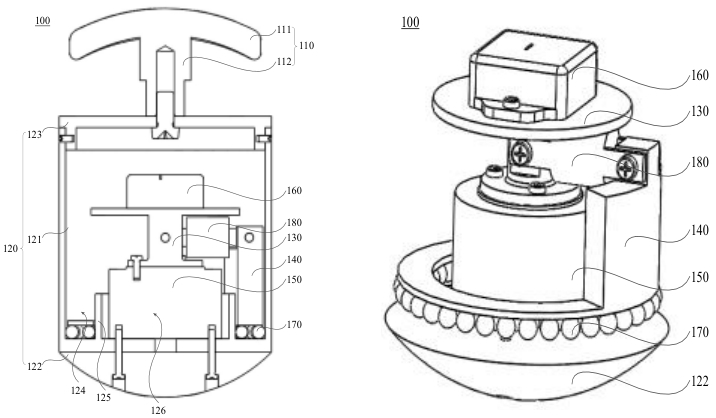
Table 2
Comparison of grip strength and pinch force between two groups"
| 指标 | 组别 | n | 测试 | t值 | P值 | |
|---|---|---|---|---|---|---|
| 握力 | 对照组 | 15 | 前测 | 2.53±0.95 | -6.576 | < 0.001 |
| 后测 | 4.16±1.28 | |||||
| 试验组 | 15 | 前测 | 2.59±0.81 | -6.613 | < 0.001 | |
| 后测 | 6.42±2.39 | |||||
| 治疗前两组均值差 | 0.05±0.32 | 0.166 | 0.869 | |||
| 治疗后两组均值差 | 2.26±0.70 | 3.231 | 0.004 | |||
| 侧捏力 | 对照组 | 15 | 前测 | 2.73±1.58 | -10.954 | < 0.001 |
| 后测 | 6.73±1.90 | |||||
| 试验组 | 15 | 前测 | 2.87±1.64 | -9.533 | < 0.001 | |
| 后测 | 12.13±4.19 | |||||
| 治疗前两组均值差 | 0.13±0.59 | 0.227 | 0.822 | |||
| 治疗后两组均值差 | 5.40±1.19 | 4.543 | < 0.001 | |||
| 指腹捏力 | 对照组 | 15 | 前测 | 2.27±1.79 | -5.683 | < 0.001 |
| 后测 | 4.80±2.65 | |||||
| 试验组 | 15 | 前测 | 2.00±1.65 | -7.948 | < 0.001 | |
| 后测 | 8.33±4.40 | |||||
| 治疗前两组均值差 | -0.27±0.63 | -0.424 | 0.675 | |||
| 治疗后两组均值差 | 3.53±1.33 | 2.633 | 0.013 | |||
| 三指捏力 | 对照组 | 15 | 前测 | 1.80±1.47 | -7.906 | < 0.001 |
| 后测 | 5.00±2.36 | |||||
| 试验组 | 15 | 前测 | 1.33±0.98 | -13.132 | < 0.001 | |
| 后测 | 10.20±3.03 | |||||
| 治疗前两组均值差 | -0.47±0.46 | -1.023 | 0.315 | |||
| 治疗后两组均值差 | 5.20±0.99 | 5.245 | < 0.001 |
Table 3
Comparison of wrist range of motion between two groups"
| 腕关节活动度指标 | 组别 | n | 测试 | t值 | P值 | |
|---|---|---|---|---|---|---|
| 背屈 | 对照组 | 15 | 前测 | 7.67±5.30 | -10.838 | < 0.001 |
| 后测 | 13.60±4.40 | |||||
| 试验组 | 15 | 前测 | 8.00±5.91 | -8.874 | < 0.001 | |
| 后测 | 23.00±9.02 | |||||
| 治疗前两组均值差 | 0.33±2.05 | 0.163 | 0.872 | |||
| 治疗后两组均值差 | 9.40±2.60 | 3.626 | 0.002 | |||
| 掌屈 | 对照组 | 15 | 前测 | 6.60±4.91 | -6.666 | < 0.001 |
| 后测 | 13.13±3.85 | |||||
| 试验组 | 15 | 前测 | 6.67±4.88 | -9.696 | < 0.001 | |
| 后测 | 20.47±6.36 | |||||
| 治疗前两组均值差 | 0.07±1.79 | 0.037 | 0.971 | |||
| 治疗后两组均值差 | 7.33±1.92 | 3.821 | 0.001 | |||
| 桡偏 | 对照组 | 15 | 前测 | 4.93±2.22 | -14.922 | < 0.001 |
| 后测 | 9.67±2.32 | |||||
| 试验组 | 15 | 前测 | 5.33±2.32 | -17.189 | < 0.001 | |
| 后测 | 16.33±2.89 | |||||
| 治疗前两组均值差 | 0.40±0.83 | 0.483 | 0.633 | |||
| 治疗后两组均值差 | 6.67±0.96 | 6.960 | < 0.001 | |||
| 尺偏 | 对照组 | 15 | 前测 | 4.20±2.89 | -7.449 | < 0.001 |
| 后测 | 9.33±4.27 | |||||
| 试验组 | 15 | 前测 | 3.93±2.96 | -13.549 | < 0.001 | |
| 后测 | 16.53±5.71 | |||||
| 治疗前两组均值差 | -0.27±1.07 | -0.250 | 0.805 | |||
| 治疗后两组均值差 | 7.20±1.84 | 3.913 | 0.001 |
Table 4
Comparison of the scores of FMA and MBI between two groups"
| 指标 | 组别 | n | 测试 | t值 | P值 | |
|---|---|---|---|---|---|---|
| FMA | 对照组 | 15 | 前测 | 36.27±5.56 | -15.057 | < 0.001 |
| 后测 | 45.47±5.89 | |||||
| 试验组 | 15 | 前测 | 34.80±4.48 | -11.923 | < 0.001 | |
| 后测 | 53.07±5.64 | |||||
| 治疗前两组均值差 | -1.47±1.84 | -0.796 | 0.433 | |||
| 治疗后两组均值差 | 7.60±2.10 | 3.614 | 0.001 | |||
| MBI | 对照组 | 15 | 前测 | 81.27±10.38 | -6.236 | < 0.001 |
| 后测 | 85.73±9.90 | |||||
| 试验组 | 15 | 前测 | 82.33±8.35 | -5.037 | < 0.001 | |
| 后测 | 87.93±6.63 | |||||
| 治疗前两组均值差 | 1.07±3.44 | 0.310 | 0.759 | |||
| 治疗后两组均值差 | 2.20±3.03 | 0.715 | 0.480 |
| [1] |
Feigin V L, Brainin M, Norrving B, et al. World Stroke Organization: global stroke fact sheet 2025[J]. Int J Stroke, 2025, 20(2): 132-144.
doi: 10.1177/17474930241308142 pmid: 39635884 |
| [2] |
Barry A J, Kamper D G, Stoykov M E, et al. Characteristics of the severely impaired hand in survivors of stroke with chronic impairments[J]. Top Stroke Rehabil, 2022, 29(3): 181-191.
doi: 10.1080/10749357.2021.1894660 |
| [3] |
Timmermans A A, Seelen H A, Willmann R D, et al. Technology-assisted training of arm-hand skills in stroke: concepts on reacquisition of motor control and therapist guidelines for rehabilitation technology design[J]. J Neuroeng Rehabil, 2009, 6: 1-18.
doi: 10.1186/1743-0003-6-1 pmid: 19154570 |
| [4] |
Sullivan J E, Drogos J, Carmona C, et al. The post-stroke upper limb improvement effort survey (IMPETUS): a survey of individuals with chronic stroke[J]. Top Stroke Rehabil, 2019, 26(8): 608-620.
doi: 10.1080/10749357.2019.1647649 pmid: 31386604 |
| [5] | 项育枝, 黄昊, 何静, 等. 一种手功能精细动作训练装置的研发及其在脑卒中康复中的应用[J]. 中国医学工程, 2025, 33(12): 19-23. |
| Xiang Y Z, Huang H, He J, et al. Development and application of a fine motor training device for hand function in stroke rehabilitation[J]. Chin Med Eng, 2025, 33(12): 19-23. | |
| [6] | 高兴, 郭坤伦, 张宇玲. 腕手康复训练器的机构设计与仿真分析[J]. 建模与仿真, 2024, 13(4): 4305-4316. |
| Gao X, Guo K L, Zhang Y L. Mechanism design and simulation analysis of a wrist-hand rehabilitation trainner[J]. Model Simul, 2024, 13(4): 4305-4316. | |
| [7] | Castelli L, Giannuzzi D, Loreti C, et al. The impact of robotic hand rehabilitation on hand function and fatigue in patients with stroke (RoHa-S)[J]. J Clin Neurosci, 2025, 139: 111145. |
| [8] |
Forbrigger S, DePaul V G, Davies T C, et al. Home-based upper limb stroke rehabilitation mechatronics: challenges and opportunities[J]. Biomed Eng Online, 2023, 22(67): 2-24.
doi: 10.1186/s12938-023-01066-2 |
| [9] |
Zubrycki I, Prączko-Pawlak E, Dominik I. Sensing system for plegic or paretic hands self-training motivation[J]. Sensors (Basel, Switzerland), 2022, 22(6): 2-24.
doi: 10.3390/s22010002 |
| [10] | 叶子璇. 动静态平衡锻炼辅助治疗膝骨关节炎的临床疗效[D]. 广州: 广州中医药大学, 2023. |
| Ye Z X. Clinical efficacy of static and dynamic balance exercises as adjunctive therapy for knee osteoarthritis[D]. Guangzhou: Guangzhou University of Chinese Medicine, 2023. | |
| [11] | 喻发勇. 核心力量训练对体育院校网球专项学生底线正反手击球效果的影响研究:以武汉体育学院2020级体育教育专业为例[D]. 武汉: 武汉体育学院, 2023. |
| Yu F Y. Impact study of core strength training on baseline forehand and backhand stroke performance among tennis-specialized students in sports universities: a case study of the 2020 Physical Education cohort at Wuhan Institute of Physical Education[D]. Wuhan: Wuhan Institute of Physical Education, 2023. | |
| [12] | 张荻若. 基于动作发展的功能性训练对5-6岁幼儿粗大运动及感觉统合能力的研究[D]. 天津: 天津体育学院, 2022. |
| [13] | 费才莲, 谢娟, 顾盈盈, 等. 多元化手功能锻炼在脑梗死手部功能障碍患者中的应用效果研究[J]. 重庆医科大学学报, 2022, 47(7): 828-833. |
| Fei C L, Xie J, Gu Y Y, et al. Effect of multi-functional hand exercise on patients with hand dysfunctionafter cerebral infarctio[J]. J Chongqing Med Univ, 2022, 47(7): 828-833. | |
| [14] | 李光硕, 赵性泉. «中国急性缺血性卒中诊治指南2023»解读[J]. 中国卒中杂志, 2024, 19(8): 956-961. |
| Li G S, Zhao X Q. Interpretation of the Chinese Guidelines for the Management of Acute Ischemic Stroke 2023[J]. Chin J Stroke, 2024, 19(8): 956-961. | |
| [15] | 杜伟, 周辉, 魏新亭. AHA/ASA«自发性脑出血诊疗指南(2022版)»解读[J]. 中华神经医学杂志, 2023, 22(3): 217-221. |
| Du W, Zhou H, Wei X T. Guidelines for management of patients with spontaneous intracerebral hemorrhage (2022) by AHA/ASA[J]. Chin J Neuromed, 2023, 22(3): 217-221. | |
| [16] |
张先卓, 吕萌, 罗旭飞, 等. 脑卒中康复临床实践指南推荐意见研究[J]. 中国康复理论与实践, 2020, 26(2): 170-180.
doi: 10.3969/j.issn.1006-9771.2020.02.007 |
| Zhang X Z, Lü M, Luo X F, et al. Recommendations of Clinical Practice Guidelines of Stroke Rehabilitation[J]. Chin J Rehabil Theory Pract, 2020, 26(2): 170-180. | |
| [17] | 白敬. 上肢康复机器人关键技术及康复评定的研究[D]. 南京: 东南大学, 2019. |
| Bai J. Research on the key technology of rehabilitation robot and assessment for upper limb[D]. Nanjing: Southeast University, 2019. | |
| [18] |
Wang D, Meng Q, Meng Q, et al. Design and development of a portable exoskeleton for hand rehabilitation[J]. IEEE Trans Neural Syst Rehabil Eng, 2018, 26(12): 2376-2386.
doi: 10.1109/TNSRE.7333 |
| [19] |
Szturm T, Peters J F, Otto C, et al. Task-specific rehabilitation of finger-hand function using interactive computer gaming[J]. Arch Phys Med Rehabil, 2008, 89(11): 2213-2217.
doi: 10.1016/j.apmr.2008.04.021 |
| [20] | 任志扬. 基于卷积神经网络的脑卒中上肢康复训练动作识别的研究[D]. 成都: 电子科技大学, 2021. |
| Ren Z Y. Research on recognition of upper limb rehabilitation exercises after stroke based on convolutional neural network[D]. Chengdu: University of Electronic Science and Technology of China, 2021. | |
| [21] |
Loubani K, Bachar Kirshenboim Y, Maman R, et al. Home-based self-training: a qualitative exploration of the experiences of individuals with chronic-stroke[J]. Clin Rehabil, 2025, 39(7): 923-933.
doi: 10.1177/02692155251344850 |
| [22] | 梅松利, 王春燕, 李艾娟, 等. 智能辅助器具在脑卒中患者居家康复中的应用瓶颈及优化策略[J]. 华西医学, 2025, 40(12): 2023-2027. |
| Mei S L, Wang C Y, Li A J, et al. Application bottlenecks and optimization strategies of intelligent assistive devices in home-based rehabilitation for stroke patients[J]. West China Med J, 2025, 40(12): 2023-2027. | |
| [23] |
Xiong J, Wang J T, Lin S, et al. Advances in hemiplegia rehabilitation: modern therapeutic interventions to enhance activities of daily living[J]. Front Neurol, 2025, 16: 1555990.
doi: 10.3389/fneur.2025.1555990 |
| [24] | Kim H, Lee C, Kim N, et al. Early functional factors for predicting outcome of independence in daily living after stroke: a decision tree analysis[J]. J Rehabil Med, 2024, 56(35095): 2-9. |
| [25] | 林佳丽. 手脑感知训练对脑卒中后上肢感觉运动功能及日常生活活动能力的影响[D]. 福州: 福建中医药大学, 2021. |
| Lin J L. The effect of hand-brain perceptual training on sensorimotor function of the upper limb and ADL with stroke[D]. Fuzhou: Fujian University of Traditional Chinese Medicine, 2021. | |
| [26] | Radder B, Prange-Lasonder G B, Kottink A I, et al. A wearable soft-robotic glove enables hand support in ADL and rehabilitation: a feasibility study on the assistive functionality[J]. J Rehabil Assist Technol Eng, 2016, 3: 2055668316670553. |
| [1] | Huang Xuli, Wang Pingzhi, Luo Tian'e. Comparison of cortical hemodynamic responses between real-time and video-based action observation therapy in patients with stroke: a functional near-infrared spectroscopy study [J]. Chinese Journal of Rehabilitation Theory and Practice, 2026, 32(9): 1041-1051. |
| [2] | Su Panpan, He Chuan, Qiongji , Meng Dianhuai. Comparison of static balance characteristics under different standing postures in older patients with post-stroke hemiplegia [J]. Chinese Journal of Rehabilitation Theory and Practice, 2026, 32(9): 1052-1060. |
| [3] | Shen Xiaohua, Chen Fangyuan, Rong Jifeng, Rao Biaoqin, Kong Lingxuan, Tian Wei, Chen Zhiqun, Li Li. Effect of anterior seat inclination on sit-to-stand ability in patients with stroke and related brain network [J]. Chinese Journal of Rehabilitation Theory and Practice, 2026, 32(9): 1061-1067. |
| [4] | Yan Jiazheng, Luo Xiaoqin, Liu Rihua, Yu Ying, Qi Fengxue. Non-invasive brain stimulation techniques for balance function after stroke: a network meta-analysis [J]. Chinese Journal of Rehabilitation Theory and Practice, 2026, 32(8): 903-915. |
| [5] | Liu Shan, Xu Kunyao, Zhou Zhimeng, Zhou Lingyun, Zeng Mao, He Sha, Dai Luoyang, Qin Ting, Hu Qinglin, Yang Jiahai, Li Rui. Effects of different electromagnetic stimulation protocols on hand function and activities of daily living for stroke patients: a network meta-analysis [J]. Chinese Journal of Rehabilitation Theory and Practice, 2026, 32(8): 916-926. |
| [6] | Zhou Jie, He Zhicheng, Zhang Xiaoyu, Wang Xue, Liu Damei, Song Ning, Wu Jun. Effect of visuomotor integration training on unilateral spatial neglect after stroke [J]. Chinese Journal of Rehabilitation Theory and Practice, 2026, 32(7): 745-751. |
| [7] | Huang Yaohui, Ye Xiangming, Liu Yong, Tang Pei, Lu Yishu. Effect of repetitive transcranial magnetic stimulation on prolonged disorders of consciousness after stroke [J]. Chinese Journal of Rehabilitation Theory and Practice, 2026, 32(7): 752-759. |
| [8] | Shan Guixiang, Du Jubao, Cao Lei, Ye Linlin, Jiang Chunjing, Zhang Ye, Ma Huijuan, Song Weiqun. Characteristics of diaphragmatic function in stroke patients based on ultrasound [J]. Chinese Journal of Rehabilitation Theory and Practice, 2026, 32(7): 760-767. |
| [9] | Zhang Fei, Fu Boxun, Shen Hui, Chen Jin. Effect of action observation therapy based on mirror neuron system combined with low-frequency repetitive transcranial magnetic stimulation on post-stroke unilateral spatial neglect [J]. Chinese Journal of Rehabilitation Theory and Practice, 2026, 32(7): 768-775. |
| [10] | Fan Liubo, Shan Tingting, Liu Baohua, Luo Mimi, Zhang Luding, Wang Minghui. Effect of different doses of Botulinum toxin type A injected under ultrasound guidance combined with modified catheter-balloon localization for post-stroke cricopharyngeal dysfunction: a randomized controlled trial [J]. Chinese Journal of Rehabilitation Theory and Practice, 2026, 32(7): 776-787. |
| [11] | Zhou Guangxue, Xu Ning, Shi Bin. Effect of virtual reality combined with occupational therapy on upper limb motor function in patients with stroke: a meta-analysis [J]. Chinese Journal of Rehabilitation Theory and Practice, 2026, 32(7): 788-796. |
| [12] | Dun Shibo, Li Yuzhou. Effect of blood flow restriction training on lower-limb motor function after stroke: a meta-analysis [J]. Chinese Journal of Rehabilitation Theory and Practice, 2026, 32(7): 797-806. |
| [13] | Yuan Yiyi, Tian Wuchao, Zhang Xianbin, Chao Qiang, Li Yongsheng, Liu Guixin, Wu Wanqing, Wang Pu. Effect of dual task training on mobility and balance in stroke patients: a meta-analysis [J]. Chinese Journal of Rehabilitation Theory and Practice, 2026, 32(7): 807-816. |
| [14] | GUAN Yujie, LIU Keyan, YANG Keqin, LIANG Yulin, ZHANG Jinpeng, ZHAO Bin. Effect of cluster scalp acupuncture combined with Taijiquan on brain functional connectivity and network topology for patients with post-stroke depression [J]. Chinese Journal of Rehabilitation Theory and Practice, 2026, 32(6): 621-630. |
| [15] | LI Xinyuan, ZHENG Jiejiao, ZHANG Tingyu, WU Xuejiao, LIANG Xiaoxiao. Effect of intermittent theta burst stimulation on lower extremity motor function and balance function in stroke patients: a meta-analysis [J]. Chinese Journal of Rehabilitation Theory and Practice, 2026, 32(6): 631-644. |
| Viewed | ||||||
|
Full text |
|
|||||
|
Abstract |
|
|||||
|
||
