



《Chinese Journal of Rehabilitation Theory and Practice》 ›› 2021, Vol. 27 ›› Issue (12): 1458-1463.doi: 10.3969/j.issn.1006-9771.2021.12.012
Previous Articles Next Articles
ZHANG Xiao-tong1a,LI Na1a,CHEN Zhao-cong1a,LIANG Jing-feng1a,YU Yong1a,WU Hui-xiang1a,KANG Zhuang1b,QIU Wei-hong1a( )
)
Received:2021-06-21
Revised:2021-10-25
Published:2021-12-25
Online:2021-12-29
Contact:
QIU Wei-hong
E-mail:q-weihong@163.com
Supported by:CLC Number:
ZHANG Xiao-tong,LI Na,CHEN Zhao-cong,LIANG Jing-feng,YU Yong,WU Hui-xiang,KANG Zhuang,QIU Wei-hong. Potential Role of Right Cerebellum in Post-stroke Aphasia: A Preliminary Study Based on Granger Causality Analysis[J]. 《Chinese Journal of Rehabilitation Theory and Practice》, 2021, 27(12): 1458-1463.
"
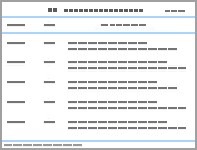
| 组别 | n | 性别(男/女,n) | 年龄(岁) | 病程(d) |
|---|---|---|---|---|
| 对照组 | 17 | 12/5 | 45.76±7.41 | 67.05±38.32 |
| 病例组 | 19 | 15/4 | 48.63±7.50 | |
| χ2/t值 | 1.151 | |||
| P值 | 0.706a | 0.258 |
"
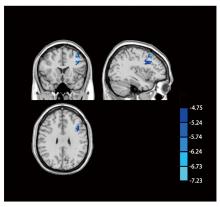
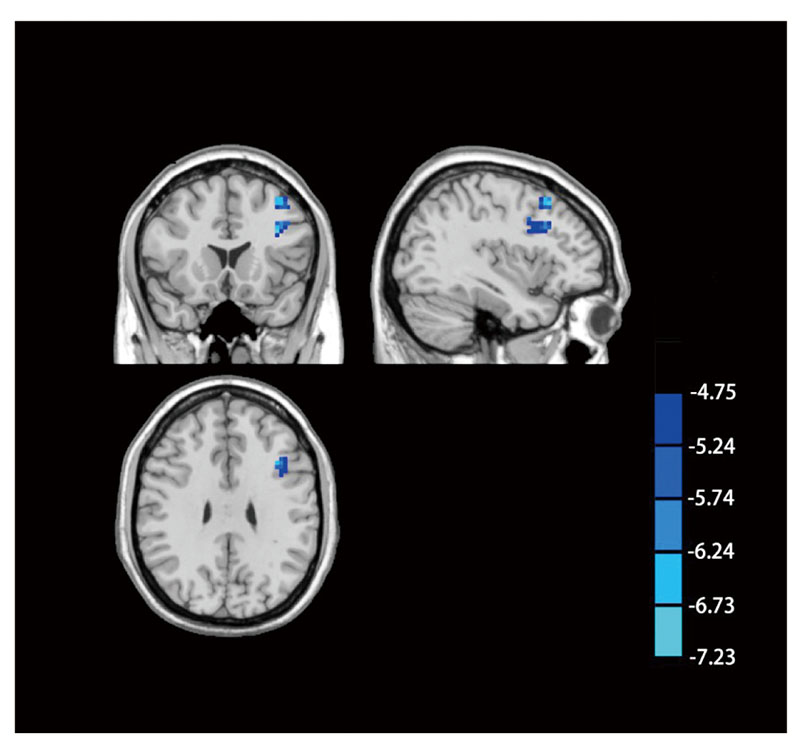
| 差异脑区 | MNI坐标 | 体素 | t值 | ||
|---|---|---|---|---|---|
| x | y | z | |||
| LIFGtri | -36 | 18 | 27 | 50 | -7.23 |
| LMFG | -39 | 21 | 48 | 26 | -7.01 |
"
"
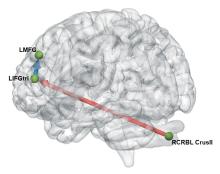
| 连接方向 | 脑区 | MNI坐标 | 体素 | t值 | ||
|---|---|---|---|---|---|---|
| x | y | z | ||||
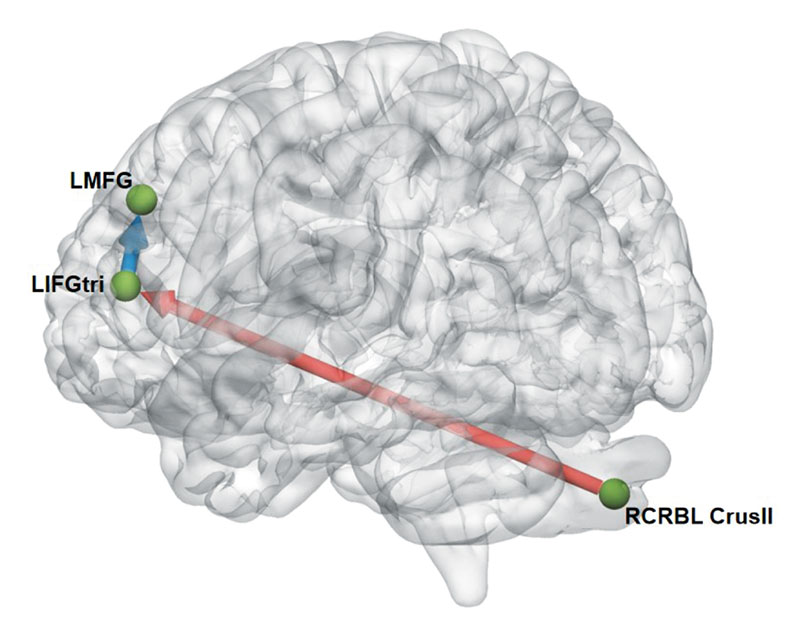
| LIFGtri→全脑 | LMFG | -36 | 51 | 12 | 258 | -4.44 |
| 全脑→LIFGtri | 右侧小脑Crus II | 39 | -69 | -45 | 198 | 4.04 |
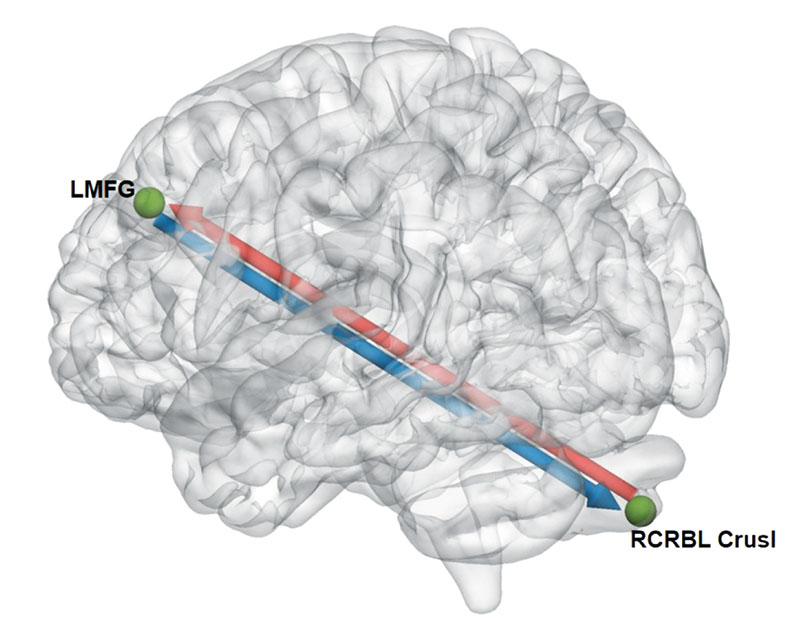
| LMFG→全脑 | 右侧小脑Crus I | 21 | -78 | -33 | 202 | -4.09 |
| 全脑→LMFG | 右侧小脑Crus I | 24 | -78 | -33 | 127 | 3.82 |
"
"
| [1] |
ENGELTER S T, GOSTYNSKI M, PAPA S, et al. Epidemiology of aphasia attributable to first ischemic stroke: incidence, severity, fluency, etiology, and thrombolysis[J]. Stroke, 2006, 37(6):1379-1384.
doi: 10.1161/01.STR.0000221815.64093.8c |
| [2] |
TSAI C F, THOMAS B, SUDLOW C L. Epidemiology of stroke and its subtypes in Chinese vs white populations: a systematic review[J]. Neurology, 2013, 81(3):264-272.
doi: 10.1212/WNL.0b013e31829bfde3 |
| [3] |
STOODLEY C J, SCHMAHMANN J D. Functional topography in the human cerebellum: a meta-analysis of neuroimaging studies[J]. Neuroimage, 2009, 44(2):489-501.
doi: 10.1016/j.neuroimage.2008.08.039 |
| [4] |
BUCKNER R L. The cerebellum and cognitive function: 25 years of insight from anatomy and neuroimaging[J]. Neuron, 2013, 80(3):807-815.
doi: 10.1016/j.neuron.2013.10.044 |
| [5] |
ZHANG N, XIA M, QIU T, et al. Reorganization of cerebro-cerebellar circuit in patients with left hemispheric gliomas involving language network: a combined structural and resting-state functional MRI study[J]. Hum Brain Mapp, 2018, 39(12):4802-4819.
doi: 10.1002/hbm.v39.12 |
| [6] |
GUO J, YANG M, BISWAL B B, et al. Abnormal functional connectivity density in post-stroke aphasia[J]. Brain Topogr, 2019, 32(2):271-282.
doi: 10.1007/s10548-018-0681-4 |
| [7] |
RAMAGE A E, AYTUR S, BALLARD K J. Resting-state functional magnetic resonance imaging connectivity between semantic and phonological regions of interest may inform language targets in aphasia[J]. J Speech Lang Hear Res, 2020, 63(9):3051-3067.
doi: 10.1044/2020_JSLHR-19-00117 |
| [8] |
SETH A K, BARRETT A B, BARNETT L. Granger causality analysis in neuroscience and neuroimaging[J]. J Neurosci, 2015, 35(8):3293-3297.
doi: 10.1523/JNEUROSCI.4399-14.2015 |
| [9] |
DESHPANDE G, HU X. Investigating effective brain connectivity from fMRI data: past findings and current issues with reference to Granger causality analysis[J]. Brain Connect, 2012, 2(5):235-245.
doi: 10.1089/brain.2012.0091 |
| [10] |
SHI Y, LIU W, LIU R, et al. Investigation of the emotional network in depression after stroke: a study of multivariate Granger causality analysis of fMRI data[J]. J Affect Disord, 2019, 249:35-44.
doi: 10.1016/j.jad.2019.02.020 |
| [11] |
ZHAO Z, WANG X, FAN M, et al. Altered effective connectivity of the primary motor cortex in stroke: a resting-state fMRI study with granger causality analysis[J]. PLoS One 2016, 11(11):e0166210.
doi: 10.1371/journal.pone.0166210 |
| [12] | GAO J, ZHANG D, WANG L, et al. Altered effective connectivity in schizophrenic patients with auditory verbal hallucinations: a resting-state fMRI study with granger causality analysis[J]. Front Psychiatry, 2020, 11:575. |
| [13] | CHEN F, KE J, QI R, et al. Increased inhibition of the amygdala by the mPFC may reflect a resilience factor in post-traumatic stress disorder: a resting-state fMRI Granger causality analysis[J]. Front Psychiatry, 2018, 9:516. |
| [14] | WANG M, LIAO Z, MAO D, et al. Application of Granger causality analysis of the directed functional connection in Alzheimer's disease and mild cognitive impairment [J]. J Vis Exp 2017(126):56015. |
| [15] | 中华医学会神经病学分会,中华医学会神经病学分会脑血管病学组. 中国各类主要脑血管病诊断要点2019[J]. 中华神经科杂志, 2019, 52(9):710-715. |
| Chinese Society of Neurology, Chinese Stroke Society. Diagnostic Criteria of Cerebrovascular Diseases in China (version 2019)[J]. Chin J Neurol, 2019, 52(9):710-715. | |
| [16] | 王荫华. 西方失语症成套测验(WAB)介绍(二)[J]. 中国康复理论与实践, 1997, 3(3):135-140. |
| WANG Y H. Chin J Rehabil Theory Pract, 1997, 3(3):135-140. | |
| [17] |
ZANG Y F, HE Y, ZHU C Z, et al. Altered baseline brain activity in children with ADHD revealed by resting-state functional MRI[J]. Brain Dev, 2007, 29(2):83-91.
doi: 10.1016/j.braindev.2006.07.002 |
| [18] | NASIOS G, DARDIOTIS E, MESSINIS L. From Broca and Wernicke to the neuromodulation era: insights of brain language networks for neurorehabilitation[J]. Behav Neurol, 2019, 2019:9894571. |
| [19] |
HAZEM S R, AWAN M, LAVRADOR J P, et al. Middle frontal gyrus and area 55b: perioperative mapping and language outcomes[J]. Front Neurol 2021, 12:646075.
doi: 10.3389/fneur.2021.646075 |
| [20] |
GLASSER M F, COALSON T S, ROBINSON E C, et al. A multi-modal parcellation of human cerebral cortex[J]. Nature, 2016, 536(7615):171-178.
doi: 10.1038/nature18933 |
| [21] | FIORI V, CIPOLLARI S, DI PAOLA M, et al. tDCS stimulation segregates words in the brain: evidence from aphasia[J]. Front Hum Neurosci 2013, 7:269. |
| [22] | MARANGOLO P, FIORI V, DI PAOLA M, et al. Differential involvement of the left frontal and temporal regions in verb naming: a tDCS treatment study[J]. Restor Neurol Neurosci, 2013, 31(1):63-72. |
| [23] | 王甜甜, 陆芳, 李霖荣, 等. 不同频率重复经颅磁刺激对脑卒中后非流利型失语症患者视图命名的影响[J]. 中国康复, 2016, 31(6):412-413. |
| WANG T T, LU F, LI L R, et al. Chin J Rehabil, 2016, 31(6):412-413. | |
| [24] |
HODGE S M, MAKRIS N, KENNEDY D N, et al. Cerebellum, language, and cognition in autism and specific language impairment[J]. J Autism Dev Disord, 2010, 40(3):300-316.
doi: 10.1007/s10803-009-0872-7 |
| [25] |
RIVA D, GIORGI C. The cerebellum contributes to higher functions during development: evidence from a series of children surgically treated for posterior fossa tumours[J]. Brain, 2000, 123(Pt 5):1051-1061.
doi: 10.1093/brain/123.5.1051 |
| [26] |
FRINGS M, DIMITROVA A, SCHORN C F, et al. Cerebellar involvement in verb generation: an fMRI study[J]. Neurosci Lett, 2006, 409(1):19-23.
doi: 10.1016/j.neulet.2006.08.058 |
| [27] |
RICE L C, D'MELLO A M, STOODLEY C J. Differential behavioral and neural effects of regional cerebellar tDCS[J]. Neuroscience, 2021, 462:288-302.
doi: 10.1016/j.neuroscience.2021.03.008 |
| [28] |
O'REILLY J X, BECKMANN C F, TOMASSINI V, et al. Distinct and overlapping functional zones in the cerebellum defined by resting state functional connectivity[J]. Cereb Cortex, 2010, 20(4):953-965.
doi: 10.1093/cercor/bhp157 |
| [29] |
D'MELLO A M, TURKELTAUB P E, STOODLEY C J. Cerebellar tDCS modulates neural circuits during semantic prediction: a combined tDCS-fMRI study[J]. J Neurosci, 2017, 37(6):1604-1613.
doi: 10.1523/JNEUROSCI.2818-16.2017 |
| [30] |
SEBASTIAN R, SAXENA S, TSAPKINI K, et al. Cerebellar tDCS: a novel approach to augment language treatment post-stroke[J]. Front Hum Neurosci, 2016, 10:695.
doi: 10.3389/fpsyg.2019.00695 |
| [31] |
MARANGOLO P, FIORI V, CALTAGIRONE C, et al. Transcranial cerebellar direct current stimulation enhances verb generation but not verb naming in poststroke aphasia[J]. J Cogn Neurosci, 2018, 30(2):188-199.
doi: 10.1162/jocn_a_01201 |
| [32] |
DI PINO G, PELLEGRINO G, ASSENZA G, et al. Modulation of brain plasticity in stroke: a novel model for neurorehabilitation[J]. Nat Rev Neurol, 2014, 10(10):597-608.
doi: 10.1038/nrneurol.2014.162 |
| [33] | 邱国荣, 丘卫红, 邹艳, 等. 重复经颅磁刺激对卒中后失语语言功能重组的影响:基于功能磁共振的研究[J]. 中国康复理论与实践, 2018, 24(6):686-695. |
| QIU G R, QIU W H, ZOU Y, et al. Effect of repeated transcranial magnetic stimulation on reorganization of aphasia after stroke: a study based on functional magnetic resonance imaging[J]. Chin J Rehabil Theory Pract, 2018, 24(6):686-695. |
| [1] | LI Hongwei, HUANG Binbin, ZHU Chuanhua, LI Wei. Effect of transcranial direct current stimulation on α-band brain connectivity in disorders of consciousness [J]. Chinese Journal of Rehabilitation Theory and Practice, 2025, 31(9): 1050-1056. |
| [2] | ZHANG Zihan, GUAN Jinzhi, HUANG Xing, ZHOU Li, ZHANG Yaxuan, ZHANG Mengyuan, CHANG Jingling. Characteristics of time-domain and time-frequency of Chinese word-picture matching task-related electroencephalogram in patients with post-stroke aphasia [J]. Chinese Journal of Rehabilitation Theory and Practice, 2025, 31(8): 947-957. |
| [3] | WANG Huihuang, LI Xuejing, LIU Fu, CHEN Sihang, LI Shuying, PU Yufan. Characteritics of resting state brain functional activities in patients with hand dysfunction after ischemic stroke [J]. Chinese Journal of Rehabilitation Theory and Practice, 2025, 31(11): 1256-1264. |
| [4] | ZHANG Zihan, ZHANG Jiacheng, LIU Jinghe, CHEN Yuhang, WU Dan, WANG Huiying, HUANG Xing, CHANG Jingling. Characteristics of brain functional network based on electroencephalogram in post-stroke aphasia patients based on functional connectivity [J]. Chinese Journal of Rehabilitation Theory and Practice, 2025, 31(11): 1342-1353. |
| [5] | CHEN Yuhang, YANG Yu'ai, LU Xuanyu, WANG Yuhang, ZHANG Mengyuan, ZHANG Zihan, WANG Huiying, CHANG Jingling. Spontaneous brain activity changes in post-stroke aphasia and post-stroke depression: a meta-analysis of resting state functional magnetic resonance imaging [J]. Chinese Journal of Rehabilitation Theory and Practice, 2025, 31(10): 1143-1155. |
| [6] | YANG Sanxia, LIU Qingluan, WAN Jiamin. Regional differences in brain activation after music intervention for Alzheimer's disease: a meta-analysis of functional magnetic resonance imaging [J]. Chinese Journal of Rehabilitation Theory and Practice, 2025, 31(10): 1156-1163. |
| [7] | HE Junyi, WANG Haifang, CHEN Jian, KONG Qiao, XU Minjie, CHANG Jingling. Application of language task-based task-state functional magnetic resonance imaging in neuropsychiatric disorders: a bibliometric analysis [J]. Chinese Journal of Rehabilitation Theory and Practice, 2024, 30(8): 930-938. |
| [8] | HUANG Xing, CHANG Jingling, ZHANG Zihan, LI Ying. Characteristics of event-related potential and frequency on working memory of post-stroke aphasia [J]. Chinese Journal of Rehabilitation Theory and Practice, 2024, 30(3): 316-325. |
| [9] | ZHANG Minglan, ZHANG Lingling, WANG Lisha, LIU Li, GAO Run, RAO Jiang, LIU Wan, XIA Zi'an, ZHANG Chuanwen, CHENG Xinxin. Impact of autonomic nerve function on motor function in patients with post-stroke depression [J]. Chinese Journal of Rehabilitation Theory and Practice, 2024, 30(2): 223-231. |
| [10] | CHENG Siman, XIN Rong, ZHAO Yan, LIU Qingyu, XIE Jiale, LIU Peng, WANG Pu. Functional magnetic resonance imaging study about repetitive transcranial magnetic stimulation for dysfunction after stroke: a scoping review [J]. 《Chinese Journal of Rehabilitation Theory and Practice》, 2023, 29(2): 193-204. |
| [11] | ZHANG Xiaoyu,YANG Fan,WEN Jianzhong,YU Weiyong. Application of resting-state functional magnetic resonance imaging in acute mild traumatic brain injury [J]. 《Chinese Journal of Rehabilitation Theory and Practice》, 2022, 28(9): 1084-1088. |
| [12] | CAI Guiyan,CHEN Ruilin,XU Shurui,TAO Jing,LIU Jiao. Characteristics of amplitude of low frequency fluctuation in patients with knee osteoarthritis and low back pain [J]. 《Chinese Journal of Rehabilitation Theory and Practice》, 2022, 28(5): 602-608. |
| [13] | ZHOU Yufan,XU Minjie,TAN Yihai,MA Ya'nan,REN Qiaosheng,CHEN Jian,ZHANG Qingsu,WANG Bo,HE Yi,CHANG Jingling. Characteristics of post-stroke aphasia structural damage based on structural covariance network [J]. 《Chinese Journal of Rehabilitation Theory and Practice》, 2022, 28(10): 1198-1204. |
| [14] | Xiao-qian YING,Yi GAO,Li-min LIAO. Small-world Network Features of Brain Functional Network as Strong Void Perception for Healthy Female [J]. 《Chinese Journal of Rehabilitation Theory and Practice》, 2021, 27(5): 510-515. |
| [15] | Shao-hong YU,Hao-jie ZHANG,Tong ZHANG. Advance in Magnetic Resonance Imaging Research of Rehabilitation Therapy on Cerebral Network Remodeling of Motor Deficits after Stroke (review) [J]. 《Chinese Journal of Rehabilitation Theory and Practice》, 2021, 27(5): 516-521. |
| Viewed | ||||||
|
Full text |
|
|||||
|
Abstract |
|
|||||
|
||
