



Chinese Journal of Rehabilitation Theory and Practice ›› 2023, Vol. 29 ›› Issue (11): 1339-1345.doi: 10.3969/j.issn.1006-9771.2023.11.012
Previous Articles Next Articles
SONG Jianfei1, DAI Lei1, QIN Zhengyuan1, ZHANG Yan1, GU Xinlu1, CHEN Yanhong1, LI Dongyue2, FENG Xiaojuan2( )
)
Received:2023-07-28
Revised:2023-10-24
Published:2023-11-25
Online:2023-11-30
Contact:
FENG Xiaojuan, E-mail: huanxue0110@163.com
Supported by:CLC Number:
SONG Jianfei, DAI Lei, QIN Zhengyuan, ZHANG Yan, GU Xinlu, CHEN Yanhong, LI Dongyue, FENG Xiaojuan. Effect of upper limb robot-assisted therapy on upper limb function in stroke patients: based on functional near-infrared spectroscopy[J]. Chinese Journal of Rehabilitation Theory and Practice, 2023, 29(11): 1339-1345.
"
| 组别 | n | 性别(男/女)/n | 年龄/岁 | 病程/月 | 卒中类型(出血/梗死)/n | 受损半球(左/右)/n |
|---|---|---|---|---|---|---|
| 对照组 | 16 | 10/6 | 53.56 | 3.38 | 7/9 | 7/9 |
| 试验组 | 16 | 12/4 | 57.00 | 3.75 | 8/8 | 9/7 |
| χ2/t值 | 0.582 | -0.723 | -0.538 | 0.125 | 0.500 | |
| P值 | 0.446 | 0.475 | 0.595 | 0.723 | 0.480 |
"
| 组别 | n | 治疗前 | 治疗后 | t值 | P值 |
|---|---|---|---|---|---|
| 对照组 | 16 | 27.1±15.5 | 36.6±17.3 | -6.090 | < 0.001 |
| 试验组 | 16 | 31.7±14.1 | 47.8±8.0 | -5.910 | < 0.001 |
| t值 | -0.881 | -2.348 | |||
| P值 | 0.365 | 0.029 |

"
"
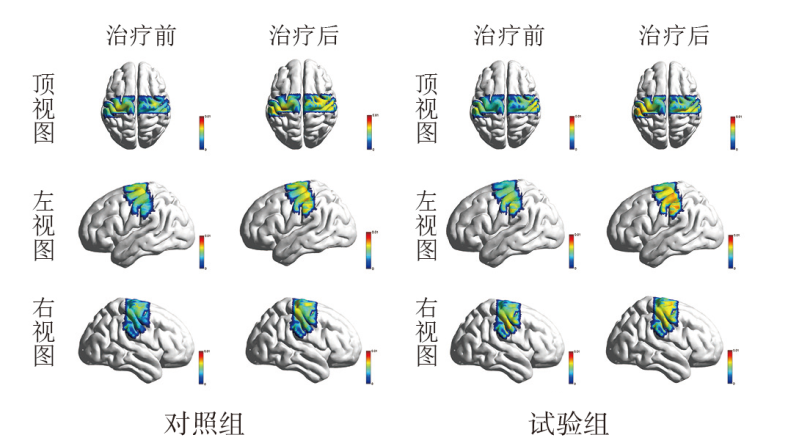
| 组别 | n | 治疗前 | 治疗后 | F值 | P值 |
|---|---|---|---|---|---|
| 对照组 | 16 | 0.006±0.005 | 0.006±0.004 | 0.029 | 0.865 |
| 试验组 | 16 | 0.005±0.005 | 0.009±0.001 | 9.354 | 0.005 |
| F值 | 4.167 | 5.217 | |||
| P值 | 0.050 | 0.030 |

"

"
| 组别 | n | 治疗前 | 治疗后 | F值 | P值 |
|---|---|---|---|---|---|
| 对照组 | 16 | 0.459±0.054 | 0.480±0.293 | 0.033 | 0.858 |
| 试验组 | 16 | 0.459±0.113 | 0.915±0.636 | 12.179 | 0.002 |
| F值 | 0.000 | 4.883 | |||
| P值 | 0.998 | 0.038 |
| [1] | TERRANOVA T T, SIMIS M, SANTOS A C A, et al. Robot-assisted therapy and constraint-induced movement therapy for motor recovery in stroke: results from a randomized clinical trial[J]. Front Neurorobot, 2021, 15: 1-17. |
| [2] |
ZHANG L, JIA G, MA J, et al. Short and long-term effects of robot-assisted therapy on upper limb motor function and activity of daily living in patients post-stroke: a meta-analysis of randomized controlled trials[J]. J Neuroeng Rehabil, 2022, 19(1): 76.
doi: 10.1186/s12984-022-01058-8 pmid: 35864524 |
| [3] |
HWANG C H, SEONG J W, SON D. Individual finger synchronized robot-assisted hand rehabilitation in subacute to chronic stroke: a prospective randomized clinical trial of efficacy[J]. Clin Rehabil, 2012, 26(8): 696-704.
doi: 10.1177/0269215511431473 pmid: 22261813 |
| [4] |
AHN S, HWANG S. Virtual rehabilitation of upper extremity function and independence for stoke: a meta-analysis[J]. J Exerc Rehabil, 2019, 15(3): 358-369.
doi: 10.12965/jer.1938174.087 pmid: 31316927 |
| [5] | LEE H S, PARK Y J, PARK S W. The effects of virtual reality training on function in chronic stroke patients: a systematic review and meta-analysis[J]. Biomed Res Int, 2019, 2019: 7595639. |
| [6] | 张海燕, 袁方超, 李建华, 等. 上肢康复机器人辅助训练对脑卒中患者上肢功能的影响[J]. 中国运动医学杂志, 2019, 38(10): 859-863. |
| ZHANG H Y, YUAN F C, LI J H, et al. Effect of upper limb rehabilitation robot assisted training on upper limb function of stroke survivors[J]. Chin J Sports Med, 2019, 38(10): 859-863. | |
| [7] |
DOUMAS I, EVERARD G, DEHEM S, et al. Serious games for upper limb rehabilitation after stroke: a meta-analysis[J]. J Neuroeng Rehabil, 2021, 18(1): 100.
doi: 10.1186/s12984-021-00889-1 pmid: 34130713 |
| [8] | CHIEN W T, CHONG Y Y, TSE M K, et al. Robot-assisted therapy for upper-limb rehabilitation in subacute stroke patients: a systematic review and meta-analysis[J]. Brain Behav, 2020, 10: 1-16. |
| [9] | LIOI G, BUTET S, FLEURY M, et al. A multi-target motor imagery training using bimodal EEG-fMRI neurofeedback: a pilot study in chronic stroke patients[J]. Front Hum Neurosci, 2020, 14(37): 1-13. |
| [10] |
SAVELOV A A, SHTARK M B, MEL'NIKOV M E, et al. Dynamics off MRI and EEG parameters in a stroke patient assessed during a neurofeedback course focused on Brodmann area 4 (M1)[J]. Bull Exp Biol Med, 2019, 166(3): 394-398.
doi: 10.1007/s10517-019-04358-7 |
| [11] |
RIEKE J D, MATARASSO A K, YUSUFALI M M, et al. Development of a combined, sequential real-time fMRI and fNIRS neurofeedback system to enhance motor learning after stroke[J]. J Neurosci Methods, 2020, 341: 108719.
doi: 10.1016/j.jneumeth.2020.108719 |
| [12] | 吴毅. 功能性近红外光谱技术在脑卒中患者康复中的临床应用[J]. 中国康复医学杂志, 2020, 35(11): 1281-1283. |
| [13] | 中华医学会神经病学分会, 中华医学会神经病学分会脑血管病学组. 中国各类主要脑血管病诊断要点2019[J]. 中华神经科杂志, 2019, 52(9): 710-715. |
| [14] |
STRAUDI S, BARONI A, MELE S, et al. Effects of a robot-assisted arm training plus hand functional electrical stimulation on recovery after stroke: a randomized clinical trial[J]. Arch Phys Med Rehabil, 2020, 101(2): 309-316.
doi: 10.1016/j.apmr.2019.09.016 |
| [15] |
NISHIMOTO A, KAWAKAMI M, FUJIWARA T, et al. Feasibility of task-specific brain-machine interface training for upper-extremity paralysis in patients with chronic hemiparetic stroke[J]. Rehabil Med, 2018, 50(1): 52-58.
doi: 10.2340/16501977-2275 |
| [16] | QU Q M, LIN Y N, HE Z J, et al. The effect of applying robot-assisted task-oriented training using human-robot collaborative interaction force control technology on upper limb function in stroke patients: preliminary findings[J]. Biomed Res Int, 2021, 2021: 1-8. |
| [17] |
KARAMIANS R, PROFFTT R, KLINE D, et al. Effectiveness of virtual reality- and gaming-based interventions for upper extremity rehabilitation post stroke: a meta-analysis[J]. Arch Phys Med Rehabil, 2020, 101(5): 885-896.
doi: 10.1016/j.apmr.2019.10.195 |
| [18] |
DEBNATH R, FRANZ E A. Perception of hand movement by mirror reflection evokes brain activation in the motor cortex contralateral to a non-moving hand[J]. Cortex, 2016, 81: 118-125.
doi: 10.1016/j.cortex.2016.04.015 pmid: 27187247 |
| [19] |
AL-WHAIBI R M, AL-JADID M S, ELSEROUGY H R, et al. Effectiveness of virtual reality-based rehabilitation versus conventional therapy on upper limb motor function of chronic stroke patients: a systematic review and meta-analysis[J]. Physiother Theory Pract, 2022, 38(13): 2402-2416.
doi: 10.1080/09593985.2021.1941458 |
| [20] |
WU J L, ZENG A H, CHEN Z Y, et al. Effects of virtual reality training on upper limb function and balance in stroke patients: systematic review and meta-analysis[J]. J Med Internet Res, 2021, 23(1): e31051.
doi: 10.2196/31051 |
| [21] |
MEHRHOLZ J, POLLOCK A, POHL M, et al. Systematic review with network meta-analysis of randomized controlled trials of robotic-assisted arm training for improving activities of daily living and upper limb function after stroke[J]. J Neuroeng Rehabil, 2020, 17(1): 83.
doi: 10.1186/s12984-020-00715-0 pmid: 32605587 |
| [22] | 戴磊, 陈健尔, 张婉莹. 功能性近红外光谱成像技术在脑卒中运动功能障碍康复中的应用进展[J]. 中华物理医学与康复杂志, 2023, 45(5): 454-459. |
| DAI L, CHEN J E, ZHANG W Y. Progress in the application of functional near-infrared spectroscopy imaging technology in the rehabilitation of stroke motor dysfunction[J]. Chin J Phys Med Rehabil, 2023, 45(5): 454-459. | |
| [23] |
MIHARA M, FUJIMOTO H, HATTORI N, et al. Effect of neurofeedback facilitation on poststroke gait and balance recovery: a randomized controlled trial[J]. Neurology, 2021, 96(21): e2587-e2598.
doi: 10.1212/WNL.0000000000011989 |
| [24] |
KIM D H, LEE K D, BULEA T C, et al. Increasing motor cortex activation during grasping via novel robotic mirror hand therapy: a pilot fNIRS study[J]. J Neuroeng Rehabil, 2022, 19(1): 8.
doi: 10.1186/s12984-022-00988-7 pmid: 35073933 |
| [25] |
CLARK D J, ROSE D K, BUTERA K A, et al. Rehabilitation with accurate adaptability walking tasks or steady state walking: a randomized clinical trial in adults post-stroke[J]. Clin Rehabil, 2021, 35(8): 1196-1206.
doi: 10.1177/02692155211001682 |
| [26] | MIYARA K, KAWAMMURA K, MATSUMOTO S, et al. Acute changes in conical activation duding active ankle movement after whole body vibration for spasticity hemiplegic legs of stroke patients: a functional near-infrared spectroscopy study[J]. Stroke Rehabil, 2020, 7(1): 67-74. |
| [27] |
MIHARA M, MIYAI I, HATTORI N, et al. Cortical control of postural balance in patients with hemiplegic stroke[J]. Neuroreport, 2012, 23(3): 314-319.
doi: 10.1097/WNR.0b013e328351757b |
| [28] |
SHI P, LI A, YU H. Response of the cerebral cortex to resistance and non-resistance exercise under different trajectories: a functional near-infrared spectroscopy study[J]. Front Neurosci, 2021, 15: 685920.
doi: 10.3389/fnins.2021.685920 |
| [1] | ZHU Lili, ZHAO Jiaxin, CHENG Xue, WANG Huijuan, CHEN Xiaoxia. Experiences and needs of stroke patients during rehabilitation: a qualitative meta-synthesis [J]. Chinese Journal of Rehabilitation Theory and Practice, 2026, 32(3): 286-293. |
| [2] | LIU Ping, ZHOU Nan, XUE Xiaojie, SHAO Weibo. Application of rehabilitation therapy techniques for post-stroke dysphagia: a bibliometric analysis [J]. Chinese Journal of Rehabilitation Theory and Practice, 2026, 32(3): 294-303. |
| [3] | YANG Ling, WANG Qinglei, WANG Jie, XU Wenjie, WANG Tong, GUO Chuan, QIAN Xue. Activation patterns and mechanism in the prefrontal cortex of post-stroke anxiety patients: a study using functional near-infrared spectroscopy [J]. Chinese Journal of Rehabilitation Theory and Practice, 2026, 32(3): 329-336. |
| [4] | YUE Yuan, ZHANG Tong, LIU Yuanmin, WANG Ya'nan. Effect of lower extremity exoskeleton robots on balance and walking function of patients with post-stroke cerebellar ataxia [J]. Chinese Journal of Rehabilitation Theory and Practice, 2026, 32(1): 23-29. |
| [5] | WU Cheng, ZHANG Yunfeng, WANG Weining, YU Kewei, ZHANG Yanzheng, SHEN Jiarong, WU Yi. Effect of elbow-wrist functional orthosis on plantar pressure and balance function in stroke patients with hemiplegia [J]. Chinese Journal of Rehabilitation Theory and Practice, 2026, 32(1): 30-39. |
| [6] | ZHANG Junfeng, CHEN Hao, DU Yuzheng, LI Chen, YU Tao, YANG Yuanqing. Non-pharmacological management for post-stroke spasticity from 2004 to 2024: a bibliometric analysis [J]. Chinese Journal of Rehabilitation Theory and Practice, 2026, 32(1): 45-58. |
| [7] | GAO Kaixiang, LU Haitao. Research in neurorehabilitation from 2015 to 2024: a bibliometric analysis [J]. Chinese Journal of Rehabilitation Theory and Practice, 2026, 32(1): 59-68. |
| [8] | WEI Jingyi, WANG Xiaojing, WANG Ran, WEI Chen, MA Sai, LIU Xihua. Effect of acupuncture synchronized speech training on post-stroke motor aphasia [J]. Chinese Journal of Rehabilitation Theory and Practice, 2025, 31(9): 1000-1008. |
| [9] | WANG Xiaojing, WEI Jingyi, WEI Chen, WANG Ran, MA Sai, LIU Xihua. Effect of synchronous acupuncture and articulation training on spastic dysarthria after stroke [J]. Chinese Journal of Rehabilitation Theory and Practice, 2025, 31(9): 1009-1016. |
| [10] | LUO Dandan, SHEN Min, WANG Sujuan, QIU Wengxin, ZHANG Yuxuan, WU Yun, WANG Shengxiao. Characterisation of whole-brain resting-state functional connectivity in children with Chinese developmental dyslexia [J]. Chinese Journal of Rehabilitation Theory and Practice, 2025, 31(9): 1023-1031. |
| [11] | ZHOU Xinyue, YE Ruixue, MA Yaqi, XU Ying, CAO Longyao, WANG Yulong. Researches on central post-stroke pain: a bibliometric analysis [J]. Chinese Journal of Rehabilitation Theory and Practice, 2025, 31(9): 1038-1049. |
| [12] | GAO Yunhan, HOU Shanshan, WANG Xinyu, ZHU Chongtian. Effect of brain-computer interface on upper limb motor dysfunction in stroke patients based on functional near-infrared spectroscopy [J]. Chinese Journal of Rehabilitation Theory and Practice, 2025, 31(9): 1066-1073. |
| [13] | LOU Yantao, WANG Jiawei, XIAO Xiaofei, LI Yanhui. Comparison of effect of cold therapy at different temperature on upper limb delayed onset muscle soreness in young men [J]. Chinese Journal of Rehabilitation Theory and Practice, 2025, 31(9): 1074-1082. |
| [14] | GAO Fei, LIU Lixu, HU Xueyan, WU Xiaoli, YANG Lingyu, YANG Yuqi, YE Changqing, DU Xiaoxia. Effect of unilateral or bilateral transcranial direct current stimulation on post-stroke dysphagia [J]. Chinese Journal of Rehabilitation Theory and Practice, 2025, 31(9): 993-999. |
| [15] | ZHANG Ziang, CHEN Jing, SHEN Mengru, GENG Zongxiao, HAN Xue, ZHAO Xu, XU Lei. Comparison of effect of different types of exercise on gait and balance for stroke patients [J]. Chinese Journal of Rehabilitation Theory and Practice, 2025, 31(8): 896-905. |
| Viewed | ||||||
|
Full text |
|
|||||
|
Abstract |
|
|||||
|
||
