



《Chinese Journal of Rehabilitation Theory and Practice》 ›› 2023, Vol. 29 ›› Issue (8): 910-918.doi: 10.3969/j.issn.1006-9771.2023.08.007
Previous Articles Next Articles
WEI Xiaowei1,2, YANG Jian1( ), WEI Chunyan3, HE Qiling4
Received:2023-08-14
Revised:2023-08-15
Published:2023-08-25
Online:2023-10-09
Contact:
YANG Jian
E-mail:yangjianxz@sina.com
Supported by:CLC Number:
WEI Xiaowei, YANG Jian, WEI Chunyan, HE Qiling. Adapted physical education programs for psychomotor development in school settings for children with intellectual and developmental disabilities: a systematic review[J]. 《Chinese Journal of Rehabilitation Theory and Practice》, 2023, 29(8): 910-918.
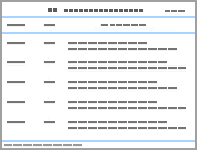
"
| 人群 (People) | 干预 (Intervention) | 比较 (Comparison) | 结局 (Outcome) |
|---|---|---|---|
| 疾病和残疾类别 智力与发展性残疾 智力障碍 孤独症 年龄:7~18岁 | 干预情景 特殊教育学校 适应性体育课程 干预内容 适应性体育课程 适应性体育活动 干预强度 干预频率 持续时间 | 干预前后 干预与否 干预时长 | 感知 1.节奏感知能力; 2.视觉、听觉、触觉的综合感知能力 运动控制 1.总运动能力; 2.精细运动能力; 3.肌肉力量和耐力 协调 1.上肢协调能力; 2.静态平衡; 3.身体灵活性和协调性; 4.肌肉耐力和力量; 5.手眼协调能力 反应时间 1.正确反应、持续反应和概念水平反应; 2.运动灵活性和敏捷性; 动作计划和执行 1.自助饮食、自助穿衣、自我指导等; 2.沟通技能; 3.运动技能; 4.运动技能熟练度; 5.执行功能 |
"

"
| 纳入文献 | 资格 标准 | 随机 分配 | 分配 隐藏 | 基线 相似 | 被试 施盲 | 治疗师 施盲 | 评估者 施盲 | 被试流失率≤ 15% | 意向性 分析 | 组间统 计比较 | 变异性 测量 | 总分 |
|---|---|---|---|---|---|---|---|---|---|---|---|---|
| Kashi等[ | √ | √ | √ | √ | √ | √ | √ | √ | √ | √ | 9 | |
| Wu等[ | √ | √ | √ | √ | √ | √ | √ | √ | √ | 8 | ||
| Fotiadou等[ | √ | √ | √ | √ | √ | √ | √ | 6 | ||||
| Pan等[ | √ | √ | √ | √ | √ | √ | √ | √ | √ | 8 | ||
| Sun等[ | √ | √ | √ | √ | √ | √ | √ | √ | 7 | |||
| Choi等[ | √ | √ | √ | √ | √ | √ | √ | √ | √ | 8 | ||
| Elgarhy等[ | √ | √ | √ | √ | √ | √ | √ | √ | √ | √ | 9 |
"
| 纳入文献 | 国家 | 样本 特征 | 健康及功能状况 | 适应性身体活动 干预方案 | 比较 | 心理运动能力结局指标 |
|---|---|---|---|---|---|---|
| Kashi等[ | 伊朗 | 年龄12~16岁 n = 36 | 轻度智力障碍 | 1.干预内容:肌肉和平衡训练、心血管耐力和肌肉耐力训练、感知动作训练 2.干预强度:轻度至中等强度 3.干预频率:每次45~60 min,每3周1次 4.持续时间:12周 | 1.与对照组相比,干预组运动能力总分干预前后改善程度较高 2.与对照组相比,干预组社会成熟度量表的自助饮食、自助穿衣、自我指导、沟通和运动分量表得分均显著升高 | 感知 未提及 运动控制 总运动能力、精细运动能力得到改善 协调 上肢协调能力得到改善 反应时间 未提及 动作计划和执行 1.自助饮食、自助穿衣、自我指导改善;2.沟通技能改善;3.运动技能改善 |
| Wu等[ | 中国 | 年龄13~18岁 n = 43 | 轻度至中度智力障碍; 孤独症; 精神障碍 | 1.干预内容:上下楼梯、使用单个有氧设备(如跑步机、步机、交叉训练机和固定自行车)、仰卧起坐、跳跃运动 2.干预强度:轻度至中等强度 3.干预频率:每次50 min,每周5次 4.持续时间:12周 | 与干预前相比,干预后的静态平衡、肌肉力量和耐力结果得到显著改善 | 感知 未提及 运动控制 肌肉力量和耐力改善 协调 静态平衡改善 反应时间 未提及 动作计划和执行 仰卧起坐达到标准次数显著增多。跳跃拿球的成功率提高 |
| Fotiadou等[ | 希腊 | 年龄8~12岁 n = 20 | 轻度至中度智力障碍 | 1.干预内容:律动性活动、视觉与动/静态平衡活动、变速移动、呼吸和伸展运动 2.干预强度:轻度至中等强度 3.干预频率:每次45 min,每周2次 4.持续时间:16周 | 1. 与对照组相比,干预组静态平衡改善 2.与对照组相比,干预组学生的感知能力显著提升 | 感知 1.节奏感知能力加强;2.视觉、听觉、触觉的综合感知能力提高 运动控制 未提及 协调 静态平衡能力提高 反应时间 未提及 动作计划和执行 未提及 |
| Pan等[ (2016) | 中国 | 年龄7~12岁 n = 22 | 孤独症谱系障碍 | 1.干预内容:运动技能训练,乒乓球特有的技术技能(如基本的正手和反手推球、发球和回球)和与乒乓球运动相关的身体运动技能(如手部弹跳、球拍弹跳、步法、身体控制、平衡训练和手眼协调) 2.干预强度:未提及 3.干预频率:每次45 min,每周2次 4.持续时间:24周 | 1.与干预12周相比,干预24周后乒乓球正确率和概念水平反应更高 2.与对照组相比,干预组学生的执行功能得到显著改善 | 感知 未提及 运动控制 未提及 协调 手动协调、身体协调、力量和灵活性得到显著改善 反应时间 正确反应、持续反应和概念水平反应得到显著改善 动作计划和执行 运动技能熟练度和执行功能有所提高 |
| Sun等[ | 中国 | 年龄7~12岁 n = 57 | 轻度至中度智力障碍 | 1.干预内容:有氧和抗阻运动 2.干预强度:中等强度 3.干预频率:每次45 min,每周2次 4.持续时间:12周 | 与干预前相比,干预后学生的肌肉耐力和力量、运动灵活性和敏捷性得到显著改善 | 感知 未提及 运动控制 肌肉耐力和力量显著提升 协调 未提及 反应时间 运动灵活性和敏捷性显著改善 动作计划和执行 未提及 |
| Choi 等[ | 中国 | 年龄7~8岁 n = 30 | 轻度智力障碍 | 1.干预内容:跳跃练习、球的控制练习、手眼协调练习、感觉控制练习、平衡练习 2.干预强度:未提及 3.干预频率:每次60 min,每周3次 4.持续时间:8周 | 与干预前相比,干预后学生的精细运动能力、手眼协调能力、平衡能力得到显著提高 | 感知 对视觉、听觉、触觉的综合运用能力有所改善 运动控制 精细运动能力得到显著改善 协调 1.手眼协调能力显著提高;2.平衡能力显著提高 反应时间 未提及 动作计划和执行 未提及 |
| Elgarhy 等[ | 埃及 | 年龄6~7岁 n = 28 | 智力障碍; 孤独症谱系障碍 | 1.干预内容:散步、跑步、方位识别、距离判断等 2.干预强度:未提及 3.干预频率:每次45 min,每周3次 4.持续时间:10周 | 1.与干预前相比,干预10周后学生的身体意识、身体概念和空间概念得到显著改善; 2.与对照组相比,干预组学生姿势控制和协调得到改善 | 感知 身体意识、身体概念和空间概念显著改善 运动控制 未提及 协调 姿势控制和协调得到改善 反应时间 未提及 动作计划和执行 未提及 |
| [1] |
BREMER E, BALOGH R, LLOYD M. Effectiveness of a fundamental motor skill intervention for 4-year-old children with autism spectrum disorder: a pilot study[J]. Autism, 2015, 19(2): 980-991.
doi: 10.1177/1362361314557548 |
| [2] |
AMENT K, MEJIA A, BUHLMAN R, et al. Evidence for specificity of motor impairments in catching and balance in children with autism[J]. J Autism Dev Disord, 2015, 45(3): 742-751.
doi: 10.1007/s10803-014-2229-0 pmid: 25231287 |
| [3] |
MACDONALD M, LORD C, ULRICH D A. Motor skills and calibrated autism severity in young children with autism spectrum disorder[J]. APAQ, 2014, 31(2): 95-105.
doi: 10.1123/apaq.2013-0068 |
| [4] |
库雪婷, 王斌. 智力和发展性残疾儿童青少年身体活动效益:基于ICF的系统综述[J]. 中国康复理论与实践, 2022, 28(12): 1416-1425.
doi: 10.3969/j.issn.1006-9771.2022.12.006 |
| KU X T, WANG B. Health benefits of physical activity for children and adolescents with intellectual and developmental disabilities: a systematic review using ICF[J]. Chin J Rehabil Theory Pract, 2022, 28(12): 1416-1425. | |
| [5] | HAUCK J, JEONG I, ESPOSITO P, et al. Benefits of learning to ride a two-wheeled bicycle for adolescents with Down syndrome and autism spectrum disorder[J]. Palaestra, 2017, 31(2): 35-41. |
| [6] |
IŞIK M, ZORBA E. The effects of hemsball on the motor proficiency of students with intellectual disabilities[J]. Int J Dev Disabil, 2018, 66(2): 104-112.
doi: 10.1080/20473869.2018.1488534 pmid: 34141372 |
| [7] |
HAN A, FU A, COBLEY S, et al. Effectiveness of exercise intervention on improving fundamental movement skills and motor coordination in overweight/obese children and adolescents: a systematic review[J]. J Sci Med Sport, 2018, 21(1): 89-102.
doi: S1440-2440(17)30942-8 pmid: 28728887 |
| [8] |
BORJI R, SAHLI S, BACCOUCH R, et al. An open-label randomized control trial of hopping and jumping training versus sensorimotor rehabilitation programme on postural capacities in individuals with intellectual disabilities[J]. J Appl Res Intellect, 2017, 31(1): 318-323.
doi: 10.1111/jar.2018.31.issue-2 |
| [9] |
LEE K, LEE M, SONG C. Balance training improves postural balance, gait, and functional strength in adolescents with intellectual disabilities: Single-blinded, randomized clinical trial[J]. Disabil Health J, 2016, 9(3): 416-422.
doi: 10.1016/j.dhjo.2016.01.010 pmid: 26975417 |
| [10] |
MARTÍNEZ S, ORDOÑEZ X, MADRONA P. Development of the Checklist of Psychomotor Activities for 5 to 6-year-old children[J]. Percept Mot Skills, 2018, 125(6): 1070-1092.
doi: 10.1177/0031512518804359 |
| [11] |
ODERMATT S, MÖHRING W, GRIEDER S, et al. Cognitive and developmental functions in autistic and non-autistic children and adolescents: evidence from the Intelligence and Development Scales-2[J]. J Intell, 2022, 10(4): 112.
doi: 10.3390/jintelligence10040112 |
| [12] | FEITOZA A, SANTOS A, BARNETT L, et al. Motor competence, physical activity, and perceived motor competence: a relational systems approach[J]. J Sports Sci, 2022, 40(8): 1-13. |
| [13] |
CHEN W, HAMMOND-BENNETT A, HYPNAR A. Examination of motor skill competency in students: evidence-based physical education curriculum[J]. BMC Public Health, 2017, 17(1): 222.
doi: 10.1186/s12889-017-4105-2 pmid: 28228116 |
| [14] |
CASHIN A G, MCAULEY J H. Clinimetrics: Physiotherapy Evidence Database (PEDro) Scale[J]. J Physiother, 2020, 66(1): 59.
doi: S1836-9553(19)30092-X pmid: 31521549 |
| [15] | KASHI A, DAWES H, MANSOUBI M, et al. The effect of an exercise package for students with intellectual disability on motor and social development[J]. Iran J Child Neurol, 2023, 17(2): 93-110. |
| [16] |
WU W L, YANG Y F, CHU I H, et al. Effectiveness of a cross-circuit exercise training program in improving the fitness of overweight or obese adolescents with intellectual disability enrolled in special education schools[J]. Res Dev Disabil, 2017, 60(5): 83-95.
doi: 10.1016/j.ridd.2016.11.005 |
| [17] |
FOTIADOU E G, NEOFOTISTOU K H, GIAGAZOGLOU P F, et al. The effect of a psychomotor education program on the static balance of children with intellectual disability[J]. J Strength Cond Res, 2017, 31(6): 1702-1708.
doi: 10.1519/JSC.0000000000001612 pmid: 28538323 |
| [18] |
PAN C Y, CHU C H, TSAI C L, et al. The impacts of physical activity intervention on physical and cognitive outcomes in children with autism spectrum disorder[J]. Autism, 2016, 21(2): 190-202.
doi: 10.1177/1362361316633562 |
| [19] |
SUN Y, YU S, WANG A, et al. Effectiveness of an adapted physical activity intervention on health-related physical fitness in adolescents with intellectual disability: a randomized controlled trial[J]. Sci Rep, 2022, 12(1): 22583.
doi: 10.1038/s41598-022-26024-1 pmid: 36585423 |
| [20] |
CHOI P H, CHEUNG S Y. Effects of an 8-week structured physical activity program on psychosocial behaviors of children with intellectual disabilities[J]. Adapt Phys Activ Q, 2016, 33(1): 1-14.
doi: 10.1123/APAQ.2014-0213 pmid: 26785496 |
| [21] |
ELGARHY S, LIU T. Effects of psychomotor intervention program on students with autism spectrum disorder[J]. School Psychol Quart, 2016, 31(4): 491-506.
doi: 10.1037/spq0000164 |
| [22] |
CHAN J S, DENG K, YAN J H. The effectiveness of physical activity interventions on communication and social functioning in autistic children and adolescents: a meta-analysis of controlled trials[J]. Autism, 2021, 25(4): 874-886.
doi: 10.1177/1362361320977645 pmid: 33307759 |
| [23] | STAPLETON J, MACK D, GINIS K. Social influence, physical activity, and social cognitions among adults with physical disability: a meta-analysis[J]. Kinesiol Rev, 2017, 6(3): 271-285. |
| [24] |
HOWELLS K, SIVARATNAM C, MAY T, et al. Efficacy of group-based organised physical activity participation for social outcomes in children with autism spectrum disorder: a systematic review and meta-analysis[J]. J Autism Dev Disord, 2019, 49(8): 3290-3308.
doi: 10.1007/s10803-019-04050-9 pmid: 31102193 |
| [25] |
OVIEDO G R, JAVIERRE C, FONT-FARRÉ M, et al. Intellectual disability, exercise and aging: the IDEA study: study protocol for a randomized controlled trial[J]. BMC Public Health, 2020, 20(1): 1266.
doi: 10.1186/s12889-020-09353-6 pmid: 32819350 |
| [26] | ZHAO M, CHEN S. The effects of structured physical activity program on social interaction and communication for children with autism[J]. Biomed Res Int, 2018, 2018(5): 1-13. |
| [27] |
OVIEDO G, TAMULEVICIUS N, GUERRA-BALIC M. Physical activity and sedentary time in active and non-active adults with intellectual disability: a comparative study[J]. IJERPH, 2019, 16(10): 1761.
doi: 10.3390/ijerph16101761 |
| [28] |
NAJAFABADI M G, SHEIKH M, HEMAYATTALAB R, et al. The effect of SPARK on social and motor skills of children with autism[J]. Pediatr Neonatol, 2018, 59(5): 481-487.
doi: S1875-9572(16)30405-3 pmid: 29402579 |
| [1] | LIANG Guanjun, XU Huanlan, ZHANG Hewei, ZHANG Dali, GU Qin, LI Mingdi. Changes in balance and lower limb biomechanics of spastic hemiplegia under different visual deprivation and task conditions [J]. Chinese Journal of Rehabilitation Theory and Practice, 2026, 32(3): 345-355. |
| [2] | MENG Lijun. Challenges and reflections on ethical review of rehabilitation research for children with disabilities [J]. Chinese Journal of Rehabilitation Theory and Practice, 2026, 32(2): 142-150. |
| [3] | YANG Tongnian, REN Jie, XIAO Hui. Effect of physical activity on anxiety for children and adolescents: a systematic review of systematic reviews [J]. Chinese Journal of Rehabilitation Theory and Practice, 2025, 31(8): 883-888. |
| [4] | YE Lü, CHEN Yuelin, LIU Yufei. Cognitive neuroscience paradigms and advances in physical activity and brain health in children: a scoping review [J]. Chinese Journal of Rehabilitation Theory and Practice, 2025, 31(8): 889-895. |
| [5] | WANG Xiaofeng, HU Mengqiao, WANG Yan, WEI Kun, XU Wenzhu, REN Dan, MA Ye. Effect of exoskeleton robot-assisted gait training on lower limb function after stroke and spinal cord injury: a systematic review [J]. Chinese Journal of Rehabilitation Theory and Practice, 2025, 31(8): 914-921. |
| [6] | LI Sha, QIU Zhuoying. Characteristics of speech and language functioning in children with intellectual and developmental disabilities and their educational curricula and rehabilitation interventions: an ICF-based study [J]. Chinese Journal of Rehabilitation Theory and Practice, 2025, 31(8): 930-938. |
| [7] | CAI Yonggang, ZHANG Teng, LIU Tianqin, WANG Jianfen, GAO Xiaohui, DU Xiaoxin. Cognitive inhibition characteristics of children with hearing impairment [J]. Chinese Journal of Rehabilitation Theory and Practice, 2025, 31(7): 853-861. |
| [8] | SHAO Xueyun. Physical activity, functioning and psycho-behavioral health in obese children: policy framework and health behavior intervention model [J]. Chinese Journal of Rehabilitation Theory and Practice, 2025, 31(6): 642-649. |
| [9] | WU Dang, ZHANG Qing, WU Jiaming, JIA Wenrong, WU Aihong, WU Jian. Support system for children with special needs participating in physical activity in an inclusive education context [J]. Chinese Journal of Rehabilitation Theory and Practice, 2025, 31(6): 650-657. |
| [10] | GU Yiqing, CHENG Shupeng, LI Yongqiang, MAO Erli, LI Jian'an. Capping versus non-capping decannulation strategy in adult tracheostomized patients: a systematic review [J]. Chinese Journal of Rehabilitation Theory and Practice, 2025, 31(6): 666-673. |
| [11] | ZHOU Tiantian, ZHANG Tong, ZHANG Qi, LIANG Yanhua, ZHANG Yanqing, YUE Qing, LI Sijia. Effect of Lokomat robotic-assisted gait training on lower limb motor function in children with hemiplegia [J]. Chinese Journal of Rehabilitation Theory and Practice, 2025, 31(6): 711-720. |
| [12] | FENG Haiyang. Reliability and validity of foot function index in flatfeet of children and adolescents [J]. Chinese Journal of Rehabilitation Theory and Practice, 2025, 31(6): 729-735. |
| [13] | WANG Mei, ZHU Wenping. Health benefits of physical activity in patients with type 2 diabetes: a systematic review of systematic reviews [J]. Chinese Journal of Rehabilitation Theory and Practice, 2025, 31(5): 553-560. |
| [14] | ZHOU Bo, SHE Wanbin, XIANG Songbai. Application of artificial intelligence in diagnosis and intervention for children with autism spectrum disorder: a bibliometric analysis [J]. Chinese Journal of Rehabilitation Theory and Practice, 2025, 31(5): 573-580. |
| [15] | YI Ling, ZHOU Jing, CHEN Xuefen, CHEN Chuanfan, CHEN Keyi, DONG Huifan. Characteristics and intervention of speech function impairments and communication limitation in children with intellectual disabilities based on ICF [J]. Chinese Journal of Rehabilitation Theory and Practice, 2025, 31(4): 398-405. |
| Viewed | ||||||
|
Full text |
|
|||||
|
Abstract |
|
|||||
|
||
