



Chinese Journal of Rehabilitation Theory and Practice ›› 2024, Vol. 30 ›› Issue (5): 513-519.doi: 10.3969/j.issn.1006-9771.2024.05.003
Previous Articles Next Articles
SU Rufeng1, ZHONG Xiaoke2, GAO Xiaoyan3, JIANG Changhao3( )
Received:2024-04-07
Published:2024-05-25
Online:2024-06-12
Contact:
JIANG Changhao, E-mail: Supported by:CLC Number:
SU Rufeng, ZHONG Xiaoke, GAO Xiaoyan, JIANG Changhao. Application of artificial intelligence in anxiety and depression among children and adolescents: a scoping review[J]. Chinese Journal of Rehabilitation Theory and Practice, 2024, 30(5): 513-519.
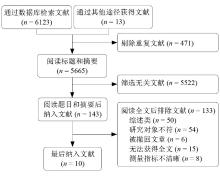
Figure 1
Flowchart of literature screening"
Table 1
Basic characteristics of included literature"
| 纳入文献 | 国家 | 年龄/岁 | 被试数量/人 | 方法与工具 | 预测 指标 | 结局指标 | 人工智能 模型/算法 |
|---|---|---|---|---|---|---|---|
| Haque等[ | 澳大利亚 | 14~17 | n = 6310 训练集 = 4417 测试集 = 1893 | 横断面研究:从Young Minds Matter数据库筛选出与抑郁最相关的11个特征,使用4种模型评估预测效果 | 抑郁 | 准确率 随机森林:95% GNB:94% 决策树:95% XGBoost:95% | 随机森林 GNB 决策树 XGBoot |
| Zhao等[ | 中国 | 15~18 | n = 1029 训练集 = 728 测试集 = 301 | 横断面研究;人口学特征、PPS; 10i-CDRS; FFMQ; GSES; BFPI; LOT; PHQ-9数据,人工神经网络建立识别模型 | 抑郁 | 准确率 抑郁:81.06% | 人工神经网络 |
| Zhang等[ | 中国 | 12~18 | n = 56 E = 18 C = 38 | 访谈:通过面对面访谈收集数据,通过MINI进行抑郁评估,提取全局和局部特征并构建模型 | 抑郁 | 准确率 融合模型:73.1% 细粒度融合模型:71.75% 粗粒度融合模型:69.59% | 粗粒度融合 细粒度融合 |
| Jin等[ | 美国 | 13~15.5 | n = 348 训练集 = 174 测试集 = 174 | 纵向研究;被试先进行RSFC扫描,然后使用IDAS-II评估被试当时和18个月后的抑郁 | 抑郁 | AUC 内部连接模型:0.78 扩展连接模型:0.72 整脑模型:0.69 | 神经网络模型 |
| Zhou等[ | 中国 | E1=16.22 E2=16.02 C=16.32 | n = 300 训练集 = 150 测试集 = 150 | 横断面研究;所有被试完成结构性磁共振成像扫描,提取68个脑区皮质厚度作为特征,建立分类模型进行区分 | 抑郁 | 准确率 MDD vs. 对照:79.21% SCZ vs. 对照:69.88% MDD vs. SCZ:62.93% | 支持向量机 |
| Hawes等[ | 美国 | 3~15 | n = 748 训练集 = 374 测试集 = 374 | 纵向研究;从3~15岁,每3年进行一次生理和心理的评估,在15岁时进行抑郁和焦虑的识别 | 焦虑、 抑郁 | AUC 抑郁:0.669~0.751 焦虑:0.621-0.788 | 逻辑回归模型 |
| Xiong等[ | 澳大利亚 | 6~16 | n = 297 将数据集随机分成5个组,依次作为训练集 | 横断面研究;通过YODA收集被试的焦虑数据,然后用贝叶斯神经网络方法预测青少年的焦虑 | 焦虑 | AUC 分离焦虑:0.8683 社交焦虑:0.9091 广泛性焦虑:0.8769 | 贝叶斯神经网络 机器学习分类器 深度学习分类器特征选择器 |
| Sawalha等[ | 美国 | 5.5~9.5 | n = 45 训练集n = 36 测试集n = 9 | 横断面研究:焦虑、非焦虑儿童完成情绪面孔处理任务,进行fMRI扫描,比较焦虑与非焦虑儿童颞极区的神经活动差异 | 焦虑 | 准确率 右侧颞极区可以最准确地区分焦虑儿童和非焦虑儿童(分类准确率81%) | AdaBoost模型 |
| Haque等[ | 澳大利亚 | 4~17 | n = 1011 训练集 = 708 测试集 = 303 | 横断面研究;根据澳大利亚青少年心理健康调查的数据库,用3种机器学习模型检测OCD、SAD和ADHD | OCD、SAD、ADHD | 准确率 GNB(OCD):91% GNB(SAD):79% 随机森林(ADHD):91% | 机器学习 随机森林 GNB |
| Chavanne等[ | 法国 | 14~23 | n = 736 训练集 = 580 测试集 = 156 | 纵向研究:测量14岁时的灰质体积,完成DAWBA、GAD、mAD、SURPS、SDQ、LEQ、NEO-FFI和TCI-R,对18~23岁的焦虑进行预测 | GAD、mAD、焦虑 | AUC GAD:0.6 mAD:0.52 总体焦虑:0.68 | 随机森林 支持向量机 逻辑回归 |
| [1] |
BENNETT K, COURTNEY D, DUDA S, et al. An appraisal of the trustworthiness of practice guidelines for depression and anxiety in children and youth[J]. Depress Anxiety, 2018, 35(6): 530-540.
doi: 10.1002/da.22752 pmid: 29697887 |
| [2] | CAMPISI S C, ATAULLAHJAN A, BAXTER J A B, et al. Mental health interventions in adolescence[J]. Curr Opin Psychol, 2022, 48: 101492. |
| [3] | ZHOU Y, CHEN X, GU R, et al. Personalized identification and intervention of depression in adolescents: a tertiary-level framework[J]. Sci Bull, 2024, 69(7): 867-871. |
| [4] | 莫大明, 闫军伟, 李欣, 等. 新冠肺炎疫情下儿童青少年焦虑症状检出率及影响因素[J]. 四川精神卫生, 2020, 33(3): 202-206. |
| MO D M, YAN J W, LI X, et al. Prevalence rate and related influencing factors of anxiety disorder in children and adolescents during the outbreak of COVID-19[J]. Sichuan Ment Health, 2020, 33(3): 202-206. | |
| [5] | BHATTACHARYA R, SHEN C, SAMBAMOORTHI U. Excess risk of chronic physical conditions associated with depression and anxiety[J]. BMC Psychiatry, 2014, 14: 1-10. |
| [6] | CHENG W, ROLLS E, GONG W, et al. Sleep duration, brain structure, and psychiatric and cognitive problems in children[J]. Mol Psychiatry, 2021, 26(8): 3992-4003. |
| [7] | YUAN W, CHEN L, WU Y, et al. Sleep time and quality associated with depression and social anxiety among children and adolescents aged 6-18 years, stratified by body composition[J]. J Affect Disord, 2023, 338: 321-328. |
| [8] | 苏志强, 王钢, 刘传星, 等. 童年中晚期抑郁的发展及其与问题行为的并发:一项两年追踪研究[J]. 心理发展与教育, 2018, 34(2): 200-209. |
| SU Z Q, WANG G, LIU C X, et al. The development trend of depression and its concurrency with problem behaviors during middle and late childhood: a two-year longitudinal study[J]. Psychol Dev Educ, 2018, 34(2): 200-209. | |
| [9] |
张婧雅, 邹敏, 孙宏伟, 等. 听障儿童青少年焦虑或抑郁情绪心理干预效果的系统综述[J]. 中国康复理论与实践, 2023, 29(9): 1004-1011.
doi: 10.3969/j.issn.1006-9771.2023.09.002 |
| ZHANG J Y, ZOU M, SUN H W, et al. Effect of psychological intervention on anxiety or depression in children and adolescents with hearing impairment: a systematic review[J]. Chin J Rehabil Theory Pract, 2023, 29(9): 1004-1011. | |
| [10] |
GROSS J J. Emotion regulation: affective, cognitive, and social consequences[J]. Psychophysiology, 2002, 39(3): 281-291.
doi: 10.1017/s0048577201393198 pmid: 12212647 |
| [11] | GHANDOUR R M, SHERMAN L J, VLADUTIU C J, et al. Prevalence and treatment of depression, anxiety, and conduct problems in US children[J]. J Pediatr, 2019, 206: 256-267. e3. |
| [12] |
THAPAR A, COLLISHAW S, PINE D S, et al. Depression in adolescence[J]. Lancet, 2012, 379(9820): 1056-1067.
doi: 10.1016/S0140-6736(11)60871-4 pmid: 22305766 |
| [13] |
KIELING C, ADEWUYA A, FISHER H L, et al. Identifying depression early in adolescence[J]. Lancet Child Adolesc Health, 2019, 3(4): 211-213.
doi: S2352-4642(19)30059-8 pmid: 30878111 |
| [14] |
PATTON G C, COFFEY C, ROMANIUK H, et al. The prognosis of common mental disorders in adolescents: a 14-year prospective cohort study[J]. Lancet, 2014, 383(9926): 1404-1411.
doi: 10.1016/S0140-6736(13)62116-9 pmid: 24439298 |
| [15] |
CALDWELL D M, DAVIES S R, HETRICK S E, et al. School-based interventions to prevent anxiety and depression in children and young people: a systematic review and network meta-analysis[J]. Lancet Psychiatry, 2019, 6(12): 1011-1020.
doi: S2215-0366(19)30403-1 pmid: 31734106 |
| [16] |
SHATTE A B R, HUTCHINSON D M, TEAGUE S J. Machine learning in mental health: a scoping review of methods and applications[J]. Psychol Med, 2019, 49(9): 1426-1448.
doi: 10.1017/S0033291719000151 pmid: 30744717 |
| [17] |
TRICCO A C, LILLIE E, ZARIN W, et al. PRISMA extension for scoping reviews (PRISMA-ScR): checklist and explanation[J]. Ann Intern Med, 2018, 169(7): 467-473.
doi: 10.7326/M18-0850 pmid: 30178033 |
| [18] | HAQUE U M, KABIR E, KHANAM R. Detection of child depression using machine learning methods[J]. PLoS One, 2021, 16(12): e0261131. |
| [19] | ZHAO F F. Artificial neural network application for identifying risk of depression in high school students: a cross-sectional study[J]. BMC Psychiatry, 2021, 21: 1-13. |
| [20] | ZHANG L, FAN Y, JIANG J, et al. Adolescent depression detection model based on multimodal data of interview audio and text[J]. Int J Neural Syst, 2022, 32(11): 2250045. |
| [21] |
JIN J, VAN SNELLENBERG J X, PERLMAN G, et al. Intrinsic neural circuitry of depression in adolescent females[J]. J Child Psychol Psychiatry, 2020, 61(4): 480-491.
doi: 10.1111/jcpp.13123 pmid: 31512744 |
| [22] |
ZHOU Z, WANG K, TANG J, et al. Cortical thickness distinguishes between major depression and schizophrenia in adolescents[J]. BMC Psychiatry, 2021, 21(1): 361.
doi: 10.1186/s12888-021-03373-1 pmid: 34284747 |
| [23] | HAWES M T, SCHWARTZ H A, SON Y, et al. Predicting adolescent depression and anxiety from multi-wave longitudinal data using machine learning[J]. Psychol Med, 2023, 53(13): 6205-6211. |
| [24] | XIONG H, BERKOVSKY S, ROMANO M, et al. Prediction of anxiety disorders using a feature ensemble based bayesian neural network[J]. J Biomed Inform, 2021, 123: 103921. |
| [25] |
SAWALHA J, YOUSEFNEZHAD M, SELVITELLA A M, et al. Predicting pediatric anxiety from the temporal pole using neural responses to emotional faces[J]. Sci Rep, 2021, 11(1): 16723.
doi: 10.1038/s41598-021-95987-4 pmid: 34408203 |
| [26] | HAQUE U M, KABIR E, KHANAM R. Early detection of paediatric and adolescent obsessive: compulsive, separation anxiety and attention deficit hyperactivity disorder using machine learning algorithms[J]. Health Inf Sci Syst, 2023, 11(1): 31. |
| [27] | CHAVANNE A V, PAILLÈRE MARTINOT M L, PENTTILÄ J, et al. Anxiety onset in adolescents: a machine-learning prediction[J]. Mol Psychiatry, 2023, 28(2): 639-646. |
| [28] | MEIER S M, DECKERT J. Genetics of anxiety disorders[J]. Curr Psychiatry Rep, 2019, 21(3): 16. |
| [29] | LUSSIER A A, HAWRILENKO M, WANG M J, et al. Genetic susceptibility for major depressive disorder associates with trajectories of depressive symptoms across childhood and adolescence[J]. J Child Psychol Psychiatry, 2021, 62(7): 895-904. |
| [30] | WEN L, YANG K, CHEN J, et al. Associations between resilience and symptoms of depression and anxiety among adolescents: examining the moderating effects of family environment[J]. J Affect Disord, 2023, 340: 703-710. |
| [31] | HAMILTON J L, SHAPERO B G, STANGE J P, et al. Emotional maltreatment, peer victimization, and depressive versus anxiety symptoms during adolescence: hopelessness as a mediator[J]. J Clin Child Adolesc, 2013, 42(3): 332-347. |
| [32] | STEARE T, MUÑOZ C G, SULLIVAN A, et al. The association between academic pressure and adolescent mental health problems: a systematic review[J]. J Affect Disord, 2023, 339: 302-317. |
| [33] | HALFON S, DOYRAN M, TÜRKMEN B, et al. Multimodal affect analysis of psychodynamic play therapy[J]. Psychother Res, 2021, 31(3): 313-328. |
| [34] | WANG Y, WANG J, LIU X, et al. Detecting depression through gait data: examining the contribution of gait features in recognizing depression[J]. Front Psychiatry, 2021, 12: 661213. |
| [35] |
ACHARYA U R, SUDARSHAN V K, ADELI H, et al. A novel depression diagnosis index using nonlinear features in EEG signals[J]. Eur Neurol, 2015, 74(1-2): 79-83.
doi: 10.1159/000438457 pmid: 26303033 |
| [36] | ABD-ALRAZAQ A, ALSAAD R, AZIZ S, et al. Wearable artificial intelligence for anxiety and depression: scoping review[J]. J Med Internet Res, 2023, 25: e42672. |
| [1] | YANG Ling, WANG Qinglei, WANG Jie, XU Wenjie, WANG Tong, GUO Chuan, QIAN Xue. Activation patterns and mechanism in the prefrontal cortex of post-stroke anxiety patients: a study using functional near-infrared spectroscopy [J]. Chinese Journal of Rehabilitation Theory and Practice, 2026, 32(3): 329-336. |
| [2] | LIANG Guanjun, XU Huanlan, ZHANG Hewei, ZHANG Dali, GU Qin, LI Mingdi. Changes in balance and lower limb biomechanics of spastic hemiplegia under different visual deprivation and task conditions [J]. Chinese Journal of Rehabilitation Theory and Practice, 2026, 32(3): 345-355. |
| [3] | MENG Lijun. Challenges and reflections on ethical review of rehabilitation research for children with disabilities [J]. Chinese Journal of Rehabilitation Theory and Practice, 2026, 32(2): 142-150. |
| [4] | ZHANG Liyin. Depression in Parkinson's disease and its association with cognition, balance and quality of life [J]. Chinese Journal of Rehabilitation Theory and Practice, 2026, 32(2): 174-180. |
| [5] | GAO Kaixiang, LU Haitao. Research in neurorehabilitation from 2015 to 2024: a bibliometric analysis [J]. Chinese Journal of Rehabilitation Theory and Practice, 2026, 32(1): 59-68. |
| [6] | YANG Tongnian, REN Jie, XIAO Hui. Effect of physical activity on anxiety for children and adolescents: a systematic review of systematic reviews [J]. Chinese Journal of Rehabilitation Theory and Practice, 2025, 31(8): 883-888. |
| [7] | YE Lü, CHEN Yuelin, LIU Yufei. Cognitive neuroscience paradigms and advances in physical activity and brain health in children: a scoping review [J]. Chinese Journal of Rehabilitation Theory and Practice, 2025, 31(8): 889-895. |
| [8] | DU Lilu, YAO Renkui, ZHAO Yanyu, LI Mengxuan, ZOU Min, ZHANG Gongfa. Impact of meaning in life and living arrangements on association between activities of daily living and depression in older adults [J]. Chinese Journal of Rehabilitation Theory and Practice, 2025, 31(8): 987-992. |
| [9] | SHAN Lei, LIU Ying, ZHANG Xin, CHI Qianqian, ZHU Xiaomin. Effect of accelerated intermittent theta burst stimulation on post-stroke depression [J]. Chinese Journal of Rehabilitation Theory and Practice, 2025, 31(7): 822-829. |
| [10] | CAI Yonggang, ZHANG Teng, LIU Tianqin, WANG Jianfen, GAO Xiaohui, DU Xiaoxin. Cognitive inhibition characteristics of children with hearing impairment [J]. Chinese Journal of Rehabilitation Theory and Practice, 2025, 31(7): 853-861. |
| [11] | SHAO Xueyun. Physical activity, functioning and psycho-behavioral health in obese children: policy framework and health behavior intervention model [J]. Chinese Journal of Rehabilitation Theory and Practice, 2025, 31(6): 642-649. |
| [12] | WU Dang, ZHANG Qing, WU Jiaming, JIA Wenrong, WU Aihong, WU Jian. Support system for children with special needs participating in physical activity in an inclusive education context [J]. Chinese Journal of Rehabilitation Theory and Practice, 2025, 31(6): 650-657. |
| [13] | WU Xiaohui, JIANG Lei, ZHU Jingru, XIE Lihui. Deep learning for diagnosis of mild cognitive impairment in older adults: a scoping review [J]. Chinese Journal of Rehabilitation Theory and Practice, 2025, 31(6): 674-681. |
| [14] | ZHOU Tiantian, ZHANG Tong, ZHANG Qi, LIANG Yanhua, ZHANG Yanqing, YUE Qing, LI Sijia. Effect of Lokomat robotic-assisted gait training on lower limb motor function in children with hemiplegia [J]. Chinese Journal of Rehabilitation Theory and Practice, 2025, 31(6): 711-720. |
| [15] | FENG Haiyang. Reliability and validity of foot function index in flatfeet of children and adolescents [J]. Chinese Journal of Rehabilitation Theory and Practice, 2025, 31(6): 729-735. |
| Viewed | ||||||
|
Full text |
|
|||||
|
Abstract |
|
|||||
|
||
